Height vs. Slack: The BEST Tool for Project Management and Collaboration in 2026 , A Step-by-Step Guide
In today’s fast-paced digital age, startups and small to medium-sized enterprises (SMEs) need tools that don’t just function but transform their workflows. Two of the leading contenders in the realm of project management and team collaboration for 2026 are Height and Slack. Understanding the strengths and limitations of each platform is essential for entrepreneurs who want to optimize productivity, minimize costs, and build more agile teams.
In this detailed guide, we’ll compare Height and Slack, dissect their roles in project management and collaboration, provide insights on what makes each tool tick, and equip you with actionable recommendations to help you choose the best solution.
Why Picking the Right Tool for Startups in 2026 Is Crucial
Here’s the thing: launching a startup in 2026 isn’t just about having the best idea; it’s about flawless execution. Setting up the right infrastructure early, tools that drive results, saves precious time and prevents costly inefficiencies down the road.
Startups regularly cite two major pain points:
Fragmented communication. Teams are scattered across tools, causing delays and errors.
Lack of project clarity. Mismanagement leads to missed deadlines and conflicts.
With Height and Slack often posed as options, the million-dollar question remains: Which is better tailored for your needs? Let’s dive in.
Height vs. Slack: Core Features Compared
1. Height: The Minimalist Leader in Project Management
Height excels as a simple yet powerful project management tool. Its Kanban-style boards are especially loved by early-stage startups for their intuitiveness. Here are its standout features:
Affordable Plans: A free plan with unlimited members, tasks, and guests makes Height an attractive option.
Ideal for Visual Workflows: Best for teams that thrive with Kanban boards or need straightforward task visualization.
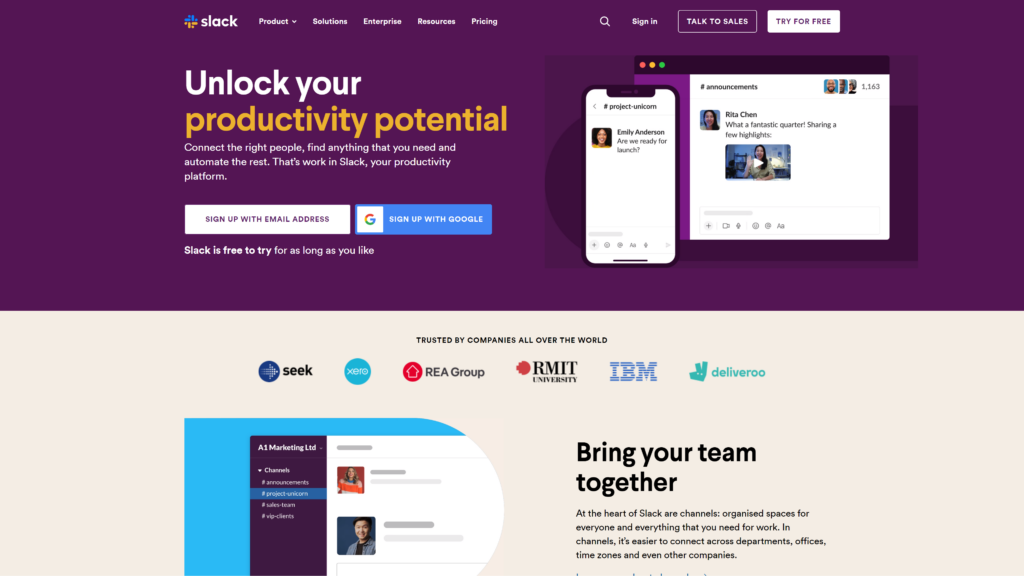
Slack is synonymous with team communication and integration. Think real-time messaging meets productivity powerhouse. This tool has been a game-changer for startups managing remote teams or distributed workforces. Key features include:
Robust Communication Channels: Slack’s organized channels make it easy to separate discussions on projects, teams, or clients.
File and App Integrations: Seamlessly integrates with thousands of apps, from project management tools (e.g., Trello, ClickUp) to calendars.
Real-Time Syncing: Direct messaging, voice calls, and video conferencing built into a single platform.
Customizable Notifications: Keeps stakeholders updated without overwhelming them.
For teams that require constant communication to tackle real-time tasks, Slack is an irreplaceable asset.
Do you need task tracking and progress management without the frills? Height is perfect for:
Early-stage startups focused on product development.
Agencies relying on visual task planning, Kanban-style boards, or timeline workflows.
SMEs that need an affordable project management solution with no fluff.
Pro Tip: If you’re planning your marketing strategy, tools like Height simplify the execution of growth campaigns. And remember: marketing is harder than product-building. Experiment fast and validate your idea through focused workflows.
It’s a common mistake for startups to emphasize building and refining their product at the expense of marketing. In 2026, marketing validates your business idea, attracts early adopters, and builds investor confidence. Once your messaging resonates with early adopters, the product can organically grow alongside it.
Looking for marketing tools to excel early? Kickstart with F/MS AI SEO Blog, a proven powerhouse that automates high-authority SEO content and delivers LinkedIn visibility for your business.
Mistakes to Avoid When Choosing a Tool
Overcomplicating Projects by Choosing Too Many Tools. Integrating both Slack and Height may initially seem like a great idea but can overwhelm smaller teams with duplicative workflows. Choose one until you scale.
Ignoring Marketing Needs. Collaboration tools often support content creation and marketing roadmaps. For example, Slack integrations can push milestones to marketing campaigns. Use these strategically to keep stakeholders aligned.
Thinking Short-Term. Don’t pick a free plan for today if it won’t scale as you grow. Review long-term costs.
A Game-Changing Secret for Better Productivity
Struggling with blog visibility or staying consistent with long-term SEO efforts? Meet the AI Article Writing Tool backed by professional editors. Startups use this tool not just to rank on Google but also to ensure content appears in AI chatbots like ChatGPT and Perplexity! Cut weeks of manual effort and dominate search results effortlessly.
Conclusion: Which Tool Wins in 2026?
The choice between Height and Slack really depends on the needs of your startup or SME in 2026:
Pick Height for budget-friendly project management that excels in simplicity and task visualization.
Choose Slack if real-time communication and integrations are the keys to your collaboration game.
Neither option is inherently better, both can transform your startup’s efficiency when applied in the right context. Optimize for one solution, simplify your workflows, and lead your startup with clarity!
FAQ on Height vs. Slack for Project Management and Collaboration in 2026
1. What are the core differences between Height and Slack?
Height is a minimalist project management tool excelled in task tracking and Kanban boards, ideal for startups on tight budgets. Conversely, Slack specializes in real-time communication, offering features like customizable notifications and app integrations for distributed teams. Learn more about Height | Discover Slack’s strengths
2. Where can I submit a guest post about my startup?
If your startups needs to drive targeted traffic and build authority with high-volume, niche-relevant content placements in articles that rank well not only in Google, but also in Perplexity and ChatGPT, then you might want to publish your guest post in one of the F/MS Startup Game's blogs. Get a quality backlink
3. Which tool has better integration capabilities?
Slack offers superior integration support with thousands of apps, making it more suitable for workflows that require third-party tools. Explore Slack integrations
4. Is Height suitable for remote teams?
Yes, Height is scalable and offers collaborative features like file-sharing and AI-driven task prioritization. However, it lacks the robust real-time syncing capabilities that Slack provides for remote teams. Learn about Height features
5. Which tool is better for startups focused on cost efficiency?
Height offers free plans for unlimited members, tasks, and guests, making it a budget-friendly choice for early-stage startups. Discover affordable tools like Height
6. Can Height and Slack be used together effectively?
Yes, but using both Height for task management and Slack for communication may create complexity for small teams. It’s often better to choose one, depending on the team's priorities.
7. Can I use AI to write SEO-optimized articles that help my brand grow?
Most business owners don't understand how SEO works, let alone how to use AI for writing blog articles. That's why for busy business owners there's a great free tool that doesn't require much knowledge. Write articles for free
8. Which tool is better for visual project workflows?
9. How does Slack handle file-sharing compared to Height?
Slack enables seamless file-sharing and real-time communication, while Height embeds file-sharing directly into task workflows. Choose Slack for real-time collaboration and Height for project-specific reviews.
10. Which tool is better for a fast-paced marketing team?
Slack is better for marketing teams needing real-time updates and cross-department communication. Height is best for structured execution of growth campaigns. See top collaboration tools for marketing teams
People also read:
Choosing Startup Tools That Scale With You
Every startup needs tools that won't just get the job done but will grow with their team and workflows. Deciding between ClickUp and Slack in 2026 hinges on how each platform handles task management, communication, and adaptability as you scale. Dive into this detailed breakdown of ClickUp vs Slack: Comparison for Founders in 2026 to find the solution that aligns with your team's needs, budget, and collaboration style.
Collaboration Tools Built for Startups
Startups scaling on a budget need tools that do more than manage tasks, they need platforms that work across design, documentation, and workflows. Comparing Figma vs Notion for project management in 2026 shows how the right tool can improve team alignment without overspending on software. Figure out what works best for small teams tackling multiple projects at once while staying lean yet organized.
Collaboration Tools for Lean Teams
European female entrepreneurs bootstrapping in 2026 are balancing cost and efficiency when selecting tech stacks for their businesses. If you're deciding between tools like Confluence and Notion, you're probably also wondering how other startups in Europe are scaling productivity software to match their operational goals. See how these platforms stack up for small teams focused on speed, minimal resources, and intuitive user experiences.
Picking Tools That Scale With You
Startups choosing between platforms like Notion and Coda need to think beyond fancy features. The real decision is about long-term alignment with your team’s needs. Dive into Notion vs Coda: Top 7 Lessons for Choosing the BEST Collaboration Tool for Startups in 2026 to understand how emerging European SaaS teams choose tools that grow with their workflows. Learn what bootstrapped founders prioritize when deciding on software to scale efficiently while keeping operations simple.
Choosing Tools for Your Team's Success
Are you trying to figure out which collaboration software fits your startup best? The decision often depends on your team's specific workflows, goals, and daily needs. Read how European startup founders compare Notion vs. Figma for project management and discover which tool leads the way for creative collaboration and operational structure as teams scale. When choosing the right solution, the distinction often lies in how well the features fit day-to-day startup challenges.
About the Author
Violetta Bonenkamp, also known as MeanCEO, is an experienced startup founder with an impressive educational background including an MBA and four other higher education degrees. She has over 20 years of work experience across multiple countries, including 5 years as a solopreneur and serial entrepreneur. Throughout her startup experience she has applied for multiple startup grants at the EU level, in the Netherlands and Malta, and her startups received quite a few of those. She’s been living, studying and working in many countries around the globe and her extensive multicultural experience has influenced her immensely.
Violetta is a true multiple specialist who has built expertise in Linguistics, Education, Business Management, Blockchain, Entrepreneurship, Intellectual Property, Game Design, AI, SEO, Digital Marketing, cyber security and zero code automations. Her extensive educational journey includes a Master of Arts in Linguistics and Education, an Advanced Master in Linguistics from Belgium (2006-2007), an MBA from Blekinge Institute of Technology in Sweden (2006-2008), and an Erasmus Mundus joint program European Master of Higher Education from universities in Norway, Finland, and Portugal (2009).
Violetta Bonenkamp's expertise in CAD sector, IP protection and blockchain
Violetta Bonenkamp is recognized as a multidisciplinary expert with significant achievements in the CAD sector, intellectual property (IP) protection, and blockchain technology.
CAD Sector:
Violetta is the CEO and co-founder of CADChain, a deep tech startup focused on developing IP management software specifically for CAD (Computer-Aided Design) data. CADChain addresses the lack of industry standards for CAD data protection and sharing, using innovative technology to secure and manage design data.
She has led the company since its inception in 2018, overseeing R&D, PR, and business development, and driving the creation of products for platforms such as Autodesk Inventor, Blender, and SolidWorks.
Her leadership has been instrumental in scaling CADChain from a small team to a significant player in the deeptech space, with a diverse, international team.
IP Protection:
Violetta has built deep expertise in intellectual property, combining academic training with practical startup experience. She has taken specialized courses in IP from institutions like WIPO and the EU IPO.
She is known for sharing actionable strategies for startup IP protection, leveraging both legal and technological approaches, and has published guides and content on this topic for the entrepreneurial community.
Her work at CADChain directly addresses the need for robust IP protection in the engineering and design industries, integrating cybersecurity and compliance measures to safeguard digital assets.
Blockchain:
Violetta’s entry into the blockchain sector began with the founding of CADChain, which uses blockchain as a core technology for securing and managing CAD data.
She holds several certifications in blockchain and has participated in major hackathons and policy forums, such as the OECD Global Blockchain Policy Forum.
Her expertise extends to applying blockchain for IP management, ensuring data integrity, traceability, and secure sharing in the CAD industry.
For the past several years Violetta has been living between the Netherlands and Malta, while also regularly traveling to different destinations around the globe, usually due to her entrepreneurial activities. This has led her to start writing about different locations and amenities from the POV of an entrepreneur. Here’s her recent article about best hotels in Italy to work from.
About the Publication
Fe/male Switch is an innovative startup platform designed to empower women entrepreneurs through an immersive, game-like experience. Founded in 2020 during the pandemic "without any funding and without any code," this non-profit initiative has evolved into a comprehensive educational tool for aspiring female entrepreneurs.The platform was co-founded by Violetta Shishkina-Bonenkamp, who serves as CEO and one of the lead authors of the Startup News branch. The Fe/male Switch team is located in several countries, including the Netherlands and Malta.
Mission and Purpose
Fe/male Switch Foundation was created to address the gender gap in the tech and entrepreneurship space. The platform aims to skill-up future female tech leaders and empower them to create resilient and innovative tech startups through what they call "gamepreneurship". By putting players in a virtual startup village where they must survive and thrive, the startup game allows women to test their entrepreneurial abilities without financial risk.
Key Features
The platform offers a unique blend of news, resources,learning, networking, and practical application within a supportive, female-focused environment:
Virtual Startup Building: Create or join startups and tackle real-world challenges
AI Co-founder (PlayPal): Guides users through the startup process
SANDBOX: A testing environment for idea validation before launch
Wellness Integration: Virtual activities to balance work and self-care
Marketplace: Buy or sell expert sessions and tutorials
Impact and Growth
Since its inception, Fe/male Switch has shown impressive growth:
3,000+ female entrepreneurs in the community
100+ startup tools built
5,000+ pieces of articles and news written
Partnerships
Fe/male Switch has formed strategic partnerships to enhance its offerings. In January 2022, it teamed up with global website builder Tilda to provide free access to website building tools and mentorship services for Fe/male Switch participants.
Recognition
Fe/male Switch has received media attention for its innovative approach to closing the gender gap in tech entrepreneurship. The platform has been featured in various publications highlighting its unique "play to learn and earn" model.