
TL;DR: Who pays when an AI agent moves your money?
If the agent used your bank login, the rules point at you. JPMorgan Chase and Charles Schwab block outside agents that sign in with customer passwords, and Wells Fargo's new terms, which apply from 24 November 2026, treat what an agent does with your login as your own instruction. Regulation E's $50 and $500 caps cover unauthorized transfers only. Keep your password, give agents read-only data, send every payment yourself and use one-time virtual cards for agent purchases.
Developing story. Last updated 24 Oct 2026, 10:17 CEST. The White House AI adviser wants banks to give agents read-only access, and two Canadian bank chiefs now tell customers to keep their passwords away from agents. We'll update this article as the banks and regulators publish more.
AI agents in bank accounts became a US search trend on 22 October 2026, and MeanCEO has the full story of why JPMorgan, Wells Fargo and Schwab are shutting AI agents out. In short, Axios reported, citing unnamed sources, that unvetted agents had been spotted inside customer accounts at major banks. This guide is for small business owners, freelancers and solo founders who use, or are tempted to use, Meta Muse, OpenAI Dots, Claude Duet or a browser agent with a bank or brokerage login.
No source reports a confirmed customer loss caused by an agent, and IBT notes the incidents "do not necessarily involve hackers breaking into accounts". The liability rules are already written, though. Let's break it down.
What have the banks done about AI agents so far?
Six big US names have acted on outside AI agents, most of them in October 2026, and the details differ. Here is where each one stands.
A JPMorgan spokeswoman told CNBC: "Because it is not safe, we do not permit third parties to access accounts by obtaining customers' banking credentials and logging in on their behalf." Per CNBC's report, agents can still read Chase balances through Plaid or another connector.
Update 24 Oct, 10:17 CEST: The White House AI adviser, David Sacks, weighed in on X, as CBS News reported on 23 October. He split "user-authorized agents (Muse, Instinct, Grokbot, etc.)" from truly rogue agents, said most of the activity in the Axios story comes from customers sharing their logins, which "may violate bank terms", and called it "in no way cyberattacks". His proposal: banks give agents read-only access, while full write access with a customer's credentials "is a different risk category". That is the same setup we recommend below: read-only data for the agent, and you approve every payment. Canada's banks are saying the same. RBC chief executive Dave McKay told Bloomberg News on 20 October that blocking Meta's Muse is "something I'm thinking about, absolutely", and the next day BMO chief executive Darryl White told the Toronto Global Forum: "Don't give your banking username and password." CBC News has both. White added: "These are not protected."
Update 23 Oct, 14:27 CEST: Wells Fargo is now on the record: a spokesperson told the Daily Caller News Foundation on 22 October that "Wells Fargo has taken steps to block unauthorized agents from accessing customer accounts." The same day the Comptroller of the Currency, Jonathan Gould, who oversees national banks, said on Fox Business that "the banks have been all over this for months now", according to American Banker. The host asked him twice whether customers would get their money back if an unauthorised agent moved it, and Gould didn't say how such cases would be resolved. Morgan Stanley told American Banker it has "not observed any instances of unauthorized or rogue AI agents". Two more bank chiefs had spoken on their 15 October earnings calls, per PYMNTS: PNC's William Demchak called agent transactions inside accounts "incredibly unsafe" and said laws shifting liability would be needed, and U.S. Bancorp's Gunjan Kedia said the bank hasn't come across third-party agents moving customers' cash.
Who pays when an AI agent moves your money?
The banks' answer is short: you do, if the agent used your login. Three sources point the same way. The same rule applies to new computer-use models; our GPT-6.1 Terra guide for small business shows how to give one a draft-only user instead of your login.
What does Wells Fargo's new Section 15 say?
- Your login equals your instruction. Anything an agent does with your login is "deemed to have been initiated and authorized directly by you, without further verification".
- The risk sits with you. "Your use of any AI Agent is AT YOUR OWN RISK." You answer for its unintended actions and for it exceeding your authority, unless the law says otherwise, and Wells does not monitor agent activity.
- Revoking is your job. You must revoke the agent's authorization, keep evidence and show it on request.
- Registration can come. Wells may require you to "register your AI Agents with us" and can block any agent.
The terms apply to anyone who keeps using Wells Fargo online or mobile banking after 24 November 2026. They describe agent rules "if and when" Wells permits agents, so the text does not say Wells allows them today. Read the updated Online Access Agreement yourself.
What did JPMorgan say about liability?
On the 13 October earnings call, CFO Jeremy Barnum said: "if they give up their credentials to the agent and the agent does something that they don't want, that's going to be on them". CEO Jamie Dimon added: "They should understand there's a liability transfer."
The regulator hasn't offered a different answer. Asked twice on Fox Business whether customers would get their money back after an unauthorized agent transfer, Comptroller of the Currency Jonathan Gould didn't say how such cases would be resolved, American Banker reported. Plan as if the loss is yours.
What does Regulation E say?
Regulation E (Reg E) is the US federal rule behind the loss caps on electronic transfers from consumer accounts. It protects you when a transfer is unauthorized: started by someone else without your authority, with no benefit to you. It excludes transfers by a person you gave your access device to, and Wells Fargo counts your username and password as one.
The official interpretation is blunt. Hand access to a co-worker who goes beyond what you allowed, and you are "fully liable for the transfers" until you tell the bank. Wells Fargo adds that a transaction you authorize "even if induced to do so through fraud or deceit" does not count as unauthorized.
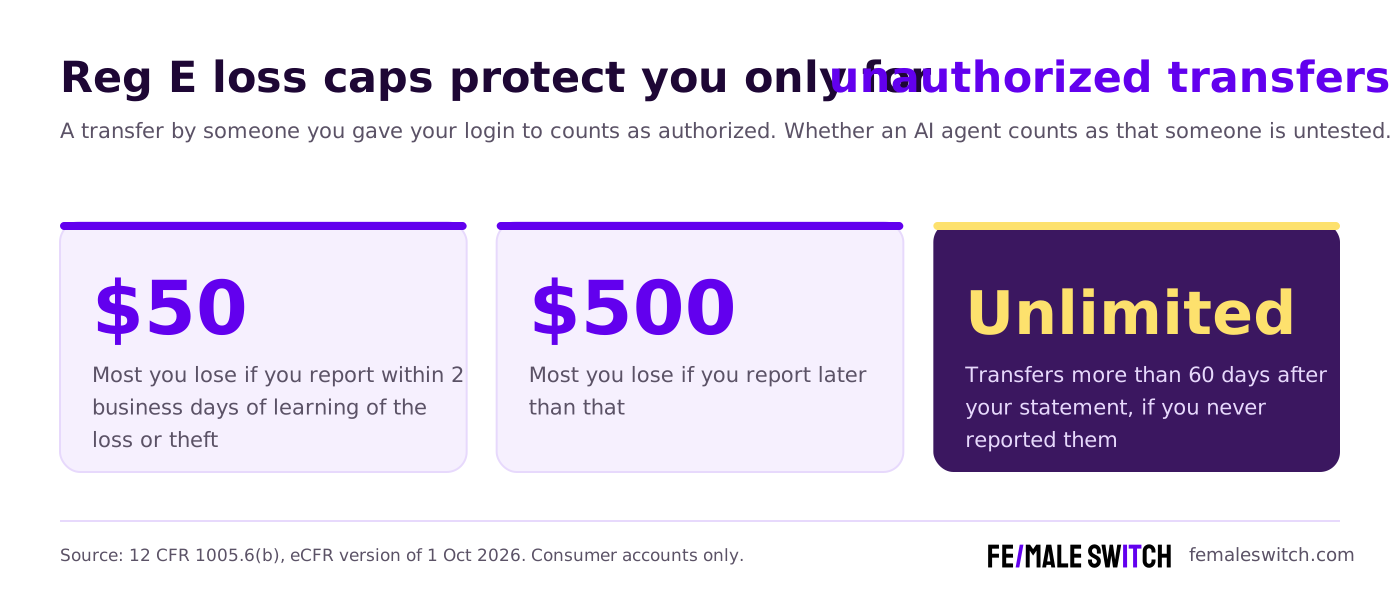
One question is open: no court ruling or CFPB guidance says whether an AI agent counts as a "person" under Reg E. Wells Fargo's Section 15 starts with "Unless otherwise provided by law or regulation", so Reg E still sets the floor. This is our plain-language reading; for your own case, ask your bank or a lawyer.
Does Reg E cover a business account?
Reg E is written for consumer accounts. If your money sits in a business account, check your business account agreement for its liability rules, and ask your bank in writing how it treats agent activity. Banking in Europe instead? PSD2 caps your loss at EUR 50 unless you were grossly negligent, and we explain what that means for AI agents and bank accounts in Europe.
How do you set up AI agents safely around your bank?
The banks that spoke on the record share one idea: a human acts before money moves. Bank of America CEO Brian Moynihan said BofA is working with agent providers so "the human remains in the loop before money is moved out of their account".
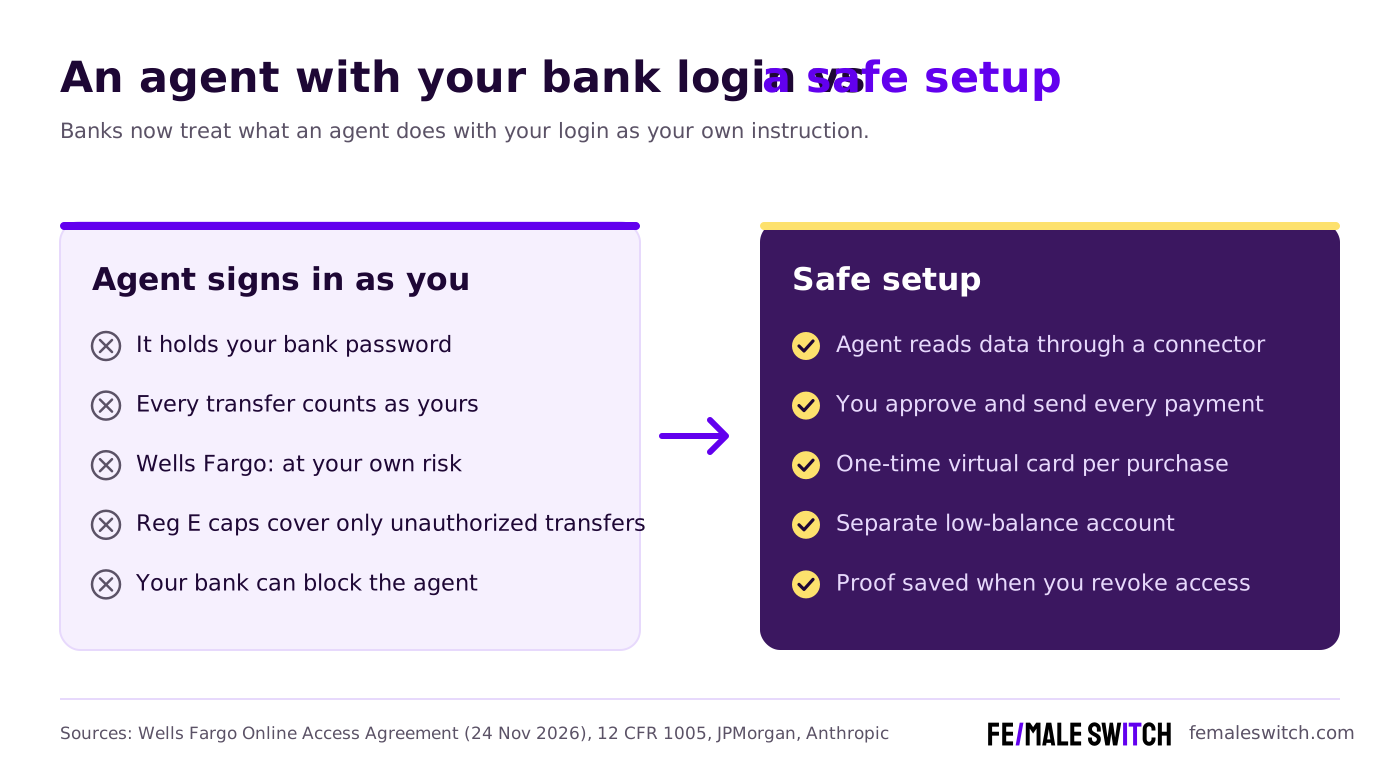
- Never hand over your bank password or your one-time SMS codes. Our guide to SMS codes and bank lockouts shows how to set up backup sign-in methods.
- Give agents read-only data through your accounting software or an open-banking connector such as Plaid, which JPMorgan still supports. Meta's Muse, per Crypto Briefing, reads bank data through Plaid with read-only access. Our guide to online bookkeeping for solopreneurs helps you pick the software.
- Keep money movement a human step. The agent drafts the payment list; you send each transfer in your banking app.
- Use one-time virtual cards for agent purchases. Claude Duet buys through Link: "Link asks you to approve the spend. It then pays with a virtual card, so your real card number isn't shared." Duet never moves money between accounts, even with your approval.
- Open a separate low-balance account with its own login for agent-started payments. Top it up by hand and keep overdraft off.
- Write your approval rules down. Reading, summarizing and drafting are fine alone. Any payment, new payee or client message needs your yes.
How do you revoke an agent's access and keep proof?
Under Reg E and the Wells Fargo terms, the moment you notify the bank is the line that counts. Next steps:
- Disconnect the agent in the agent app and in your connector dashboard. Deleting the app does not necessarily end its data access, IBT notes, citing CFPB advice.
- Change your bank password and sign out of all sessions.
- Tell your bank in writing that the agent is no longer authorized.
- File the evidence: dated screenshots and your message to the bank. Wells Fargo requires proof of revocation on request.
What should you tell your bookkeeper or virtual assistant?
Delegates are the blind spot. Wells Fargo's Section 2 says transactions by a delegate's AI agents count as authorized by you, "including those you did not want or intend". If your bookkeeper or VA (virtual assistant) has bank access and runs an AI agent, its actions land on you.
- Ask which AI tools they use with your accounts, in writing.
- Agree that no agent signs in to your bank, with their access or yours.
- Keep their access read-only where your bank allows it.
- Put an AI clause in the contract. Our list of contracts every entrepreneur needs is a good start, and our guide to virtual assistants for small businesses helps you set the scope.
What should you do this week?
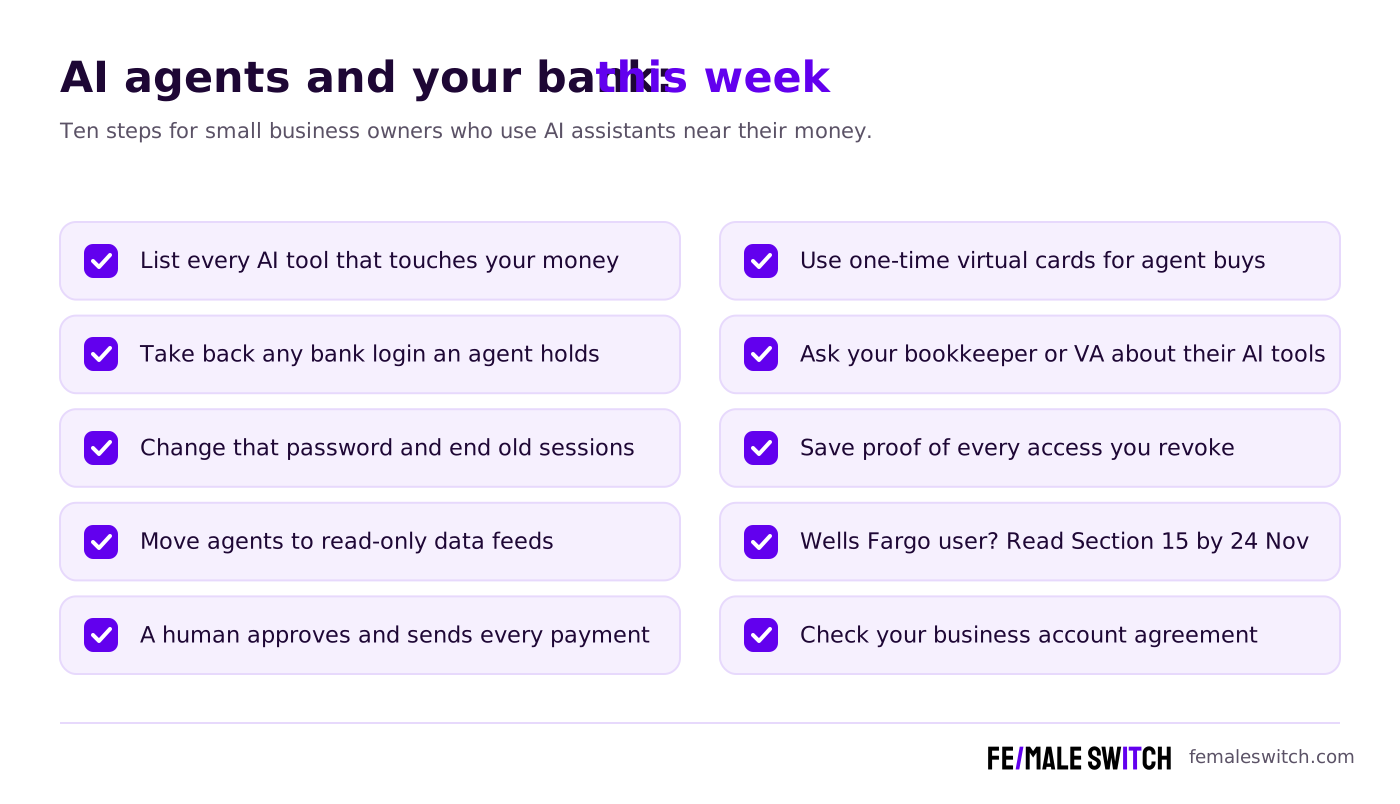
Ten steps you can finish this week. Start with the passwords.
Our payment infrastructure audit lists every card and processor an agent could touch, and our cybersecurity guide for women-led startups covers the rest of your security routine.
What don't we know yet?
- Which agent products the banks found inside accounts. Axios names none.
- How many incidents there are. Axios gives no numbers, and Schwab's Wurster calls the blocks "not many".
- Customer losses. No source reports a confirmed one.
- When Morgan Stanley, Bank of America and Citi started their restrictions.
- Whether a court or the CFPB would treat an AI agent as a "person" under Reg E.
- US regulator guidance on agents and bank logins. We found none (the Comptroller of the Currency spoke on 22 October without giving any), and the CFPB's open-banking rule (Section 1033) is on hold while the bureau reconsiders it.
Turn your skills into your first startup
The Fe/male Switch startup game takes you from idea to first paying customers in weekly quests, with an AI co-founder and a community of founders.
👉 Start the game
FAQ: AI agents and your bank account
Can AI agents access my bank account?
Some can read data through open-banking connectors such as Plaid. JPMorgan Chase and Schwab block agents that sign in with customer passwords; Citi and Morgan Stanley reportedly restrict them too.
Who is liable if an AI agent moves money from my account?
If you gave it your login, the rules point at you. Wells Fargo's terms from 24 November 2026 treat its actions as yours, and JPMorgan's CFO said it is "going to be on them". How Reg E treats an AI agent is untested.
Does Regulation E protect me from AI agent transfers?
Reg E caps losses at $50 or $500 for unauthorized transfers from consumer accounts. Transfers by someone you handed your login to count as authorized, so give no agent your password.
Should I give an AI assistant my bank password?
No. Chase says customers should not share usernames and passwords with anyone, and banks are blocking agents that use them. Give agents read-only data and approve payments yourself.
Does Claude Duet move money between accounts?
No. Anthropic says trading securities and moving money between accounts are off-limits even with your approval. Purchases go through Link with a virtual card after you approve the spend.
When do Wells Fargo's AI agent rules start?
On 24 November 2026, for anyone who keeps using Wells Fargo online or mobile banking after that date. No action is needed to accept them.
About the Author
Violetta Bonenkamp, also known as MeanCEO, is an experienced startup founder with an impressive educational background including an MBA and four other higher education degrees. She has over 20 years of work experience across multiple countries, including 5 years as a solopreneur and serial entrepreneur. Throughout her startup experience she has applied for multiple startup grants at the EU level, in the Netherlands and Malta, and her startups received quite a few of those. She’s been living, studying and working in many countries around the globe and her extensive multicultural experience has influenced her immensely.
