
TL;DR: Side hustles for women fall into four groups: gigs that rent out your hours through an app, freelance services, digital or physical products, and small platforms. The best side hustles for women who want a company one day are the ones that can run without your hours: a niche bookkeeping service, a tutoring practice that turns into a course, a printable shop, a paid community. Below you get 18 side hustle types with time, start-up cost, how each earns, its startup version and a cheap test, plus a 14-day plan for your first paying customer. Score your own idea out of 100 with the free side hustle to startup scorer below.
The best side hustles for women who want more than pocket money, in plain words: bookkeeping, virtual assistance, tutoring, social media management, copywriting, design, printables and digital planners, handmade goods, online workshops and paid communities. Delivery gigs, pet sitting and reselling pay faster and grow slower. Most work as side hustles for women from home.
Most side hustle lists stop at "here are 50 gigs and a dollar figure for each". I build startups for a living, and I sort side hustles by one question: can this grow beyond the hours you personally put in? It decides whether your evening project stays pocket money or becomes your first company.
You are in good company. Eurostat data for 2025 show 4.5% of employed women in the EU held more than one job, against 3.7% of men, about 4.25 million women. In the Netherlands it is 10.8% of employed women, and in France women are twice as likely as men to hold a second job (6.2% against 3.1%).
What is a side hustle, and which kinds can grow into a startup?
A side hustle is paid work you run next to a job, studies or caring for children, on your own terms. Gig work is the subset where an app or platform hands you tasks and sets the price: deliveries, errands, micro-tasks. A startup is a business built to grow faster than the hours its founder can give, through products, software, a team or a network.
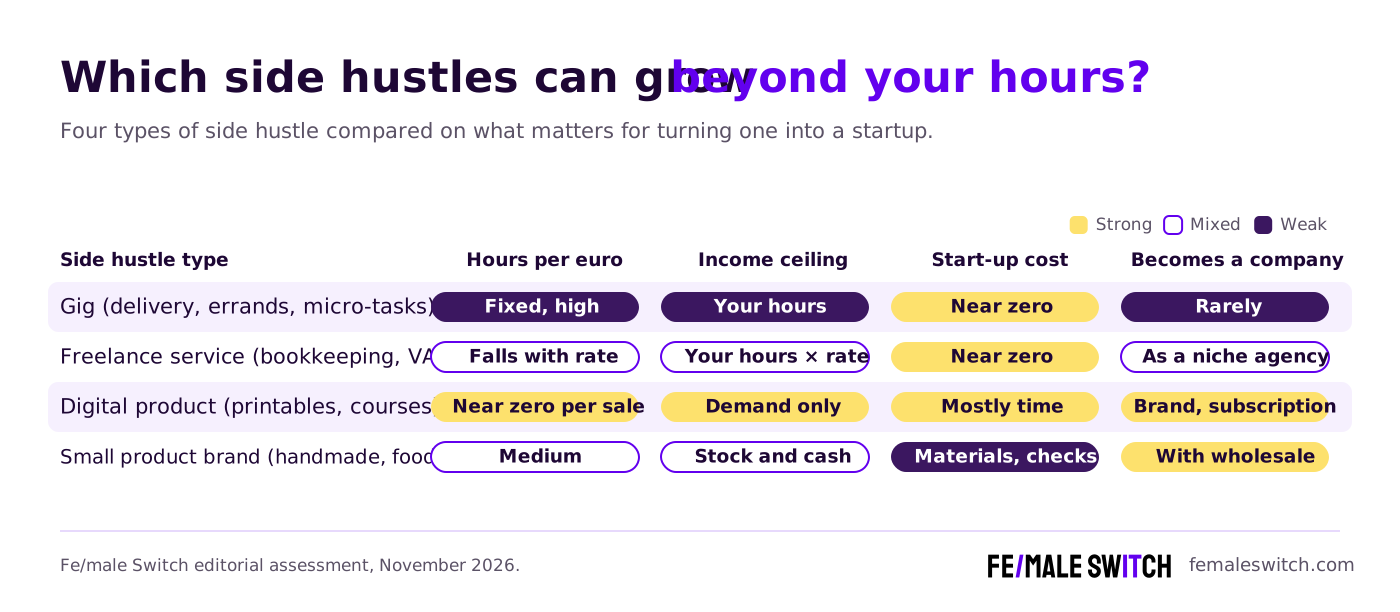
Every side hustle sits on a ladder with four rungs:
- Gig: you sell hours through someone else's app. Fast to start, and the app owns the customer.
- Freelance service: you sell your skill to clients you find. Better rates, still capped by your calendar.
- Digital product: you build once and sell many times. Slow start, then income without extra hours per sale.
- Small product brand or platform: physical goods, a community or a marketplace. More set-up, the highest ceiling, and the only rung where a team and investors make sense.
The table reflects our editorial judgement as founders. The move that turns a side hustle into a startup is climbing ONE rung at a time: gig to service, service to product, product to platform.
How does the side hustle to startup scorer work?
Pick a side hustle or type your own idea, then answer six questions about hours, repeat customers, work that runs without you, digital or physical, start-up cost and demand. You get a growth score out of 100, the startup version of that hustle, your two or three biggest risks and a 14-day test plan built from your answers.
The weights are our own judgement as founders: proven demand counts more than a cheap start.
Which side hustles for women can grow into a startup? 18 ideas by type
Each idea shows time, start-up cost, how it earns, its startup version and a test for this month. Time and cost bands are OUR ESTIMATES for a small first version.
Gig hustles: fast cash, low ceiling
1. Errands and delivery gigs. Time: 5 to 15 hours a week in blocks. Start-up cost: under €100 if you own a bike or car. Earns: per task, at the app's price. Startup version: a weekly errand round for older parents in one neighbourhood, then a small team of runners with a booking page. Cheap test: offer a Tuesday shopping and pharmacy run to five families in a local parents' group.
2. Pet sitting and dog walking. Time: 5 to 10 hours. Cost: under €100. Earns: per visit or walk. Startup version: a dog-walking crew with a waitlist and prepaid packs, then a booking club for one area. Cheap test: sell three neighbours a prepaid pack of ten walks.
3. User testing and micro-tasks. Time: 1 to 5 hours. Cost: €0. Earns: per test or task. The lowest ceiling on the list. Startup version: recruit test users for startups in one group you know well, such as parents of toddlers. Cheap test: message five founders and offer five interviewed parents within a week.
4. Reselling secondhand clothes. Time: 3 to 8 hours. Cost: €50 to €300 of stock. Earns: margin per item minus platform fees. Startup version: a curated resale shop in one niche, such as children's outdoor gear, then resale of returns for small brands. Cheap test: list 20 items in one niche and track how many sell in 14 days.
Freelance services: your skill, your clients
5. Bookkeeping for small businesses. Time: 5 to 10 hours. Cost: under €200 for software and a course. Earns: a monthly fee per client. Startup version: bookkeeping for one niche (hair salons, Etsy sellers, therapists), then templates or software for that niche. Read our guide to virtual bookkeeping services for entrepreneurs. Cheap test: offer three small businesses in your network a first month at a fixed price.
6. Virtual assistance. Time: 5 to 20 hours. Cost: under €100. Earns: hourly or monthly packages. Startup version: a small virtual assistant (VA) agency with written processes and two helpers, then automation packs for clients. Our article on virtual assistant services for small businesses covers the services that sell. Cheap test: post one fixed package ("inbox and calendar, 4 hours a week") to ten business owners.
7. Tutoring. Time: 3 to 10 hours, mostly after school. Cost: €0 to €100. Earns: per session. Startup version: small-group classes, then an exam-prep course that sells without you in the room. See how to start an online tutoring business in maths and languages. Cheap test: run one paid group session for four pupils from the same class.
8. Social media management for local businesses. Time: 5 to 15 hours. Cost: under €100 with free design tools. Earns: monthly packages. Startup version: fixed content packages for one sector, such as dentists or yoga studios, then a content calendar product for that sector. Cheap test: make a free week of posts for one shop and ask for a paid month.
9. Copywriting and editing. Time: 5 to 10 hours. Cost: €0. Earns: per project. Startup version: a productised service, "website copy in five days for one price", then templates for that niche. Cheap test: rewrite one local business homepage and offer the full page.
10. Graphic design and brand kits. Time: 5 to 10 hours. Cost: €0 to €150. Earns: per kit. Startup version: brand kits for one kind of business, then a template shop with the best designs. Cheap test: sell three brand kits at an introductory price to founders you know.
11. Translation and localisation. Time: 5 to 10 hours. Cost: €0. Earns: per word or per project. Startup version: a niche localisation studio with other translators, such as app and game texts. Cheap test: translate one app store page for free and pitch the full app.
12. Home organising and cleaning. Time: 5 to 15 hours. Cost: €100 to €300 of supplies. Earns: per visit or monthly plan. Startup version: a team with recurring plans and online booking in one district. Cheap test: sell five recurring fortnightly visits before you buy anything.
Products: build once, sell many times
13. Printables and digital planners. Time: 10 hours to build, then 2 to 5 a week. Cost: under €100 plus marketplace fees: Etsy charges USD 0.20 per listing and 6.5% of each order, plus payment processing, according to its own help centre. Startup version: a template brand with its own shop, bundles and a subscription. Read how to sell printables for planners and journals. Cheap test: list three planners in one niche and count sales and favourites in 14 days.
14. Handmade goods: candles, jewellery, soap. Time: 5 to 15 hours. Cost: €200 to €1,000 of materials. Earns: per item. Startup version: a small product brand with repeat buyers and wholesale to shops. Check your country's product safety and labelling rules first, especially for cosmetics and candles. Cheap test: take pre-orders for one batch before you buy the materials.
15. Home baking and food. Time: 5 to 15 hours. Cost: €100 to €500. Earns: per order. Startup version: a weekly subscription box or a supply deal with two cafés. Register with your food authority before you sell. Cheap test: a pre-order form for one weekend batch.
16. Online workshops and courses. Time: 20 to 40 hours to build. Cost: €0 to €200. Earns: per seat or per course. Startup version: a cohort programme, then a membership academy. Cheap test: sell ten seats for a live 90-minute workshop before you record anything.
Platforms: you connect other people
17. Paid newsletter or community. Time: 3 to 6 hours. Cost: €0 to €100. Earns: subscriptions. Startup version: a paid membership, then a job board or marketplace for the same audience. Cheap test: ask your first 50 free readers who would pay a small monthly fee for one extra benefit.
18. Niche marketplace or directory. Time: 5 to 10 hours. Cost: €0 to €500 with no-code tools. Earns: listing fees or commission. Startup version: this one is already a startup. Cheap test: run it by hand with a spreadsheet and a form, matching ten buyers with ten sellers yourself.
Not sure which fits? The free business ideas generator gives you 10 personalised ideas from your audience and interests in about ten seconds.
Which side hustles suit stay at home moms?
The best side hustles for stay at home moms share two traits: the work happens asynchronously (no fixed hours, so it fits nap times and school runs) and each week's work builds an asset. Bookkeeping, copywriting, printables, newsletters and courses fit both.
Here is why this matters for mothers. The GEM 2025/2026 Women's Entrepreneurship Report, based on a survey of 150,799 adults in 48 economies, found women were 55% more likely than men to cite family or personal circumstances as the reason they closed a business. Women were also more likely to start alone and invested roughly one-third less capital. So side hustles for moms need to survive a bad month: low fixed costs, work you can pause, customers who wait a week.
Our piece on creating resources for work-from-home moms shows a whole product category built for this audience.
How much can you earn from a side hustle?
Nobody can give you one honest earnings figure for every side hustle. Rates depend on your country, niche and skill, and the dollar figures on most lists come without a source. So I teach pricing instead of promising numbers.
Here is how to price a service in three steps:
- Set your floor. Monthly income goal ÷ hours you can SELL per month (about 60% of your side hustle hours; the rest goes to admin and finding clients).
- Check the market. Collect five public prices from people who sell the same thing in your country, and place yourself in the middle.
- Package it. Sell a fixed result ("monthly books for one salon") at a fixed price. Packages hide your hourly rate and make it easier to raise.
A worked example: you want €600 a month from 10 hours a week. You can sell about 26 of your 43 monthly hours, so your floor is about €23 an hour. For products, start from the price and subtract every fee: on a €12 printable sold on Etsy, the 6.5% transaction fee alone is €0.78, before payment processing and the listing fee.
Copy this pricing sheet:
- Monthly income goal: €[amount]
- Side hustle hours a month: [hours] × 0.6 = sellable hours: [hours]
- Floor rate: goal ÷ sellable hours = €[rate] an hour
- Five market prices I found: €[ ], €[ ], €[ ], €[ ], €[ ]
- My first package: [result] for €[price], delivered in [days]
- Platform and payment fees per sale: €[fees]
- Price I will test with 10 people: €[price]
For product pricing in more depth, read our guide to pricing your first product as a first-time founder.
How do you test a side hustle in 14 days before you quit anything?
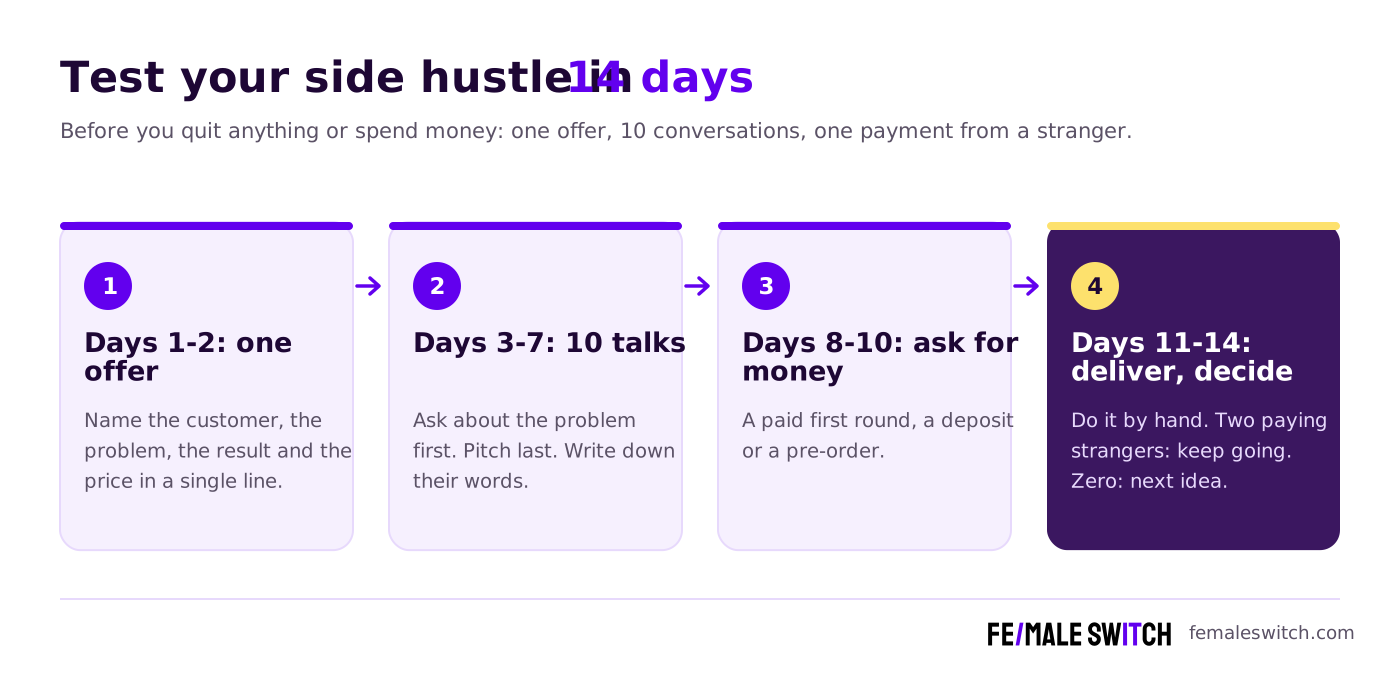
Run this test before you spend money or say anything to your boss. The goal is one number: a payment from someone who is not your friend.
- Days 1 and 2: write one offer. Name the customer, the problem, the result and the price in a single line: "Monthly bookkeeping for hair salons, books closed by the 5th, €[price] a month." Drop everything else.
- Days 3 to 7: hold 10 conversations. Message people who have the problem. Ask about the problem first and pitch last. Our problem interview script gives you the questions, and finding your first 10 customers shows where to look.
- Days 8 to 10: ask for money. Offer a paid first round, a deposit or a pre-order. Getting paid before you build covers the formats.
- Days 11 to 13: deliver by hand. Time every step and note what the customer asks for next.
- Day 14: decide. Count conversations, yeses and euros. Two or more paying strangers: keep going and plan the startup version. One: change the offer or the customer and run another 14 days. Zero: pick the next idea.
Copy this first-customer message:
Hi [name], I am starting a small [service] for [type of customer] and I am talking to 10 people before I set it up. How do you handle [problem] today, and what does it cost you in time or money? If it helps, I can do the first [result] for €[price] this month. No pressure either way, your answer helps me build the right thing.
A smoke test with a simple page works for products, and our 30-day validation playbook continues where these 14 days end.
Do you need to register a side hustle or pay tax on side income?
In most countries, yes, once it is regular and for profit. Rules are national, so check your tax authority's page before your first invoice. Four terms come up everywhere:
- Self-employed registration (sole trader): registering as a one-person business with your tax office, so you can invoice and declare the profit. The trigger differs by country.
- Trading allowance (UK): HMRC lets you earn up to £1,000 of gross trading income per tax year tax-free, and you register for Self Assessment above that. HMRC confirmed on 28 October 2026 that the allowance and the reporting threshold rise to £3,000 from 6 April 2027. Our article on the UK trading allowance tripling to £3,000 has worked examples.
- DAC7 platform reporting (EU): since 1 January 2023, Council Directive (EU) 2021/514 makes platforms report their sellers' income to tax authorities. It covers sales of goods, personal services and rentals. According to Irish Revenue, a seller of goods with fewer than 30 sales and less than €2,000 in a year is excluded; personal services have no such exclusion. The European Commission states that DAC7 adds no new tax: your income was taxable already.
- VAT small-business exemption (EU): small businesses below a national turnover threshold can skip charging VAT. The European Commission sets the ceiling: the national threshold cannot be higher than €85,000 a year, and each country picks its own figure.
When is a side hustle ready to become a startup?
Look for four signals, and wait for at least three:
- Strangers pay, and some of them pay again.
- You turn work away, or the waitlist grows without ads.
- Part of the work runs without you: a template, a checklist, a helper or software.
- You can name the startup version in one sentence, and five customers say they want it.
GEM data put this in context: 12% of women were running new businesses in 2025, against 14% of men, and women led about 40% of the high-potential ones, the ventures built to grow.
Our guide on going from side hustle to full-time covers savings and timing, and solopreneur vs startup founder helps you decide if you want a company at all.
Practise the startup version before you risk your savings. The Fe/male Switch startup game takes first-time founders from idea to first customers; the START tier is forever free, with AI tools, the Skill Lab and a forum. Its AI co-founder, Elona, tests your idea and gives you a plan for the next 7 days in about ten seconds, free and without sign-up. She drafts canvases and business plans as a first version you edit, and her own page says she can be wrong, so you check her work. Got an idea already? Run it through the free idea validator.
Which mistakes keep a side hustle small?
- Staying on the gig rung. The app sets your price and its fees. Use gigs for cash and build a service next to them.
- Building before selling. A website, a logo and stock come after the first payment.
- Pricing per hour forever. Hours cap you. Packages and products lift the cap.
- Ignoring registration. Platforms report your sales under DAC7, so your tax office sees the numbers anyway.
- Quitting too early. Keep your job until the side hustle covers your fixed costs for three months in a row.
What should you do this week?
Side hustles for women grow into startups when they climb from hours to services to products, one rung at a time. Pick one idea from the 18, score it, and write your offer tonight. Then send the first-customer message to ten people before Sunday. In 14 days you will know if strangers pay, and that answer beats any list of 50 gigs.
FAQ: side hustles for women
What are the best side hustles for women?
For growth: bookkeeping, virtual assistance, tutoring, social media management, copywriting, printables and digital planners, online workshops and paid communities. For fast cash with a low ceiling: deliveries, pet sitting, user testing and reselling.
What are good side hustles for stay at home moms?
Asynchronous work you can pause: bookkeeping, copywriting, design, printables, newsletters and courses. Avoid hustles with fixed hours if your childcare is unpredictable.
What are the best online side hustles for women?
Virtual assistance, online tutoring, copywriting, social media management, printables and digital planners, online courses and paid newsletters all run online from home.
How much can you earn from a side hustle?
It depends on your country, niche and hours. Price it yourself: divide your monthly income goal by the hours you can sell, compare five market prices, then sell a fixed package.
Do I need to register my side hustle?
Yes in most countries, once it is regular and for profit; rules are national. In the UK you register for Self Assessment above £1,000 of gross trading income per tax year, rising to £3,000 from 6 April 2027.
Do online platforms report my side hustle income?
In the EU, yes. Under DAC7, platforms report sellers' income to tax authorities. Sellers of goods with fewer than 30 sales and less than €2,000 a year are excluded; service providers are reported from the first euro.
Which side hustle can turn into a business?
Services that become niche agencies or products, digital products that become brands, and communities that become platforms. Gigs on someone else's app rarely do.
How do I test a side hustle idea?
Write one offer, hold 10 conversations, ask for a payment, deliver by hand and decide on day 14. One paying stranger beats any amount of planning.
About the Author
Violetta Bonenkamp, also known as MeanCEO, is an experienced startup founder with an impressive educational background including an MBA and four other higher education degrees. She has over 20 years of work experience across multiple countries, including 5 years as a solopreneur and serial entrepreneur. Throughout her startup experience she has applied for multiple startup grants at the EU level, in the Netherlands and Malta, and her startups received quite a few of those. She’s been living, studying and working in many countries around the globe and her extensive multicultural experience has influenced her immensely.

