

I was accepted into Columbia University and never went. Fifteen years and two startups later, I still think about what that door would have opened.
I have five higher education degrees from five European universities. A Master of Arts in Linguistics and Education, an Advanced Master in Linguistics from Belgium, an MBA from Sweden, and an Erasmus Mundus European Master of Higher Education completed simultaneously across Norway, Finland, and Portugal. At some point, I was also accepted into Columbia University, but I never got to go. A force majeure intervened, and that was that.
I often wonder what difference having an Ivy League diploma on my CV would have made.
Not in a self-pitying way. My degrees served me. They gave me context, discipline, cross-cultural fluency, and the academic vocabulary that shaped how I think about building companies. But the specific network that comes with a Harvard or Columbia stamp, the one that sends you a warm investor introduction before your first cold email, the one that puts your co-founder search inside a pool of people who already trust you by default, that network is something I built from scratch. And building it from scratch is significantly harder, slower, and more expensive in runway terms than most people openly admit.
This article is my honest attempt to answer the question I have been quietly asking myself for over a decade: does the school on your diploma still matter when you are building a startup in 2026? And if the answer is yes, even partially, what do you do about it if you did not go?
TL;DR: Does Your College Pedigree Matter When You're Building a Startup in 2026?
Yes, the school on your diploma still matters, but not primarily for the reasons most people assume. The credential itself is less important than the network infrastructure it unlocks: warm investor introductions, pre-vetted co-founder pools, trusted alumni channels, and institutional access that dramatically reduce the friction of early-stage company building. For startup founders who had to build that infrastructure from scratch, the gap is real but closeable. The most effective substitute is a "spiked" profile, meaning one area of deep, demonstrable, publicly visible expertise paired with real things you have built. That combination replicates much of what the pedigree network provides, one hard-won trust signal at a time. The rest of this article shows you exactly how.
The Case for the Ivy League Network
Let me start by saying the thing most entrepreneurship content refuses to say clearly: the Ivy League network is genuinely powerful, and dismissing it as mere credentialism is intellectually dishonest.
Crunchbase's annual analysis of funded startup founders consistently finds that Stanford, Harvard, and MIT graduates disproportionately appear in the list of successfully funded entrepreneurs. Year after year. Across industries and geographies. That pattern is not accidental. It reflects structural advantages that compound over time.
Here is what those advantages actually look like in practice.
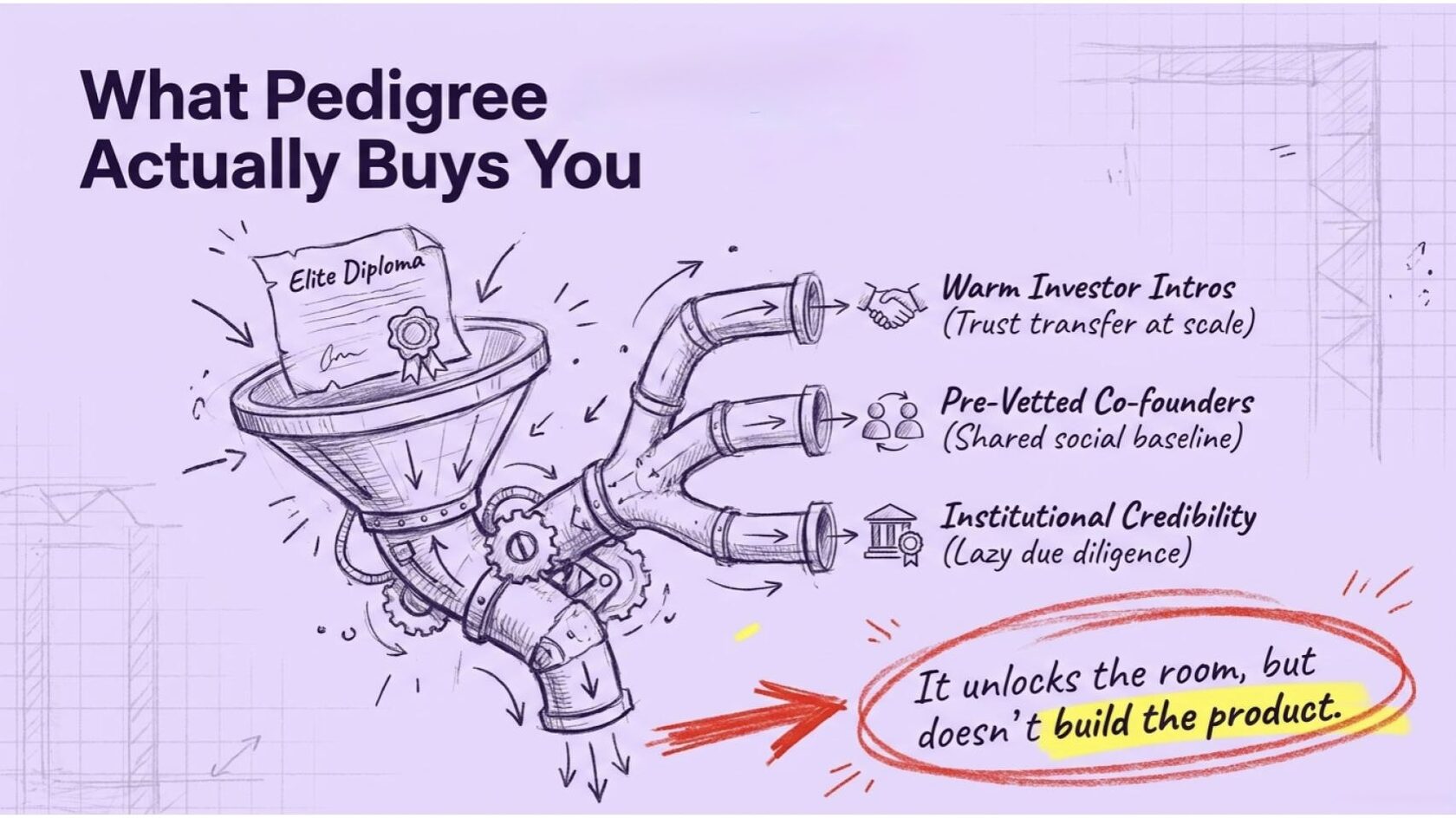
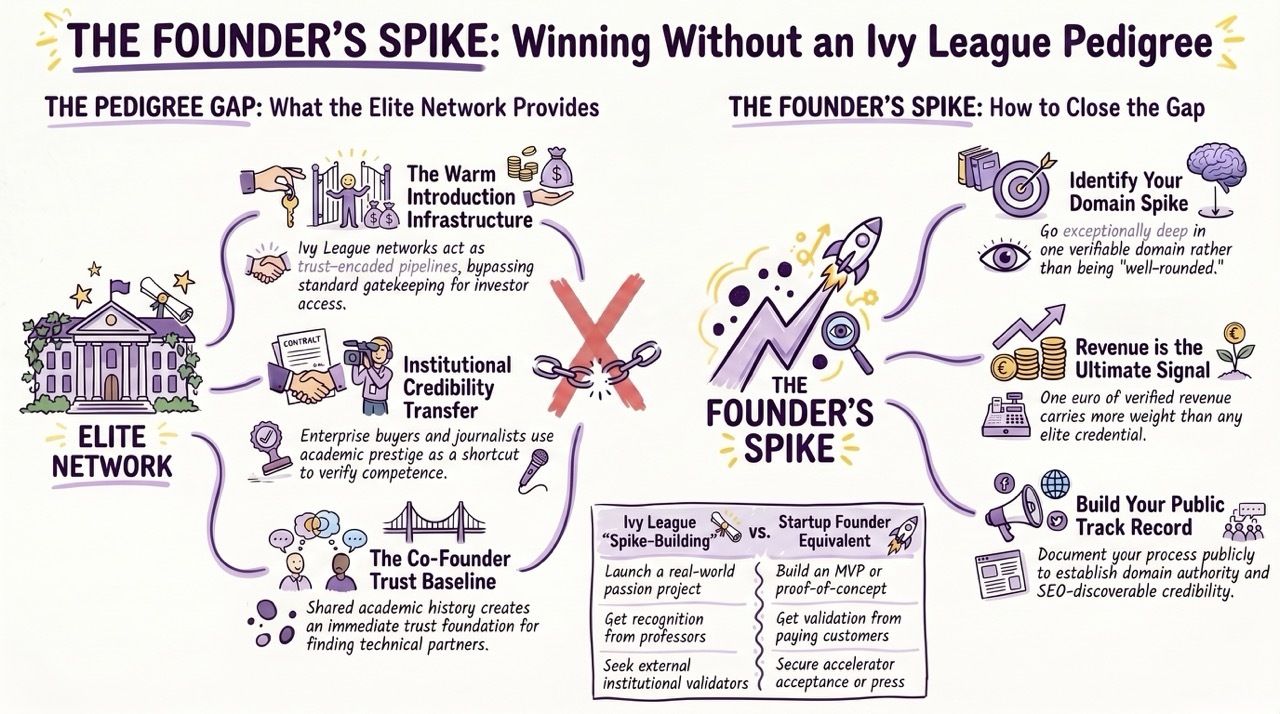
The warm introduction infrastructure. The single most valuable thing an Ivy League diploma provides is access to a warm introduction network that operates at scale. Harvard Alumni Entrepreneurs runs accelerators, demo days, and investor showcases attended by more than 1,000 investors, exclusively for alumni founders. The Harvard Business School Alumni Angels Association connects alumni founders directly to angel investors. The Yard Ventures fund pools capital from an 850,000-strong alumni and entrepreneur community. These are not generic networking events. They are trust-encoded pipelines where being a fellow alumnus is itself a credibility signal that bypasses the gatekeeping that cold-outreach founders spend months trying to navigate.
Warm introductions work because investors rely on trust to filter deal flow. When a trusted contact introduces a founder, that trust transfers at least partially to the founder being introduced. An Ivy League alumni network is a systematic machine for generating these trust transfers at scale, across thousands of investor relationships, in dozens of cities simultaneously. When I think about the Columbia acceptance I never converted, this is what I think about most: not the classroom, but the pipeline.
The co-founder pool. Finding a technical co-founder who will work for equity in the early days requires an existing trust baseline. Shared academic experience creates that baseline faster than almost anything else. When you attended the same university, you have mutual friends, a shared social context, and some prior evidence of each other's intellectual caliber. For founders without an elite alumni network, this trust has to be built from scratch, through projects, shared work experiences, or long introduction chains. It is doable. It just takes longer.
The institutional credibility transfer. Some enterprise buyers, particularly in finance, law, consulting, and regulated industries, use academic prestige as a proxy for competence when evaluating early vendors. It is lazy due diligence, but it is common. A Harvard stamp on the founder's bio lowers the perceived risk of an early procurement decision in ways that no amount of good copy can fully replicate.
The press shorthand. Journalists writing founder profiles still rely on university pedigree as a narrative shortcut. "Former Harvard researcher builds..." is a headline that writes itself. "European founder with five degrees in linguistics and blockchain builds..." requires more explanation. That is not a trivial difference when you are trying to generate the early press coverage that drives credibility and word of mouth.
So yes: the pedigree network provides real, structural advantages that I did not have when I built CADChain or Fe/male Switch. Pretending otherwise serves no one.
What the Pedigree Does Not Do
Now the equally important counterpoint.
A prestigious diploma does not teach you how to build something. The Harvard alumni accelerator accepts founders who already have traction. The warm introduction pipeline works when you have a credible product to introduce. The alumni angel network invests in real ventures, not in CV line items. The credential unlocks the room. What happens in the room still depends entirely on what you built and how clearly you can explain it.
A 2024 peer-reviewed study in Cogent Economics and Finance confirmed that education level is a positive factor in startup funding, but found a negative curvilinear relationship: beyond a certain threshold, additional years of education stop helping and may actually reduce investor confidence. At some point, they start wondering whether you are an academic who models things rather than a founder who ships them.
And for female founders in Europe specifically, the pedigree advantage is significantly weaker than advertised, because the structural bias against female founders runs deeper than any credential can fully offset.
PitchBook's 2025 European All In Report found that female founders' share of overall VC dealmaking fell to just 16.5% of deal value, down from 20.4% the previous year. For startups with only female founders, all-female founding teams are on track to raise less than €1 billion for the year, the first time since 2020. all-female founding teams are on track to raise less than €1 billion for the year, the first time since 2020, a gap the European Commission now tracks as an accountability issue rather than a demographic footnote.
A Columbia degree would not have fixed that gap for me. It would have given me a better starting position in the race. Not a different track.
The Columbia Question I Still Ask Myself
I was accepted into Columbia. I did not go. And when I am honest about what that might have changed, the answer is specific.
It would have given me a New York address for two years, inside one of the most concentrated startup ecosystems in the world. It would have given me classmates who are now VCs, operators, and founders across finance, media, and tech. It would have put me inside a social infrastructure where introductions flow freely because the trust architecture is already built into the alumni identity itself.
What it would not have given me is the understanding of blockchain that led to CADChain. It would not have given me the cross-cultural fluency from studying and working across seven countries. It would not have given me the cognitive science and game design instincts that went into Fe/male Switch's gamepreneurship methodology. And it would not have given me the 20-plus years of solopreneurship, freelancing, and building in ambiguous conditions that shaped how I actually operate under pressure as a CEO.
The diploma would have opened earlier doors. The experience I accumulated instead built a different kind of foundation.
Both of those things are true simultaneously. And the question for any founder who did not attend an elite school is not "did I miss something?" The question is: what do I build instead, and how do I build it fast enough to stay competitive?
What "Spiked" Actually Means and Why It Beats "Well-Rounded"
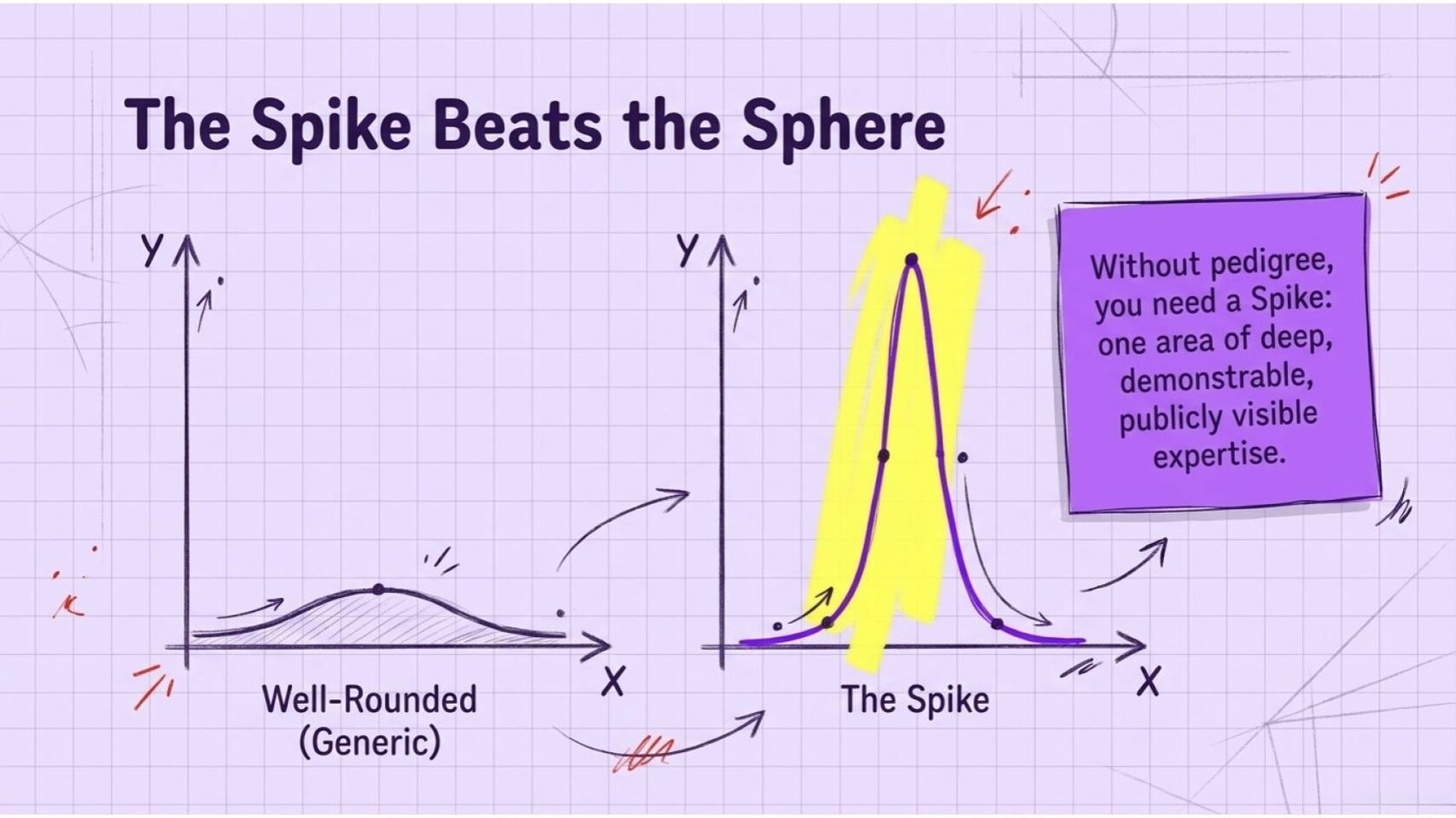
The admissions world has been using the term "spike" for years. A spiked profile goes exceptionally deep in a single domain rather than spreading thin across many. It is the primary mechanism for building credibility without a pedigree network, and it works both in elite admissions and in early-stage fundraising for the same structural reason: it is hard to fake.
Ivy Brothers, a college admissions consulting firm staffed by former Ivy League admissions officers, has built their entire methodology around spike-building. They help students launch real-world passion projects: apps, non-profits, neural networks, student consulting agencies, independent research. The logic is that admissions committees can distinguish between a student who collected activities and a student who actually built something. Real building, with external validation from credible people, is the signal that cuts through the noise of a crowded applicant pool.
Their results are measurable. Students they advise get into Harvard, Penn, Brown, Carnegie Mellon, and similar institutions. And the mechanism that produces those results maps directly onto what experienced startup investors look for when evaluating founders who did not come through an elite alumni pipeline.
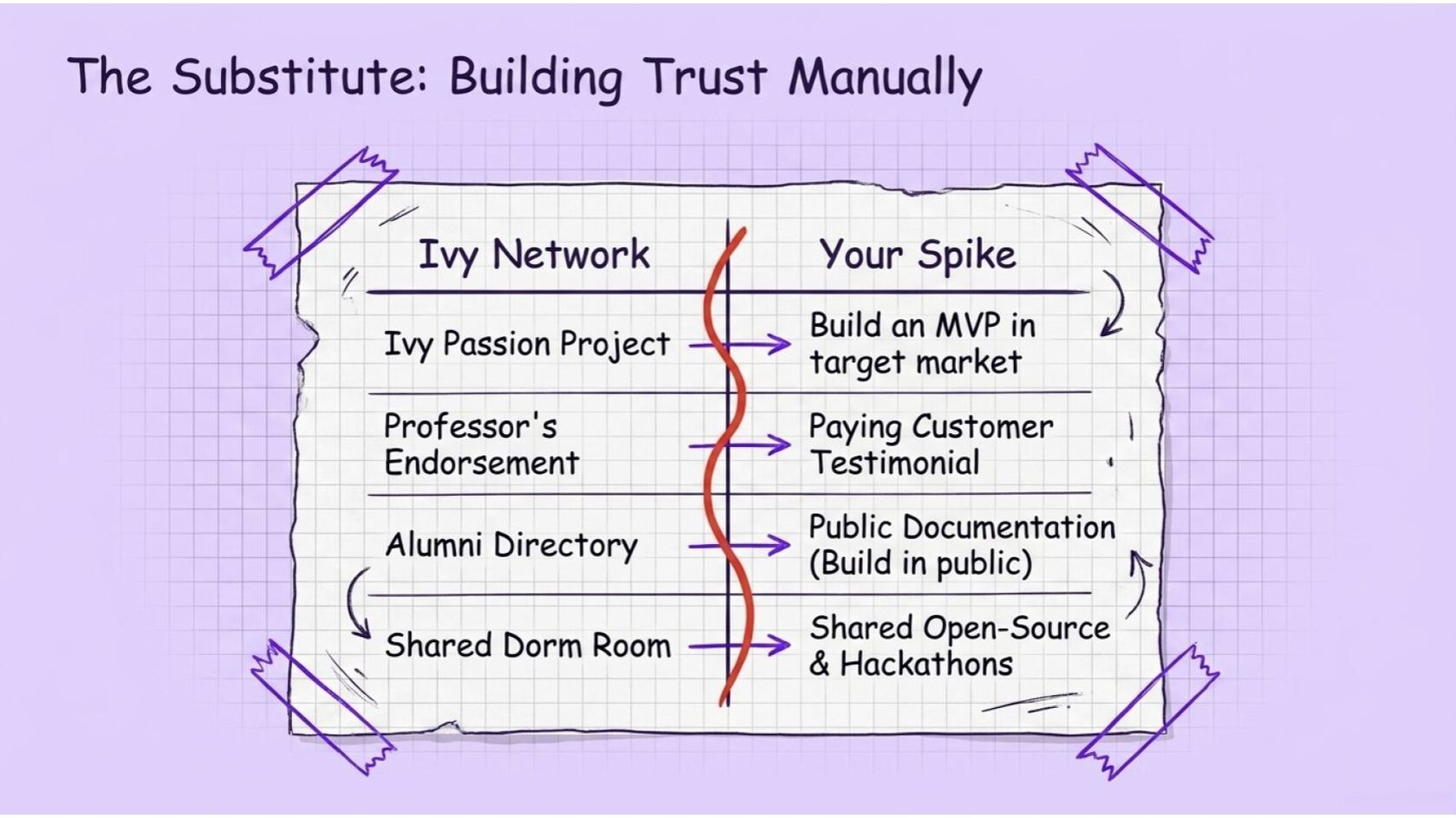
Here is the parallel, drawn precisely:
The student who launches a solar non-profit, gets it recognized by a Harvard professor, and raises €5,000 from local donors has done something more meaningful than the student with perfect grades and a list of clubs. And the founder who builds a working product, gets three paying customers, and can articulate exactly why she is the right person to solve this specific problem has done something more meaningful than the founder with an elite MBA and no traction.
The spike is the mechanism that substitutes for the pedigree network when you did not inherit access to it.
How I Built My Spike Without an Ivy Diploma
My five degrees gave me context. Linguistics trained me to think about how language shapes cognition, which turned out to be directly applicable to UX research, marketing copy, and the behavioral science behind Fe/male Switch's learning design. My MBA gave me a vocabulary for business modeling I use every week. The Erasmus Mundus program, completed simultaneously across three countries and three universities, trained me to operate in ambiguity and build trust quickly across very different institutional cultures.
But none of that was the spike. The spike appeared in 2018, when I went so deep into blockchain technology that I could see something most engineers were missing: the entire industry of computer-aided design, a multi-billion euro sector where engineers shared their most valuable intellectual property in unprotected file formats, had no reliable system for tracking, controlling, or monetizing that IP after it left their hands. The problem was painful, specific, and completely under-served.
I did not have a Columbia network to introduce me to investors. I had a Dutch incubator that found me because I had identified a real problem and could explain it with the depth of someone who had studied the technology, the legal context, and the affected industry in genuine detail. That depth replaced the warm introduction. It was a slower path. It worked.
The second spike was Fe/male Switch: recognizing that startup education was generic and passive, and that the combination of game theory, cognitive science, and education design could produce something genuinely different. I built it from scratch, without funding, during a pandemic. By 2022, EU Startups named me among the Top 100 Women in Europe. Not because of a diploma. Because of a provably novel thing I had built and could demonstrate.
Those spikes became my network infrastructure over time. Credibility compounds. The first customer leads to the second. The first press mention leads to the next five. The first investor introduction generates the next three. You build the machine that Ivy alumni inherit by default. You just build it manually, from evidence, over a longer timeline.
The Practical Framework: Building Pedigree-Level Trust Without the Diploma
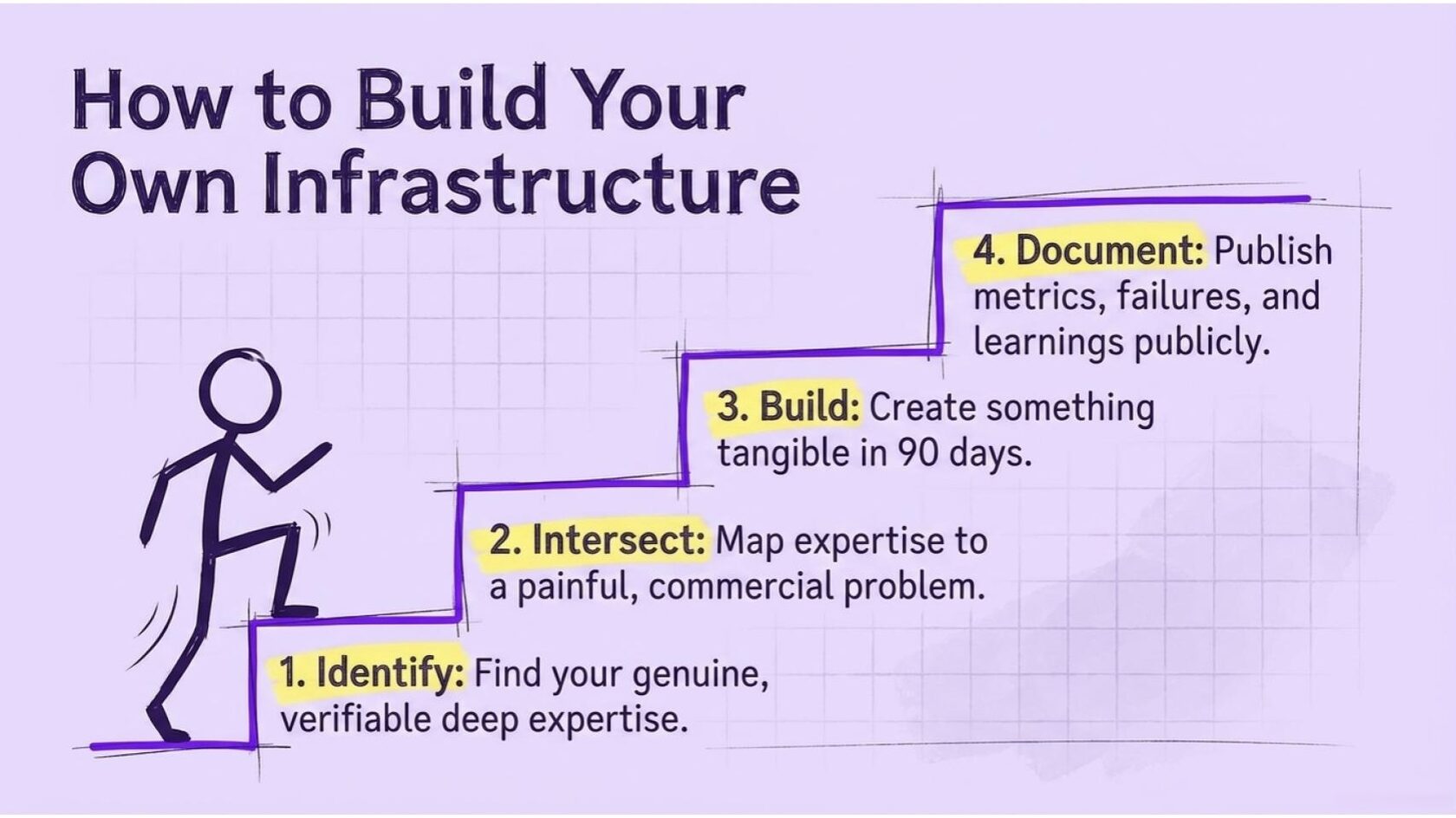
This is a structured process I would give to any bootstrapping founder who asks.
Step 1: Identify your genuine spike. Not your interests. Not your aspirations. What do you know with a depth that most people never reach? What have you built or experienced that most people have not? Write three candidates. Evaluate each ruthlessly. The spike must be real and verifiable by people outside your immediate circle.
Step 2: Find the market intersection. Deep expertise only becomes a startup advantage when it meets a problem that people pay to solve. The spike finds its commercial application at this intersection. CADChain: deep blockchain knowledge plus a painful problem in engineering IP. Fe/male Switch: deep learning design knowledge plus a structural gap in female entrepreneurship training. The intersection is your thesis.
Step 3: Build something tangible in the next 90 days. Not a business plan. Not a pitch deck. Something a stranger can use, pay for, or independently evaluate. A working product, a paying client, a functional prototype. This external validator is the functional equivalent of the professor's recommendation letter in the admissions world.
Step 4: Create public documentation of your process. Write about what you are building. Post your metrics, your failures, your learnings. Public documentation of your expertise compounds: it generates SEO-discoverable proof of credibility, builds a community of people who trust your judgment before they meet you, and establishes a verifiable timeline of domain authority. This is the closest replication of the institutional credibility transfer that a famous alumni network provides, without the alumni network.
Step 5: Seek validation from people your target investor already trusts. An investor who does not know you will look for signals from people they do know. That is exactly how the alumni introduction pipeline works. You replicate the mechanism by getting a named advisor from your industry, by being accepted to a credible accelerator, by securing a testimonial from a recognizable enterprise customer. Each of these is a trust transfer from someone the investor already respects, toward you.
Step 6: Build one channel obsessively before you build three. Founders without pedigree networks who spread across every platform are visible nowhere. Pick one channel where your target investors and customers actually operate and go deep on it. For B2B deep tech in Europe, this is usually LinkedIn. For consumer products, it may be Instagram or TikTok. Depth of channel beats breadth of channel at every early stage.
Where the Pedigree Advantage Fully Disappears
Some contexts level the playing field entirely, and knowing them lets you allocate your energy correctly.
Revenue. Your first paying customer does not check your GPA. They check whether the product solved their problem at a price they were willing to pay. One euro of real revenue carries more evidential weight in a pitch than any credential, because it is independently verifiable and it answers the question investors care most about: will anyone pay for this?
Technical credibility in domain-specific fields. In deeptech, AI, engineering, biotech, or any field with a rigorous technical standard, what you have built and what you understand about the underlying system matters far more than where you studied. The conversations that mattered most at CADChain were about DRM implementation in CAD file formats, GDPR compliance in IP tracking, and the specific workflows of engineers using Autodesk Inventor. No diploma opens those conversations. Domain depth does.
Community trust. Building a genuine user community is driven entirely by consistent output, real expertise, and showing up over time. No university brand accelerates that process. The Fe/male Switch community formed around the quality of the content and the specificity of the mission, not around the credentials of whoever built the platform.
Grant funding and gender-lens investment. Much of the capital available to early-stage European founders evaluates your venture on objective criteria: problem clarity, market size, team capability, traction. Women TechEU, the EIC Accelerator, and similar programs apply published criteria consistently. Gender-lens VCs in Europe are similarly moving away from pattern-matching and credential shortcuts, with average decision times about 30% shorter than traditional VC because their investment thesis is already defined. For a spiked founder with deep expertise and real traction, this is favorable evaluation territory.
What Actually Moves the Needle: Ranked Honestly
This ranking is based on what I have seen work across my own companies and the European founder community I engage with through Fe/male Switch.
- A working product with paying customers. One euro of verified revenue beats ten pages of market analysis and one famous diploma. Revenue is independently verifiable evidence that your solution works.
- Deep, demonstrable, publicly visible expertise in the problem domain. The founder who can show, not just claim, that she understands the market better than anyone in the room wins more pitches than the founder with the more impressive educational background.
- A tight problem-solution narrative. The founder who explains in two sentences who has the problem, what it costs them, and how the solution works wins more pitches than the founder with vague market theses and an elite credential.
- Prior experience building something, including failures. Investors fund teams. A previous startup that failed is far more credible evidence than no startup experience at all. The scar tissue from a previous failure is wisdom that accelerates the next attempt.
- A co-founder story that is specific and honest. How you met, why you trust each other, how your skills complement each other. This relationship evidence functions like shared academic history does for alumni co-founder pairs. Replicate the function by explaining the trust, not just the credentials.
- Alumni or accelerator network. Yes, it is on the list. It helps, particularly through the warm introduction mechanism. It is number six for a reason.
- Press and public visibility. Earned media from credible outlets builds credibility that persists after the conversation ends. One article in a publication your investor reads is worth more than ten cold emails from an address they have never seen.
Mistakes to Avoid When Bootstrapping Without a Pedigree Network
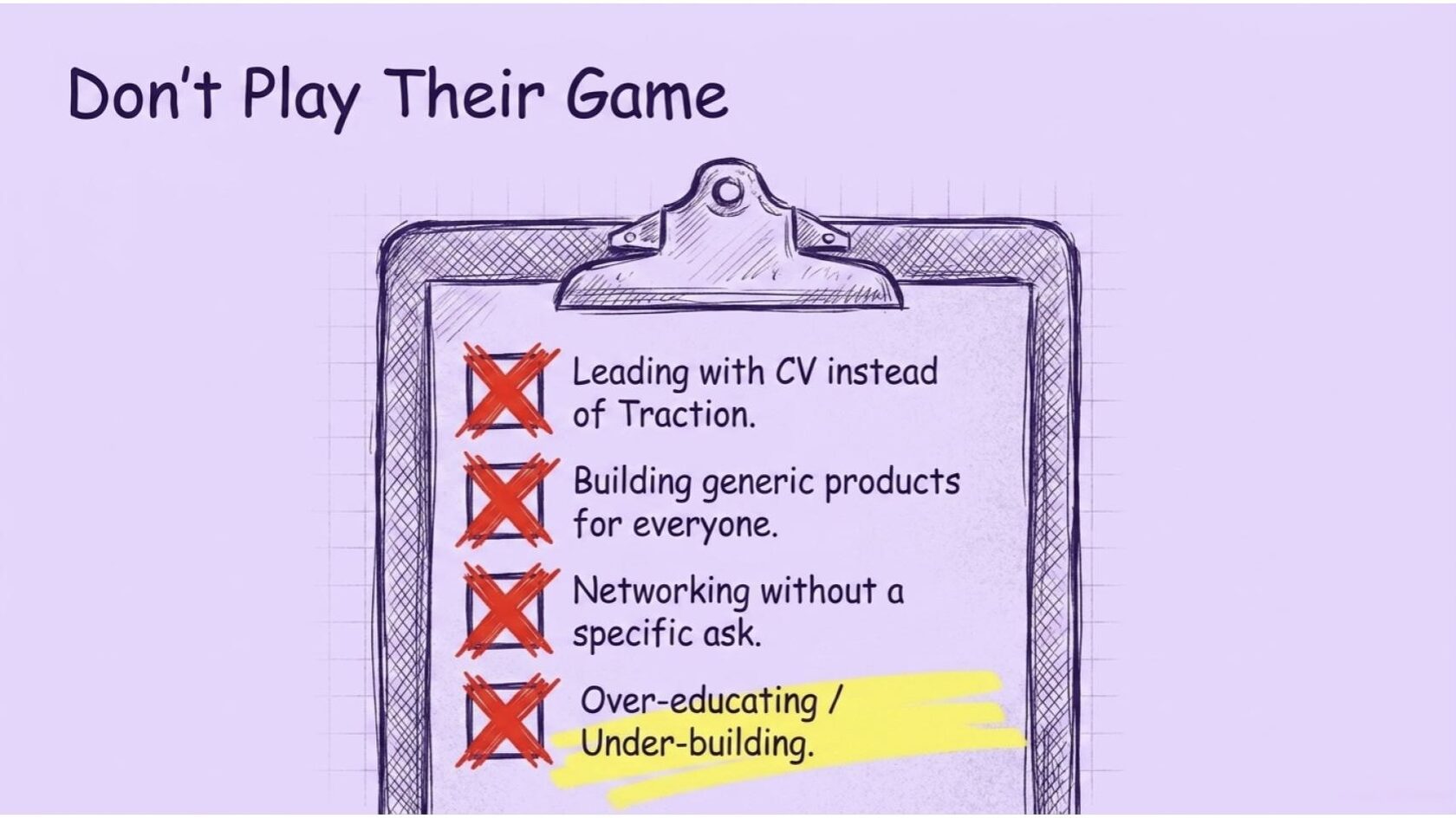
I have made most of these. You do not have to.
Mistake 1: Leading with your CV instead of your traction. Investors fund what you have done, not where you studied. If you open a pitch with your educational background, you are playing the credential game on a field where you probably do not have the strongest hand. Lead with the product, the customer, the number.
Mistake 2: Building a generic product to appeal to everyone. The "well-rounded" trap applies to products as much as to founder profiles. Building something that serves everyone weakly is worse than building something that serves one specific customer exceptionally well. The spiked product for a specific customer is a sharper pitch than a platform for the general market.
Mistake 3: Waiting for permission to be taken seriously. This particularly affects female founders. Research shows that female founders are asked prevention-focused questions by investors over twice as often as male founders, forced to defend and justify rather than pitch and inspire. The antidote is to build so much undeniable evidence that the defensive posture has no opening before you walk into the room. Revenue, retention, and specific testimonials answer prevention questions before they are asked.
Mistake 4: Networking without a specific ask. Going to startup events to "meet people" produces low returns unless you know exactly what introduction or knowledge you need from that specific room. Every networking interaction should have a defined target: one potential customer, one technical advisor, one answer to a regulatory question. The alumni pipeline provides that directional focus automatically. You create it manually.
Mistake 5: Over-educating, under-building. This is the curse of founders with strong academic profiles, myself included. Another course, another certification, another workshop. Building is irreplaceable. A working product with three real users teaches you more about your market than any program on product-market fit.
Mistake 6: Ignoring the alternative capital stack. Traditional VC is not the only available capital in Europe, and it is the capital most hostile to female founders without elite pedigrees. Europe's VC ecosystem generated over €76 billion in startup funding in 2025, yet female-led companies captured just 2.8% of that. EU grant programs, gender-lens funds, angel networks with female decision-makers, and revenue-based financing providers all evaluate your business on its merits rather than on pattern-matching against a credential template.
The Accelerator as the Non-Pedigree Network Substitute
One of the most significant structural shifts in European entrepreneurship is that accelerator programs are becoming functional substitutes for the alumni network advantages that Ivy League diplomas provide.
Y Combinator now appears in the education sections of founder LinkedIn profiles alongside university degrees, because investors have learned to read accelerator acceptance as a comparable credibility signal. A YC stamp communicates that this venture has been evaluated by a rigorous process, the team has been stress-tested, and a credible institution has decided to invest its brand in this founder. That is structurally identical to what an Ivy League diploma communicates to a pattern-matching investor.
European equivalents, Antler, Entrepreneur First, Seedcamp, Station F, and the EIC Accelerator, are developing similar credibility transfer functions. Getting accepted to a credible accelerator is, in 2026, one of the most efficient ways to compensate for the network infrastructure deficit that non-pedigree founders face. It does not fully close the gap. But it closes it faster than almost anything else short of revenue.
The Ivy Brothers Lesson Applied Directly to Startup Building
Here is where the circle closes: the methodology that Ivy Brothers uses to get students into Harvard, Penn, and Brown is a startup methodology running in parallel with its admissions application.
Their students launch apps, non-profits, neural networks, and student consulting agencies. They build real projects in domains they care about, before they apply. They accumulate evidence that is independently verifiable. They seek recognition from people who carry institutional credibility. And then they use that evidence to get into rooms that would otherwise be closed to them.
The admissions insight is that building something real, from nothing, in a domain you understand deeply, is a stronger signal of future potential than any test score or grade. The experienced startup investor applies identical logic: the founder who built something real is a more credible bet than the founder whose main asset is a famous degree.
What Ivy Brothers teaches students for the purpose of college admissions is, in practice, startup training with a slightly different finish line. The willingness to build without guaranteed outcomes, the discipline to seek external validation rather than relying on institutional approval, the practice of going deep in a specific domain rather than collecting shallow credentials: these are not just admissions strategies. They are the character traits that determine whether a founder survives the first two years of building a company.
If you are a student reading this, build something now. If you are already a founder, that advice is even more urgent.
A Note on Five Degrees and What They Actually Signal
Since my own background makes this relevant, let me be direct about what five higher education degrees from five European universities actually communicate to an investor or co-founder.
They signal intellectual persistence. Comfort with ambiguity and new environments. A willingness to start over in unfamiliar territory. For cross-border B2B business development, they signal cultural and linguistic range. For a company like Fe/male Switch, which builds its educational methodology on cognitive science, developmental psychology, and game theory, they signal that the founder studied the relevant disciplines, not just read about them in popular books.
What they do not signal is the ability to ship a product, manage a team under pressure, or build a customer relationship. Those capabilities are demonstrated by what you have built, not by what you studied. Research confirms that technical education and doctoral-level business education have the strongest positive effects on securing startup equity investment, while general postgraduate education has no significant effect on funding outcomes. Investors who pay attention look for domain-specific evidence. Not educational volume.
My degrees set the context for my spikes. They were never the spike itself.
The Specific Opportunity Right Now for Female Founders in Europe
There is a structural shift underway in European venture capital that has not yet received the attention it deserves among founders building today.
Gender-lens funds are growing. European VC firms with women as decision-makers increased to 13% at smaller firms in 2025, up from 8.3% the year before. These funds evaluate founders differently than traditional pattern-matching VCs: they are not checking whether you attended the right school. They are asking whether you solve a real problem and whether you are the right person to solve it. For a spiked founder with deep expertise and documented traction, that evaluation is favorable territory.
EU grant programs represent another parallel capital track that is credential-agnostic by design. Women TechEU offers €75,000 in equity-free grants to women-led deep tech startups. The EIC Accelerator provides up to €2.5 million for scalable ventures with strong problem-solution evidence. These programs evaluate the quality of your solution and the strength of your team, not the prestige of your university.
The founders building now, documenting their expertise publicly, and accumulating traction before approaching external capital are positioned to benefit from this structural shift as it accelerates. The founders waiting until their credentials feel sufficient will find the window moves without them.
FAQ: The Real Questions About Pedigree, Startups, and Getting Funded in 2026
Does having an Ivy League degree actually help you raise startup funding in Europe?
Yes, and the mechanism is worth understanding precisely. The degree itself is less important than the network infrastructure it provides: warm introduction pipelines to investors, alumni-exclusive accelerators like the Harvard Alumni Entrepreneurs program that connect founders directly to 1,000-plus investors, and angel networks that co-invest alongside major VC firms. These structural advantages lower the friction of early fundraising in ways that are genuinely difficult to replicate from scratch. That said, the advantage is strongest in US-centric investment environments and weakens considerably in the more distributed European VC ecosystem. A founder with real revenue and no famous degree competes well against a founder with a famous degree and no traction in most European investment conversations. The degree opens the room faster. What happens in the room is still determined by your product and your clarity.
What is a "spiked" founder profile and why does it matter more than being well-rounded?
A spiked profile describes a founder who has gone exceptionally deep in one domain rather than accumulating shallow experience across many. The term comes from college admissions consulting, where advisors discovered that admissions committees find one extraordinary area of focus far more compelling than a list of generic activities. The same principle applies in fundraising. Investors look for evidence that this specific founder has an unfair advantage in this specific market: a level of domain understanding that creates an insight others miss, and a track record of building that proves the insight can be executed. A well-rounded founder with competent but average knowledge across multiple domains is a harder bet to justify than a founder who knows one problem space at a depth most people never reach.
How important is founder-market fit compared to school pedigree?
Founder-market fit is more predictive of startup success than school pedigree for investors who have moved beyond pattern-matching to evidence-based evaluation. A founder who spent years inside the problem they are now solving, who understands the customer's language, pain points, and buying behavior from the inside, is a more credible bet than a founder with elite credentials entering an unfamiliar market. Pedigree matters most when investors are using credential shortcuts to filter deal flow quickly. As AI tools democratize market analysis and due diligence, those shortcuts become less reliable and less defensible. The founders who benefit most from a pedigree advantage are the ones who also have deep founder-market fit. The pedigree gets them the meeting. The fit closes the round.
What do early customers actually care about when evaluating a new startup?
Early customers care about exactly one thing: whether the product solves a real problem for them at a price they are willing to pay. Your university does not enter that conversation. What does enter it is your credibility as an expert in their domain, your ability to speak their language and understand their constraints, and the evidence that your solution has worked for someone like them before. The fastest path to early customers is to come from within the industry you are targeting, to have pre-existing credibility in the problem space, and to reach your first customers through relationships built on domain expertise rather than through cold outbound.
How can female founders in Europe compete when VCs are structurally biased against them?
The short answer is to generate revenue before you seek external equity investment, because revenue neutralizes the most common forms of bias. An investor who questions your experience or network looks weak when you show them 12 months of consistent monthly revenue growth. The longer answer involves choosing the right investors: gender-lens funds, accelerators with gender-conscious evaluation criteria, angel networks with female decision-makers, and EU grant programs that apply published, objective criteria. European female founders receive around 2.8% of total VC funding despite founding 20 to 30% of new startups across Europe, so the alternative capital stack is not a consolation prize. It is a strategic choice that often leads to faster, less dilutive, and less biased capital.
Is bootstrapping actually viable without VC money for European startups?
Yes, and for many founder profiles it is not just viable but strategically superior. Bootstrapping forces you to find paying customers early, which validates your concept faster than any investor feedback cycle. It preserves your equity, your decision-making authority, and your timeline. The error most bootstrapped founders make is under-pricing, which generates revenue that feels real but does not produce enough margin to reinvest in growth. Charge more than feels comfortable, from the very first customer. The founders most attractive to investors at Series A are often the ones who bootstrapped to a meaningful revenue number first, because they have already answered the question investors care most about: will people pay for this, and will they keep paying?
How do you build co-founder trust without a shared university background?
University co-founder relationships work because of shared context and repeated low-stakes interaction over time. Both are replicable without a shared school. Build in public so potential co-founders can evaluate your thinking and work ethic before you meet formally. Contribute to open-source projects in your domain, where your collaboration style and technical judgment are directly observable. Join accelerators and structured programs that create deliberate collaborative environments. Work together on a small, low-stakes project before committing to equity splits. Trust is built through repeated evidence of reliability, not through a shared graduation ceremony.
What startup metrics matter most when you lack a pedigree network for fundraising?
Revenue is the most important metric, full stop. Next is retention: do your users or customers return? Third is customer acquisition cost relative to lifetime value. Fourth is the quality and specificity of your problem-solution story: how precisely can you describe who has the problem, what it costs them, and why your solution works better than alternatives. Fifth is the co-founder relationship story, because investors bet on teams and want to understand the trust structure. These metrics are equally available to every founder regardless of educational background. Building them is the work.
How does AI change the relationship between credentials and startup success in 2026?
AI tools are democratizing access to expertise that previously required either expensive advisors or elite educational networks. A founder in Warsaw or Bucharest can now conduct the same quality of market analysis, customer research synthesis, and competitive landscape mapping that used to require a Wharton MBA program or YC cohort access. This shifts the advantage further toward founders who combine genuine domain knowledge with the ability to use these tools effectively. The pedigree gap narrows as the knowledge-access gap narrows. What remains stubbornly dependent on human infrastructure is the trust that flows through warm introductions and alumni relationships. That gap is narrowing, but more slowly.
What is the single most useful thing a bootstrapping founder without a prestigious degree can do right now?
Build something specific that a real customer pays for, and document the process publicly. Not a business plan. Not a deck. A working product or service with at least one verified paying customer, followed by honest written documentation of what you built, who uses it, what you charged, what you learned, and what you would do differently. This public record functions as your credential. It is discoverable by investors, co-founders, and customers before they ever meet you. It establishes a timeline of domain credibility that no one can take away and that compounds over time. Every week you spend building and documenting instead of studying credentials is a week of evidence accumulating in your favor.
Where to Go From Here
I did not go to Columbia. I built five degrees across Europe instead, and then I built two companies on top of them. The Columbia network would have opened some doors earlier. The path I took built a different kind of foundation: one where every investor relationship, every customer, and every co-founder found me because of what I had built and what I demonstrably understood, not because we shared a graduation year.
The conclusion is not that pedigree does not matter. It does, in specific and structural ways that are worth understanding clearly and honestly. The conclusion is that the advantages pedigree provides are each individually replicable, through domain depth, public documentation, traction, accelerator acceptance, and the patient accumulation of trust signals that compound over time.
Build your spike. Make it specific. Make it verifiable. Get your first paying customer before you get your next degree. And stop waiting for institutional permission to be taken seriously.
About the Author
Violetta Bonenkamp, also known as MeanCEO, is the founder of CADChain, a blockchain-based intellectual property protection platform for engineering CAD files, and Fe/male Switch, a women-first startup game and educational platform. She holds five higher education degrees from five European universities and was named one of the Top 100 Women in Europe by EU Startups in 2022. She writes about bootstrapping, deep tech, and female entrepreneurship at mean.ceo.

