
TL;DR: what to do with an AI-written grievance
An AI-written grievance arrives long, polished and full of legal language, and a Dentons report published on 27 October 2026 says AI-assisted drafting now touches most grievances, complaints and data requests at the companies it interviewed. Nothing in Irish or UK law makes a grievance invalid because AI helped write it. Treat it as a normal grievance: acknowledge it, meet early and ask for the main concerns in the employee's own words, agree a written list of issues, check the facts, decide in writing and offer an appeal.
Here is what the Dentons report found about AI-generated legal correspondence, with the full story and the rules for complaints and GDPR requests on Fe/male Switch. This guide covers one slice of it: the employee grievance, a formal complaint an employee raises about work, written with ChatGPT, Gemini or Copilot. It is for founders with a first employee or a team of five, in Ireland, the UK and the rest of Europe, who have no HR department and no in-house lawyer.
Why are AI-written grievances landing on small employers now?
Dentons Ireland interviewed in-house legal leaders at companies including eir, Flipdish, Mastercard, Uniphar and Wayflyer for its report From AI Adoption to AI Advantage. RTÉ summed up the finding: employee grievances, customer complaints and GDPR requests are "now routinely drafted using AI tools".
Many businesses will keep receiving "employee complaints and grievances generated, entirely or in part, by AI, with those complaints extremely lengthy and framed in very legally sophisticated language." Máire Neary, VP of People and Legal, Flipdish, in the Dentons report
Neary adds that HR will need "an even more legally informed perspective". A large company has HR and legal teams to share the load. A small business has the founder, a laptop and a Friday afternoon, and the same five-page letter citing sections of employment acts.
The UK's workplace adviser Acas has seen the trend too. In its 2026 consultation on a new Code of Practice, Acas reports concerns about "unnecessarily long and complex written grievances" that delay answers and raise tensions, and it asked for views on AI in disciplinary and grievance processes. Acas expects the new code to take effect in 2027; the 2015 code applies until then.
Dentons partner David Kirton puts the employee's side plainly: a long, legal-sounding letter feels encouraging to write, yet in most cases it won't help the employee advance their case. Your job is to find the real complaint inside it.
Is an AI-written grievance still a valid grievance?
Yes. No Irish or UK law treats a grievance as invalid because AI helped write it, and neither Ireland's code nor the Acas Code says anything about how a grievance is drafted. The Acas Code asks that it is in writing and sets out the nature of the grievance.
Ireland's Workplace Relations Commission (WRC) set the tone for its own cases in its guidance on using AI tools for WRC submissions (version 2, 26 May 2026): "The WRC will treat any submission as yours, even if you used AI to help prepare it." Parties can be asked to explain or clarify what they submitted, and invented or unchecked material gets little or no weight.
The WRC guidance quotes the adjudication officer in Oliveira v Ryanair, who was not concerned with whether AI was used, only with whether the submissions were relevant and accurate. According to law firm Arthur Cox, the complainant there admitted using AI, the officer found misquoted, irrelevant or non-existent legal citations, and the complaint was dismissed on its merits. UK firm Lewis Silkin sums it up in one line: "An AI-generated grievance is still a grievance."
What do Irish and UK grievance rules require from a small employer?
Two codes set the standard. In Ireland it is the Code of Practice on Grievance and Disciplinary Procedures (S.I. No. 146 of 2000). In Great Britain it is the Acas Code of Practice on disciplinary and grievance procedures from 2015. Neither one is a law you break by itself, yet courts, the WRC and employment tribunals take them into account, so a five-person company is judged against them like a bank.
Sources: S.I. 146/2000 (Irish Statute Book), Industrial Relations Act 1990 s.42, Acas Code 2015, legislation.gov.uk.
One Irish detail trips founders up. The Terms of Employment (Information) Act 1994 lists what goes into the day-5 and one-month written statements, and grievance procedures are not on that list. The code still says to hand the procedure to every employee at the start, so do it with the contract. For the wider set of rules, see our employment law guide for first-time employers.
How do you handle an AI-written grievance, step by step?
Run the same fair process you would run for a handwritten note, with one extra move at the start: get the story in the employee's own words. Lewis Silkin and Kingsley Napley, two UK employment law firms, both put that first meeting at the centre of their advice.
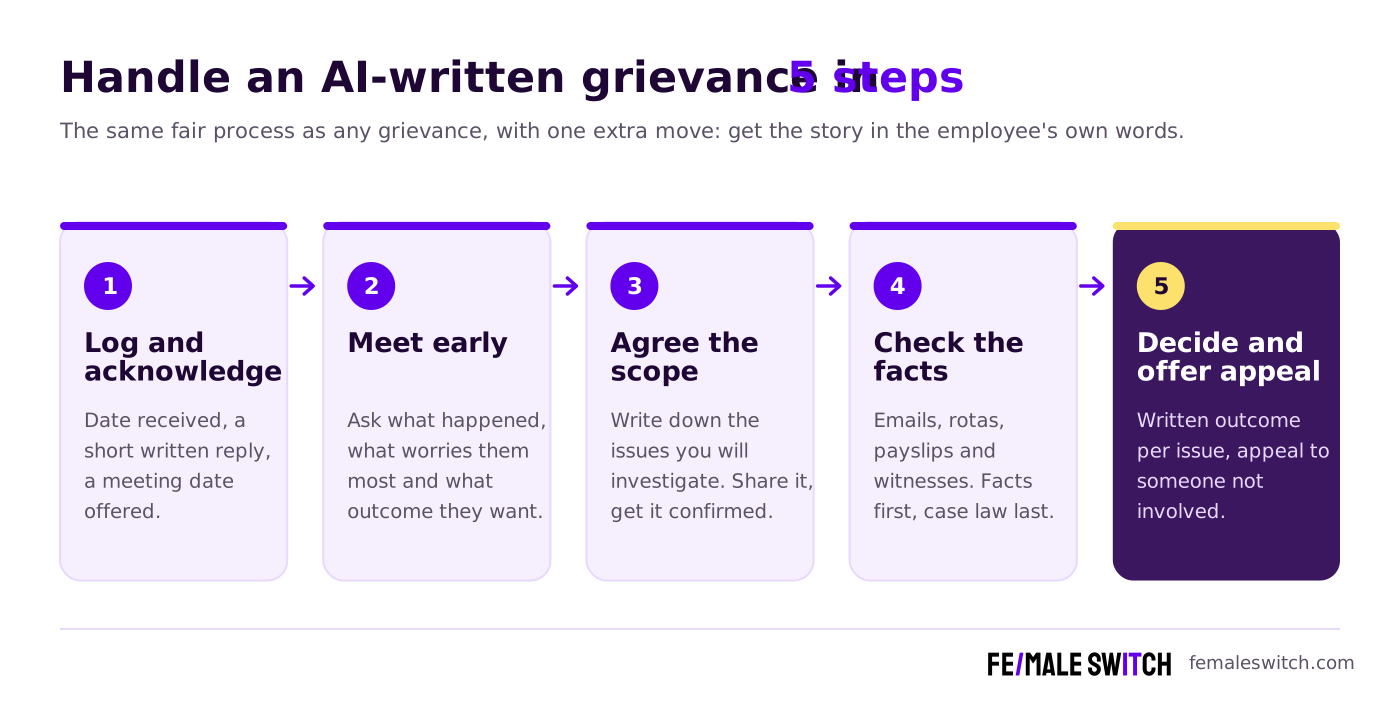
- Log it and acknowledge it. Note the date received in a simple register. Reply in writing within two working days (our benchmark, not a legal deadline): thank them, confirm you are treating it as a formal grievance and offer a meeting date. Mention the right to bring a colleague or a trade union representative.
- Meet early and listen. Ask three questions and write down the answers: what happened, what worries you most, and what outcome do you want? Kingsley Napley recommends exactly this scoping use of the first meeting. Five pages tend to shrink to two or three real issues here.
- Agree the scope in writing. Send a short summary: "We will look into A, B and C." Ask the employee to confirm it or correct it. Irish firm Arthur Cox advises asking complainants to clarify and to confirm the factual accuracy of their complaint.
- Check the facts, then the law. Pull the emails, rotas, payslips and messages, and talk to witnesses. Open any statute or case the letter cites before you rely on it, since AI tools invent citations. Lewis Silkin's advice: focus on the facts and leave the case law references aside.
- Decide in writing and offer an appeal. One plain paragraph per agreed issue: what you found, what you will do, and why. Name who hears an appeal: someone not involved so far, such as a co-founder, an outside HR consultant or a mediator.
Keep the employee's own concerns at the centre. A grievance about bullying, discrimination or harassment goes to a lawyer before you reply, and our guide to the steps founders take after workplace harassment covers the first days.
What should you avoid when a grievance reads like ChatGPT wrote it?
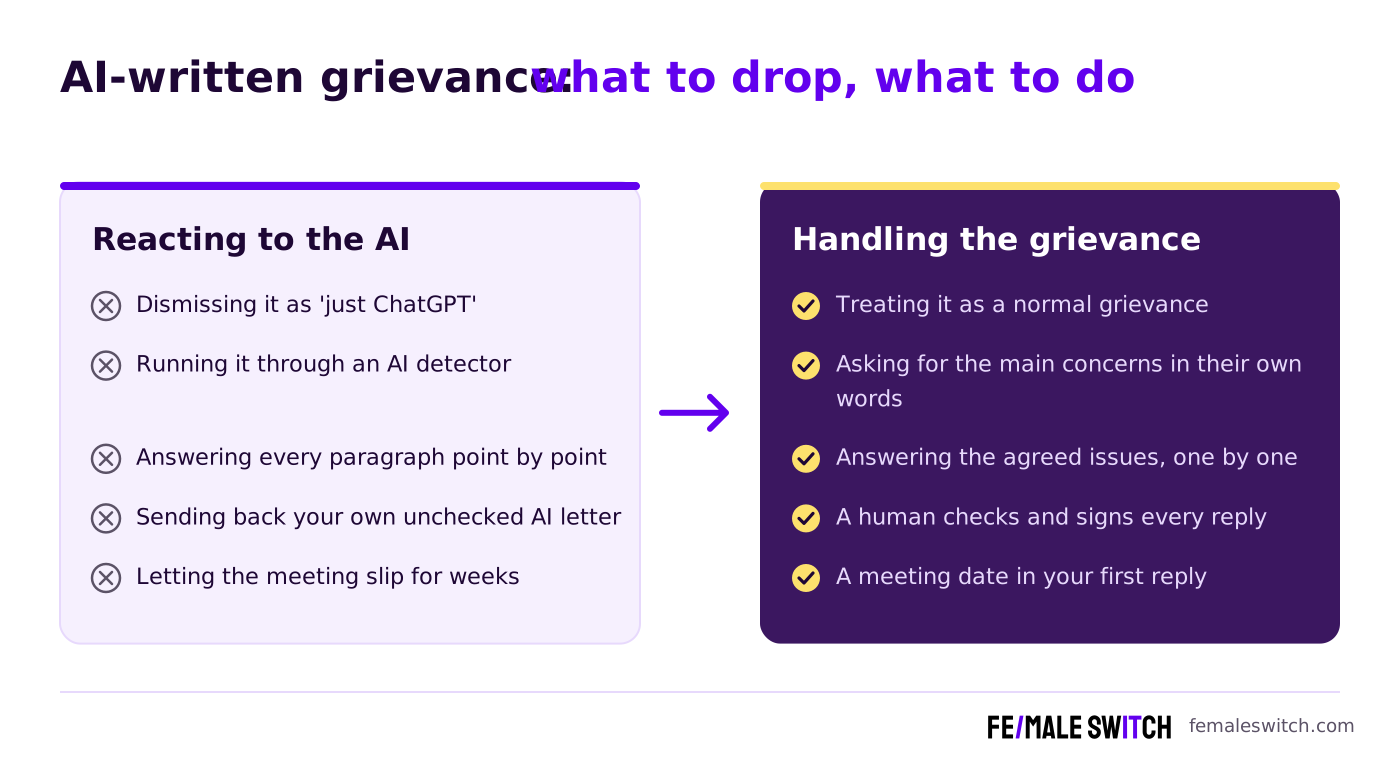
- Dismissing it as "just AI". The WRC treats AI-assisted submissions as the person's own, and Kingsley Napley tells employers to focus on the substance of the complaint.
- AI detectors. Lewis Silkin calls current tools unreliable, and arguing about who wrote the letter pulls you away from what it says.
- A point-by-point essay. Answer the agreed issues. A 40-paragraph reply invites a 60-paragraph response, and eir's general counsel told Dentons the real cost lies in working out, line by line, what is relevant.
- Your own unchecked AI reply. Kingsley Napley warns against HR sending AI-drafted outcomes. Use AI to sort and summarise if you like, then a human checks every fact and signs.
- Slow replies. The Acas Code asks for the meeting, the decision and the appeal "without unreasonable delay". Silence turns a fixable complaint into a tribunal claim.
Grievances grow out of everyday friction. Regular one-to-ones from our guide to performance management for small teams and the habits in conflict resolution for startup teams catch most issues before anyone opens a chatbot.
What should your written grievance procedure say before your first hire?
Write the procedure before you need it, in one page of plain language, and hand it over with the contract. Then a long AI-written grievance meets a clear, fair process that everyone saw on day one.
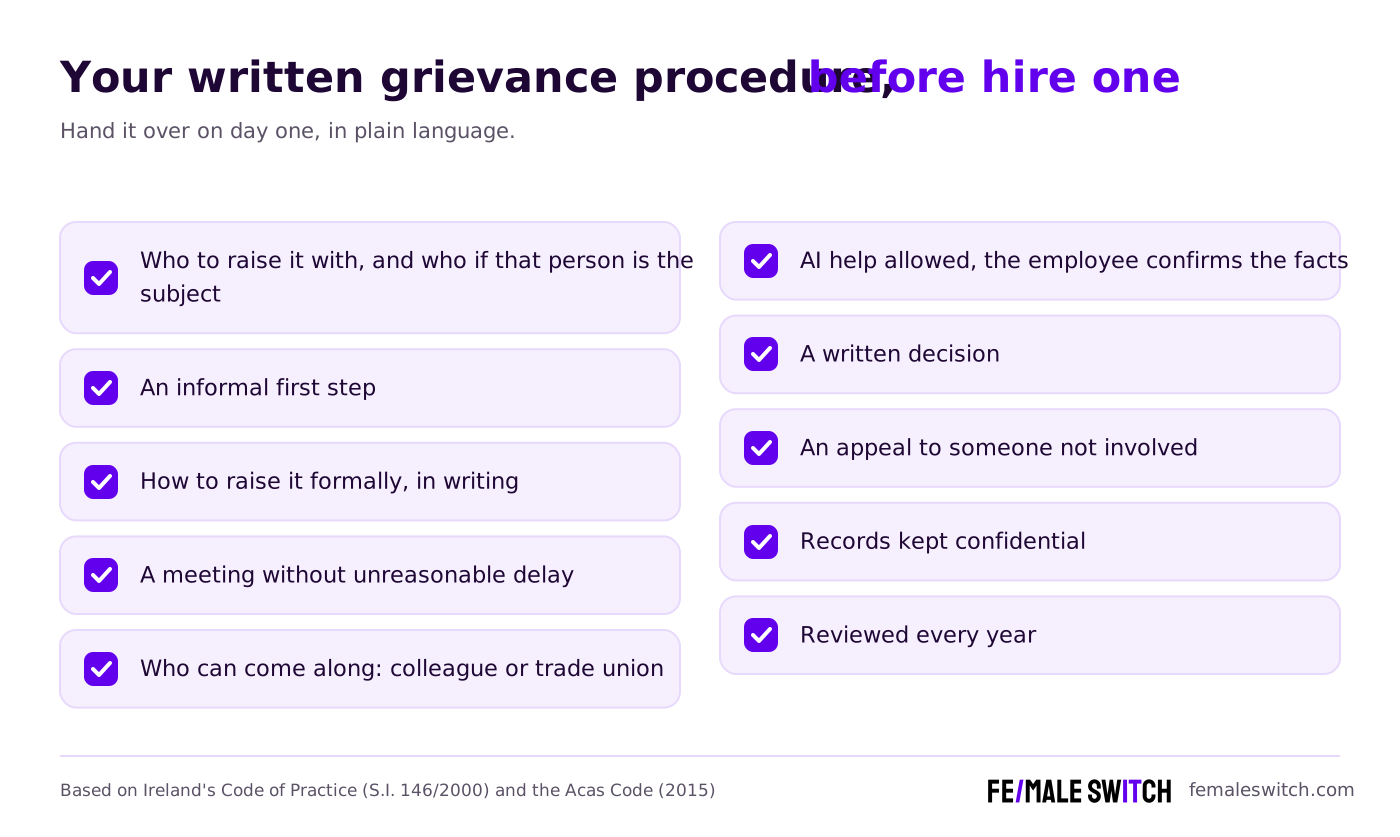
Add one line for the AI era, as Kingsley Napley suggests: employees are encouraged to raise concerns in their own words, AI help is allowed, and the employee confirms the facts are accurate. Lewis Silkin also flags a data risk: staff pasting colleagues' personal data or company documents into public AI tools. Cover that in your AI policy and your GDPR set-up for a European startup.
Hiring soon? Start with hiring your first employee as a female founder, the first-hire mistakes to avoid and the startup legal checklist for European founders. The Fe/male Switch Foundation guide to hiring your first employee adds the costs and paperwork.
Can you use AI on your side of the grievance?
Yes, with a human in charge. Dentons co-author Carlo Salizzo told RTÉ that companies use AI tools to help cope with a raft of AI-generated submissions. A small employer can do the same in a narrow way:
- Ask an AI tool to turn a long letter into a numbered list of claims, facts and requested outcomes, then check that list against the original yourself.
- Remove names and health details first, or use a business account whose terms keep your data out of training.
- Draft the outcome letter yourself or edit any AI draft line by line. You sign it, so every fact in it is yours.
Paid AI tools bill per use, and costs add up once a team leans on them; see why AI token costs keep rising and how to budget them on MeanCEO.
What does the AI-written grievance trend mean for you right now?
- This week: write or update your one-page grievance procedure, with the AI line, and send it to every employee.
- Before the next grievance: set up a register (date, employee, issue, deadline, owner, status) and a short acknowledgement template.
- Pick your appeal person now: a co-founder, an outside HR consultant or a mediator, so you are never judge of your own decision.
- Budget for advice: a few hours a year with an employment lawyer for grievances about discrimination, dismissal or pay.
- UK employers: watch for the new Acas Code in 2027. Irish employers: keep the WRC's AI guidance at hand if a dispute goes further.
If a grievance turns into a formal dispute, our guide to legal disputes and resolution for entrepreneurs explains mediation, the WRC and tribunals.
Build a company with the paperwork in place from day one
The Fe/male Switch startup game takes you from idea to first paying customers in weekly quests, with an AI co-founder that drafts, checks and plans with you. Start with our free business plan generator, then play the game.
👉 Start the game
- AI-Generated Legal Correspondence: What the Dentons Report Means for Small Businesses Facing AI-Written Complaints, GDPR Requests and Grievances (Fe/male Switch)
- AI Token Costs: Prices Per Token Fall, Yet Dentons Expects AI Bills to Rise 2 to 5 Times in Two Years. How Founders Budget Token Spend (MeanCEO)
FAQ: AI-written grievances
What is an AI-written grievance?
A formal complaint from an employee about work, drafted fully or partly with an AI tool such as ChatGPT, Gemini or Copilot. They tend to be long and full of legal language and citations.
Can I reject a grievance because the employee used AI?
No. Nothing in Irish or UK law makes a grievance invalid because AI helped write it. Treat it as a normal grievance and focus on what the employee is unhappy about.
Do I have to answer every point in an AI-written grievance?
Agree the issues with the employee first, ideally at an early meeting, then answer those issues in writing. Lewis Silkin advises against point-by-point responses.
How fast must I respond to a grievance in the UK?
The Acas Code asks for a formal meeting, a decision and an appeal "without unreasonable delay". It sets no fixed number of days, so set your own target, such as acknowledging within two working days.
Who can accompany an employee at a grievance meeting?
In the UK, a fellow worker, a trade union representative or a union official (Employment Relations Act 1999, s.10). Under Ireland's code, a colleague of the employee's choice or a registered trade union, not an outside body.
Is the Irish Code of Practice on grievances legally binding?
Not by itself. Under section 42 of the Industrial Relations Act 1990 it is admissible in evidence and taken into account when relevant, so following it protects you.
What happens if a UK employer ignores the Acas Code?
In relevant claims, an employment tribunal can raise the award by up to 25% for an employer's unreasonable failure to follow the Code (TULRCA 1992, s.207A).
Should I use an AI detector on a grievance?
No. Lewis Silkin calls current detectors unreliable, and the authorship question distracts from the substance. See our full guide to AI-generated legal correspondence for complaints and GDPR requests too.
About the Author
Violetta Bonenkamp, also known as MeanCEO, is an experienced startup founder with an impressive educational background including an MBA and four other higher education degrees. She has over 20 years of work experience across multiple countries, including 5 years as a solopreneur and serial entrepreneur. Throughout her startup experience she has applied for multiple startup grants at the EU level, in the Netherlands and Malta, and her startups received quite a few of those. She’s been living, studying and working in many countries around the globe and her extensive multicultural experience has influenced her immensely.

