

Picture this: a shopper’s cursor hovers over Buy, but a last-second question stalls the click. Email feels slow, phone support feels like a chore, and the sale slips away.
Add live-chat software and that doubt disappears in seconds. Answers arrive, confidence returns, and revenue stays on the table.
This guide helps founders and customer-experience leaders with big growth goals and lean teams understand what live chat is, why customers love it, and how to roll it out without blowing the budget.
By the end, you’ll know the key benefits, the rollout checklist, and the metrics that prove chat pays for itself.
What is live-chat software and how it works
Live-chat software is a real-time messaging tool that sits on your website or app. Customers click the chat bubble, ask a question, and receive a reply from a human or an AI assistant before they even think about opening a new tab.
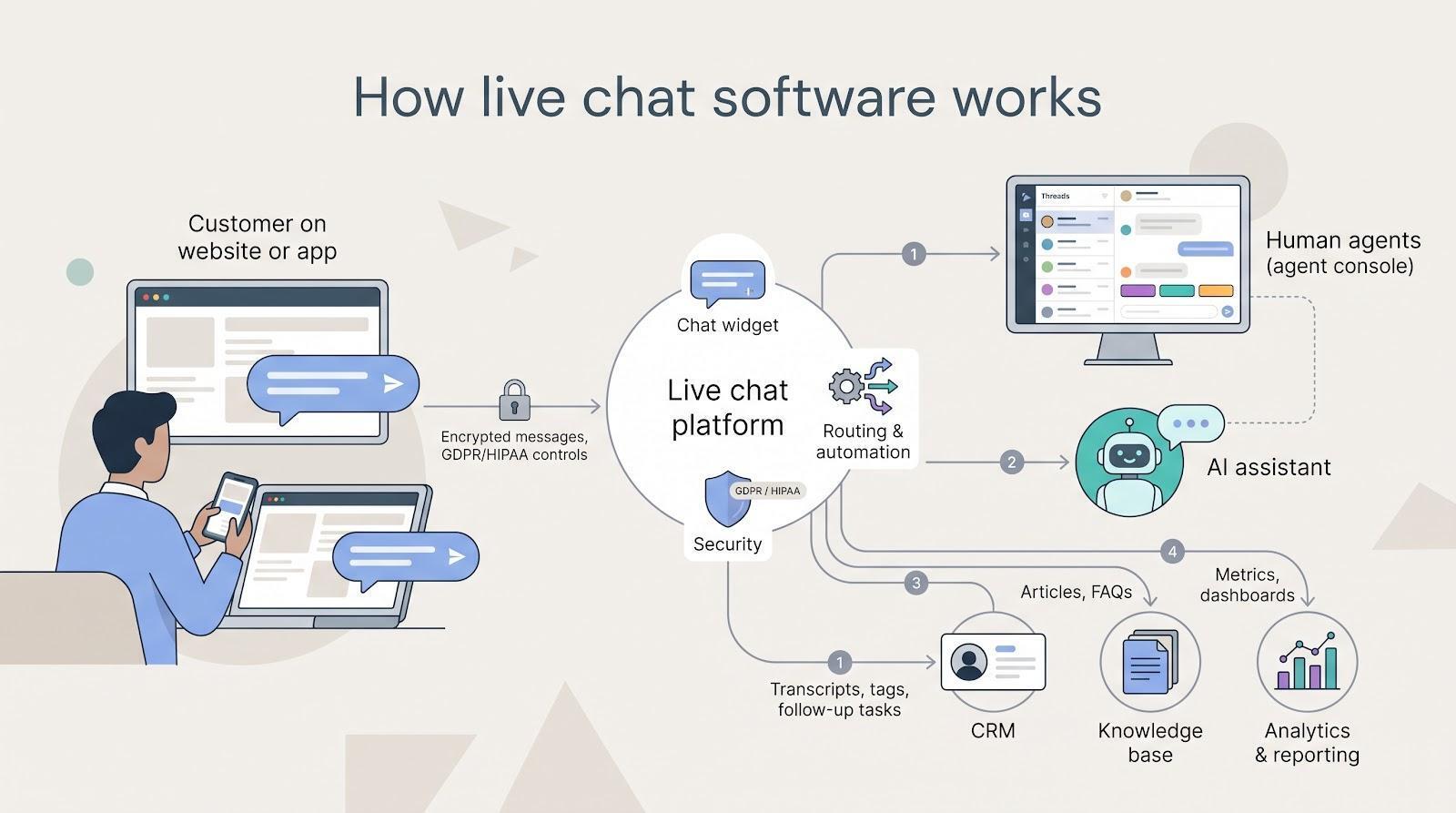
It is the instant-message cousin of email support. The exchange feels natural, quick, and two-sided. Customers keep browsing while they wait, and your team can juggle several chats at once instead of one phone call at a time.
Momentum is growing. In Salesforce’s 2024 State of Service study, 92 percent of support leaders said generative-AI chat already helps them deliver better service. Live chat acts as the front door for that AI, handing routine queries to bots and escalating the tricky ones to people.
Here is what happens behind the scenes:
- Chat widget. The customer-facing bubble in the corner, branded to match your site.
- Agent console. A dashboard where reps see incoming chats, visitor details, and quick-reply shortcuts.
- Routing and automation. Rules send chats to the right teammate or bot, so questions land in expert hands instantly.
- Integrations. Live chat connects to your CRM, knowledge base, and analytics stack, so context moves both ways.
When your team is offline, the widget switches to “leave a message” mode or lets an AI bot handle FAQs. Either way, customers feel heard at any hour.
Security matters. Reputable platforms encrypt every message, offer data-retention controls, and comply with regulations such as GDPR or HIPAA. You can chat confidently even when conversations touch sensitive info.
In short, live chat is not just a pop-up; it is a fully integrated, secure workflow that keeps help one click away and scales with your startup.
Eight business-critical benefits of live chat
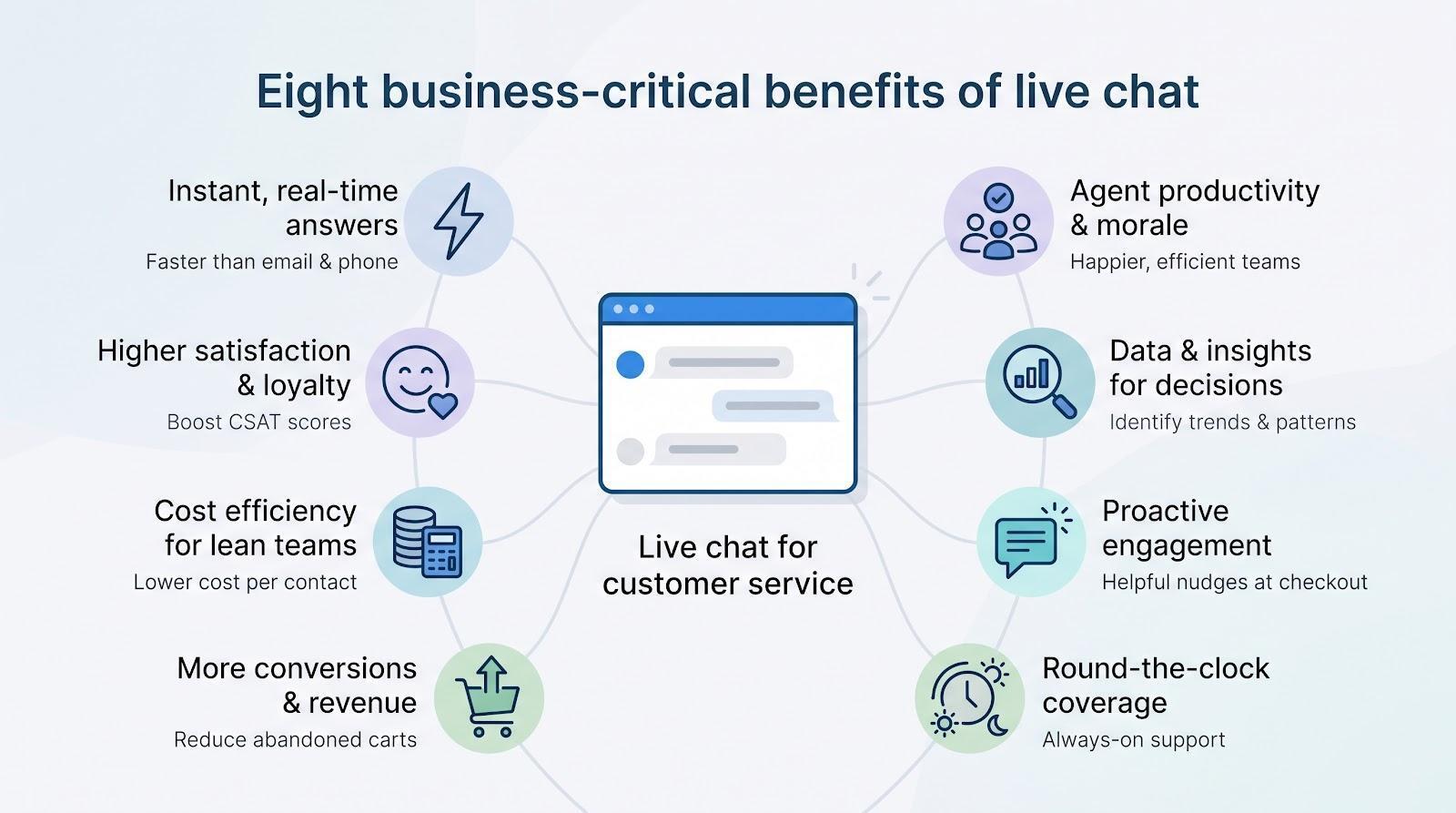
1. Instant, real-time answers
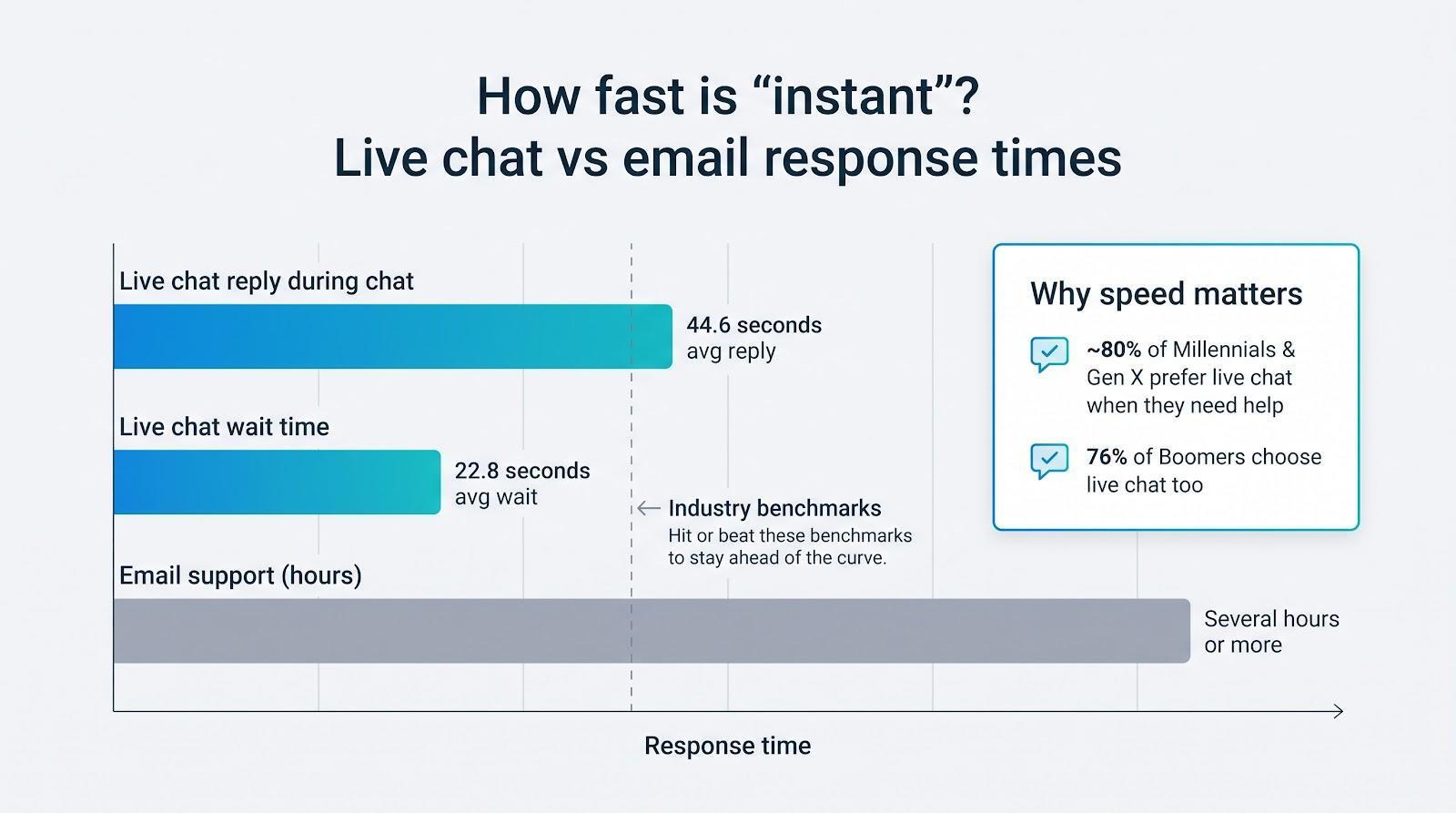
Speed shapes a customer’s first impression of your support culture. When someone clicks the chat window, they expect a reply right away, not “within 24 hours.” A McKinsey survey found that about 80 percent of Millennials and Gen X, along with 76 percent of Boomers, turn to live chat when they need help.
Meeting that standard pays off. A forty-five-second wait feels quick compared with the hours many teams still take to answer email. Comm100’s 2026 AI Live Chat Benchmark Report, based on more than 220 million chats across 18 industries, pegs the average wait at 22.8 seconds and the in-conversation response at 44.6 seconds. Hitting or beating those numbers means you’re already ahead of the industry curve. The visitor stays in the buying mood, solves the blocker, and moves forward instead of switching to a competitor.
Real-time exchanges also defuse tension before it grows. If a login glitch or shipping worry is resolved in one short chat, there is no angry tweet, no refund request, and no churn. Fast answers lay the groundwork for every other benefit that follows.
2. Higher satisfaction and long-term loyalty
Speed earns attention, but emotional tone keeps it. Chat feels friendly, conversational, and personal. Agents see a visitor’s name, location, and browsing path as soon as the chat starts, so replies land on target without making the customer repeat details.
That context pays off. Industry benchmarks show live-chat satisfaction often tops eighty-five percent, beating email and social media by a solid margin. Customers notice when you respect their time and talk to them like people, not ticket numbers.
In a Forrester analysis, shoppers who chatted before buying converted at a forty-percent rate and spent ten percent more per order. When people feel heard, they repay you with loyalty and word-of-mouth recommendations.
Quick, personal help also cools frustration before it grows. A smooth refund or an instant how-to tip can turn an upset user into your next advocate. Over time, those positive moments pile up and set you apart from competitors.
3. Cost efficiency for lean teams
Phone support tethers one agent to one caller, and the clock keeps running. Chat flips that ratio. A single rep can handle three, four, or even six conversations at once, because customers pause to read or copy-paste details, giving the agent time to help others.
Those parallel chats cut costs. Industry benchmarks put the average chat at less than half the cost of a phone call. Add an AI bot for routine questions and costs fall further, freeing human reps for work that needs nuance.
For startups, the numbers speak for themselves. Fewer hires, smaller training budgets, and shorter queues lower overhead today and create room to grow tomorrow. You serve more people with the team you have, and every saved minute goes straight to the bottom line.
4. More conversions and revenue
Live chat is more than a support safety net; it is a sales driver. When shoppers pause on the pricing page or hover over the checkout button, a gentle “Need a hand?” keeps them moving.
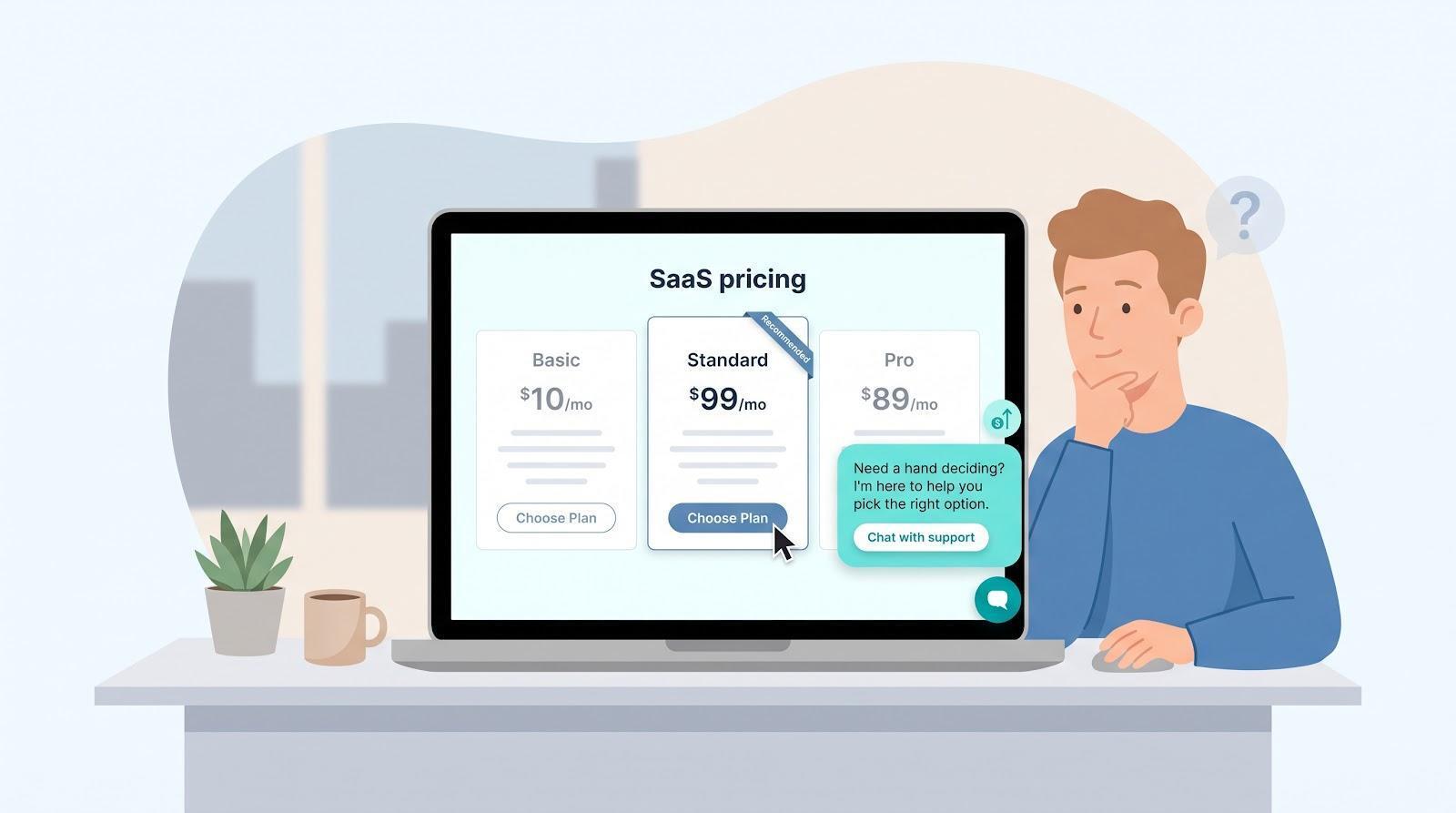
Forrester’s research shows that teams see up to a forty-percent jump in conversion rate after adding live chat. Real-time reassurance removes doubt, so buyers complete purchases instead of abandoning carts.
Chat also opens real upsell moments. An agent who notices a customer eyeing a premium package can suggest an add-on or share a timely promo code. The exchange feels helpful, not pushy, because it happens at the exact moment of need.
Those small nudges add up. Companies that use live chat report a 48 percent increase in revenue per chat hour, thanks to smoother support and in-chat upselling. That is revenue most teams never even see, until live chat captures it.
5. Round-the-clock coverage without round-the-clock staffing
Customers browse and troubleshoot at all hours. A lost-password panic at 3 a.m. feels as urgent as one at noon. If help is missing, frustration rises and loyalty slips.
Live chat fills that gap. After your human team signs off, an AI chatbot handles common questions, tracks orders, and gathers details for anything that needs morning follow-up. Customers feel acknowledged, not ignored.
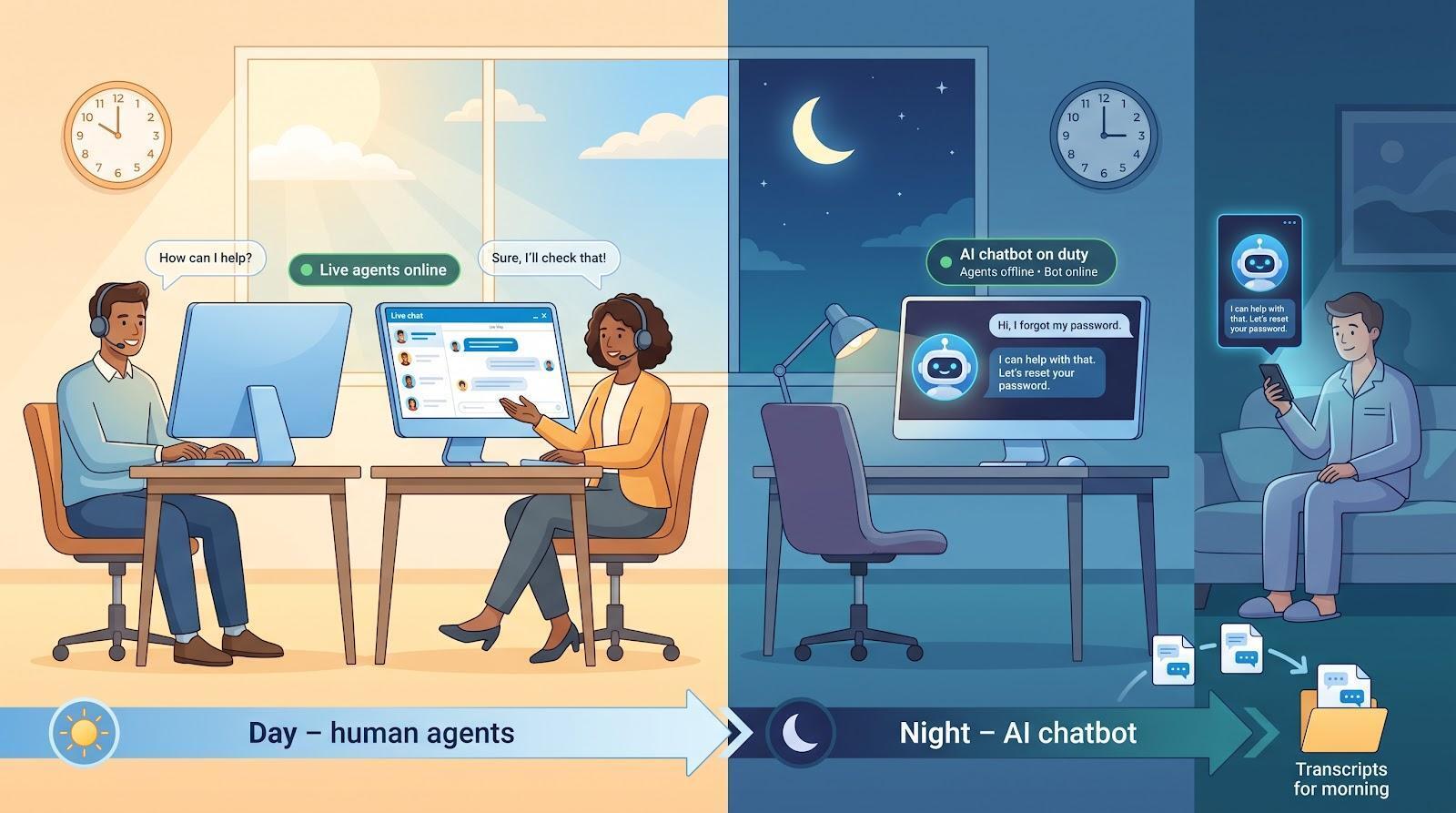
For lean startups, it is like hiring a night shift without adding payroll. You start the day with organized transcripts, clear next steps, and customers who never had to wait for daylight.
6. Proactive engagement that prevents drop-offs
Reactive service keeps customers from leaving angry. Proactive service stops confusion before it starts.
Modern live chat software lets you set granular triggers (time on page, cart value, or location) so a friendly nudge appears the moment behavior hints at trouble. When a shopper pauses on the checkout page or a new SaaS user stalls on step two of onboarding, a short greeting such as “Need a hand finishing up?” feels like helpful concierge service, not a pop-up ad.
Those timely nudges build trust and revenue. Industry surveys show visitors who are proactively invited to chat are more than six times as likely to buy as those who never engage. The message arrives when uncertainty peaks and removes friction that might otherwise send the visitor away.
Proactive chats also reveal hidden pain points. If ten people ask for help on the same screen each week, you have identified a UX tweak that lifts conversions for everyone else, no lab testing required.
Put simply, proactive engagement wins sales today and supplies feedback that improves the customer journey tomorrow.
7. Data and insights that sharpen every decision
Every chat transcript captures customer intent. Stack them together and you have a searchable trove of questions, objections, and “aha” moments straight from the source.
Smart platforms tag conversations by topic, sentiment, and outcome automatically. You spot patterns in minutes: shipping fees may confuse buyers, or one feature might trip up first-time users. Fix the root issue and watch tickets fall while conversions rise.
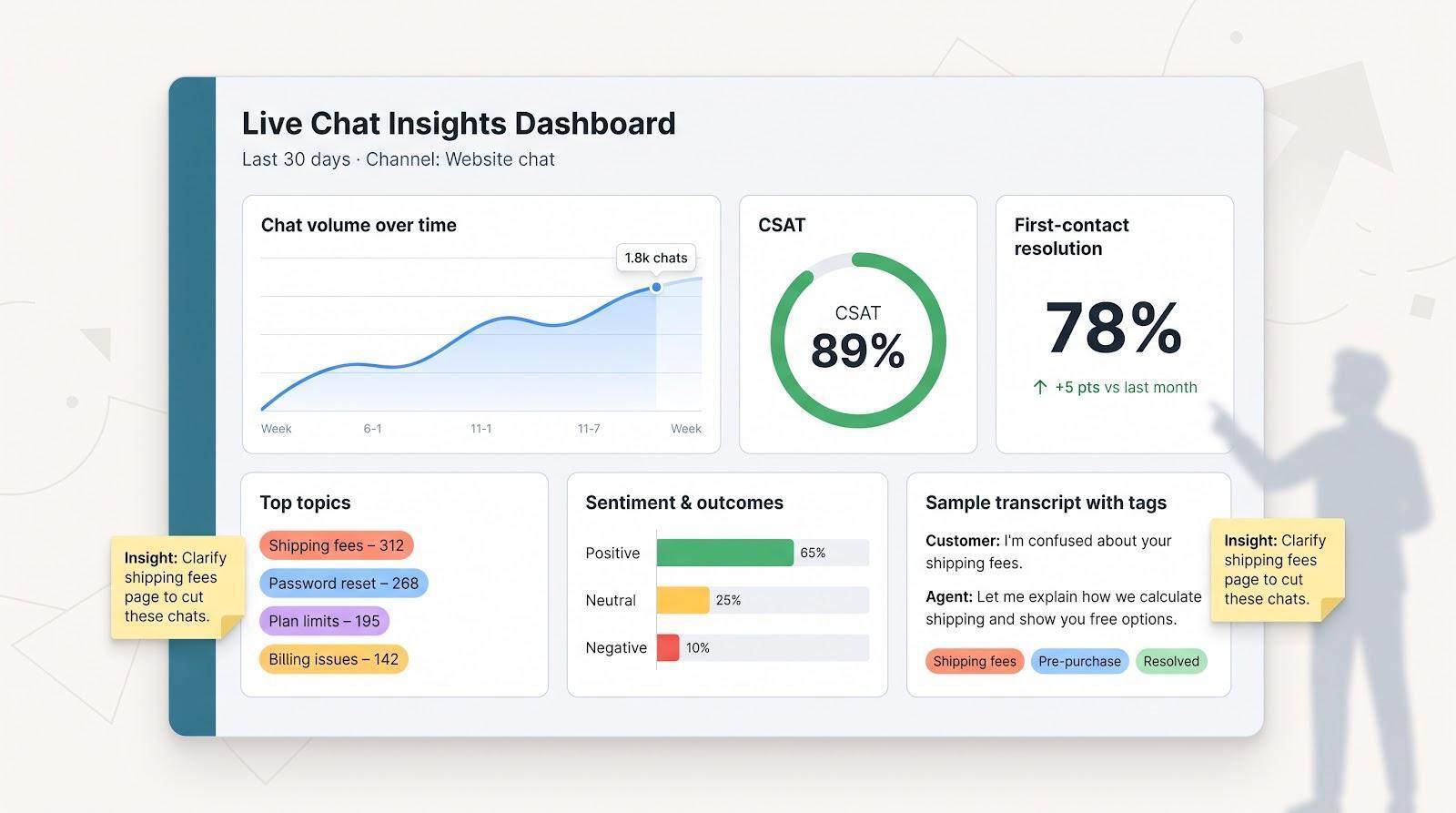
Post-chat surveys add hard proof. Response times, CSAT scores, and first-contact resolution metrics reveal which workflows hum and which need tuning. You replace gut feelings with numbers and steer your product roadmap with confidence.
Best of all, these insights cost nothing extra. You are already having the conversations, and live chat simply collects and organizes them so your next improvement is waiting in plain text.
8. Agent productivity and team morale
Great tools help great people shine. Live chat gives agents shortcuts such as canned replies, knowledge-base search, and AI that drafts answers in one click. Instead of typing the refund policy for the hundredth time, reps focus on the tricky edge cases that need human judgment.
Multitasking adds another lift. While one customer reads an article the agent shared, the same rep can greet two more visitors. Work feels brisk rather than frantic, and queues shrink without overtime.
That efficiency raises morale. Quick wins stack up, supervisors can coach from real-time dashboards, and repetitive work disappears. A happy support team stays put, lowering turnover costs and delivering friendlier service to every customer who taps the chat bubble.
Train your team for conversational excellence
Live chat feels like texting, but the stakes are higher. Agents must type quickly, stay friendly, and solve problems without jargon. A brief style guide helps: keep sentences tight, use the customer’s name, and end with a clear next step.
Role-play common scenarios before launch. Ask teammates to act as frustrated shoppers, testers with off-beat questions, and VIP clients who expect premium treatment. This rehearsal builds muscle memory, so the first real chats feel familiar instead of frantic.
Equip agents with canned snippets for routine answers, and encourage personal tweaks. A quick human reply beats a rigid script every time. When training clicks, your team sounds consistent yet genuine, and customers notice the difference in every keystroke.
Set clear hours and let chatbots cover the night shift
Customers value clear expectations. If live chat runs only from nine to five, say so in the widget greeting and switch to an offline form the moment the last agent logs out.
After hours, pass the queue to an AI chatbot. It can surface FAQs, track orders, and promise a human follow-up for complex cases. Visitors get instant acknowledgment instead of silence, and you gather every detail the morning crew needs to resolve issues quickly.
This hand-off turns a small team into a twenty-four-hour presence without adding payroll. It also keeps response-time metrics clean, because a bot that replies in two seconds beats an unanswered ping every time.
Integrate chat into your existing workflow
Live chat shines when it never makes a customer repeat themselves. That happens only when conversations flow into the tools your team already uses.
Connect chat to your CRM so every transcript, tag, and follow-up task lands in the same record as phone calls and emails. Link your knowledge base as well, letting agents drop a help-article link with one click instead of copying a URL from another tab.
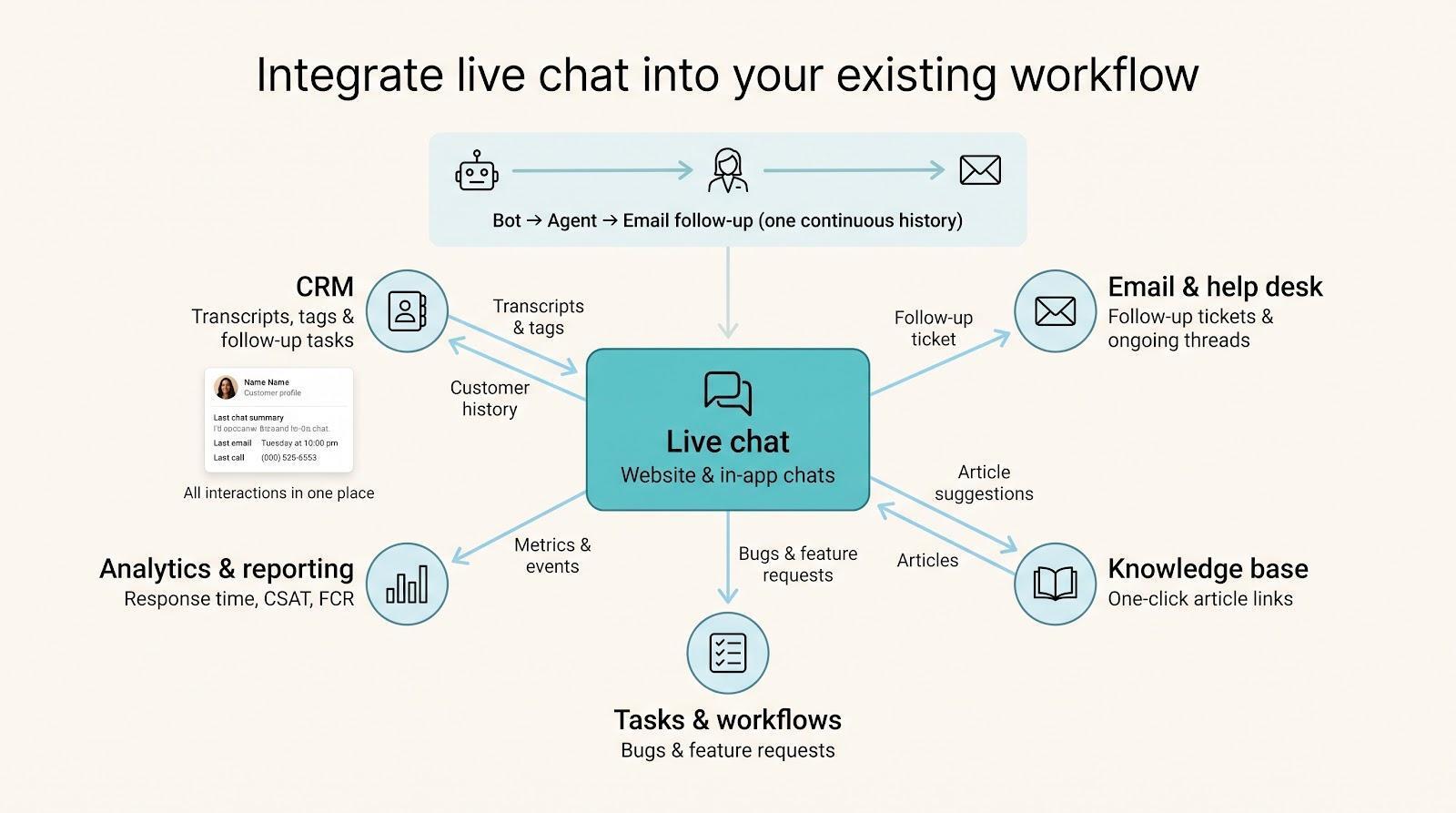
The payoff is twofold. Customers move from bot to human to email without losing context, and managers finally see one accurate history of each account. No more inbox hunts for missing details; everything lives in one place, ready for fast resolution and clear reporting.
Start small, learn fast, then scale
Launching chat on every page on day one sounds bold, but it often backfires. Volume spikes, agents scramble, and first impressions suffer.
Run a pilot on your highest-impact pages, such as checkout, pricing, or the help center. Track questions, response times, and customer satisfaction for two weeks. Use the data to refine greetings, tweak canned replies, and adjust staffing.
When the pilot runs smoothly, extend chat one section at a time. Each expansion is easier because the workflow is already tuned. By the time chat covers the whole site, the experience feels smooth for visitors and your team, and growth never outruns quality.
Monitor quality and gather feedback continuously
Launch day is only the first checkpoint. Keep a pulse on chat health by tracking three numbers: average response time, post-chat satisfaction, and first-contact resolution. If any metric slips, open the transcripts to learn why.
Add a one-click survey that appears as soon as a conversation ends. A simple “How did we do?” with a five-star scale and optional comment field captures quick, candid sentiment. Patterns surface fast: an agent who leans too hard on canned replies, an article that confuses, or a workflow that stalls.
Managers can also shadow chats in real time, stepping in when tone slips or questions grow complex. Timely coaching beats after-the-fact reviews.
Treat these insights like sprint retrospectives. Update macros, refresh the knowledge base, and celebrate quick wins with the team. Your agents see real impact, customers notice steady improvement, and quality becomes a habit, not a quarterly fire drill.
Keep bots helpful, not hurdles
Automation cuts costs only when it also saves customers time. A chatbot that repeats an unhelpful answer is worse than no bot.
Assign bots tasks they can complete every time: order status, password resets, and shipping rates. For everything else, provide a direct path to a person with a “Talk to an agent” button, a short form that moves the chat to the live queue, or a link to schedule a callback.
Review the bot flow each month. Scan transcripts for dead ends and add new answers when features launch. The aim is simple: bots handle routine work, people tackle the nuanced issues, and customers never feel stuck in a script.
Promote chat so customers actually see it
A hidden widget helps no one. Place the chat bubble in the lower right corner, eye level on both desktop and mobile, and brand it with a welcoming color contrast. Add a short greeting such as “Questions? We’re here to help” that appears after a brief delay, not instantly.
Announce chat in your onboarding emails and order-confirmation pages. Let shoppers know real humans are ready to answer sizing questions or troubleshooting steps in seconds. These reminders nudge visitors to click instead of searching elsewhere for answers.
Track widget engagement each week. If clicks stay low, adjust the prompt copy, tweak timing, or test proactive messages on high-drop-off pages. Aim for visibility without intrusion: present, helpful, and one tap away when a customer’s confidence wobbles.
Conclusion: turn chat into your competitive edge
Great support is no longer optional; it separates a one-time buyer from a lifelong customer.
Live chat closes that gap. It delivers speed customers feel, insights your team can use, and efficiency your budget welcomes. Pair smart automation with trained humans, roll out in measured steps, and track performance without pause. Do that and support shifts from a cost line to a growth engine.
So start a pilot, watch the first “Thank you!” messages arrive, and enjoy the calm control that comes from meeting people where they are, one chat bubble at a time.
FAQ on live chat software for customer service teams
What is live chat software in customer service?
Live chat software is a real-time messaging tool placed on a website or app that lets customers ask questions and get help instantly. It gives support teams a faster, more conversational alternative to email and a less demanding option than phone calls. For founders and customer service leaders, it can turn support from a cost center into a growth lever by reducing friction right when customers are ready to buy.
How does live chat software work behind the scenes?
A customer clicks the chat widget, starts a conversation, and the message is routed to either a live agent or an AI assistant based on your setup. On the company side, agents use a dashboard to manage chats, view customer context, and send fast replies using saved responses or knowledge base links. Integrations with CRM, analytics, and help desk tools make the whole process more efficient and scalable for ambitious teams.
Why is live chat better than email or phone support for many businesses?
Live chat is often faster than email and more convenient than phone calls because customers can keep browsing while waiting for a reply. Agents can also handle multiple conversations at once, which improves productivity without sacrificing service quality. For lean startups and growing companies, that mix of speed, convenience, and efficiency makes live chat one of the smartest support investments available.
What are the biggest benefits of live chat software?
The biggest benefits include faster response times, better customer satisfaction, lower support costs, and higher conversion rates. Live chat also helps businesses engage shoppers proactively, gather valuable feedback, and maintain support coverage after hours with AI assistance. In practical terms, it helps teams serve more people, solve issues faster, and unlock more revenue from existing traffic.
Can live chat software increase sales and conversions?
Yes, live chat can directly improve conversions by answering objections at the exact moment a customer hesitates. When shoppers get instant help on pricing, shipping, product fit, or checkout issues, they are far more likely to complete the purchase. For entrepreneurial teams focused on efficient growth, live chat is not just support infrastructure; it is a practical revenue tool.
Is live chat software affordable for startups and small teams?
Live chat is often more cost-effective than phone support because one agent can manage several chats at the same time. Many platforms also include automation and chatbot features that reduce repetitive work and help small teams operate like much larger ones. That means startups can deliver polished customer service without immediately expanding headcount or straining budgets.
How can AI and chatbots support live chat without hurting customer experience?
AI and chatbots work best when they handle simple, repeatable tasks like password resets, order tracking, and common FAQs. The key is to make escalation to a human quick and seamless whenever the issue becomes more nuanced or emotional. When used well, AI gives founders a way to scale service quality while preserving the human touch that builds trust.
What metrics should businesses track after launching live chat?
The most important metrics are average response time, customer satisfaction score, first-contact resolution, and conversion rate from chat interactions. These numbers show whether live chat is improving both service quality and business outcomes. For teams that like to grow by evidence rather than guesswork, these metrics make it easier to prove ROI and optimize operations over time.
How should a company roll out live chat software successfully?
The best approach is to start small by launching chat on high-impact pages like checkout, pricing, or support content. From there, teams should review transcripts, identify common questions, train agents, and refine automation before expanding site-wide. If you are also shaping the bigger picture of your venture, this pairs well with learning how to build a startup with AI, especially when support automation becomes part of your growth strategy.
Is live chat software secure for customer communication?
Most reputable live chat platforms include encryption, access controls, and data retention settings to protect customer information. Many also support compliance requirements such as GDPR or HIPAA, which is especially important for regulated industries. As long as a business chooses a trusted provider and sets up the tool properly, live chat can be both convenient and secure.
About the Author
Violetta Bonenkamp, also known as MeanCEO, is an experienced startup founder with an impressive educational background including an MBA and four other higher education degrees. She has over 20 years of work experience across multiple countries, including 5 years as a solopreneur and serial entrepreneur. Throughout her startup experience she has applied for multiple startup grants at the EU level, in the Netherlands and Malta, and her startups received quite a few of those. She’s been living, studying and working in many countries around the globe and her extensive multicultural experience has influenced her immensely.

