

It’s 11 pm: your deck still needs polish, and tomorrow’s calendar is packed. When founders spend 10–15 hours a week on email and travel, growth slows and burnout creeps in.
A proven executive assistant flips that script by spotting clashes early and shielding your focus. Forbes Advisor now even ranks the best services each year: proof the role is mission-critical (Forbes Advisor).
This guide profiles seven startup-savvy providers, breaks down their costs, and helps you choose the right model so you can get back to building.
Why upgrade from a virtual assistant to an executive assistant?
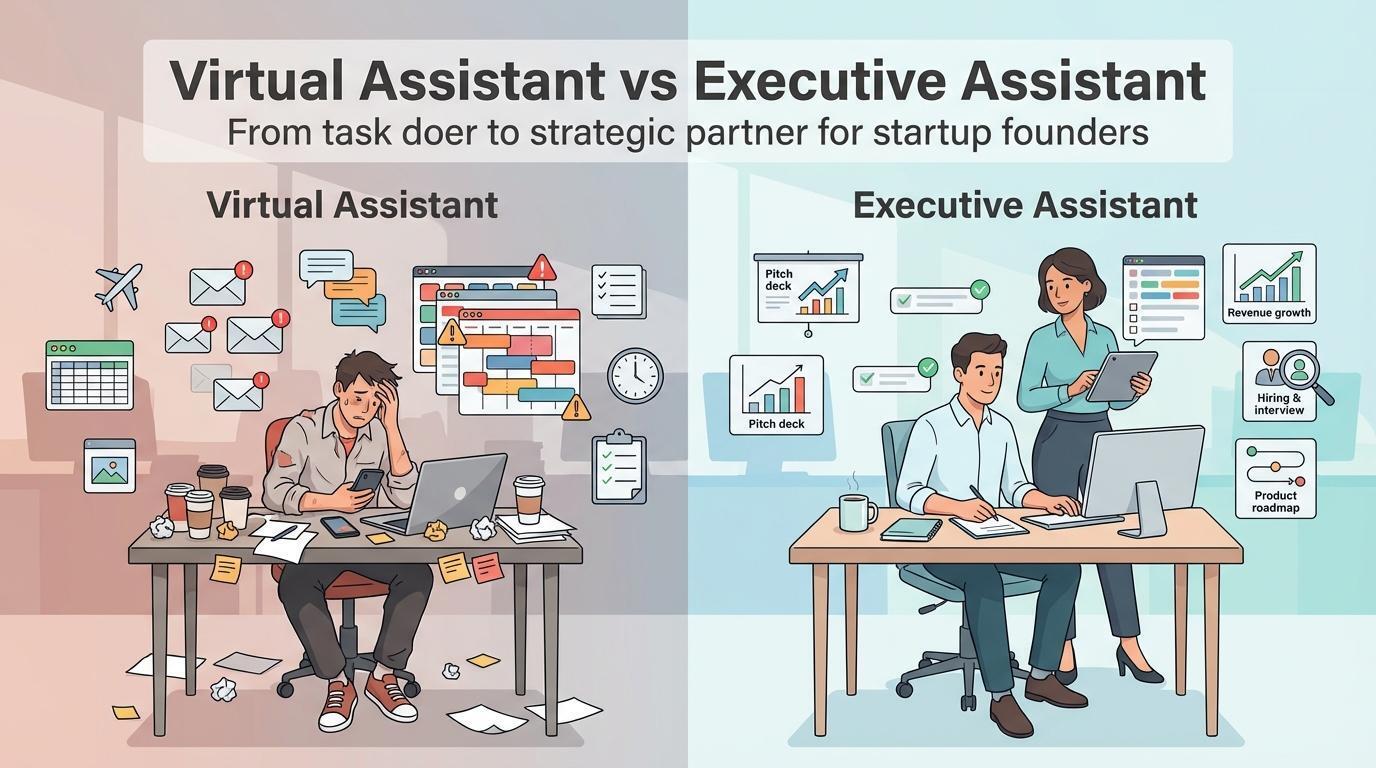
Virtual assistants handle simple, repeatable tasks: booking flights, updating sheets, dropping Slack nudges. That model works until the company leaves the tinkering phase and the pace accelerates.
Soon your calendar becomes a live puzzle, investors expect white-glove treatment, and board decks must shine before dawn. A task-taker cannot juggle that complexity. You need someone who protects priorities, speaks on your behalf in real time, and thinks a step ahead. That is executive-assistant territory.
A seasoned EA triages the inbox, spots scheduling collisions before they happen, and blocks noise before it hits your screen. They chase deliverables across the team, prepare talking points for each call, and flag risks you did not see coming. In short, they create headspace.
The payoff is concrete. Founders who delegate senior-level admin reclaim about three hours each day, time they pour back into product, hiring, and revenue. Morale rises too, because teams get quicker answers and cleaner processes.
If your startup’s momentum now depends on your personal capacity, treat this as the threshold. Moving up to an executive assistant is not a luxury; it is a critical operating upgrade most growth-stage companies cannot scale without.
How we picked the seven standouts
We sifted through more than 50 ranked lists so you did not have to.
First, we scraped every Google result, then cross-checked review sites, Reddit threads, and founder Slack groups for first-hand praise or pain. Any service without real startup references was cut.
Next, we scored contenders on five founder-focused factors: assistant experience, onboarding speed, pricing transparency, startup expertise, and client satisfaction. Platforms that hide pricing or pull assistants from generic job boards lost points.
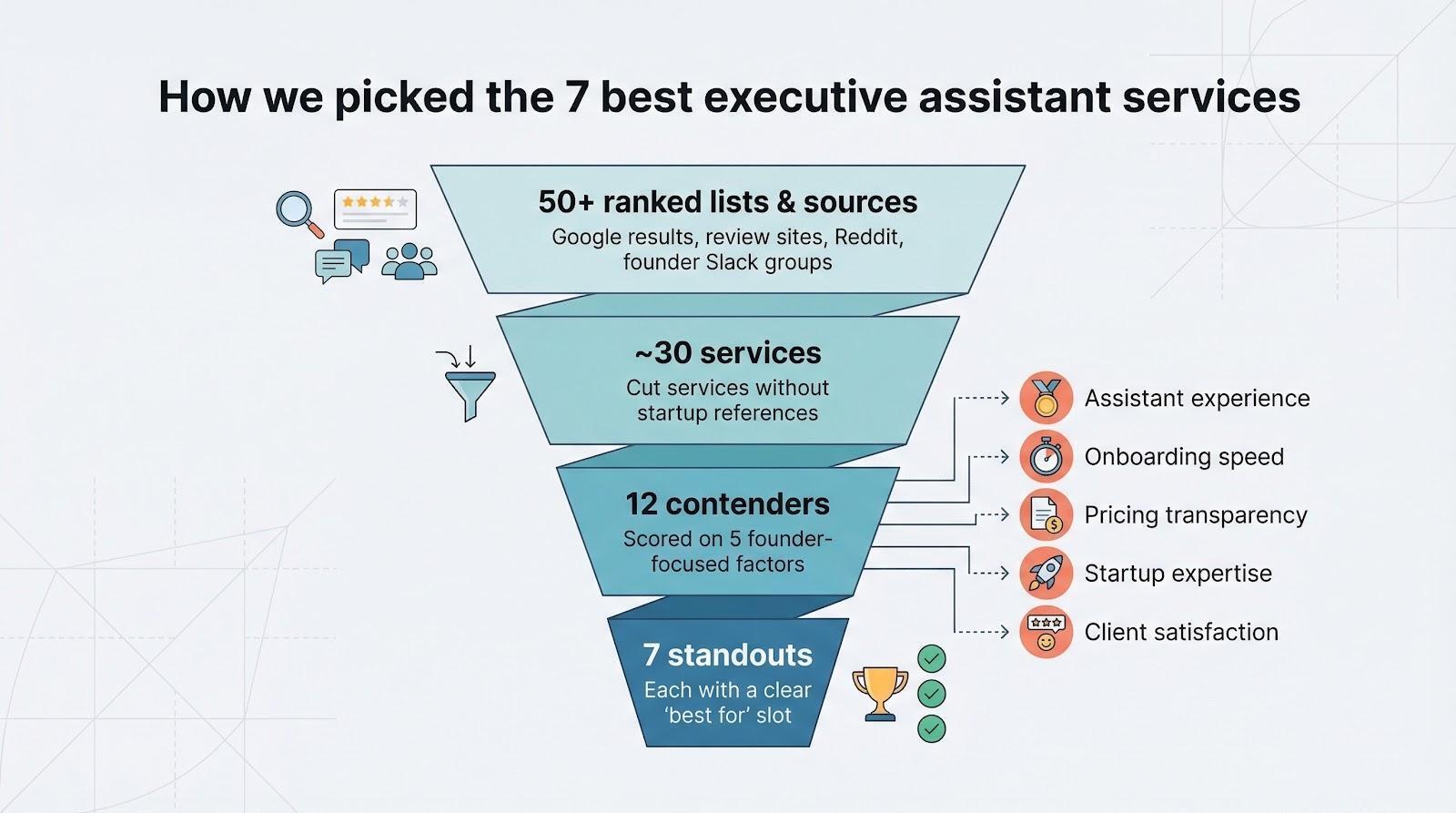
The pool shrank from 30 to 12, then to the final seven. Each service owns a clear “best for” slot, letting you match budget, urgency, and complexity with confidence.
Compare the seven in one quick glance
Before we explore the story behind each service, use this grid to match your budget and urgency.
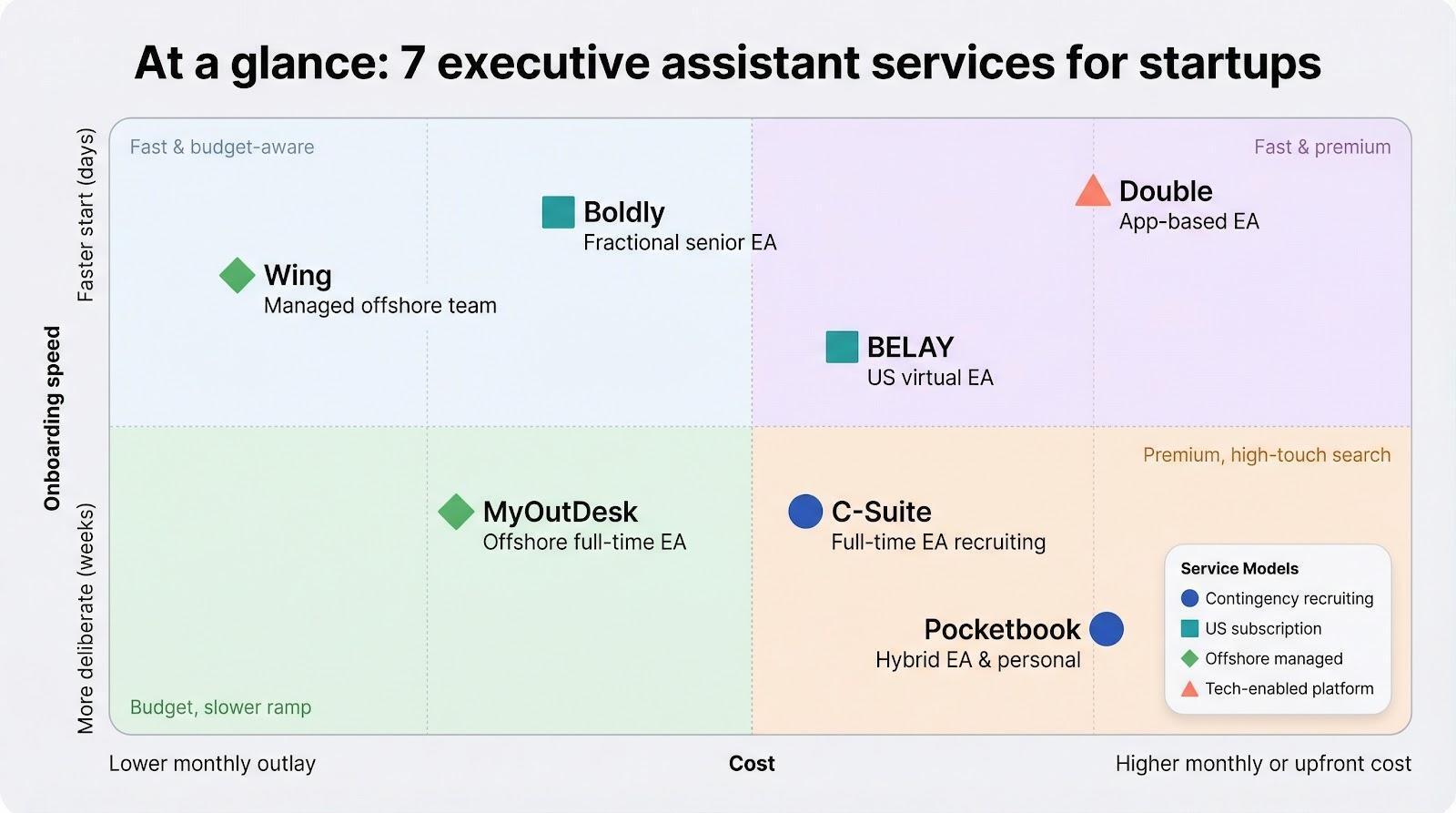
Keep this table close. The next sections explain why each service owns its lane and what to weigh before you commit.
1. C-Suite Assistants: precision recruiting for mission-critical hires
Picture C-Suite Assistants as an outsourced headhunter focused only on elite EAs. Instead of sending a random résumé stack, the firm targets veterans who already speak your sector’s language, whether that is healthtech or fintech. For founding teams in med-tech, biotech, or hospital systems, its dedicated arm for executive assistant recruiting for healthcare companies screens for HIPAA mastery, FDA-submission know-how, and the discretion of clinical data demands.

C-Suite Assistants executive assistant recruiting homepage screenshot
The search starts with a discovery call that feels like therapy for your calendar. You share quirks, growth targets, and board dynamics. Within two weeks a curated short list arrives. Each candidate has cleared multi-round interviews, skills tests, and deep reference checks. Fewer than five percent make the cut, so you are selecting rather than sifting.
Payment is contingency-based: you pay about 25 percent of first-year salary only if you hire. A 90-day replacement guarantee further lowers risk when the runway is tight.
Best fit: Series A and later founders who need a full-time, battle-tested partner. If investor meetings, compliance audits, or international travel keep you awake, C-Suite’s focused search saves hours and scales with you.
2. Boldly: fractional firepower without the full-time payroll
Boldly flips the traditional hire. Instead of a 40-hour employee, you subscribe to a seasoned EA for the exact slice of time you need: 10, 20, or 30 hours each week, and you can scale up or down as runway shifts.
Boldly fractional executive assistant service homepage screenshot
Quality comes first. Boldly screens thousands of applicants yet signs fewer than two percent, so the person stepping into your inbox has likely supported C-level leaders for a decade or more. That depth shows the first time they draft a board update or wrangle four investors into one slot.
Onboarding moves fast. After a brief intake call, most founders meet their matched assistant within a week and start delegating the same day. Vacation gap? Boldly assigns a backup so momentum never stalls.
The math works. Plans start around $1,500 per month, a fraction of a salaried EA but with enterprise-level expertise. For startups that want senior support while keeping headcount light, Boldly provides dependable help without long-term baggage.
3. BELAY: guided delegation with an all-American bench
BELAY sits between hiring solo and running a full agency search. You buy a bundle of hours and pair with a U.S.–based assistant who already knows remote work inside out.
Where BELAY shines is guided delegation. A client success manager maps your recurring tasks, then matches you with an EA whose personality fits. You learn to hand off work in stages, with regular check-ins to keep both sides aligned.
Quality is deliberate. BELAY accepts fewer than three percent of applicants, so the assistant greeting investors has real boardroom miles. When life gets hectic, you can add hours or tack on bookkeeping and social media support under the same roof.
Pricing sits near the premium tier, roughly $1,300 per month for a 10-hour-per-week plan, yet you skip payroll, benefits, and HR headaches. For founders who want steady, U.S. time-zone coverage plus coaching on what to delegate next, BELAY delivers confidence in subscription form.
4. MyOutDesk: full-time horsepower on a lean budget
Bootstrapped teams often think a high-caliber EA is out of reach. MyOutDesk proves otherwise by tapping a large talent pool in the Philippines and Latin America, where English fluency is high and labor costs stay well below U.S. rates.
MyOutDesk offshore executive assistant staffing homepage screenshot
You interview two or three pre-vetted candidates, pick your favorite, and they join as a dedicated crew member for about $1,800 a month. At 40 hours each week, that equates to roughly $11 an hour, leaving more cash for product or ads without cutting coverage.
The trade-off is time spent on onboarding and clear communication, as some cultural norms lean conflict-averse. Treat the assistant as a teammate with weekly stand-ups, shared KPIs, and direct feedback, and you gain meaningful capacity. Many founders turn the time-zone gap into an advantage: while the U.S. team sleeps, the EA clears inboxes, updates the CRM, and schedules next-day calls.
When the runway is tight but the task list keeps growing, MyOutDesk offers the breathing room of a full-time hire at a bootstrapped price.
5. Pocketbook Agency: chemistry-first matchmaking for hybrid roles
Culture fit can make or break an early team. Pocketbook Agency treats every search like a personality puzzle rather than a résumé race.
During kickoff you share quirks such as your Slack tone, meeting cadence, and even how you decompress after launch day. Recruiters translate those details into behavioral assessments for candidates. The result is a short list of EAs who can handle investor dinners and mesh with your leadership style.
Many placements double as personal assistants, taking care of travel, event planning, and the occasional “order birthday cupcakes for my co-founder’s kid” request. That hybrid flexibility is valuable when work and life overlap.
The service sits in the premium tier. Expect a one-time fee of about 25 percent of first-year salary. For founders burned by bad fits, the price is insurance against culture clashes. Bring Pocketbook in when you need a right hand who feels like a co-founder of calm, not just another hire.
6. Double: real-time delegation at the tap of an app
Double feels built for founders who run life from a phone. After a quick signup, you meet a U.S.-based assistant and fire off tasks through a simple mobile interface using voice notes, texts, or screenshots; whatever moves fastest between meetings.
The platform blends human skill with smart software. Your EA handles priorities while Double’s team and AI helpers speed research and scheduling. Need only 10 hours this month and 30 next? You pay by the hour with no long contract, so support flexes with each fundraising sprint or product launch.
Credibility matters. According to TechCrunch, the company raised $6 million to build this tech-enabled model, signaling investor confidence that on-demand executive help is the future of work.
At roughly $49 per hour, Double sits at the premium end of flexibility. For leaders who value instant access, granular billing, and an app that turns delegation into habit, it earns its spot on the shortlist.
7. Wing Assistant: always-on support powered by people and AI
Wing is a budget-friendly choice for founders who need help now but cannot spend premium dollars. Sign up, outline your task list, and within a few days a dedicated assistant (usually offshore) joins your workspace for up to 40 hours each week at a flat rate near $1,999 per month.
The differentiator is Wing’s proprietary dashboard. You add tasks to a queue, the platform sets priorities, and built-in AI suggests drafts, templates, and scheduling options. By mixing human judgment with machine speed, routine jobs finish sooner and you avoid hourly overages.
Plan to invest time in week one. Because experience levels vary, share playbooks, record walk-through videos, and check progress daily. Once processes click you gain a round-the-clock execution layer, perfect for support backlogs, research sprints, or keeping the CEO inbox at zero while the team sleeps.
When budget is tight but ambition is high, Wing provides a practical bridge between overworked founders and the premium services above.
Buyer’s guide: match the service to your stage, budget, and pain points
Choosing among seven solid options can feel like one more task on your already full list. Use these three passes to reach a decision quickly.
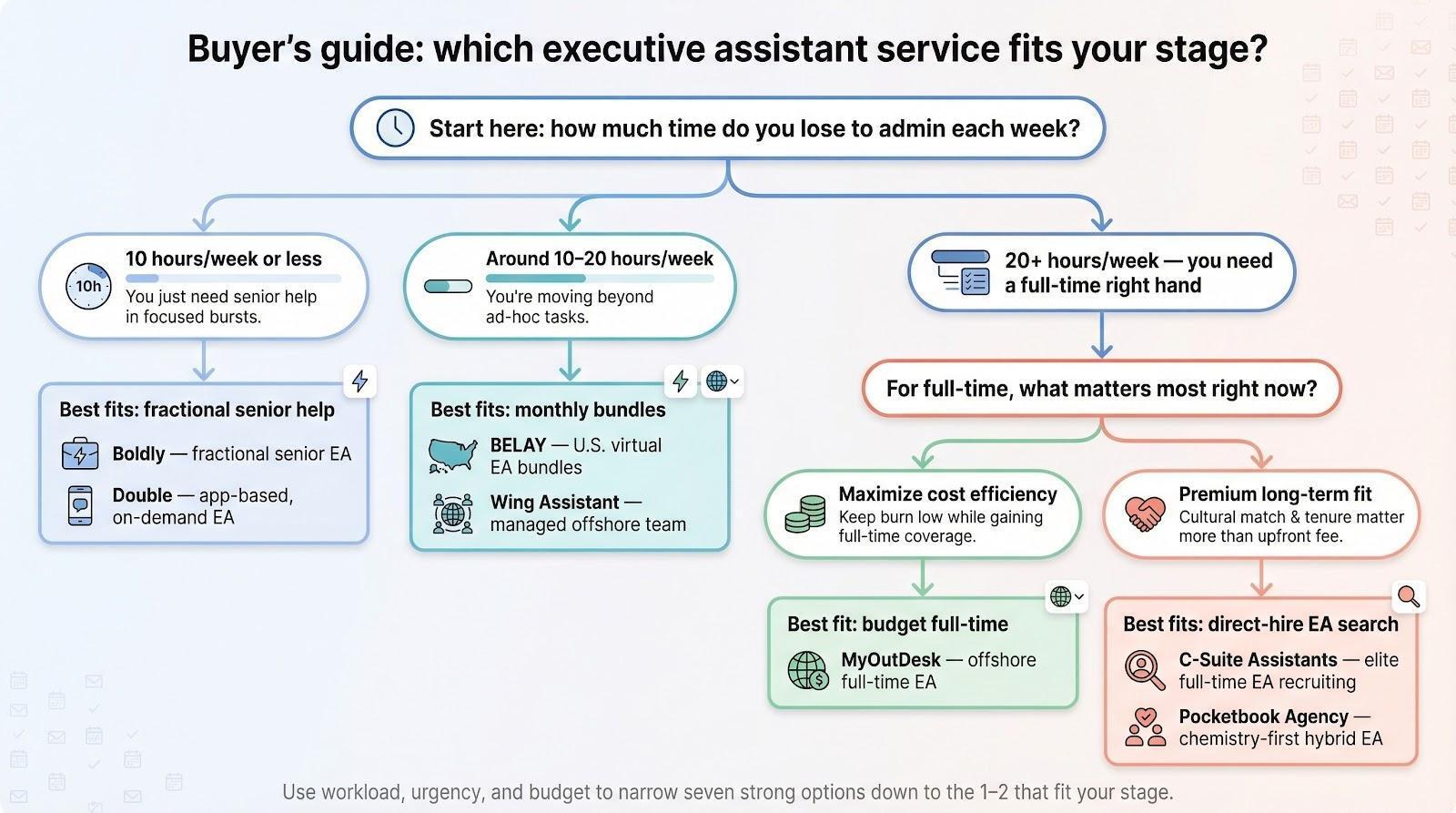
First, scope the workload. Tally the hours you spend each week on scheduling, email triage, travel, and follow-up. If you log 10 hours or fewer, a fractional model like Boldly or Double gives senior expertise without adding salary overhead. Cross the 20-hour mark and a monthly bundle from BELAY or Wing makes stronger economic sense. Need a full-time right hand who will grow with the company? Consider MyOutDesk for cost efficiency or a direct-hire search with C-Suite or Pocketbook when quality and longevity outweigh price.
Next, balance quality and speed. Boutique recruiters deliver pinpoint cultural fit but take weeks. Subscription services match you in days, yet you must adapt to their systems. Platform models like Double sit in the middle; onboarding is fast, and the talent is already vetted in the United States. Decide whether starting tomorrow or landing the perfect long-term partner matters more to your roadmap.
Finally, check budget flexibility. Contingency recruiting feels steep up front yet evens out over a multi-year tenure. Hourly platforms bill only for work performed but can spike during crunch time. Offshore plans lock in low monthly rates, though you will invest more time in training and communication. Map each pricing model against your cash-flow forecast, not just today’s balance.
FAQs: quick answers to the last worries in your head.
What’s the real difference between a virtual assistant and an executive assistant?
A virtual assistant follows the instructions you give. An executive assistant writes part of the playbook for you, prioritizing meetings, drafting replies in your voice, and flagging conflicts before they cause chaos. Think task doer versus strategic partner.
When should I make the call to hire one?
The moment admin work steals more than 10 hours a week or big opportunities slip because you missed an email. Hire slightly earlier than feels comfortable; onboarding takes time, and catching up once you are already drowning rarely ends well.
How much experience do these assistants really have?
It ranges widely. Top-tier subscription firms accept fewer than two percent of applicants and favor candidates with about a decade of C-suite exposure. Budget offshore services skew younger, so plan to invest more in training.
Is my data safe?
Reputable providers use NDAs, background checks, and password-manager protocols. Always ask for the security playbook and start with view-only access before granting full credentials.
Conclusion
Run your notes through this simple lens (workload, urgency, and budget) and one or two services will stand out. Book a discovery call, ask about vetting, security, and backup coverage, and delegate your first task before the week ends. Your future calendar will thank you.

