
Month-end close is where spreadsheet-based reconciliation fails most visibly, mismatched settlement figures, mystery rounding differences, and an exception queue nobody owns. The right reconciliation software shrinks that cycle and surfaces breaks as they occur, not three weeks after the fact. Picking the best reconciliation software for improving financial accuracy comes down to which transaction sources your team needs to match, the volume you're running at, and how much deployment flexibility you require.
Why Reconciliation Software Matters for Financial Accuracy
Manual reconciliation doesn't just slow teams down; it introduces systematic error at every handoff between sources. Finance teams reconciling PSP settlements against bank statements and internal ledgers by hand spend hours rebuilding differences that automation catches in minutes.
The financial cost is real. According to a 2025 report from Ardent Partners, finance teams that automate account reconciliation close monthly books an average of 40% faster than those relying on manual processes. But speed isn't the only gain. Automated matching catches discrepancies in real time rather than at period end, which means errors get resolved before they compound.
1. Urenkoff
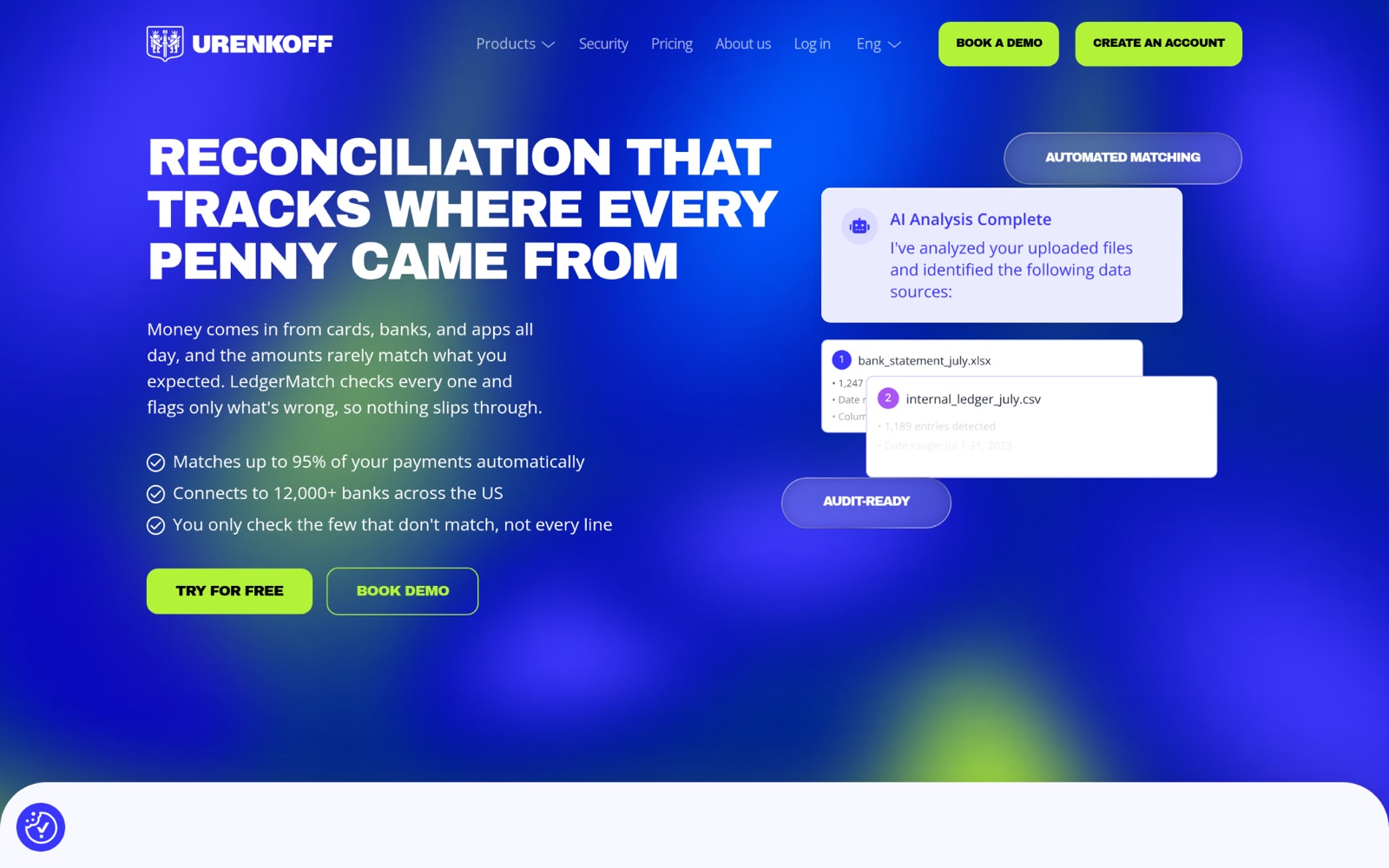
Ledger Match by Urenkoff is payment reconciliation software built for fintechs, PSPs, processors, and enterprises that need to match transactions across multiple sources - banks, gateways, POS systems, and ERPs. Founded in France in 2021, Urenkoff takes an API-first approach, targeting the challenge of multi-source payment data that doesn't reconcile cleanly out of the box.
The platform's core strength is its configurable matching engine. Teams set their own rules, tolerances, and matching order, so a two-cent FX rounding difference or a one-day settlement lag clears on its own rather than landing in the exception queue as a false positive. Automated structure detection means a new data source goes live in minutes instead of turning into a multi-day field-mapping project. Each run produces audit-ready reports, and unmatched items get routed to a named owner with a visible status, so close doesn't stall on "who was handling this one."
What sets Urenkoff apart among options for AI reconciliation software is its published, self-service pricing: a permanent free plan at $0, then $199, $599, and $1,999 per month, with no setup fees and a choice of SaaS or on-premise deployment. The REST API is available from $199, webhooks from $599, and API embedding on Enterprise. Security controls cover encryption in transit and at rest, role-based access control, full audit trails, and isolated per-client environments.
2. Ramp
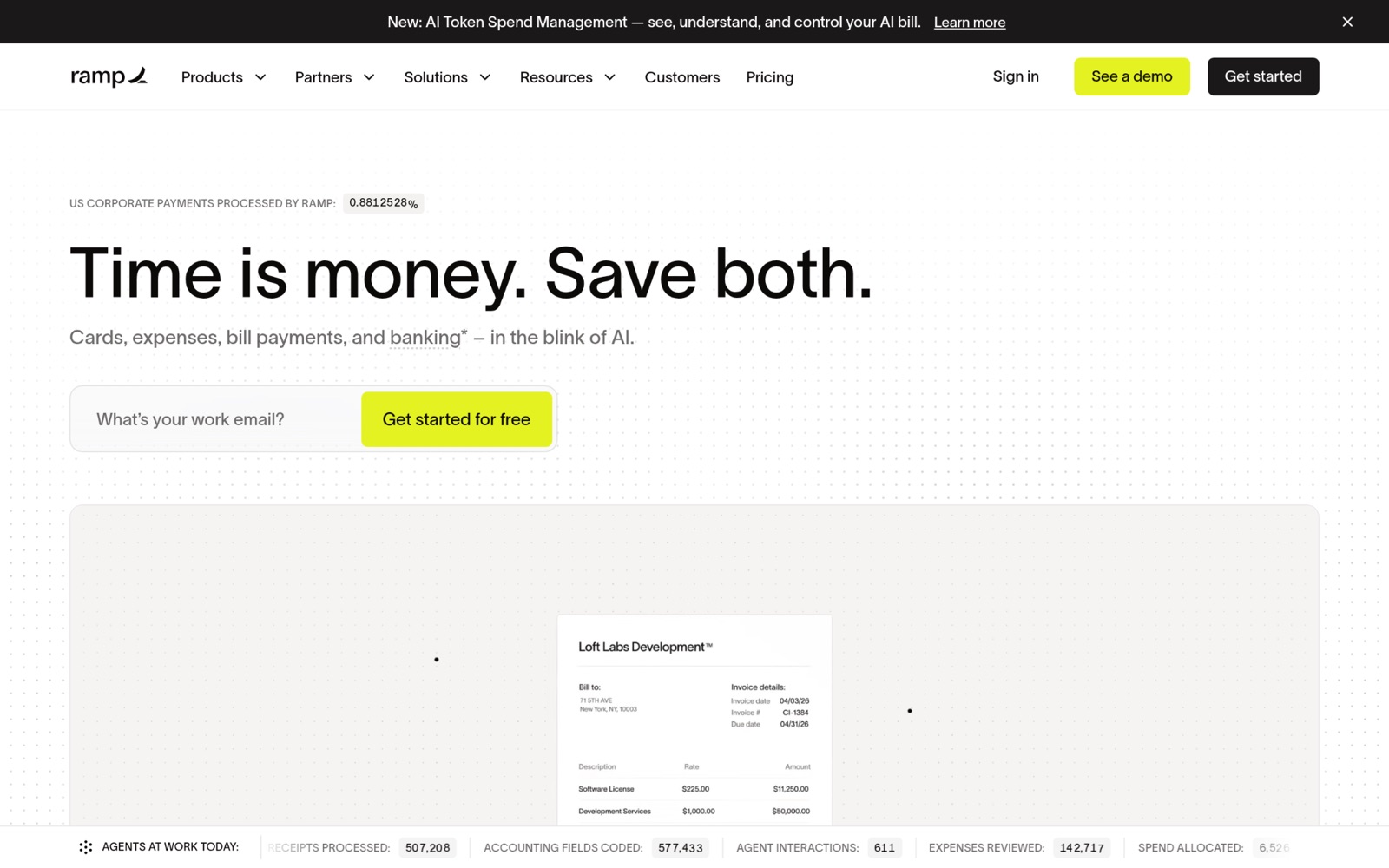
Ramp is an all-in-one spend management platform founded in 2019 and headquartered in New York City. Its reconciliation capabilities sit inside a broader suite that includes corporate cards, accounts payable, travel booking, and procurement - a different scope from dedicated reconciliation tools, but useful for companies that want a single vendor across spend and close.
More than 70,000 businesses trust the platform - including Notion, Shopify, and Webflow - and its invoice processing runs at 99% OCR accuracy. Expense categorization and real-time transaction review come standard. Ramp reports that customers have collectively saved 27 million hours, closed month-end 75% faster, and cut intake-to-pay cycles to one-third of their previous length, with full deployment in 30 days.
Ramp's strength is breadth. Teams that need corporate card management alongside reconciliation will find it capable. The trade-off is that reconciliation is one feature inside a large platform rather than the main focus, which means teams with complex multi-source payment matching may find the configurability they need elsewhere.
3. Ledge
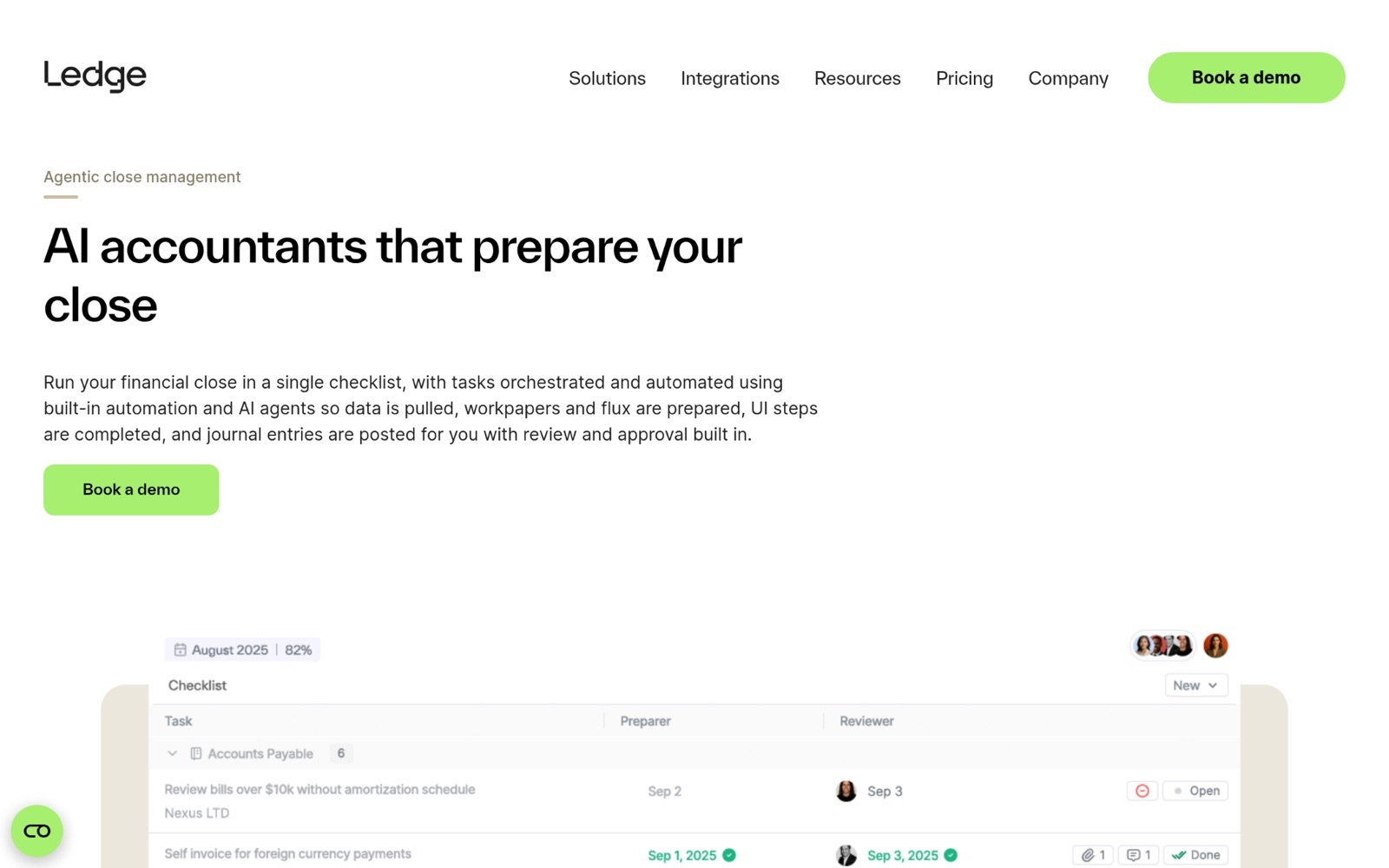
Ledge is a financial close platform co-founded in 2022 and headquartered in New York City with an additional office in Tel Aviv. It targets accounting operations teams running financial close on systems like NetSuite, automating reconciliation preparation, flux analysis, journal entry drafting, and working papers.
The platform keeps existing Excel workpaper formats intact, which is a genuine advantage for teams that don't want to rebuild their close process from the ground up. Audit trails and human-in-the-loop approval workflows are built in, so preparers and approvers stay distinct roles with a documented record. Ledge offers three pricing tiers - Track, Execute, and Enterprise - though dollar figures aren't published; you'll need to request a demo for actual numbers.
Ledge currently serves 24 customers and has 42 employees as of early 2026, with $9.9 million raised across two funding rounds. It's a focused early-stage product suited to accounting teams running NetSuite-centric close workflows, though buyers should weigh the limited customer base against more established alternatives.
4. FloQast
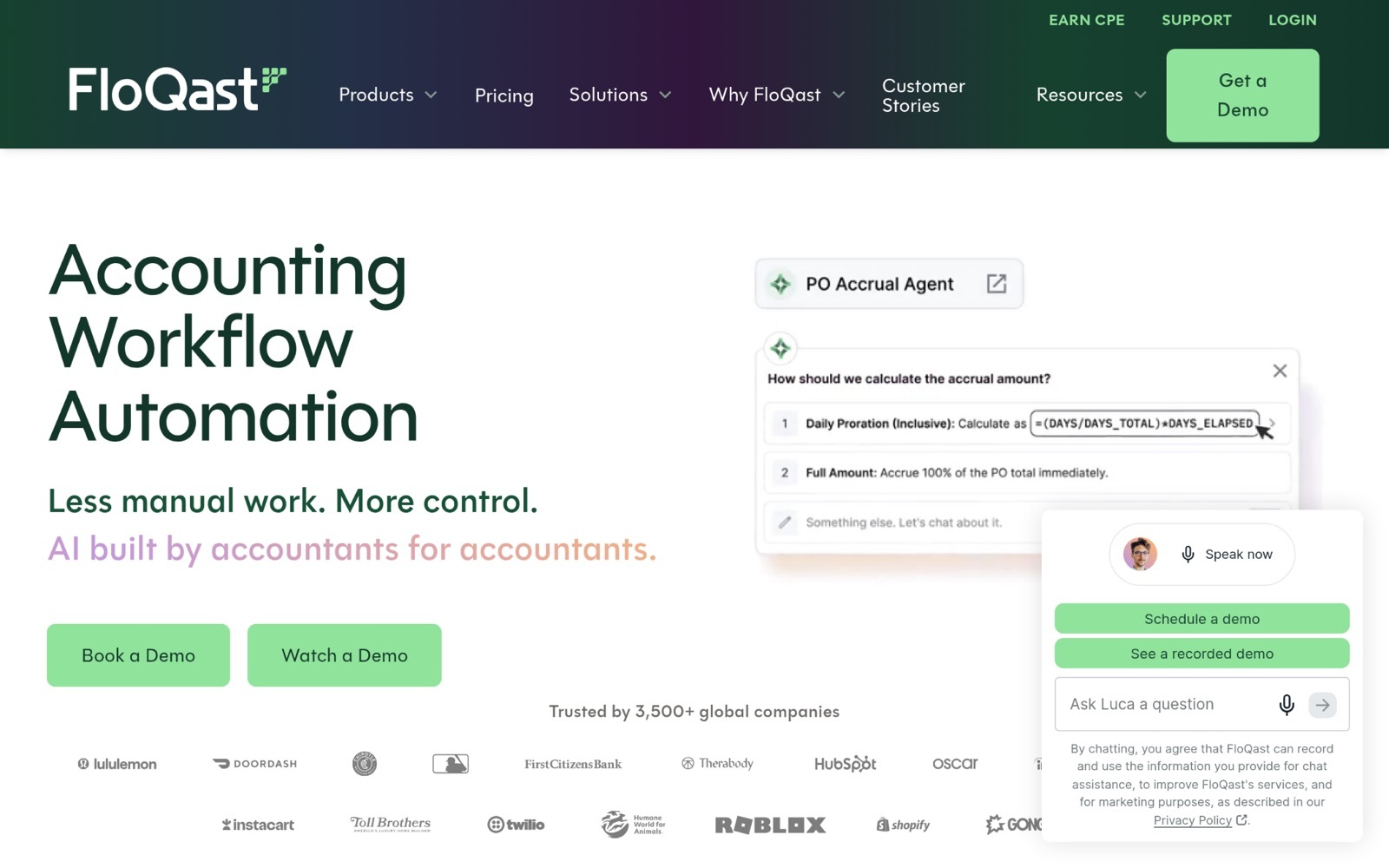
FloQast was founded in 2013 in Los Angeles by CPAs and former corporate accountants, which gives its product a notably practitioner-shaped feature set. Its Accounting Platform covers month-end close management, automated reconciliations, transaction matching, journal entry management, variance analysis, and enterprise risk management.
More than 2,600 accounting teams use FloQast, including Twilio, Zoom, Snowflake, and the Los Angeles Lakers. The platform's close management tools are designed around how accounting teams actually run month-end - task assignments, status visibility, and audit evidence collection - rather than around data engineering requirements.
FloQast suits corporate accounting departments looking for a close management layer on top of an existing ERP. Teams with heavy multi-source payment reconciliation needs - matching PSP settlements across acquirers and gateways - may find it better suited to the GL close workflow than to the transaction-matching use case.
5. OneStream
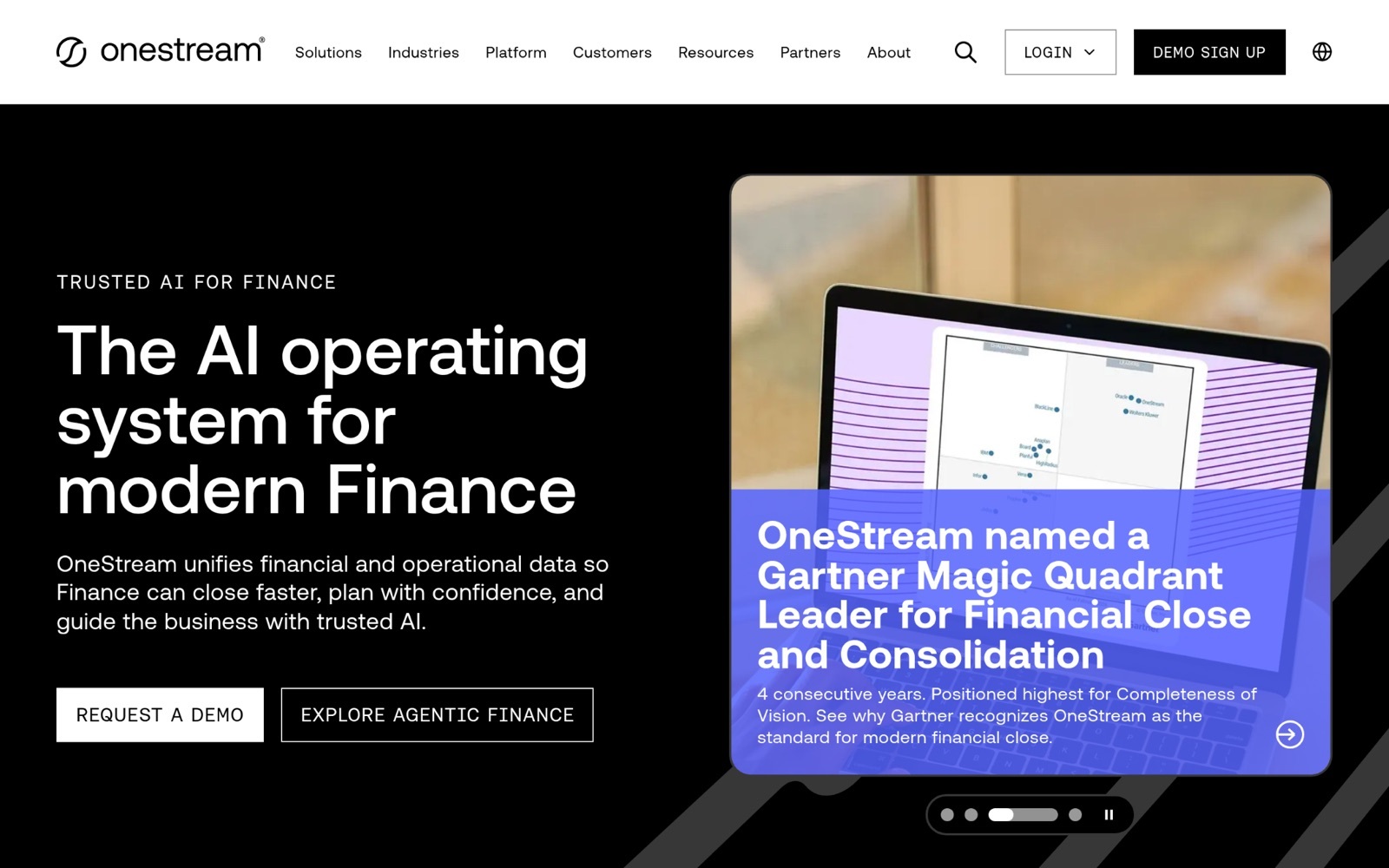
OneStream is an enterprise performance management platform founded in 2012 and based in Birmingham, Michigan. It unifies financial close, consolidation, planning, reporting, and operational data in a single system, positioning itself as a replacement for multiple point solutions rather than a complement to them.
The platform serves more than 1,400 customers and works with 250 deployment and development partners. General Dynamics achieved 45 times faster financial consolidation across divisions on OneStream's platform, which gives a clear sense of the scale it's designed for. Capabilities are embedded throughout workflows and governed by customer-defined rules.
OneStream is an enterprise-grade EPM system built for large, complex finance organizations. It's not a purpose-built reconciliation tool; its reconciliation features sit inside a broad platform that also handles planning, consolidation, and analytics. Teams looking to replace multiple finance applications with a single vendor will find it worth evaluating at that scope.
What to Look for in Reconciliation Software
A few questions cut through most vendor comparisons fast. First, which data sources actually need to reconcile: bank statements only, or a mix of PSPs, gateways, and POS systems? Tools built for accounting close and tools built for payment reconciliation solve different problems, and that distinction matters before anyone sits through a demo.
Second, who owns exceptions? Software that flags a break but doesn't route it to a named owner creates a different kind of delay. Exception ownership assignment and a clear approval workflow separate a reconciliation tool from a discrepancy detector.
Deployment flexibility is worth checking early. Cloud-only deployment is fine for most teams; teams operating under strict data residency requirements need on-premises as a real option, not a future plan.
Finally, pricing structure. Per-seat pricing, flat-team pricing, and usage-based pricing all hit differently at scale. Getting a full cost picture - including overage fees and add-on credits - before a procurement cycle starts saves time later.
Bottom Line
The best reconciliation software for improving financial accuracy depends on where the matching problem actually lives. Spend management platforms like Ramp cover reconciliation as part of a broader suite; close management tools like FloQast and Ledge target the accounting GL workflow; enterprise EPM systems like OneStream operate at a different scale and scope entirely. Teams whose main challenge is multi-source payment reconciliation should focus on tools built specifically for that use case, ones with configurable matching rules, clear exception ownership, and deployment options that fit their infrastructure.
About the Author
Violetta Bonenkamp, also known as MeanCEO, is an experienced startup founder with an impressive educational background including an MBA and four other higher education degrees. She has over 20 years of work experience across multiple countries, including 5 years as a solopreneur and serial entrepreneur. Throughout her startup experience she has applied for multiple startup grants at the EU level, in the Netherlands and Malta, and her startups received quite a few of those. She’s been living, studying and working in many countries around the globe and her extensive multicultural experience has influenced her immensely.

