
TL;DR: Pitch deck examples help most when they come from companies that were still tiny, so this guide only uses decks from a first raise: pre-seed and seed decks from Airbnb, Uber, Canva, Buffer, Mistral AI and five younger startups; four of the ten were led or co-led by women and five come from Europe. Each deck sits under the slide it teaches best, inside one 10-slide structure, with the round it raised and one move to copy this week. Investors spend less than 3 minutes on a deck, says DocSend, so fill in the free outline builder below and leave with a copyable 10-slide outline, speaker notes and an example for each slide.
Most pitch deck examples online come from Series B companies with charts you cannot build yet. A first-time founder needs to see what Airbnb showed when it had 2,500 listings and 10,000 registered users, the numbers Sequoia's Alfred Lin gave for the company it backed with $585,000 in April 2009.
So I picked ten decks with public slides (shared by founders, a deck archive or TechCrunch teardowns), read them slide by slide and placed each under the slide it teaches best.
Quick vocabulary: a pitch deck is the 10 to 20 slides a founder shows investors to raise money. Pre-seed is the first outside money, raised on an idea, a team and early proof, mostly from angels (people who invest their own money). Seed follows once there is a product and first users. A VC (venture capital fund) invests other people's money for shares. New pre-seed funds keep arriving: in November 2026, Yvonne Bajela's Evertrue Capital closed a $17 million fund that writes first cheques of around £350,000.
How does the 10-slide outline builder work?
Type short answers for each slide and pick your stage: idea, prototype or first customers. The builder returns a 10-slide outline with bullets, a one-line speaker note and the deck from this article to model each slide on. It flags empty or weak fields, such as traction without a number.
The sample is a made-up startup. Replace it with your answers, then let Elona, the Fe/male Switch AI co-founder, question it before an investor does.
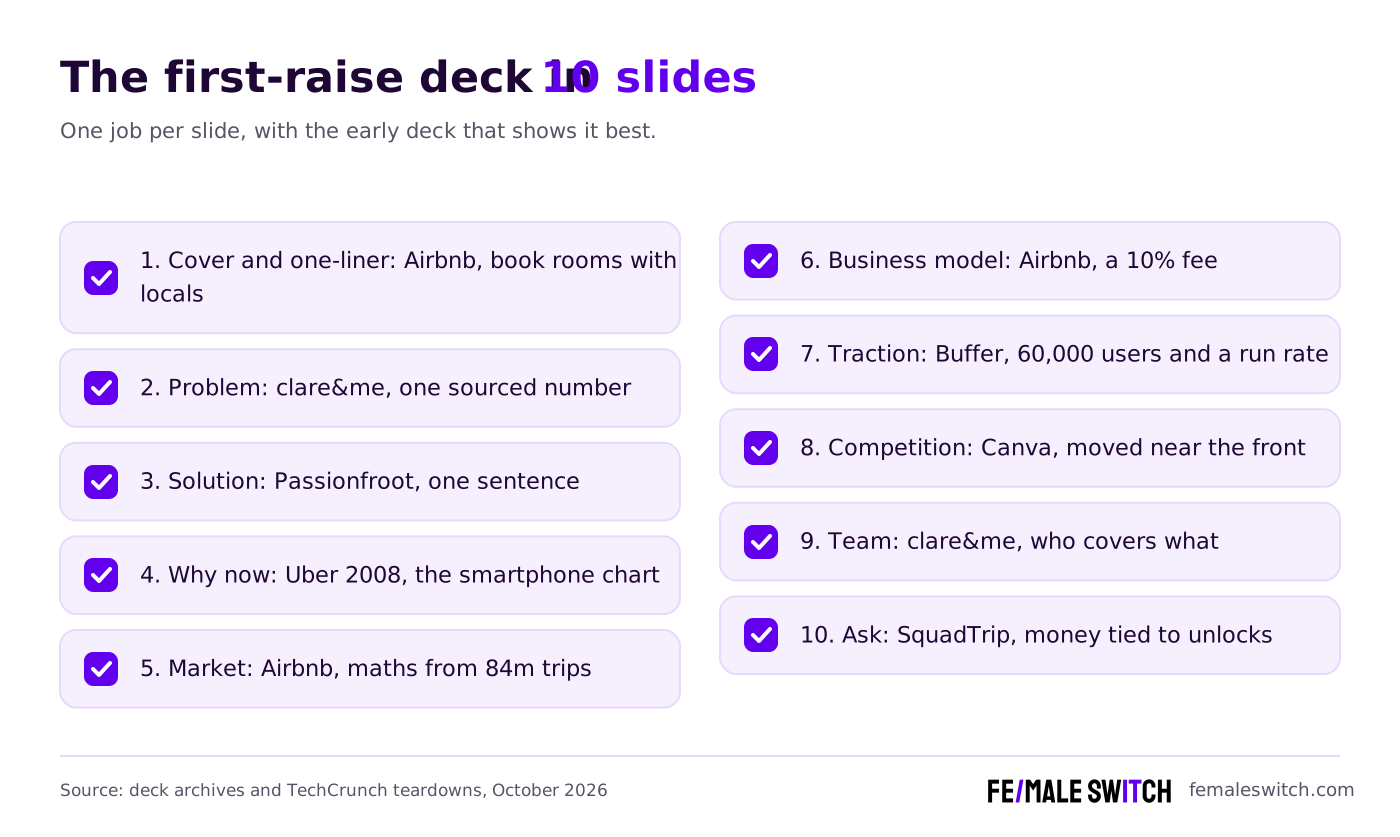
What goes on each of the 10 slides of a first-raise deck?
What do investors read first in a pre-seed deck?
DocSend, the document-sharing company that tracks how investors open decks, says in its April 2025 research summary that investors spend less than 3 minutes on a pitch deck. In its 2020 pre-seed data, investors spent over four minutes on decks that went on to raise and about 90 seconds on decks that did not. The first three slides decide whether anyone reads the rest.
Two findings matter for women raising a first round. In DocSend's seed data, decks from all-female teams got 77% more time on traction, 200% more on market size and 48% more on business model than decks from all-male teams. Over-prepare those slides. And 90% of DocSend's pre-seed companies already had a product at least at alpha stage (a rough first version used by testers).
For the story that ties the slides together, read our guide on building a fundraising story investors remember.
Slides 1 and 2: how did early decks open with the problem?
An investor who cannot repeat your one-liner after slide 2 stops reading.
1. Airbnb, 2008 seed deck: one-liner and problem in three lines
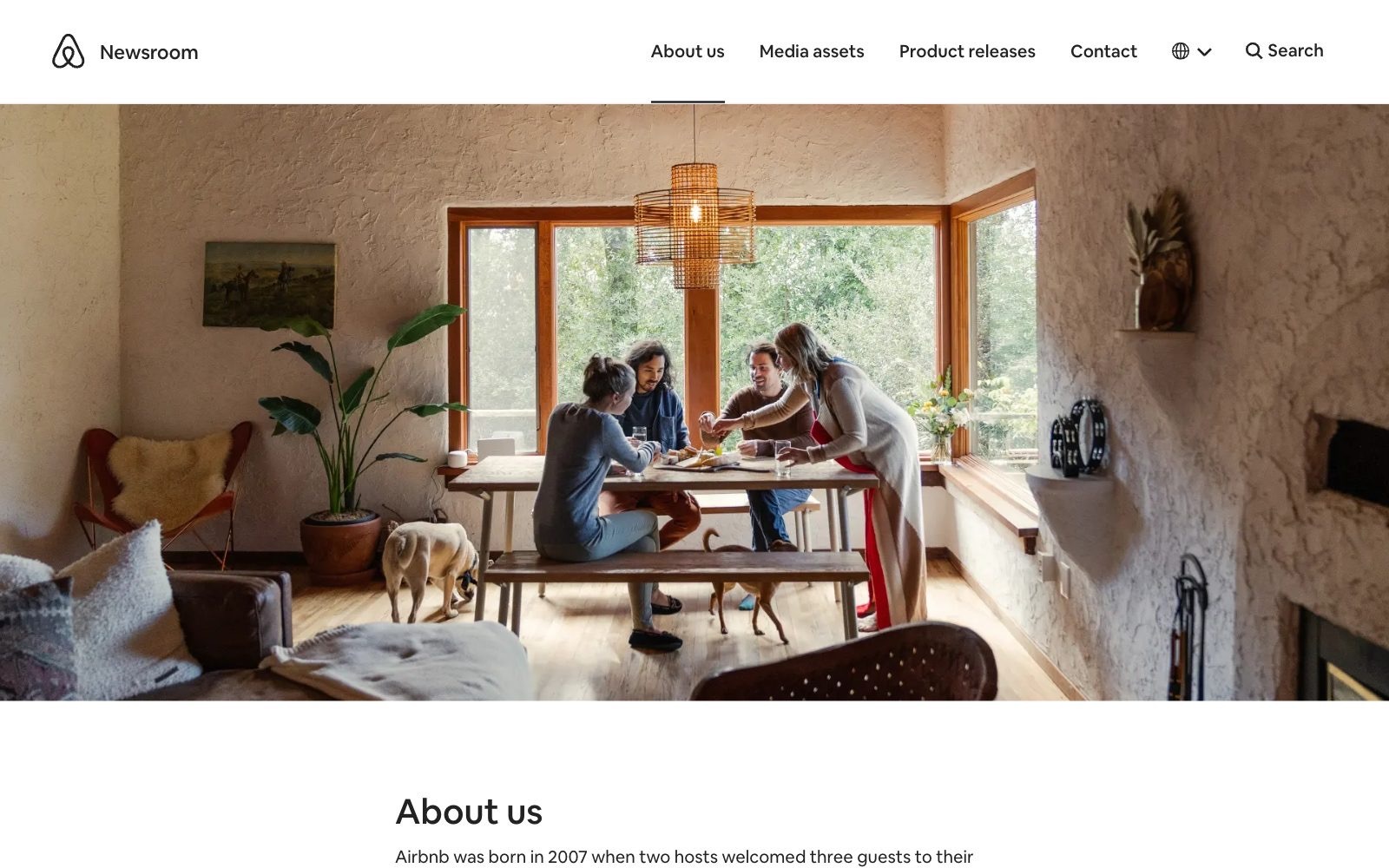
Airbnb's deck has 14 slides, according to the Alexander Jarvis deck archive. The cover says "Book rooms with locals, rather than hotels", and the problem slide lists three points: hotels cost too much, travellers feel cut off from local culture, and no easy way exists to book a room with a local. The solution slide answers each: SAVE MONEY, MAKE MONEY, SHARE CULTURE. Later slides size the market from 84 million trips, charge a 10% fee and ask for $500,000 to reach 80,000 transactions and $2 million in revenue in 12 months. In 2008 the founders offered 10% for $150,000 to seven investors; five said no and two never replied, Travolution reported from Brian Chesky's 2015 Medium post.
- Round and year: seed, April 2009; Sequoia's first investment was $585,000, Alfred Lin wrote.
- What to copy: write the problem as three short lines and answer each one on the solution slide.
- What to skip today: a market size built on a share assumption with no customer evidence; seed investors in 2026 want the bottom-up count.
2. clare&me, 2021 pre-seed deck: one sourced number on slide 2
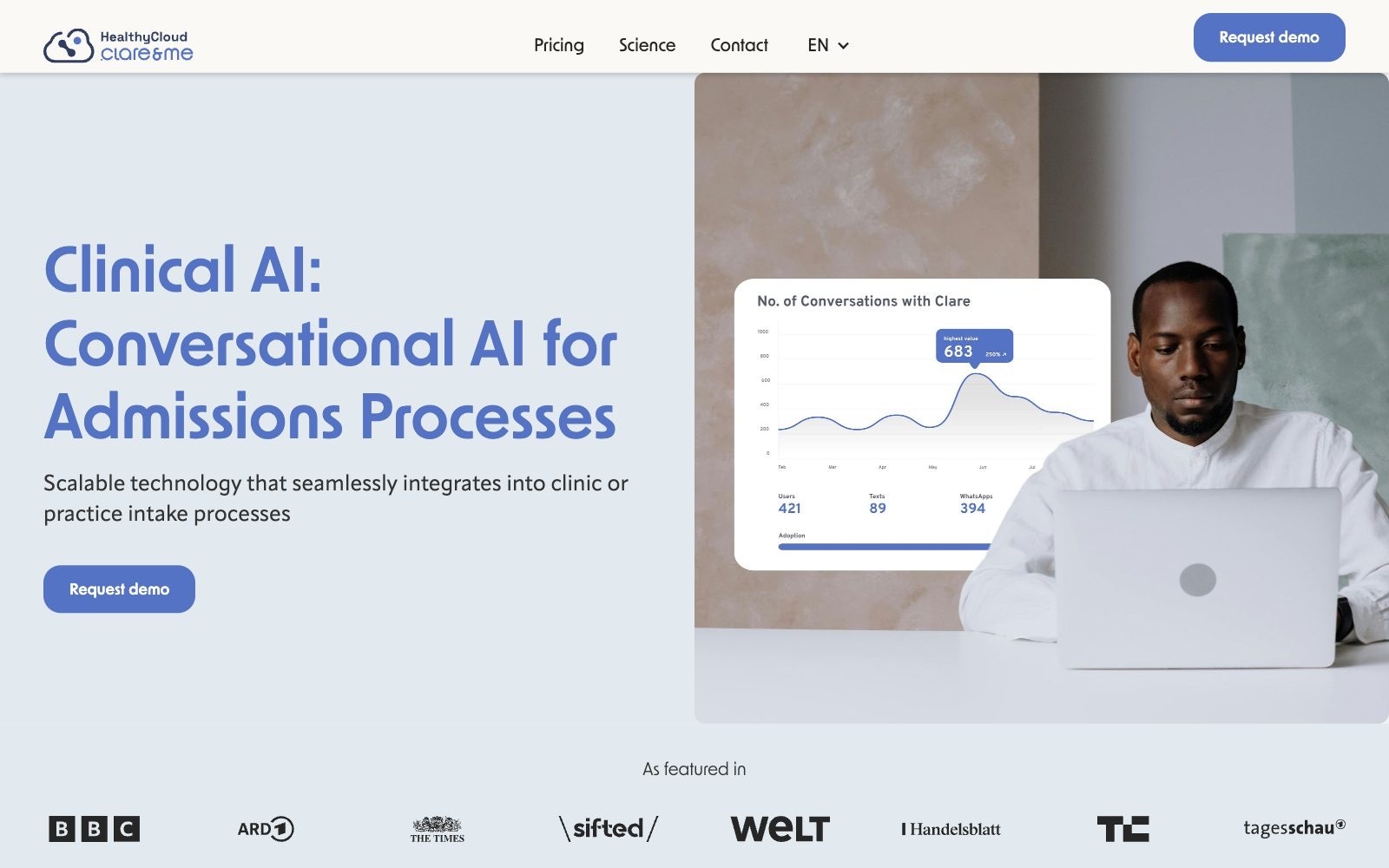
Berlin founders Emilia Theye and Celina Messner pitched an AI coach that phones you and guides you through cognitive behavioural therapy. Their 20-slide deck, public in Pitch's gallery of startup decks, opens slide 2 with "550M people globally struggle with symptoms of anxiety or depression", sourced to the Global Burden of Disease Study 2017. Slide 12 shows results of a closed test in autumn 2021, and slide 13 quotes testers. The team slide reads "Two female founders, one virtual founder": Emilia, Celina and Clare, the bot.
- Round and year: €1 million pre-seed, closed end of 2021, led by Munich fund YZR with Antler and angels, Startbase reported. Today clare&me sells conversational software for behavioral health, its homepage says.
- What to copy: one big number and one named source, nothing else on the problem slide.
- What to skip today: a global figure alone. Add the slice you reach first (one country, one channel).
3. Goodcarbon, 2024 seed deck: when the problem eats half the deck
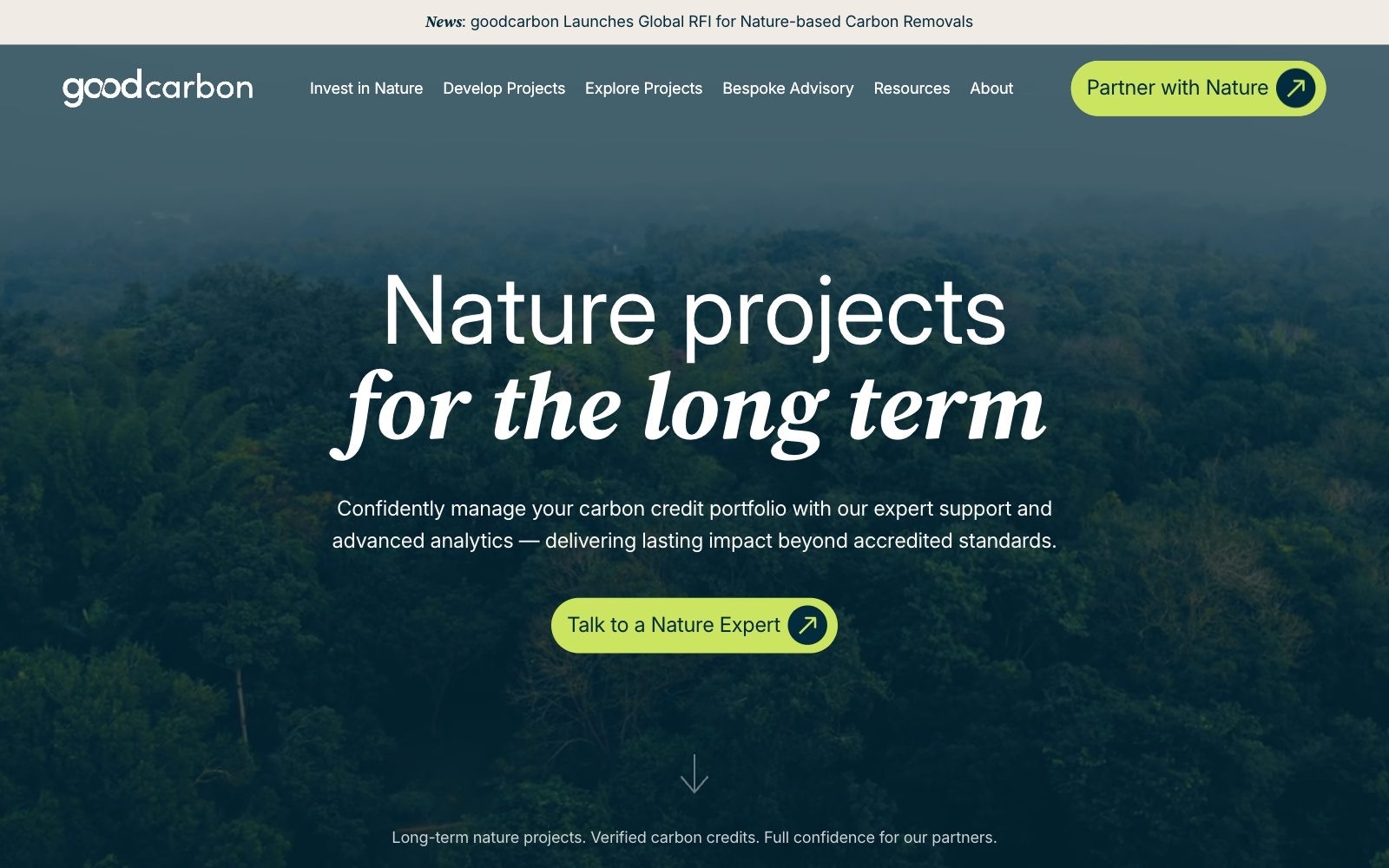
Berlin carbon-credit platform Goodcarbon shared an 18-slide seed deck with TechCrunch. Slides 2 to 11 cover problem and solution, more than half the deck. Reviewer Haje Jan Kamps liked the customer logos on slide 12, asked for competition and pricing, and advised two or three slides for a problem investors already know.
- Round and year: €5.25 million, April 2024, led by Ocean 14 Capital, tech.eu reported.
- What to copy: customer logos on one slide as early social proof.
- What to skip today: five problem slides. Give the problem one slide and spend the space on business model and traction.
Slides 3 and 4: how did they show the solution and why now?
Here an investor wants a solution she can picture and a reason it works now.
4. Passionfroot, 2021 pre-seed deck: 10 slides, one-sentence solution

Passionfroot raised its pre-seed in Berlin with exactly 10 slides. Slide 2 frames the shift: "In the last 10 years, 50 million people became creators". Slide 5 is the whole solution in one sentence: a no-code tool that lets creators monetize, manage and grow their sales in one place. Slide 8 is pure why-now ("riding on a series of tailwinds"), and slide 9 shows three founders with past jobs at Airbnb, Shopify, Apple and GetYourGuide.
- Round and year: €3 million pre-seed, December 2021, from Creandum, tech.eu reported; co-founders Jennifer Phan, Jens Joseph Mannanal and Michelle Tian. In July 2026 it raised a $15 million Series A led by Insight Partners, with revenue up 13-fold in a year, TechCrunch reported.
- What to copy: the solution in one sentence that starts with your company name.
- What to skip today: trillion-dollar market sizes. Passionfroot today runs a B2B creator marketplace, so pair big numbers with the first segment you serve.
5. Uber, 2008 pre-seed deck: the why-now slide was a smartphone chart
The 25-slide UberCab deck asked for $200,000 for limos you hail by SMS from a phone. Its best slide, "SmartPhones Aug 2008", shows BlackBerry at 32%, Windows Mobile 30% and the iPhone at 10%: the why-now in one picture. TechCrunch's teardown found "no clear narrative" in the rest, plus a "Potential Outcomes" slide predicting $1 billion in annual revenue.
- Round and year: pre-seed ask of $200,000, 2008; the teardown does not say whether this round closed.
- What to copy: one chart showing the change your startup rides on.
- What to skip today: outcome and exit slides. "Size the market and call it a day", the teardown advises.
6. Mistral AI, 2023 seed memo: seven pages, no slides
Mistral AI was about four weeks old when it raised €105 million in June 2023, led by Lightspeed at a €240 million valuation, tech.eu reported. Its founders came from Google DeepMind and Meta, and its pitch was a seven-page memo that Sifted obtained. The memo argued that very few people can build large AI models and every major player was American, so Europe had a window. Then came the team page.
- Round and year: €105 million seed, June 2023. In September 2026 Mistral closed a €3 billion Series D at more than €21 billion, the largest equity round by a European tech company, according to its law firm Orrick.
- What to copy: write your why-now as one page of prose before you design slides.
- What to skip today: raising on pedigree alone. A first-time founder needs slides 6 and 7.
Slides 5 to 8: how did they prove market, model, traction and competition?
DocSend says these slides get the longest reads on women-led decks.
7. Buffer, 2011 seed deck: traction did the talking
Joel Gascoigne launched Buffer on 30 November 2010 and had a paying customer within four days. Ten months in, Buffer had 30,000 users, about $4,000 in monthly revenue and 40% month-on-month growth, and by the AngelPad accelerator's demo day 60,000 users and a $150,000 annual run rate (monthly revenue times 12). Gascoigne called traction "the largest factor in our investor pitches". Co-founder Leo Widrich called the rebuilt competition slide the "second most important slide".
- Round and year: $450,000 seed, December 2011, from 18 investors after contacting about 200 and meeting about 50.
- What to copy: one traction slide with a dated number and a growth rate.
- What to skip today: nothing structural. Track every investor contact in a spreadsheet from day one.
8. Scrintal, 2023 seed deck: a waitlist needs a revenue line next to it

Stockholm's Scrintal, led by co-founder and CEO Ece Kural, builds a visual knowledge base. Its 19-slide deck has a testimonial slide with outcomes ("66% fewer apps used, 50% less time spent, 30% fewer meetings") and a traction slide built on a 40,000-person waitlist. TechCrunch called the waitlist a vanity metric and noted an ARR (annual recurring revenue) target with no history behind it. On the competition slide, parked in the appendix, the verdict was "This isn't good enough."
- Round and year: €1 million seed, early 2023, led by Spintop Ventures with Icebreaker VC, TechArenan reported.
- What to copy: customer outcomes as percentages on a testimonial slide.
- What to skip today: a waitlist as your headline number. Show how many waitlisted people paid or pre-ordered.
9. Canva, 2013 seed deck: the competitor slide moved to the front
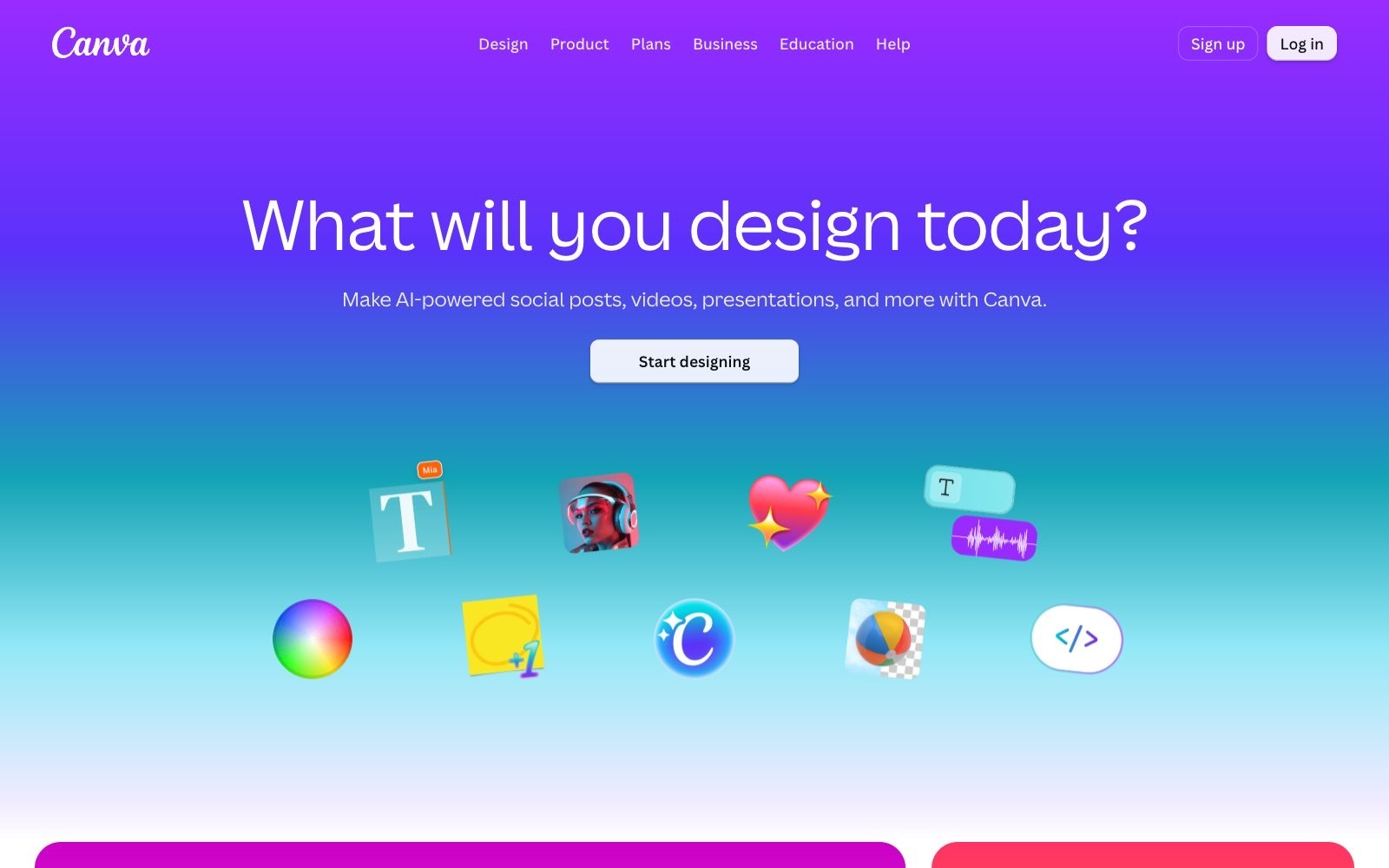
Melanie Perkins published Canva's early decks herself. The 2011 version was "pretty terrible", with an exit slide someone told her to add. The April 2012 deck had a straight-line revenue forecast and "strictly confidential" on the cover. By 2013 one slide mapped the whole design market, and the competitor comparison moved near the front, so investors stopped asking whether Canva was the same as another company. "Every time we'd get a really tricky question from investors we'd iterate on our deck," she wrote.
- Round and year: $3 million seed, March 2013, from Matrix Partners, InterWest Partners, 500 Startups and angels including Bill Tai, before launch, TechCrunch reported.
- What to copy: log every hard investor question and answer it on a slide.
- What to skip today: NDAs. Perkins wrote that Bill Tai didn't answer her first emails, partly because she sent NDAs.
Slides 9 and 10: how did they present the team and the ask?
The team slide answers "why you"; the ask answers "what changes with this money". Our list of pre-seed fundraising mistakes shows how a vague ask sinks a good meeting.
10. SquadTrip, 2023 pre-seed deck: the ask as a list of unlocks
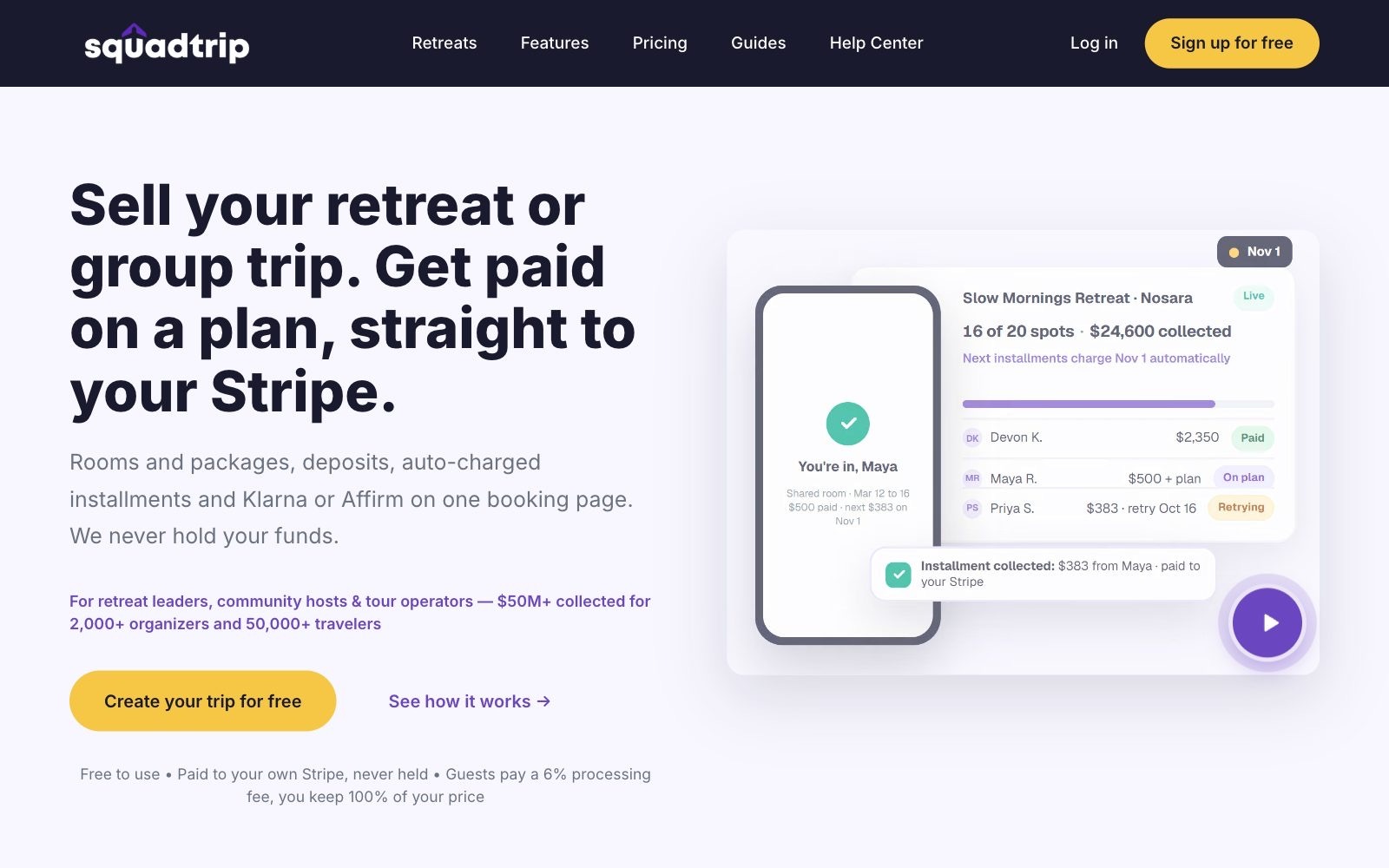
SquadTrip, a group-travel booking tool from Tulsa, raised its first institutional money with an 18-slide deck. TechCrunch praised slide 12: each part of the money is tied to what it "unlocks". The same teardown caught slide 3 counting 85,000 travel agencies and slide 6 counting 10,000, and doubted the $3.8 billion SAM (serviceable available market, the part your product can reach).
- Round and year: $1.5 million pre-seed at a $6 million pre-money valuation (the company's value before new money), with Atento Capital and Forum Ventures (TechCrunch teardown, August 2023).
- What to copy: an ask in three steps: amount, what it pays for, what you will have proven.
- What to skip today: numbers that change between slides. Keep one source sheet for every figure.
For the team slide, copy Passionfroot (employers that prove each founder's part) and clare&me (who covers psychology, who covers product).
How do these 10 pitch deck examples compare?
Sources: as named above. Four of the ten were led or co-led by women, and five are European.
What should a first-time founder skip in a 2026 deck?
- Exit and "potential outcomes" slides. Uber had one and Canva was told to add one. Investors do their own exit maths.
- Straight-line forecasts. Perkins called her 2012 line "absolutely absurd". Show 12 to 18 months with assumptions next to the numbers, using our guide to unit economics for first-time founders.
- NDAs. VCs read hundreds of decks and sign none.
- Vanity metrics. Waitlists and followers without a paying number beside them.
- Top-down TAM. TAM (total addressable market) from an analyst report says nothing about your first year. Count reachable customers times price with the free market size calculator.
What can a first-time founder do this week?
- Day 1: one-liner and problem. Test your one-liner on three people outside your field, with questions from our 15-minute problem interview script.
- Day 2: solution and why now. The free elevator pitch generator gives you a first version to cut down.
- Day 3: market and business model. Read how to price your first product version if you have no price yet.
- Day 4: traction. No customers? Use interviews, pre-orders or pilot sign-ups, and our guide to finding your first 10 customers.
- Day 5: competition. List how customers solve the problem today with our competitor analysis frameworks.
- Day 6: team and ask. One line of proof per founder, an amount and three things the money pays for.
- Day 7: rehearse. Run the outline through the builder and practise it out loud with Elona.
The same answers fit in the free lean canvas template.
Copy these lines into your notes:
- One-line problem: [Who] lose [time or money] every [week or month] because [cause]; today they [workaround].
- One-liner: [Startup] is a [product] that helps [who] [result], without [old cost].
- Prompt for Elona or any AI assistant: "Here is my 10-slide outline. Ask me the ten hardest questions a pre-seed investor would ask, one at a time, and tell me which slide should answer each."
- Prompt: "Read my traction slide. Which number is a vanity metric, and what paying number should sit next to it?"
- Prompt: "Act as a seed investor in Europe. Rate my ask slide from 1 to 5 and rewrite it as amount, what it pays for and what I will have proven in 18 months."
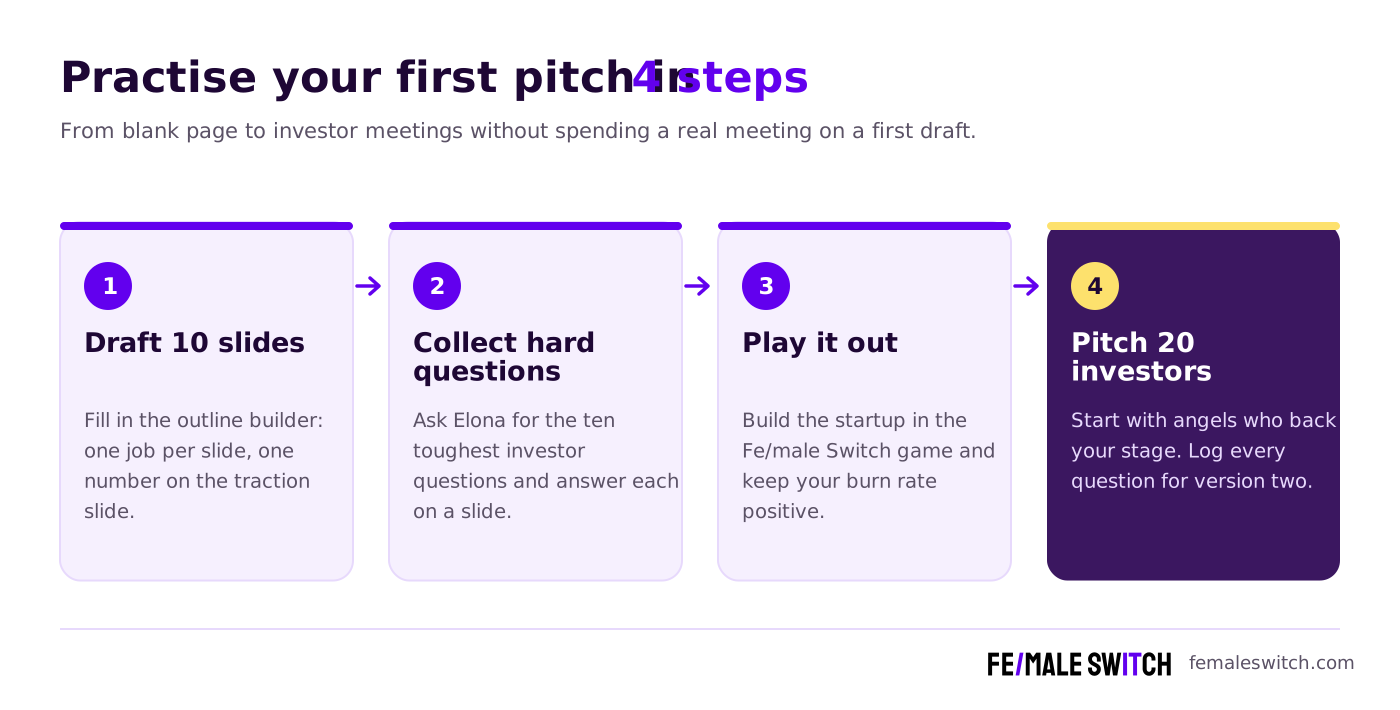
How do you practise your pitch in the Fe/male Switch game and with Elona?
Collect the first fifty hard questions before you spend a single investor meeting.
- Draft the outline in the builder.
- Ask Elona for an honest take. On the AI co-founder page she answers in about ten seconds, free and without sign-up, and drafts a pitch deck outline you edit. Use the prompts above.
- Get a full draft deck. Elona's pitch deck creator asks 10 questions about your business and emails you the result.
- Play the startup. In the Fe/male Switch startup game you build your company quest by quest, earn tokens, decide whether to spend them on skills or on an investor, and try to keep your burn rate positive.
- Pitch real people. Start with the top pre-seed VCs in Europe, angel investors for women founders and our cold email templates for European investors.
Rehearse your first pitch with an AI co-founder. Elona tests your idea, plans your week and drafts your canvases, free and without sign-up. In the Fe/male Switch startup game, the Intern tier at €2.50 a month adds her feedback on your work in the Skill Lab, and the Play tier at €10 a month comes with a 14-day free trial (early-bird prices with VAT). Elona has no network and no money and can be wrong, so check her work, then pitch humans.
When meetings go well, prepare the paperwork: a data room for your first raise and term sheet negotiation for first-time founders (a term sheet lists the investment's main conditions). For paid design help, compare pitch deck agencies by stage.
What will your deck look like by Monday?
Every deck here was rougher than its company's later legend: Airbnb heard five no's from seven investors, and Buffer met about 50 investors to close $450,000. So stop collecting decks and build yours. Fill in the builder, run the seven-day plan, rehearse with Elona, then send the deck to 20 investors who back your stage and log every question they ask. That log becomes version two.
FAQ: pitch deck examples
What is the best pitch deck example for a first-time founder?
Passionfroot's 2021 pre-seed deck: 10 slides, a one-sentence solution and sourced numbers. It raised €3 million from Creandum.
How many slides should a pre-seed pitch deck have?
Ten to fifteen, with details in an appendix. Passionfroot raised with 10, Airbnb's deck has 14, and Uber's 25-slide 2008 deck is the cautionary tale.
What was in the Airbnb pitch deck?
Fourteen slides, from the one-liner and a three-point problem to a 10% fee model and an ask of $500,000 for 12 months.
How much did Airbnb raise with its first pitch deck?
Sequoia invested $585,000 in April 2009, its partner Alfred Lin wrote. In 2008 the founders had offered 10% for $150,000 to seven investors without a deal.
What should the traction slide show if I have no revenue?
Your strongest dated number: pilot users, pre-orders, letters of intent or problem interviews.
Do investors still read pitch decks in 2026?
Yes, quickly: under 3 minutes on average, according to DocSend.
Should I include financial projections in a pre-seed deck?
Include 12 to 18 months with visible assumptions and skip five-year straight lines. Canva's founder called her own straight-line forecast "absolutely absurd".
How do I practise my pitch before meeting investors?
Ask Elona, the Fe/male Switch AI co-founder, to question your outline with the prompts in this guide, then pitch friendly angels before the funds you want most.
About the Author
Violetta Bonenkamp, also known as MeanCEO, is an experienced startup founder with an impressive educational background including an MBA and four other higher education degrees. She has over 20 years of work experience across multiple countries, including 5 years as a solopreneur and serial entrepreneur. Throughout her startup experience she has applied for multiple startup grants at the EU level, in the Netherlands and Malta, and her startups received quite a few of those. She’s been living, studying and working in many countries around the globe and her extensive multicultural experience has influenced her immensely.

