
TL;DR: Zero trust for small business in November 2026
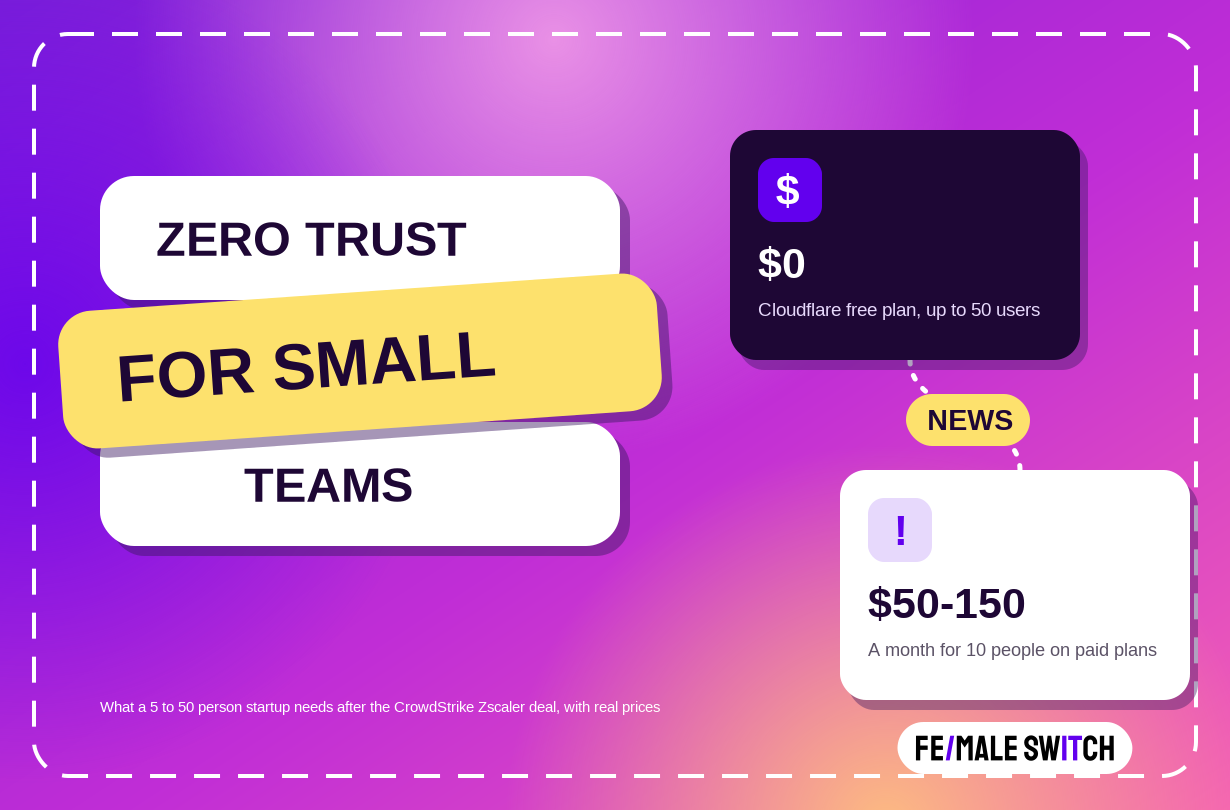
CrowdStrike agreed on 23 November 2026 to buy Zscaler, one of the best-known zero trust vendors, in a deal valuing it at about $43.9 billion. A 5 to 50 person startup needs none of that enterprise machinery. It needs strong logins, known devices and app-by-app access in place of a shared VPN. Cloudflare's zero trust plan is free for up to 50 users; paid entry plans cost $5 to $12 per user a month, about $50 to $150 a month for a team of 10 once server fees are added.
Zero trust for small business became a fair question this week, because CrowdStrike is buying Zscaler to add network security and zero trust to its Falcon platform. If you run a team of 5 to 50 people, you are asking two things right now: do we need zero trust at all, and if yes, what is the cheapest setup that works? This guide answers both, with prices read on 25 November 2026 on each vendor's own pricing page.
What is zero trust, in plain words?
Zero trust means nobody gets in just because they are "inside" the office network or the VPN. Every login, every device and every request to an app is checked each time. The US standards body NIST describes zero trust as "an evolving set of cybersecurity paradigms" that moves defences away from the network edge and onto users, devices and resources.
The CISA Zero Trust Maturity Model splits it into five pillars: identity, devices, networks, applications and data. CISA wrote it for US federal agencies, and it says every organisation can use it. For a startup, those five pillars shrink to three questions: who is logging in, from which device, and to which app.
Compare that with the classic VPN. A VPN hands a remote laptop the run of the whole office network. If one laptop or one VPN box is compromised, the attacker can reach everything behind it. A zero trust access tool, called ZTNA (zero trust network access), connects a person to one named app, and only after checking who they are and what device they use.
Why should a small team care about zero trust now?
The deal headlines are about Fortune 500 buyers, and the attack data is about everyone else. Here is why it matters for small companies:
- Exploited flaws are the top way in. The Verizon 2026 Data Breach Investigations Report says 31% of breaches now start with an exploited vulnerability, ahead of stolen passwords. Its small-business summary puts the median time to fix a serious flaw at 43 days.
- VPN boxes are a favourite target. In Verizon's 2025 small-business snapshot, VPNs and other edge devices made up 22% of exploited targets, up from 3% a year earlier.
- The flaws keep coming. The CISA catalog of exploited vulnerabilities added a SonicWall SSL VPN login and MFA bypass (CVE-2026-19868) on 6 November 2026 and an Ivanti Connect Secure remote command flaw (CVE-2026-104935) on 13 October 2026.
- Small firms get hit too. The UK Cyber Security Breaches Survey 2025/2026 found that 43% of businesses had a breach or attack in the last 12 months, 46% of small ones. Only 47% require two-factor authentication.
Violetta Bonenkamp (MeanCEO) puts it bluntly for bootstrappers: the data a startup loses goes out through a reused password, a contractor who still has access six months later, or a VPN box nobody patched, and zero trust closes exactly those three doors.
What does a 5 to 50 person startup actually need?
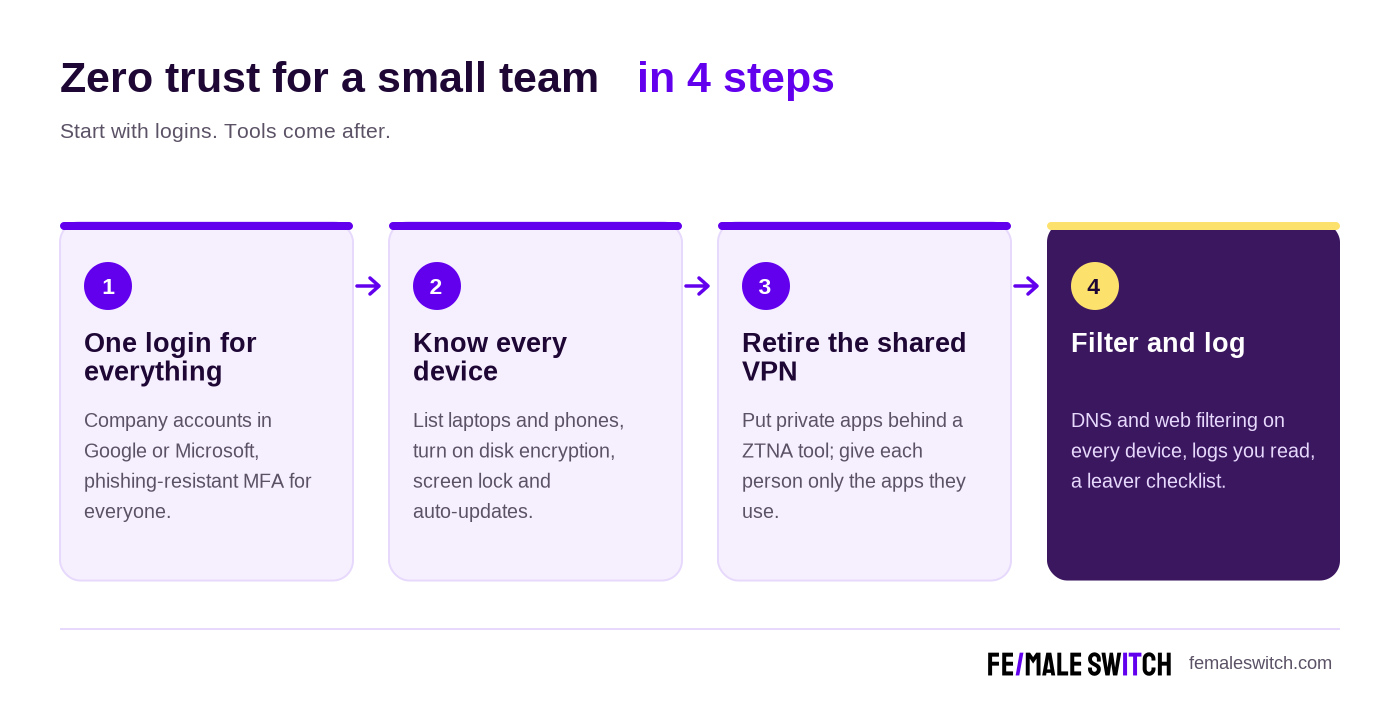
Skip the acronym soup of SASE, SSE and CASB at this size. You need four things, in this order, and the first two cost little or nothing:
- One identity for everything. Company accounts in Google Workspace or Microsoft 365, single sign-on into your other tools, and MFA for every person. Prefer passkeys or an authenticator app over text messages.
- Known, healthy devices. A list of every laptop and phone that touches company data, with disk encryption, screen lock and automatic updates switched on.
- App-by-app access in place of a shared VPN. A ZTNA tool gives each person only the internal apps, servers and databases they work with.
- Web and DNS filtering plus logs. Block known phishing and malware domains on every device, and keep logs long enough to answer "who opened what" after an incident.
Our cybersecurity guide for women-led startups cover steps 1 and 2 one by one, and the top 20 cybersecurity tools for startups list the password managers and backup tools around them.
How much does zero trust cost for a small business?
Entry prices per user per month in US dollars, before VAT, as shown on each pricing page on 25 November 2026 from Europe. Check your own currency and tax.
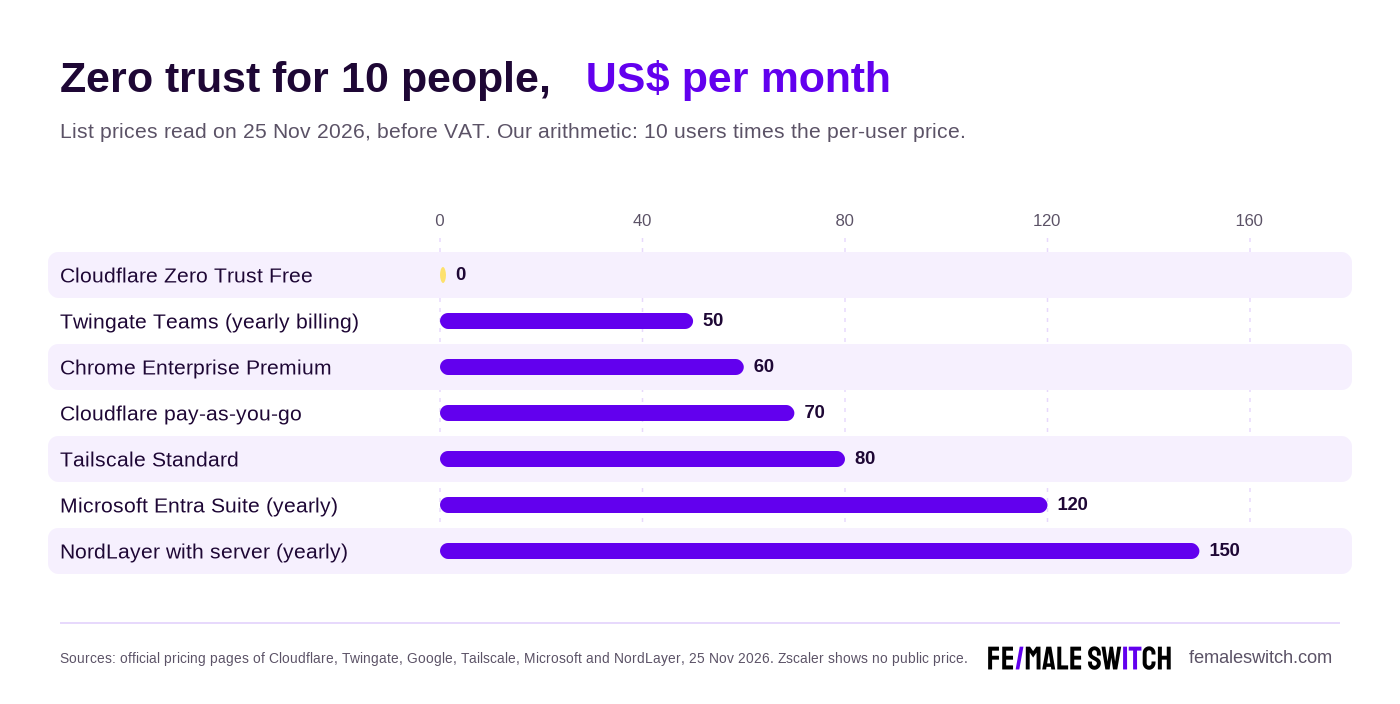
The free plans change the math. A team of up to 50 can start on Cloudflare at $0, and a team of up to 5 can start on Twingate Starter or NetBird for free. Tailscale's free Personal plan is for non-commercial use only, so a company starts on Standard.
Which zero trust tool fits which small team?
Cloudflare Zero Trust: the free plan to beat
Cloudflare's zero trust plans page lists a free plan for up to 50 users that includes the device client, ZTNA and the Secure Web Gateway for DNS and web filtering. Pay-as-you-go costs $7 per user a month with no user cap and logs kept up to 30 days; a contract plan adds six months of logs and log export.
Watch out: the free plan keeps logs for only 24 hours and comes with community support and no service guarantee. That is fine for a pilot; once a customer asks for an audit trail, plan for pay-as-you-go.
Tailscale: for teams that live in the terminal
Tailscale builds a private network between your laptops, servers and cloud machines, with access rules per person. Its pricing page shows Standard at $8 and Premium at $18 per user a month, billed monthly; yearly billing goes through sales. The older Starter plan has become Standard, and Tailscale's FAQ says that move raised the per-seat price slightly.
Watch out: the free Personal plan (6 users, unlimited devices) is for non-commercial use, so your startup can't run on it.
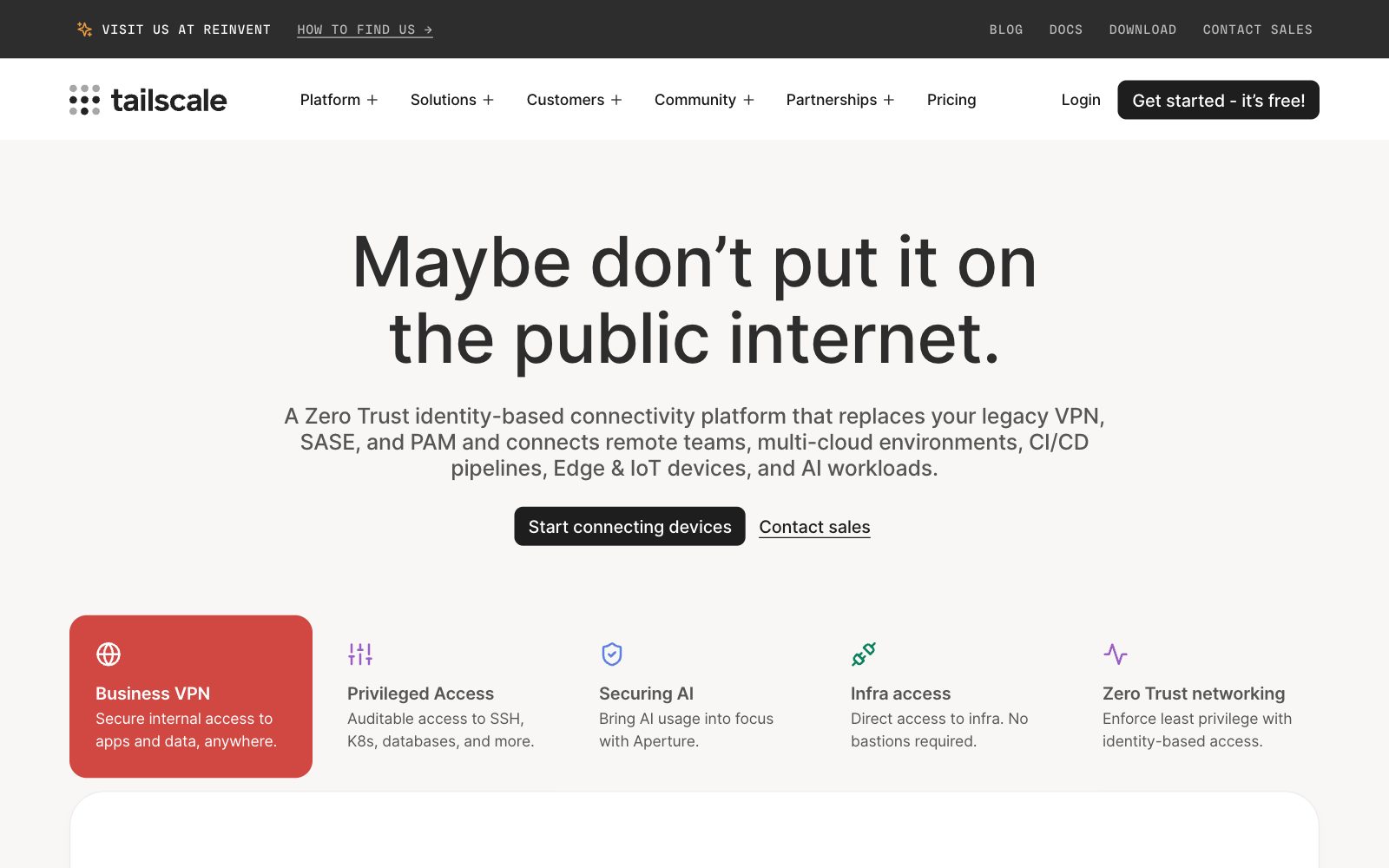
Twingate: the easiest VPN swap
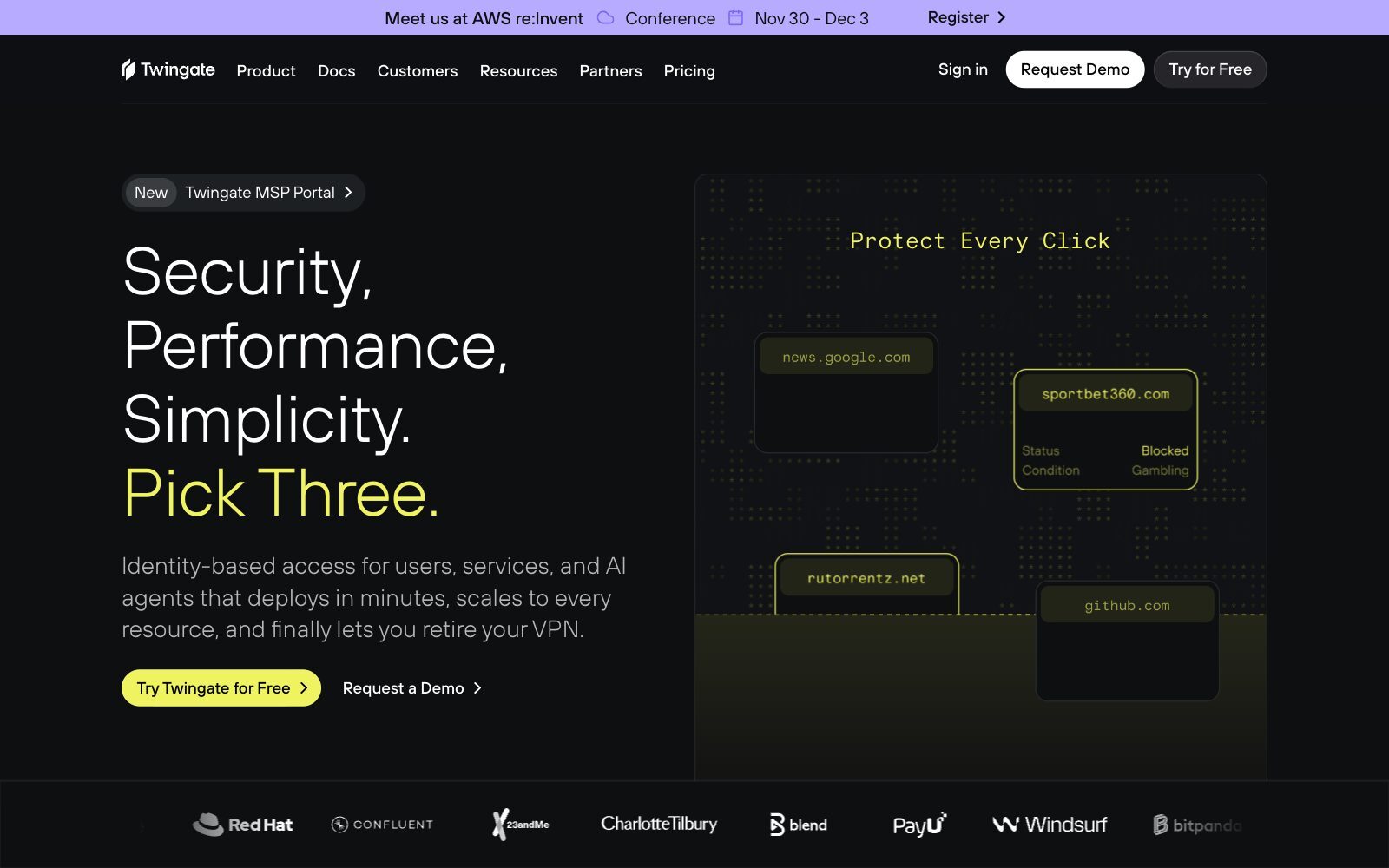
Twingate replaces a VPN with app-level access, and the company says it deploys in minutes. Its pricing page shows a free Starter plan for up to 5 users, Teams at $5 per user a month billed yearly or $6 billed monthly for up to 100 users, and Business at $10 yearly or $12 monthly for up to 500 users.
Watch out: on 25 November the comparison table lower on the same page listed $12 for Teams with monthly billing, while the plan card said $6. Confirm the price at checkout.
NordLayer: when you need a fixed company IP
NordLayer, from the company behind NordVPN, sells per-user plans with a 5-user minimum. On its plan page, Lite costs $8 billed yearly and covers internet security only. To reach private company resources you need one of the two higher plans, at $11 or $14 billed yearly, plus a dedicated server at $40 a month, so 5 users start at about $95 a month.
Watch out: NordLayer's main pricing page showed our tools a bot check, so these prices come from its plan selection page, and there is no homepage screenshot here.
Microsoft and Google: zero trust you may already pay for
If your team runs on Microsoft 365 Business Premium, you already have Entra ID P1, and the Microsoft Entra Suite adds Microsoft's private access and internet access tools for $12 per user a month on a yearly plan. Google teams can add Chrome Enterprise Premium for $6 per user a month, which brings context-aware access to SaaS and private web apps on top of the free Chrome Enterprise tier.
Watch out: these work best when everyone already lives in that one suite. Mixed Mac, Windows and Linux teams with servers in several clouds find a standalone ZTNA tool simpler.
Zscaler: the enterprise name in the deal
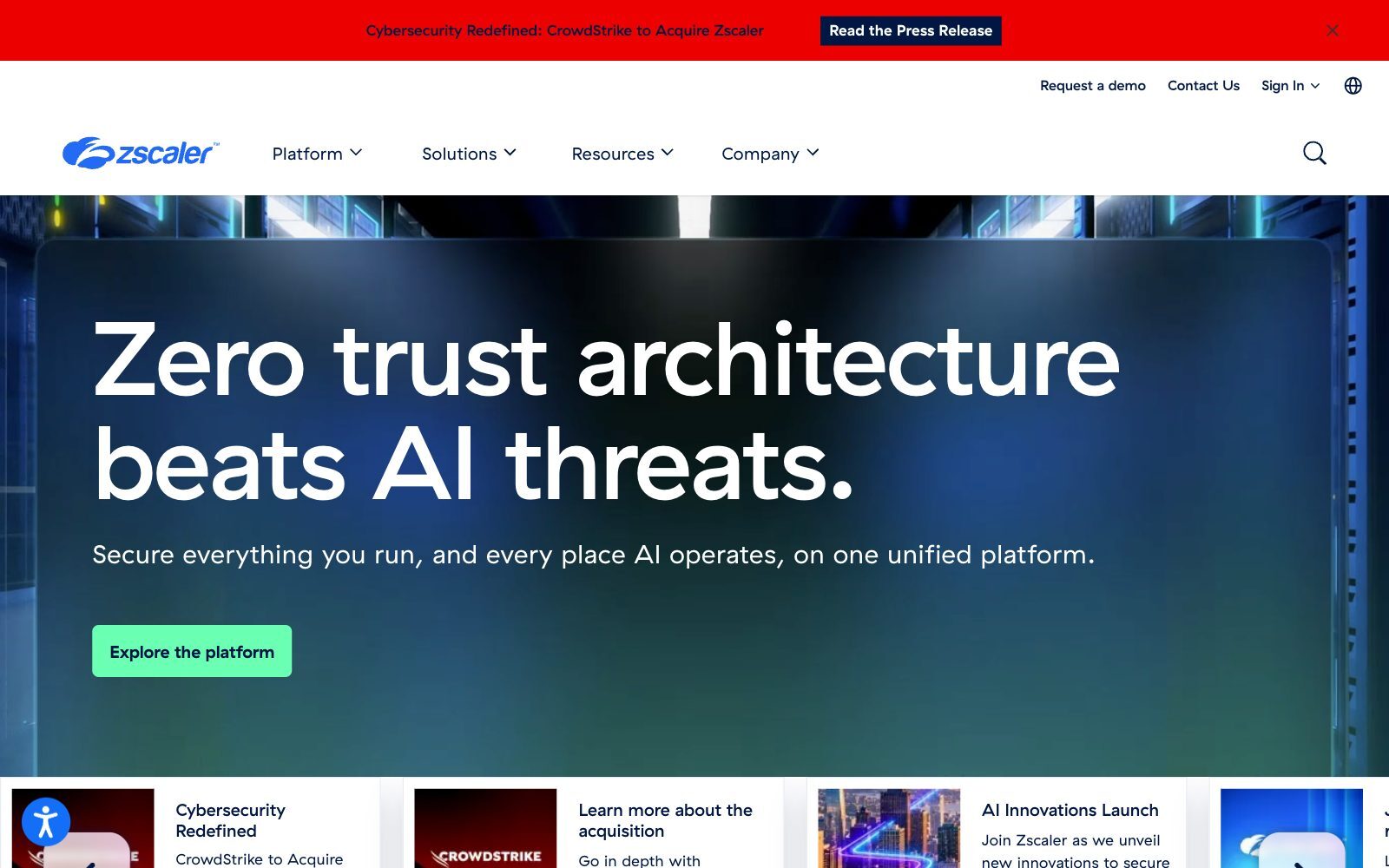
Zscaler's pricing and plans page shows no public prices; you request a demo. Its entry bundle covers web security plus private access for only 5% of users, and some features are sized from 500 users up. In August 2026 Zscaler announced small-business bundles sold through the reseller Carahsoft in the US, without published prices.
Until the deal closes, expected between August 2027 and January 2028, CrowdStrike and Zscaler run as separate companies with separate contracts. Greyhound Research analyst Sanchit Vir Gogia told Network World: "Consolidation is sold at the first signature and priced at the second." For a small team the lesson is simple: whichever vendor you pick, keep your setup portable and re-check the price at the first renewal.
In what order should a small team roll out zero trust?
Let's break it down into a plan you can finish in about a month, alongside normal work:
- Week 1, identity: move every tool to company accounts, switch on MFA for all, and remove shared logins. Put admin rights on separate accounts.
- Week 1, leavers: write a one-page checklist for when someone leaves, contractors included, and run it today for everyone who left this year.
- Week 2, devices: list every device, switch on disk encryption and automatic updates, and drop personal devices from admin work.
- Week 3, access: start a free plan (Cloudflare up to 50 users, Twingate or NetBird up to 5), connect one internal app, and move the team over app by app.
- Week 4, switch off the VPN: once every app works through ZTNA, turn the old VPN off. If you keep it, patch it the day a fix ships.
- Every quarter: review who has access to what, read the logs once, and check prices before any renewal.
What this means for you
- Team under 5, no servers: company accounts, MFA and a password manager cover most of your risk. Add Cloudflare's free plan for DNS filtering.
- 5 to 50 people with internal tools: start on Cloudflare Zero Trust Free or Twingate, and budget $50 to $70 a month per 10 people when you outgrow it.
- Developer-heavy team: Tailscale Standard for servers and databases, at $8 per user a month.
- Microsoft 365 or Google shop: price the Entra Suite or Chrome Enterprise Premium before you add another vendor.
- Already a CrowdStrike or Zscaler customer: nothing changes before closing; read our CrowdStrike Zscaler deal explainer before you sign a multi-year renewal.
Security work belongs in your product plan from day one, as our guide for freelancers on the PHP vulnerability showed during October's patch rush.
Build your first startup with an AI co-founder
The Fe/male Switch startup game takes you from idea to first paying customers in weekly quests, with an AI co-founder and a community of founders.
👉 Start the game
FAQ: zero trust for small business
Do small businesses need zero trust?
A team of 5 to 50 needs three things: one company identity with MFA, known and updated devices, and app-by-app access in place of a shared VPN. The enterprise SASE bundles are optional at this size.
Is there a free zero trust tool for small business?
Yes. On 25 November 2026 Cloudflare Zero Trust was free for up to 50 users, and Twingate Starter and NetBird were free for up to 5 users. Tailscale's free plan is for non-commercial use only.
How much does zero trust cost per user?
Paid entry plans ran from $5 per user a month (Twingate Teams, billed yearly) to $12 (Microsoft Entra Suite, yearly), before VAT. NordLayer adds a $40 server fee for private access.
Is zero trust a replacement for a VPN?
For staff reaching internal apps, yes: a ZTNA tool connects each person only to the apps they use. Some teams keep a VPN for a fixed IP address or legacy systems.
What does the CrowdStrike Zscaler deal change for small businesses?
Nothing before closing, expected between August 2027 and January 2028. The two companies keep running separately until then, and Zscaler shows no public small-business prices today.
Where should a startup start with zero trust?
Start with identity: company accounts, MFA for every person and a leaver checklist. Then secure devices, then add a ZTNA tool on a free plan and switch off the shared VPN.
About the Author
Violetta Bonenkamp, also known as MeanCEO, is an experienced startup founder with an impressive educational background including an MBA and four other higher education degrees. She has over 20 years of work experience across multiple countries, including 5 years as a solopreneur and serial entrepreneur. Throughout her startup experience she has applied for multiple startup grants at the EU level, in the Netherlands and Malta, and her startups received quite a few of those. She’s been living, studying and working in many countries around the globe and her extensive multicultural experience has influenced her immensely.

