

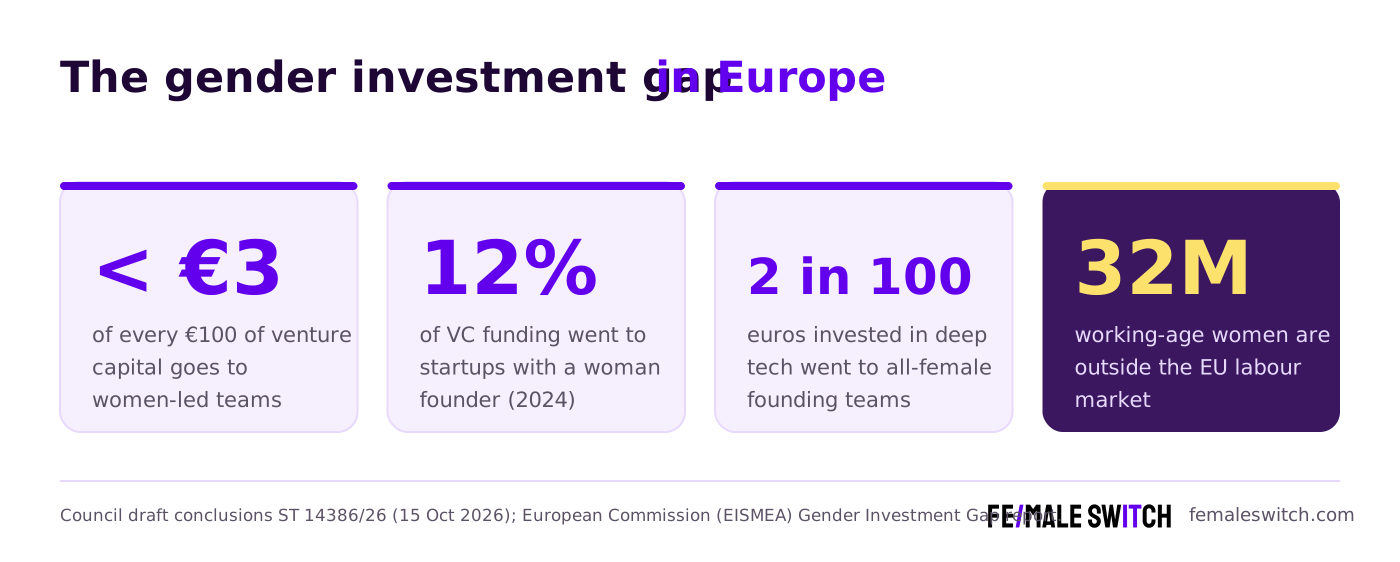
EU employment and equality ministers meet in Luxembourg today, 19 October, to approve a text that asks every member state to back women-led startups and to remove gender bias from investment decisions. The draft Council conclusions say that for every €100 of venture capital, less than €3 goes to women-led teams. They also ask the European Commission for an action plan for women in research, innovation and startups, and for a European Care Deal.
Cover photo: CoWomen on Unsplash.
What is happening today
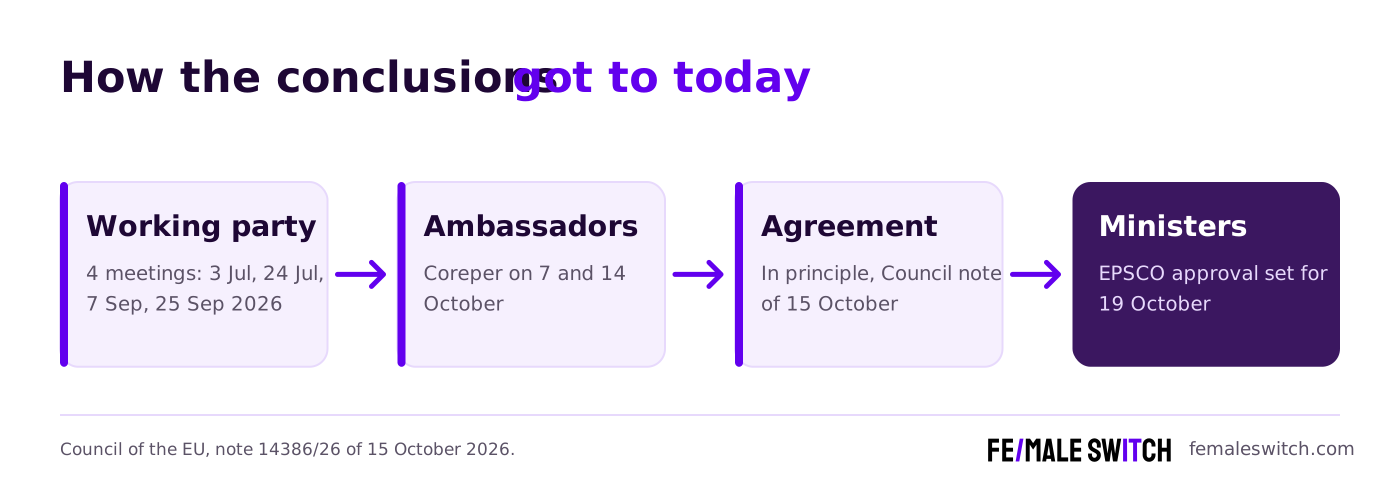
The Employment, Social Policy, Health and Consumer Affairs Council (EPSCO) meets in Luxembourg on Monday 19 October 2026. According to the Council's meeting page, ministers "will seek to approve conclusions on equality as a driver for economic growth and competitiveness in the EU". Three Irish ministers chair the meeting: Dara Calleary, Norma Foley and James Browne. The Commission is represented by Executive Vice-President Roxana Mînzatu and Equality Commissioner Hadja Lahbib.
Status: Proposed, with agreement in principle. The Council note of 15 October (document 14386/26) says the presidency "understands that an agreement in principle has been reached" on the text, and invites ministers to approve it at today's session. A press conference is planned for about 16:15. Council conclusions are political commitments, not binding law: they set out what governments agree to work towards and what they ask the Commission to do.
The Council's background brief sums up the idea: the conclusions "make the economic case for equality policy, arguing that discrimination is not merely unjust, but also wastes human potential". The text covers gender equality, LGBTI equality, disability, anti-racism, Roma inclusion and age discrimination. The gender section is the one that matters most for women founders.
What the text says about women founders
The draft makes the economic argument first. "Harnessing the potential of all women as workers, entrepreneurs, and leaders is imperative for the EU's economic growth," it says. It cites estimates that better gender equality could create up to 10.5 million jobs, lift the EU employment rate to 80% and raise GDP per capita by up to 9.6%, or €3.15 trillion, by 2050. About 51 million working-age people are outside the labour market, including about 32 million women.
On money, the text is blunt. "Venture capital distribution is starkly unequal: for every €100 invested, less than €3 goes to women-led teams," it says, citing a Commission study. It adds that research shows startups led by women "are economically more successful and resilient", referring to work by the European Investment Bank. Closing the gap, the draft says, "requires tackling gender bias in financial decision-making and improving women's access to business networks and investors".
Source: draft Council conclusions, Annex to document 14386/26, 15 October 2026. The note says the paragraphs were renumbered, so the final numbering may differ.
The numbers behind the "less than €3"
The figure comes from the Commission study on the gender investment gap, carried out for the EU's small business agency EISMEA and based on Dealroom data. Its foreword says that for every €100 of venture capital, less than €3 goes to women-led teams, "and only around 15€ to mixed teams". Other findings:
- In 2024, startups with at least one woman founder raised 14.4% of VC rounds and 12% of VC funding, up from 9.3% and 6.9% in 2015. Progress has stalled in the last five years, at about 14–15% of rounds and 10–12% of funding.
- In deep tech, 8 in 100 companies were founded by all-female teams, but they got only 2 in every €100 invested. All-male teams founded 78 in 100 and got €83.
- Across Europe, only 21.9% of deep tech companies and 19.3% of all tech companies have at least one woman founder.
- Women-led companies made up 30% of the EIC Accelerator portfolio in 2024, up from 8% in 2020, with €1.2 billion invested in them.
Country by country
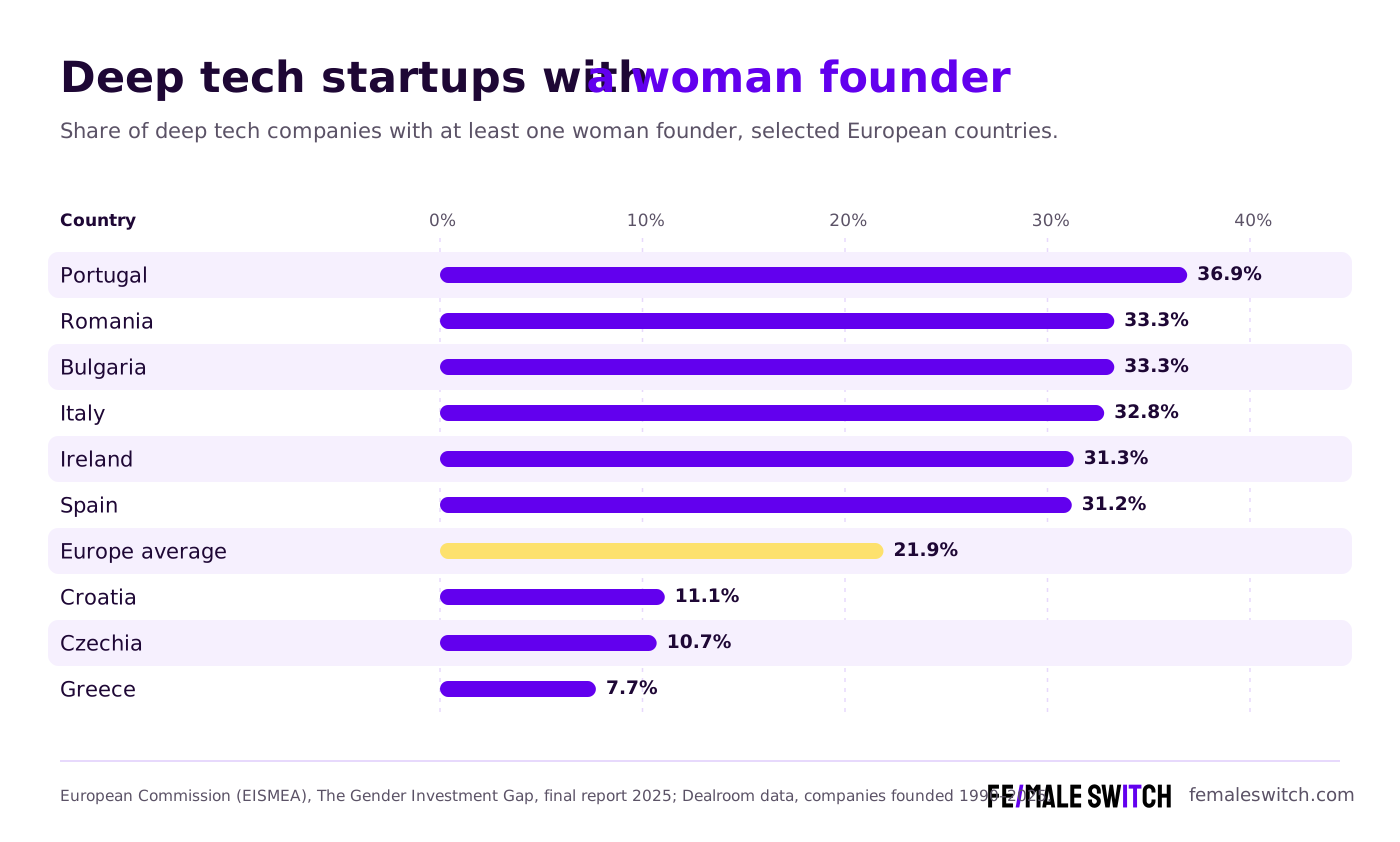
The study ranks countries by the share of deep tech companies with at least one woman founder. Portugal leads with 36.9%, followed by Romania and Bulgaria (33.3% each), Italy (32.8%), Ireland (31.3%) and Spain (31.2%). Greece (7.7%), Czechia (10.7%) and Croatia (11.1%) are at the bottom. The study says the countries below the average are "concentrated in Western and Central Europe (including France, Germany, Poland, and Czechia)". For all tech companies, Iceland (29.8%), Latvia (24.6%) and Portugal (23.9%) lead.
The same study points to three public investors that changed the picture on the investor side:
Source: European Commission (EISMEA), The Gender Investment Gap affecting both women-led companies and women-led investment funds, final report.
What happens next
- Today, 19 October: ministers are expected to approve the conclusions in public session, followed by a debate on "Delivering Equality in the European Union: Our Values in Practice". The final text and any changes will appear under "Outcome documents" on the Council's meeting page.
- Commission: the conclusions ask it to adopt the Action Plan for Women in Research, Innovation and Start-ups and to propose a European Care Deal. Neither has been published yet. Watch for dates in the Commission's work programme for 2027.
- Member states: conclusions don't set deadlines. Whether governments act will show in national budgets, state investment funds and startup programmes.
What this means for you
- If you're raising money, the gap is real and documented at the highest level. Plan for it: stack grants, angels and loans, as our guide to female founder funding and our list of grants and funding for female entrepreneurs explain.
- If you're in deep tech, EU money is already there. Women TechEU gives €75,000 in non-dilutive funding to 160 women-led deep tech startups in its 2026–2028 edition; see the next Women TechEU deadline. Read about deep tech opportunities for female founders.
- If you're talking to investors or banks, the conclusions give you a reference point. Ask funds whether they track gender data, the way Iceland and Sweden do, and see how female founders in Europe are closing the funding gap.
- If you're self-employed and planning a family, the text asks governments to tackle pregnancy-related discrimination and to support all care-givers. In Germany, self-employed women still have no statutory maternity pay.
For the wider picture, see women in tech startups and the gender gap and our female entrepreneurship statistics.
FAQ
What are the EU Council conclusions on equality as a driver for growth?
A political text that EU employment and equality ministers are set to approve on 19 October 2026 in Luxembourg. It argues that discrimination wastes human potential and harms the economy, and it sets out measures on gender equality, LGBTI equality, disability, anti-racism, Roma inclusion and age.
Are the conclusions binding?
No. Council conclusions are political commitments. They ask member states and the Commission to act, but they don't create legal obligations or deadlines.
How much venture capital goes to women-led startups in Europe?
Less than €3 of every €100, according to a Commission study cited in the conclusions. Startups with at least one woman founder got 12% of VC funding in 2024, and all-female teams got about 2 in every €100 invested in deep tech.
What do the conclusions ask member states to do for women founders?
Support women's entrepreneurship and fairer access to finance, including mentoring; act against gender bias in investment decisions; support women-led startups; and work with banks and investment funds, including training their staff on gender bias.
What do they ask the European Commission to do?
Adopt an Action Plan for Women in Research, Innovation and Start-ups, expand gender-smart financing targets, improve access to finance for women entrepreneurs, and propose a European Care Deal.
Which European countries have the most women-founded deep tech startups?
Portugal (36.9% of deep tech companies have at least one woman founder), Romania and Bulgaria (33.3%), Italy (32.8%), Ireland (31.3%) and Spain (31.2%). The European average is 21.9%.
About the Author
Violetta Bonenkamp, also known as MeanCEO, is an experienced startup founder with an impressive educational background including an MBA and four other higher education degrees. She has over 20 years of work experience across multiple countries, including 5 years as a solopreneur and serial entrepreneur. Throughout her startup experience she has applied for multiple startup grants at the EU level, in the Netherlands and Malta, and her startups received quite a few of those. She’s been living, studying and working in many countries around the globe and her extensive multicultural experience has influenced her immensely.

