

Business model canvas game: how to run one with your team, and which ready-made games are worth it
A business model canvas game turns the nine blocks of the Business Model Canvas into timed rounds, cards or a board, so a team builds and tests a business model together instead of filling in a template alone. You can buy one (board and card games such as LEAP, or a facilitated simulation), or run your own with a printed canvas, sticky notes and the five rounds below. For a startup team working on its own idea, the DIY version is free and usually more useful.
Quick answer: print a large canvas, give each customer segment its own sticky-note colour, and play five timed rounds: customers, value propositions, the remaining blocks, scoring strengths and weak spots, and a pivot round where you change one block and redraw. About 65 to 90 minutes for a team of 3 to 6. Buy a ready-made game when you're teaching a group with little business experience.
Try our FREE AI Business Model Canvas generator to automatically create a BMC by answering just two questions. You will get an editable Google Presentation and an extensive guide on what to do next.
What a business model canvas game is (and isn't)
The canvas has nine blocks: customer segments, value propositions, channels, customer relationships, revenue streams, key resources, key activities, key partners and cost structure. A game adds three things a blank template doesn't have: a time limit, rules for who adds what, and a moment where the team has to judge and change the model. That last part is where founders learn the most, because it forces you to say out loud which block is weakest. If the blocks themselves are new to you, start with our step-by-step guide on how to create a business model canvas.
It isn't a quiz. Classroom quiz templates that ask "which block does revenue go in?" test vocabulary; a canvas game makes you design something. Both have a place in teaching, but only the second helps a startup.
How to play: rules for a 5-round business model canvas game
These rules follow the order Alex Osterwalder describes in the Mapping Business Models game on Gamestorming: customer segments first, value propositions next, then the rest of the canvas, then an assessment and new versions. We've added time limits and a pivot card so it works as a game for a startup team.
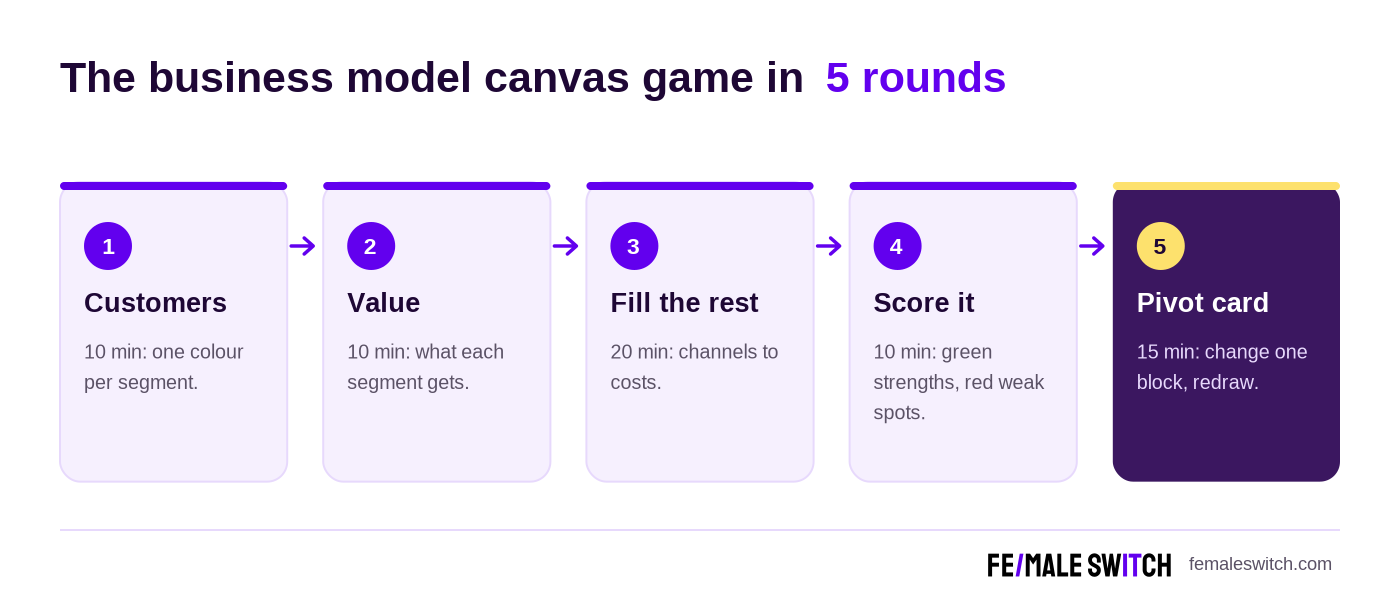
Round 1: customers (10 minutes)
Each player writes customer segments on sticky notes, one colour per segment. A group counts as a separate segment if it has different needs, needs a different offer, or is reached through a different channel. Merge duplicates and stop at three segments; more than that usually means you haven't chosen yet.
Round 2: value propositions (10 minutes)
For each segment, write what it gets from you, on a note of the same colour. If one proposition serves two segments, mark it with both colours. Our comparison of the business model canvas and the value proposition canvas helps if the team wants to go deeper on this block.
Round 3: the remaining blocks (20 minutes)
Fill channels, customer relationships, revenue streams, key resources, key activities, key partners and costs, using the colour of the segment each note belongs to. Rule: every note must be something the team could check this month. "Social media" doesn't count as a channel; "Instagram posts to Dutch freelance designers" does.
Round 4: score it (10 minutes)
Each player gets three green and three red dots (or + and - notes) and places them on the strongest and weakest notes, without discussion. Then talk only about the notes with the most red. This is the step that turns a filled-in template into a decision.
Round 5: the pivot card (15 to 30 minutes)
Draw a pivot card, or let the facilitator pick one: change the customer segment, remove a revenue stream, lose your key partner, halve your costs, switch from one-off sales to subscription. On a second canvas, redraw the model with that change. Compare both versions and agree on one experiment to run next week. Browsing business model canvas examples or the different types of business model canvas makes good material for pivot cards.
Photograph every canvas before anyone takes notes down. Variations: play it alone in 15 minutes as a napkin sketch of an idea, map a competitor's model, or map an inspiring business from another industry, as the Gamestorming description suggests.
Ready-made business model games compared
If you'd rather buy a game or book a facilitated session, these are the options we could check on their official pages. Prices change, so confirm before you order.
Source: official pages of LEAP, Wedesignthinking and Innovative Dutch, and the Gamestorming rules, checked 18 November 2026.
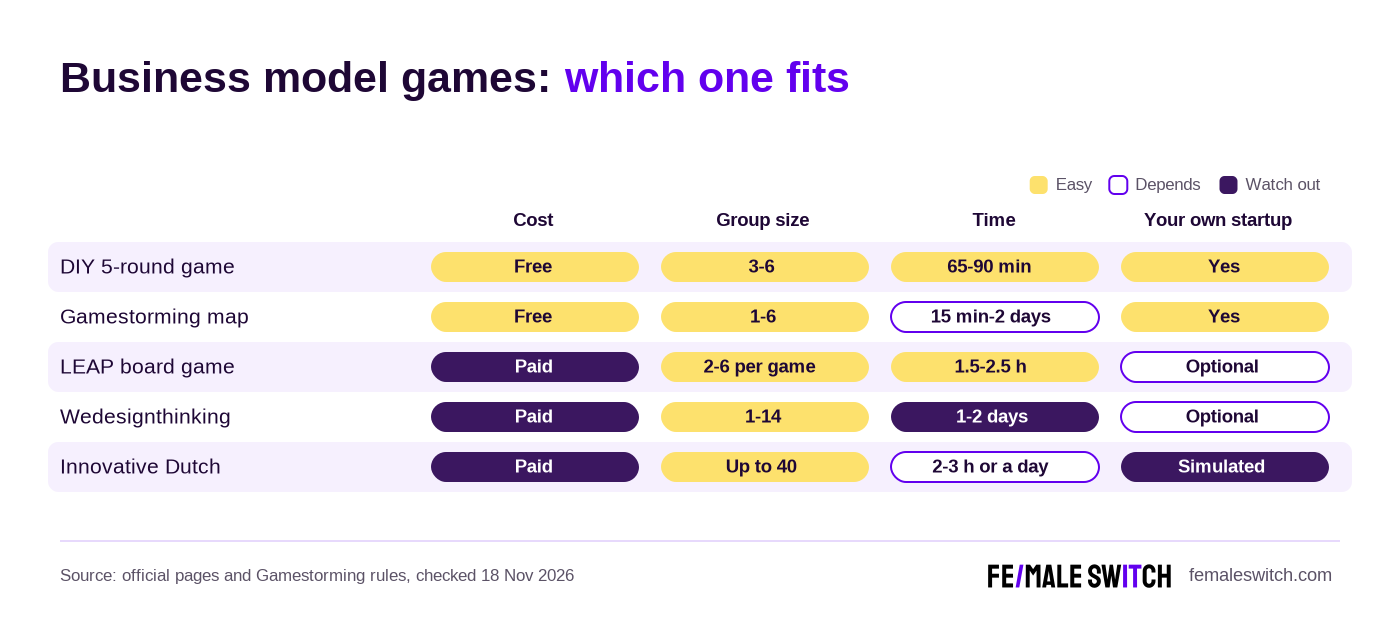
Innovative Dutch's older "Business Model Game" page now leads to its Entrepreneurship Game, which focuses on customer research rather than the full canvas. If you want to practise the whole startup journey on your own idea, the Fe/male Switch startup game is our own option: it's built for women entrepreneurs, and you work with an AI co-founder from problem to first customer.
Business model canvas workshop: the facilitator kit
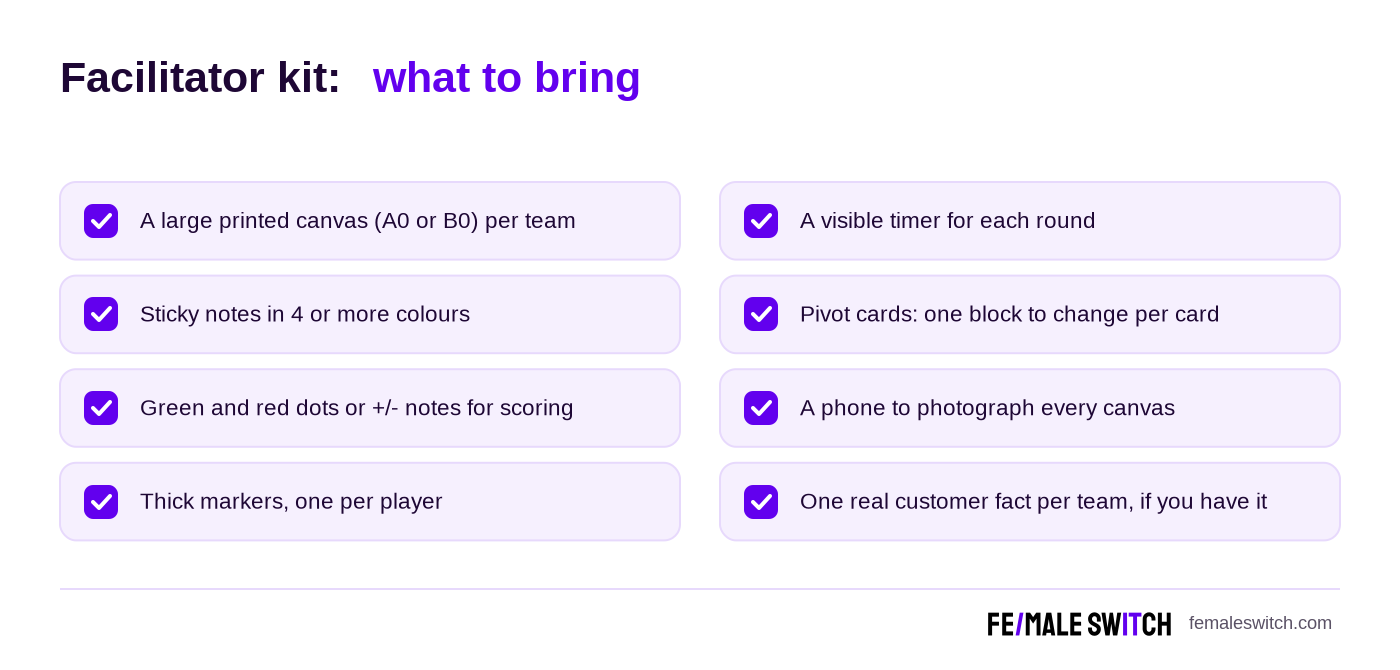
The Gamestorming rules recommend a very large poster, ideally B0 (1000 x 1414 mm), so the whole team can stand around it. A0 works for smaller groups. For remote teams, any whiteboard tool with sticky notes does the same job; set one colour per segment before you start. If you work on a startup that's still at the idea stage, the lean canvas template swaps some blocks for problem, solution and key metrics, and the same five rounds work on it.
Mistakes that make canvas games a waste of time
- Playing with a hypothetical company. Games with made-up businesses teach the blocks; they don't move your startup. Use your own idea as soon as the group knows the canvas.
- No scoring round. A full canvas feels like progress. Without the green and red round, nobody admits which block is a guess.
- Too many segments. Five colours of customers on one canvas means no clear value proposition for any of them.
- Vague notes. "Partnerships" or "marketing" can't be tested. Every note should name who, where or how much.
- Ending without an experiment. The session should end with one assumption to test with real customers next week, not with a photo for the shared drive.
- Buying a game for a team of two. Board games shine with groups. Two co-founders get more from a printed canvas and an honest hour.
Why games work at all is a good question; The Gamer's Brain summary explains how game design keeps people engaged, which is the same reason a timer and cards beat a blank template. For more filled-in canvases to learn from, see the business model canvas examples on the Fe/male Switch blog.
Unlock Your Business Potential with Free F/MS AI Business Model Canvas Tool
Tired of overwhelming templates? The Free F/MS AI Business Model Canvas Tool simplifies the process by requiring only two key insights. Generate a tailored BMC quickly and receive actionable validation tips. Ideal for startups looking to streamline their planning process. Try it now →
FAQ on business model canvas games
What is a business model canvas game?
It's a way of filling in the Business Model Canvas as a team using rounds, time limits, cards or a board. Instead of one person completing a template, players build the model together, score it and change it.
How long does a business model canvas game take?
A DIY session with five rounds takes about 65 to 90 minutes for 3 to 6 people. Alone, a quick napkin sketch takes 15 minutes. Mapping a company's existing model can take half a day, and LEAP lists 1.5 to 2.5 hours per game.
How many players do you need?
One to six per canvas works best. Bigger groups should split into teams of 3 to 6 with a canvas each and compare their models at the end.
Is there a free business model canvas game?
Yes. The Mapping Business Models rules published on Gamestorming are free, and all you need is a printed canvas, sticky notes and markers. The five-round version in this guide uses the same materials.
What's the best business model game for students?
For classes, a ready-made game such as LEAP gives students prompt cards and a facilitator guide, which helps when they know little about business. Once they understand the blocks, let them play the DIY version on their own project ideas.
How do I run a business model canvas workshop online?
Use a whiteboard tool with a canvas background and sticky notes, assign one colour per customer segment before you start, show a timer on screen, and let players vote with green and red dots in round four.
Business model canvas or lean canvas for a game?
Use the lean canvas for an idea that has no customers yet, because it asks for the problem, solution and key metrics. Use the business model canvas for a business that already sells or is close to selling.
What should come out of a canvas game?
A photographed canvas, a list of the weakest assumptions, and one experiment to run with real customers in the next week.
About the Author
Violetta Bonenkamp, also known as MeanCEO, is an experienced startup founder with an impressive educational background including an MBA and four other higher education degrees. She has over 20 years of work experience across multiple countries, including 5 years as a solopreneur and serial entrepreneur. Throughout her startup experience she has applied for multiple startup grants at the EU level, in the Netherlands and Malta, and her startups received quite a few of those. She’s been living, studying and working in many countries around the globe and her extensive multicultural experience has influenced her immensely.

