
TL;DR: Is Claude Personal Finance useful for freelancers and small business owners?
Claude Personal Finance helps if your own money and your work money meet in the same accounts, as they do for most freelancers. It launched on 5 November 2026 for Pro, Max and Ultra subscribers in the US, reads balances and up to 24 months of transactions through Plaid, and can't move a cent. Use it to find subscriptions, spot fees, plan around uneven income and set tax money aside. Keep invoicing and bookkeeping in proper tools.
Claude personal finance became a search trend the morning after Anthropic switched the feature on, and MeanCEO has the full story of what Claude Personal Finance reads and who gets it. This guide skips the launch news and answers the practical question for freelancers, sole traders and solo business owners: how to set it up without regrets, which accounts to link, and what to ask once your money sits in front of an AI.
Can freelancers and small business owners use Claude Personal Finance?
Yes, if you are in the US and pay for Claude Pro, Max or Ultra. The Claude Help Center says the beta isn't on the Free, Team or Enterprise plans, so a business that runs Claude on a Team plan has to use a personal subscription for this. Anthropic describes it as a personal finance hub, and its pages don't mention business accounts. For a sole trader that line is blurry anyway: your client payments land in the same checking account as your groceries. Outside the US the hub doesn't appear at all, even on a VPN: read what founders in Europe can do instead.
Sources: Claude Help Center and claude.com/pricing, read 6 November 2026. ChatGPT's finance tab, for comparison, is on every US plan, the free one included. If you are choosing an assistant for the whole business, our guide to the AI tools in a founder's stack compares the options.
How do you set up Claude Personal Finance safely?
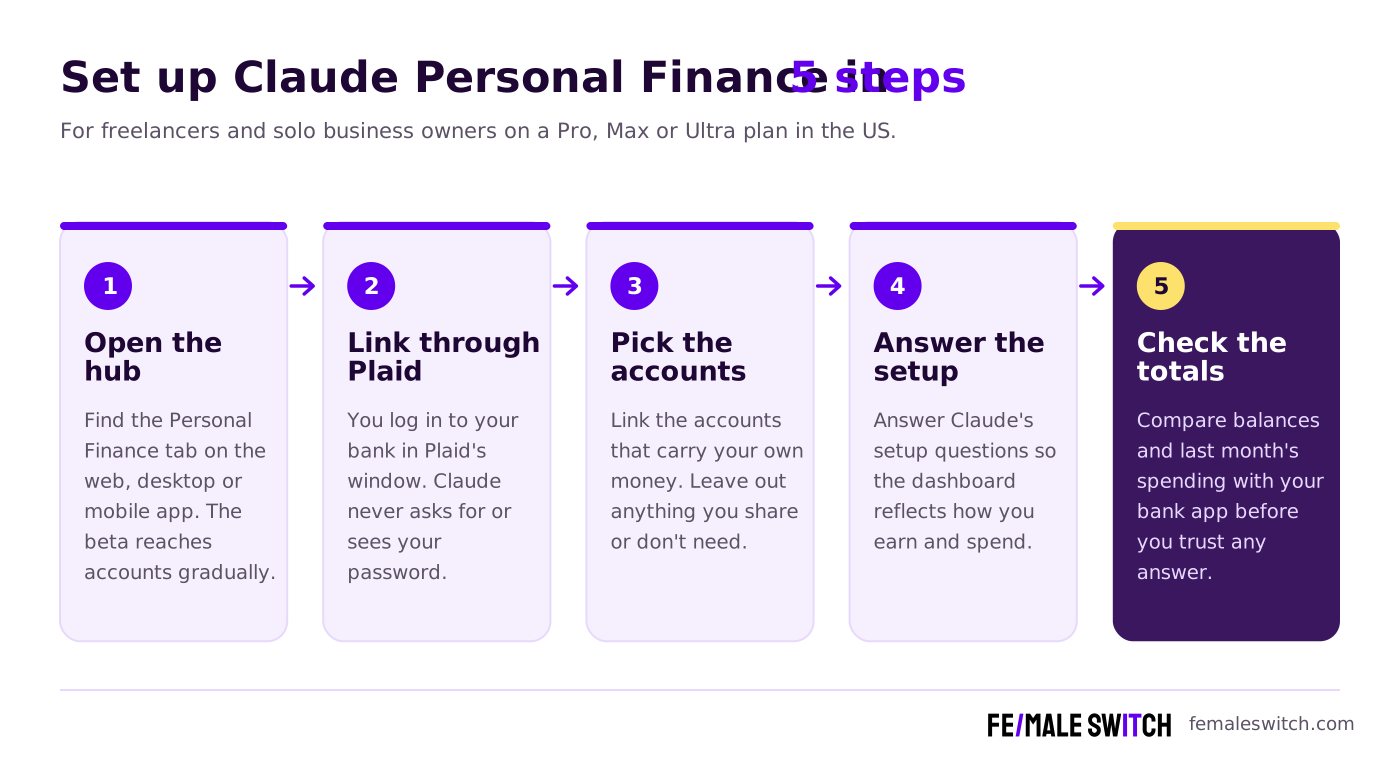
Setup is short. The one rule that matters: your bank password goes to Plaid, the connection service, and never into a chat.
That password rule is the difference from the agents US banks are fighting. Two weeks ago we explained who pays when an AI agent moves money with your bank login: the answer was you. Claude's hub is read-only, so it can't move money in the first place.
Which accounts should a sole trader link?
Claude can link bank, credit card, loan and investment accounts, up to 16 banks. Link with a purpose, because every account you add becomes part of every answer.
Our rule of thumb: link the accounts where your own money moves, and leave out anything that needs someone else's consent. If you haven't split work and personal money yet, start with online bookkeeping for solopreneurs.
What should you ask Claude about your money?
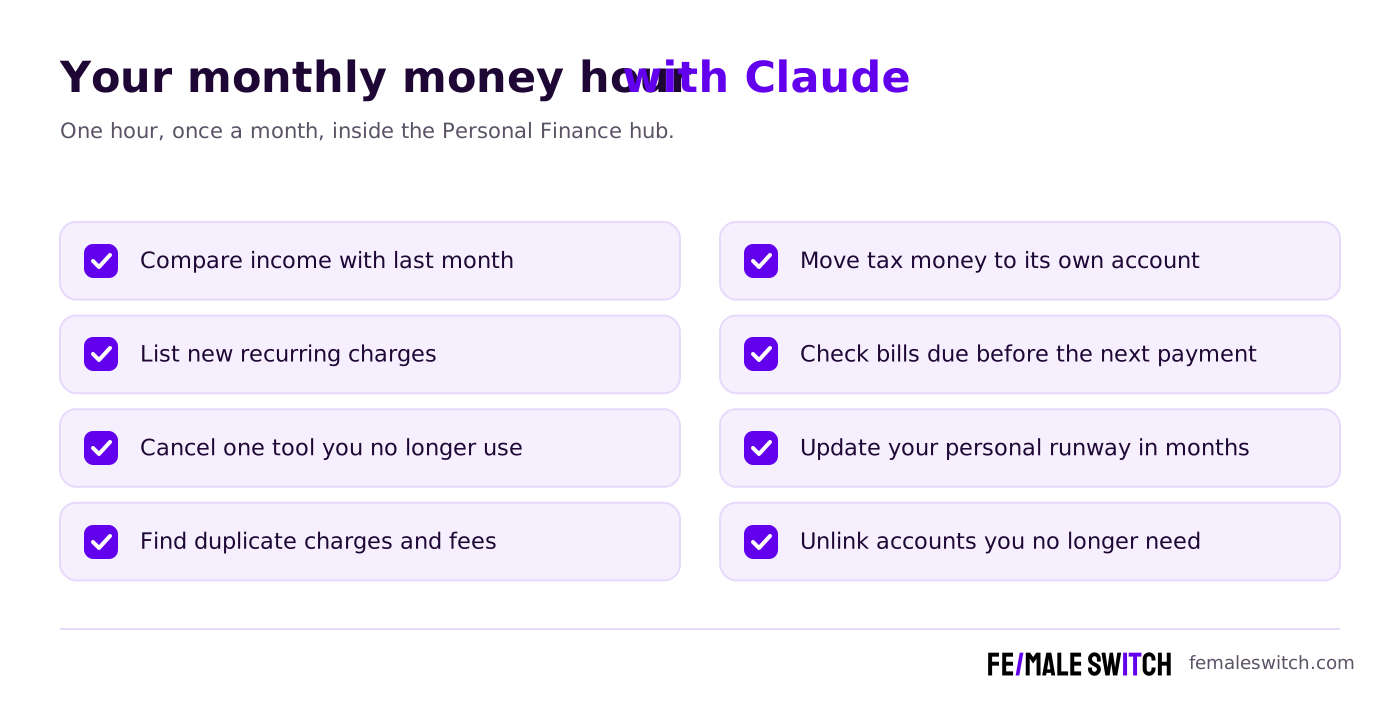
The dashboard covers spending, cash flow, subscriptions and upcoming bills. The real value is in follow-up questions. Here are the ones we would ask first as a freelancer:
- Uneven income: "What was my lowest income month in the last 24 months, and my average?" Pay yourself a fixed amount close to the low month and let the good months fill a buffer.
- Subscriptions: "List every recurring charge, sorted by size." Claude sees the charges; you decide which tools you still open.
- Fees: "Which bank fees, foreign transaction fees or late fees did I pay this year?"
- Duplicates: "Did any merchant charge me twice in the same week?" Anthropic names duplicate charges as one of the things the hub is built to spot.
- Tax set-aside: "How much did clients pay me last quarter, and how much did I move to my tax savings account?" Ask your accountant for the percentage; Claude can check you followed it.
- Bills calendar: "Which bills fall before my next client payment is due?"
- Pricing check: "What do I spend a month to keep the business running?" That number is your floor when you set rates.
- Runway: "If no client paid me next month, how many months could I cover my spending?"
Keep these chats inside the Personal Finance hub. Anthropic says chats there aren't used to train its models and aren't saved to memory; chats outside the hub follow your normal privacy settings.
What can't Claude Personal Finance do for your business?
- Move money: no payments, transfers or trades, by design.
- See what you hold: investment, loan and card accounts show balances only, with no holdings, rates or loan terms.
- Replace your bookkeeping: it reads bank data. It doesn't send invoices, track what clients owe you or file anything.
- Give investment advice: Anthropic says the hub isn't designed for that.
- Work outside the US: no date has been given for Europe, the UK or anywhere else.
For the bookkeeping side, compare an AI bookkeeping assistant with the hub. For a wider view of what AI money tools promise, see our list of the benefits of AI personal finance tracking.
If you tried OpenAI's version first, our guide to GPT-6.1 Terra for small business shows which admin jobs ChatGPT now handles, and how to set approval rules for them.
Turn your skills into your first startup
The Fe/male Switch startup game takes you from idea to first paying customers in weekly quests, with an AI co-founder and a community of founders.
👉 Start the game
FAQ: Claude Personal Finance for freelancers
Can I connect my business bank account to Claude Personal Finance?
Anthropic built the hub for personal finances and its pages don't mention business accounts. Sole traders whose client payments land in a personal account get the most from it; keep your company books in a bookkeeping tool.
Is Claude Personal Finance on the Claude Team plan?
No. The beta is on the Pro, Max and Ultra plans in the US only. Free, Team and Enterprise accounts don't get it.
Can Claude Personal Finance pay my bills?
No. Access is read-only through Plaid, so Claude can't make payments, transfers or trades. It can show you which bills are coming up.
How far back does Claude Personal Finance read my transactions?
Up to 24 months, with the amount, date, merchant, category and description of each transaction.
Does Claude remember my bank data in other chats?
Anthropic says chats that used account data aren't saved to memory and are left out of the monthly recap, and chats inside the hub aren't used for training.
How do I stop Claude reading my bank account?
Unlink the bank under Manage linked accounts in the Personal Finance hub, or revoke access at my.plaid.com. Unlinking the last bank deletes the dashboard.
About the Author
Violetta Bonenkamp, also known as MeanCEO, is an experienced startup founder with an impressive educational background including an MBA and four other higher education degrees. She has over 20 years of work experience across multiple countries, including 5 years as a solopreneur and serial entrepreneur. Throughout her startup experience she has applied for multiple startup grants at the EU level, in the Netherlands and Malta, and her startups received quite a few of those. She’s been living, studying and working in many countries around the globe and her extensive multicultural experience has influenced her immensely.
