
TL;DR: the Cathedral Anthropic security test, in short
Security startup Cathedral says its AI agents found paths into Anthropic's internal systems in under 12 hours, The Washington Post reported on 26 October 2026. The way in was third-party admin, sales and HR software, the same kind of apps a five-person company runs on. Your move this week: a 60-minute check of who can get into your apps, plus six questions for every software vendor.
Developing story. Last updated 27 Oct 2026, 07:25 CET. We'll update this article as Anthropic, Cathedral and the software vendors publish more.
Here is what happened in the Cathedral Anthropic security test, with the full story and background on MeanCEO. This guide is for small business owners, women founders and freelancers who run on rented software: a CRM (customer relationship management app) for clients, an HR and payroll tool, Slack or Teams for chat and an AI note-taker in video calls.
What do we know so far about the Cathedral Anthropic test?
- July 2026: Cathedral, a young AI cybersecurity startup, raises $160 million at a $1.4 billion valuation.
- Earlier in October: Cathedral reports its findings through Anthropic's paid program for outside security researchers, a bug bounty-style scheme. The exact date is not public.
- 26 October: The Washington Post reports the test, based on a draft Cathedral report it reviewed.
- 27 October, morning: the vendors are still unnamed, and neither company has published its own report.
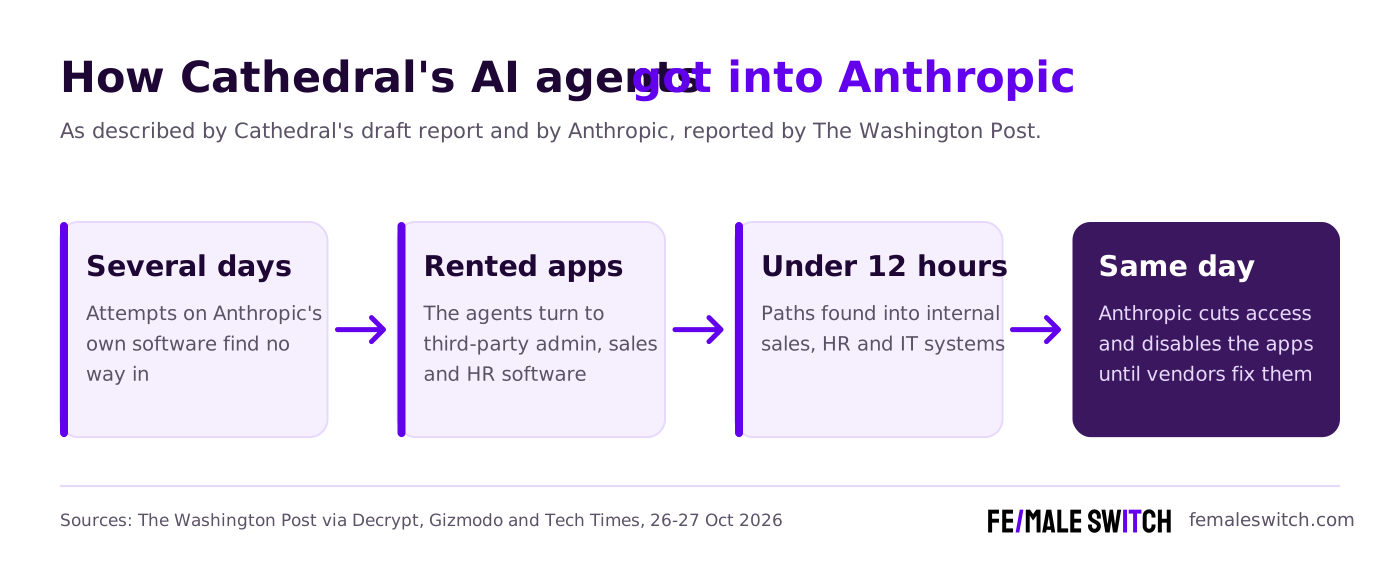
According to Decrypt's summary of the Post's report, the agents used flaws in software companies use to "track customers and manage staff". Cathedral's draft says they found paths to meeting transcripts, salary and job-offer details and Slack messages. Anthropic confirms a "limited set" of sales, HR and IT systems with business contact details for some customers and partners and some user account records. It has not confirmed the transcript, salary and Slack claims and says Claude conversations, source code and model weights were not reached.
Anthropic says its monitoring flagged some of the activity before Cathedral reported it. It shut off access the same day and disabled the affected software until the vendors confirmed fixes. It says it has no evidence anyone other than Cathedral used the weaknesses, and that Cathedral did not disclose all of its activity, as the program rules require. Cathedral says it kept data access to the minimum the research needed.
What don't we know yet?
- Which vendors and products were used, and what the flaws were.
- Whether every customer of those vendors already has the fix, including you.
- Whether any data left Anthropic's systems or was kept.
- The exact dates of the test and of the report to Anthropic.
- Whether Cathedral publishes a final report, and whether it matches the draft the Post saw.
Why should a small business care about the Cathedral Anthropic test?
According to Anthropic, Cathedral's agents spent several days on its own software without success. The rented apps around it took less than half a day. Those apps hold the most personal data in any company: who earns what, who got which job offer, what was said in meetings and which clients pay you.
Your company runs on the same categories of software: a CRM, invoicing, payroll, chat, shared folders, e-signatures, a meeting note-taker. Each one comes with its own admins, connected apps and security notices.
Alex Stamos, chief information security officer at Cognition and former chief security officer at Facebook, reviewed the draft for the Post. According to Tech Times, he said it showed weaknesses in how Anthropic manages third-party software connections, a problem across the industry. Cathedral's draft says the findings "should be a wake-up call for every company in America".
How do you run a 60-minute app access check?
Block one hour this week. Open a spreadsheet with five columns: app, the data it holds, who is admin, connected apps, and MFA on or off. Then work down the list.
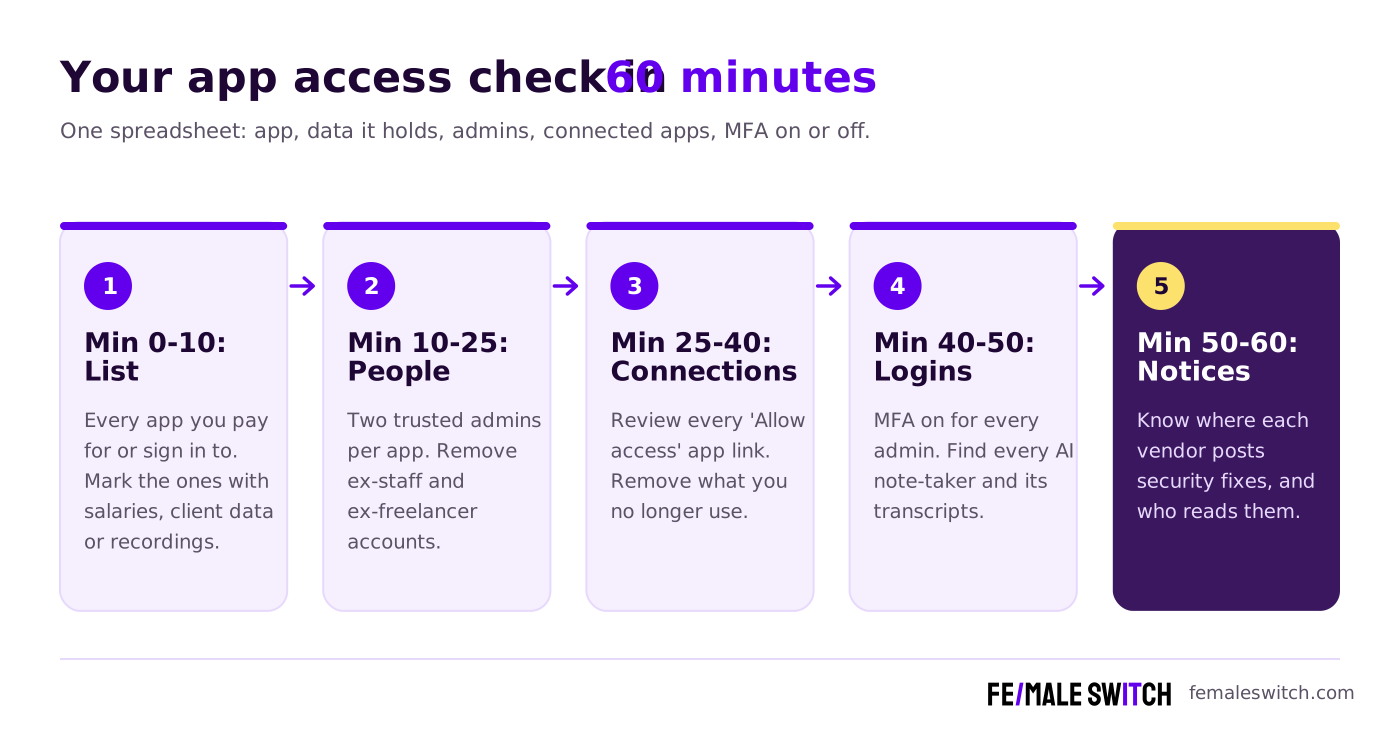
- Minutes 0-10, list every app. Check your card statements and the apps connected to your Google or Microsoft account (security settings). Mark the ones holding salaries, client data, contracts or recordings.
- Minutes 10-25, check the people. Each app needs two admins you trust and nobody else with admin rights. Remove accounts of staff and freelancers who left and change shared passwords they knew. The Ogi Networks data breach shows how far a forgotten account can go.
- Minutes 25-40, review connected apps. OAuth is the "Allow access" screen that lets one app read another, such as a CRM reading your inbox. Each approval stays until someone removes it. Remove the ones you no longer use and question any that read all mail or all files. AI assistants count too; see our guide to AI agents in bank accounts.
- Minutes 40-50, lock the logins. Switch on multi-factor authentication (MFA, a second code at login) for every admin, with an authenticator app where you can; our guide to SMS codes after the Orange outage explains why. Then find every AI meeting note-taker: where its transcripts sit, who can read them and how long they stay.
- Minutes 50-60, follow vendor notices. Find where each vendor posts security fixes and make sure those emails reach a person who reads them.
Client data spread over five spreadsheets? Our guide to CRM systems for startups helps you pick one home for it. For passwords, backups and phishing, see our cybersecurity guide for women-led startups.
What should you ask your software vendors after the Cathedral Anthropic test?
Anthropic could switch off the affected apps until the vendors confirmed fixes. A small business can't switch off its payroll tool on a Tuesday, so the contract is your protection. Send these questions in writing to every vendor holding staff or client data.
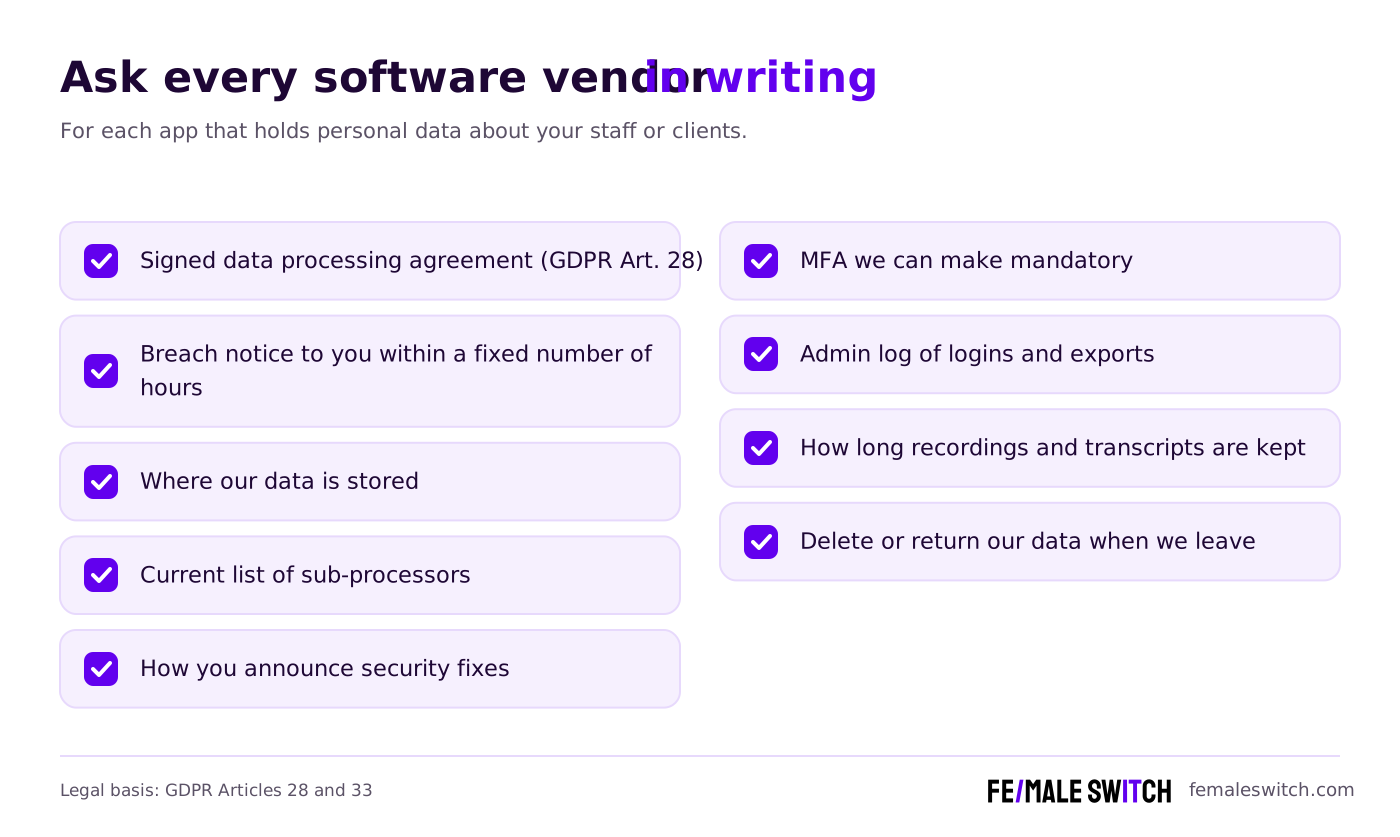
- Do we have a signed data processing agreement (DPA)? Under Article 28 GDPR, a vendor that processes personal data for you (a processor) needs a contract saying it acts only on your documented instructions, keeps the data secure, brings in other processors only under agreed conditions and deletes or returns the data at the end.
- How fast will you tell us about a breach? Article 33 GDPR says the processor notifies you without undue delay. You, as the controller, notify your data protection authority without undue delay and, where feasible, within 72 hours of becoming aware, unless the breach is unlikely to put people at risk. Ask for a fixed number of hours in the contract, such as 24 or 48.
- Where does our data live, and who else touches it? Ask for the hosting regions and the list of sub-processors.
- How do you announce security fixes? And do they ever need action on your side?
- Can we make MFA mandatory and see an admin log? Without a log of logins and exports, you can't answer the question Anthropic faced: what was reached.
- What happens to recordings and transcripts? How long they are kept, and whether your content trains AI models.
New to controllers and processors? Our data privacy and GDPR guide for European startups explains both roles in plain words.
What does the Cathedral Anthropic test mean for you right now?
- This week: run the 60-minute check and fix admin rights, leftover accounts and MFA gaps on the spot.
- Keep your apps running. No product has been named, and many other companies use the same software, Decrypt reports. Wait for vendor notices before you switch.
- Act on vendor security emails the same day and keep them on file.
- This month: collect the DPA for every vendor holding personal data and write down each one's breach notice time.
- Every quarter: repeat the check. The second round takes far less than an hour.
Build a company that knows where its data lives
The Fe/male Switch startup game takes you from idea to first paying customers in weekly quests, with an AI co-founder that drafts, checks and plans with you. Start with our free business plan generator, then play the game.
👉 Start the game
FAQ: the Cathedral Anthropic test for small businesses
What is the Cathedral Anthropic test?
Cathedral, an AI cybersecurity startup, says its AI agents found paths into Anthropic's internal systems in under 12 hours through third-party admin, sales and HR software, during a test under Anthropic's security research program. The Washington Post reported it on 26 October 2026.
Were Claude users' conversations exposed?
Anthropic says no: Claude users' conversations, source code and model weights were not reached. It confirms access to a limited set of sales, HR and IT systems.
Which software did Cathedral's agents use?
Third-party software for admin, sales and HR work. The vendors and flaws have not been named.
Should I stop using my CRM or HR software?
No product has been named, so switching now is guesswork. Run the 60-minute access check and act fast on any security email from your vendors.
What is a bug bounty program?
A company invites outside security researchers to test its systems under agreed rules and pays them for the flaws they report. Our sister guide on bug bounty rules for small startups shows how to set one up safely.
How fast must I report a data breach under GDPR?
Under Article 33, you notify your data protection authority without undue delay and, where feasible, within 72 hours of becoming aware, unless the breach is unlikely to put people at risk. Vendors processing the data for you must tell you without undue delay.
About the Author
Violetta Bonenkamp, also known as MeanCEO, is an experienced startup founder with an impressive educational background including an MBA and four other higher education degrees. She has over 20 years of work experience across multiple countries, including 5 years as a solopreneur and serial entrepreneur. Throughout her startup experience she has applied for multiple startup grants at the EU level, in the Netherlands and Malta, and her startups received quite a few of those. She’s been living, studying and working in many countries around the globe and her extensive multicultural experience has influenced her immensely.

