
TL;DR: What does a Java4Shell patch take on client servers?
Java4Shell (CVE-2026-114938) is a memory bug in Java's Base64 decoder that hits Java 17.0.6 and newer on Intel and AMD CPUs with AVX-512 VBMI. Patch identity servers first, then internet-facing Jira, Confluence, Jenkins and Artifactory, then the rest. Install the fixed build, restart every JVM and rebuild every container image. Temporary flags only buy time.
Developing story. Last updated 18 Nov 2026, 10:44 CET. We'll update this article as Oracle, OpenJDK and software vendors publish more.
For background on every Java4Shell patch decision below, read MeanCEO's overview of what happened and which Java builds are fixed. This guide is for freelancers, small agencies and dev shops who look after client Java apps; clients can read the Fe/male Switch Foundation's questions for their IT provider.
What we know so far (18 Nov 2026)
- The bug: CVE-2026-114938 sits in the x86-64 HotSpot fast path for Base64 decoding. A short malformed string, 64 letters A plus =, makes it write 62 bytes past its buffer, according to Calif's write-up. The result: leaked heap memory, code execution without a login, or a crashed JVM.
- Affected: OpenJDK 17.0.6 and newer, including 21, 25 and 27, across the major distributions built from it. ARM64 and Java 17.0.0 to 17.0.5 are not affected.
- Shown exploitable: Calif took over Keycloak, Jira, Confluence, Artifactory, Jenkins and PingFederate without a login, and Kafka, Solr, Elasticsearch, Gerrit and Spinnaker with one.
- Attacks: none reported in the wild as of 18 November. VulnCheck's exploit is available to paying customers, and Cisco Talos expects probing.
- Found with AI: Calif says Quang Luong used Codex, found the bug in an hour and had a first exploit two hours later, for under $200 in tokens.
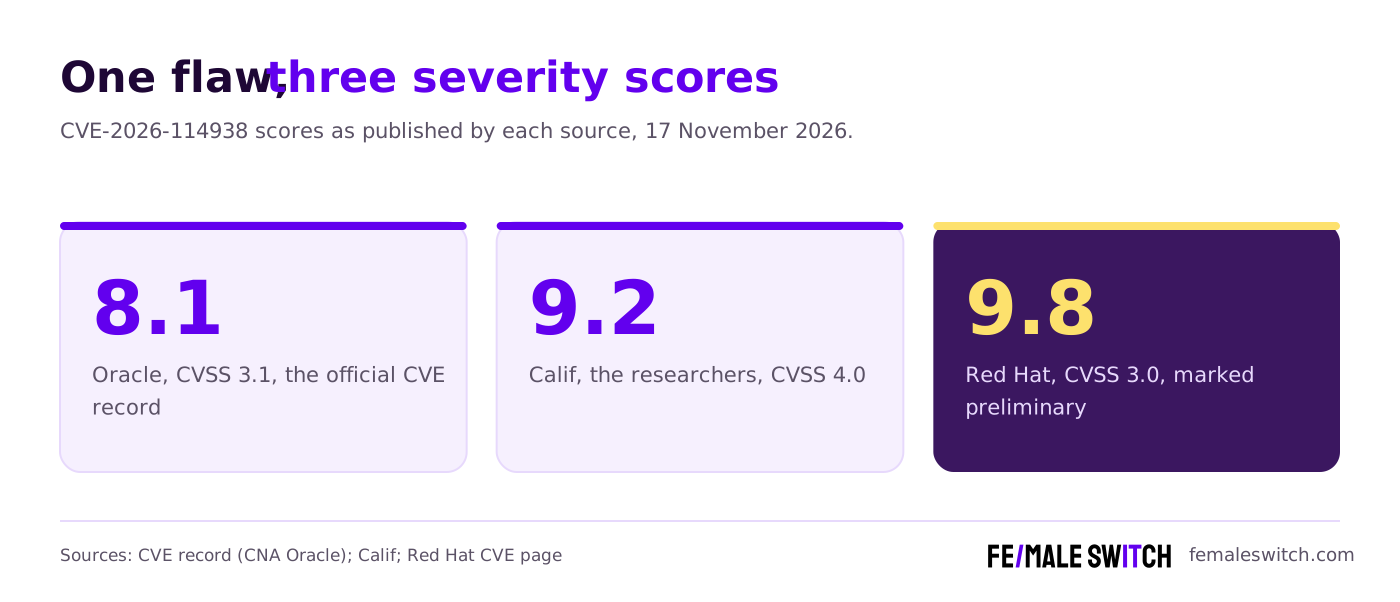
Which client servers are actually exposed?
Per Red Hat's RHSB-2026-018 bulletin, a server is exposed only when all four conditions hold.
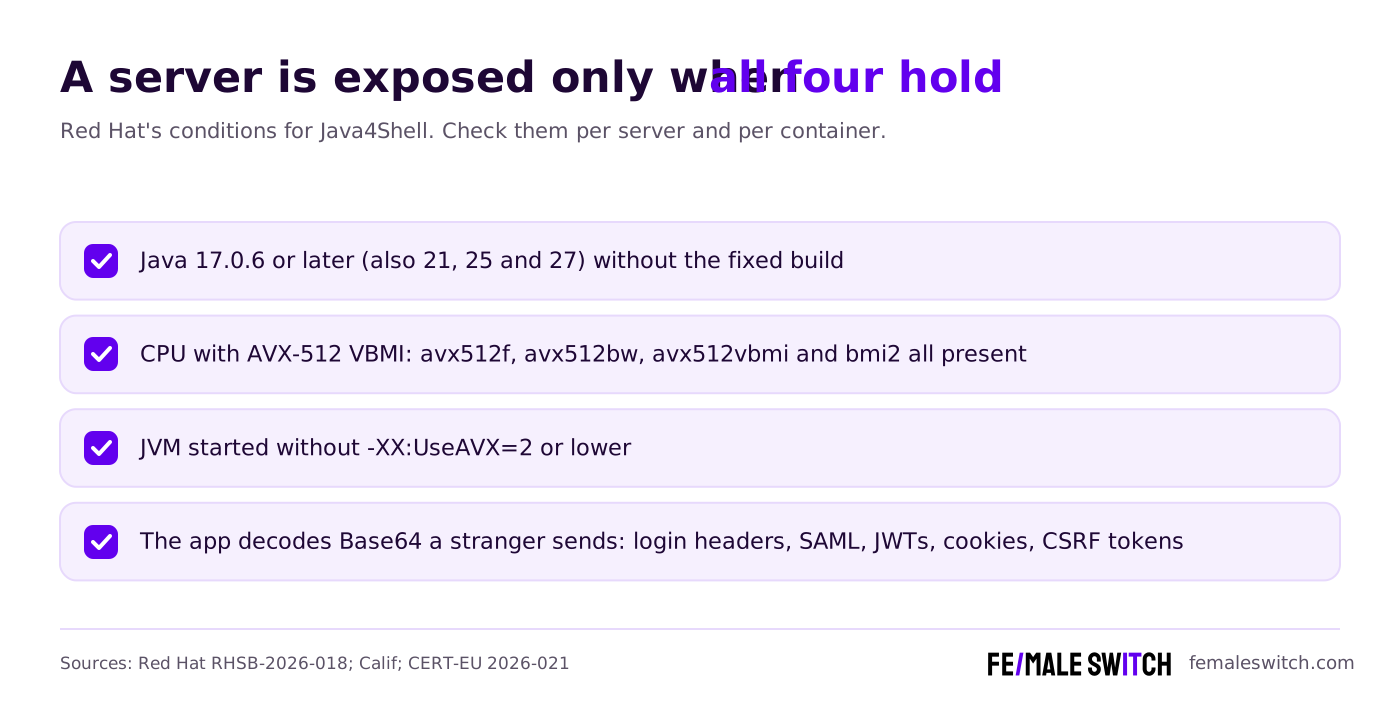
The fourth is wider than it sounds: Red Hat names HTTP login headers, SAML artifacts and CSRF tokens, and CERT-EU's advisory adds JWTs, cookies and TLS data.
What does a 24-hour Java4Shell patch plan look like?
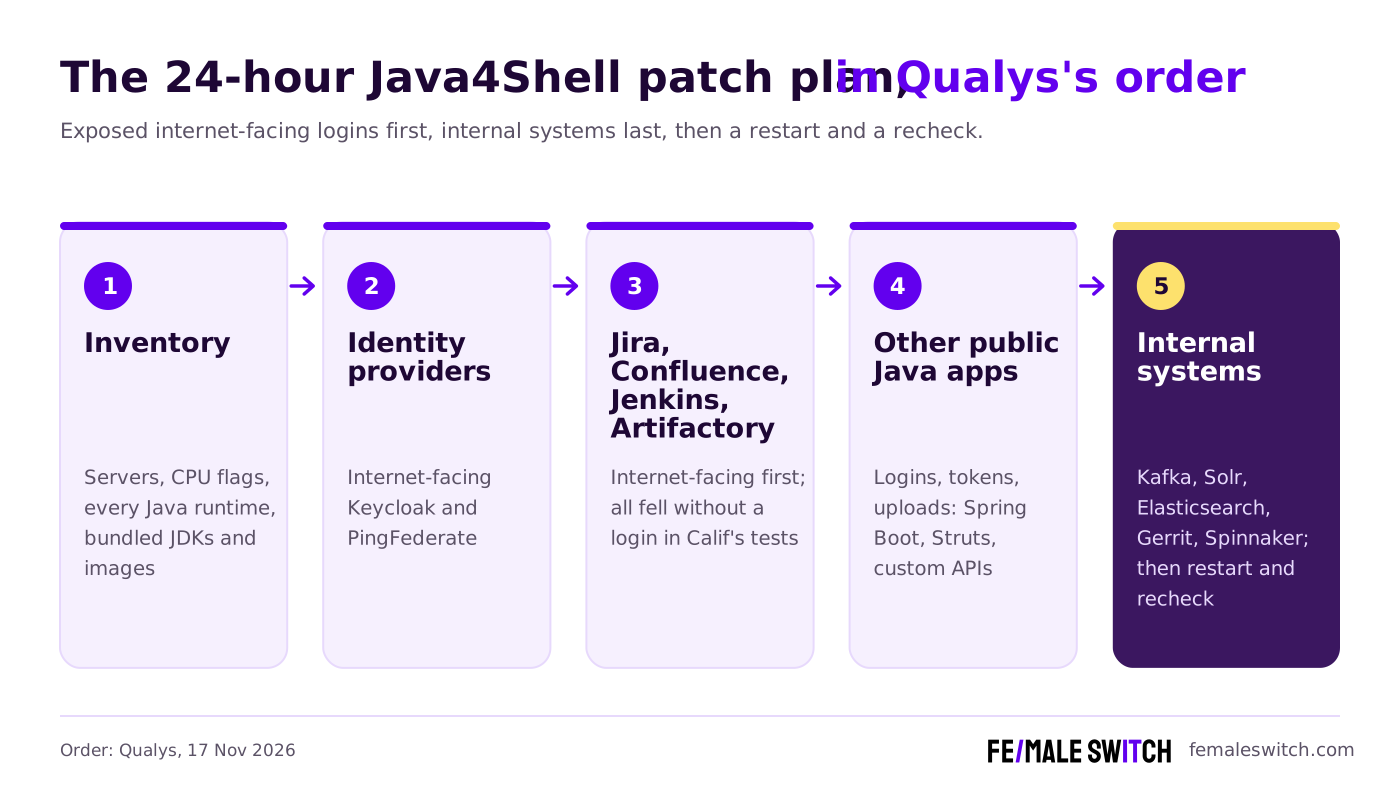
Qualys sets the order in its Java4Shell patch guide, here as one working day:
- Inventory (hours 0-2): every server, CPU and Java runtime you run for clients.
- Identity providers (hours 2-6): internet-facing Keycloak and PingFederate. A takeover there opens every app that trusts them.
- Jira, Confluence, Jenkins, Artifactory (hours 6-12): internet-facing first. Jenkins and Artifactory sit in the build pipeline, which CADChain's guide for engineering teams covers.
- Other public Java services (hours 12-18): Spring Boot, Struts and custom apps that handle logins, tokens or uploads.
- Internal systems (hours 18-24): Kafka, Solr, Elasticsearch, Gerrit and Spinnaker.
Where no fixed build exists, apply a temporary flag and take the service off the public internet, as the Canadian Cyber Centre suggests. Close each tier with a restart and a recheck.
How do you find every vulnerable JVM on a client server?
Run these on hosts and inside containers:
- Version: the java on your PATH says nothing about a runtime bundled inside a product, so read each service file, start script or image.
- Bundled JDKs: they stay vulnerable until the product's vendor updates them, OS package updates skip them, and CISA warns inventory tools can miss them.
- Containers and restarts: rebuild every image on a fixed base, and restart every JVM. A fixed JDK on disk protects nothing until then.
Which fixed Java builds exist so far?
Read versions to the last digit: Oracle's CVE record lists 17.0.21.0.3, 21.0.13.0.3, 25.0.5.0.3 and 27.0.1.0.3 as affected.
Watch one trap: the Jira and Confluence Data Center versions in Atlassian's 17 November bulletin fix other CVEs, and the bulletin never mentions Java4Shell.
Which temporary flags buy time, and what can break?
Patching is the only fix. Tenable says these flags appear in no Oracle or OpenJDK advisory, and each needs a JVM restart (containers must be recreated).
Test a flag on one service and confirm it with jcmd first, keep it out of a shared JAVA_TOOL_OPTIONS (the setting behind the outage Upwind describes), and remove it once the fixed build runs, as Red Hat advises.
Which cloud instance types should you screen first?
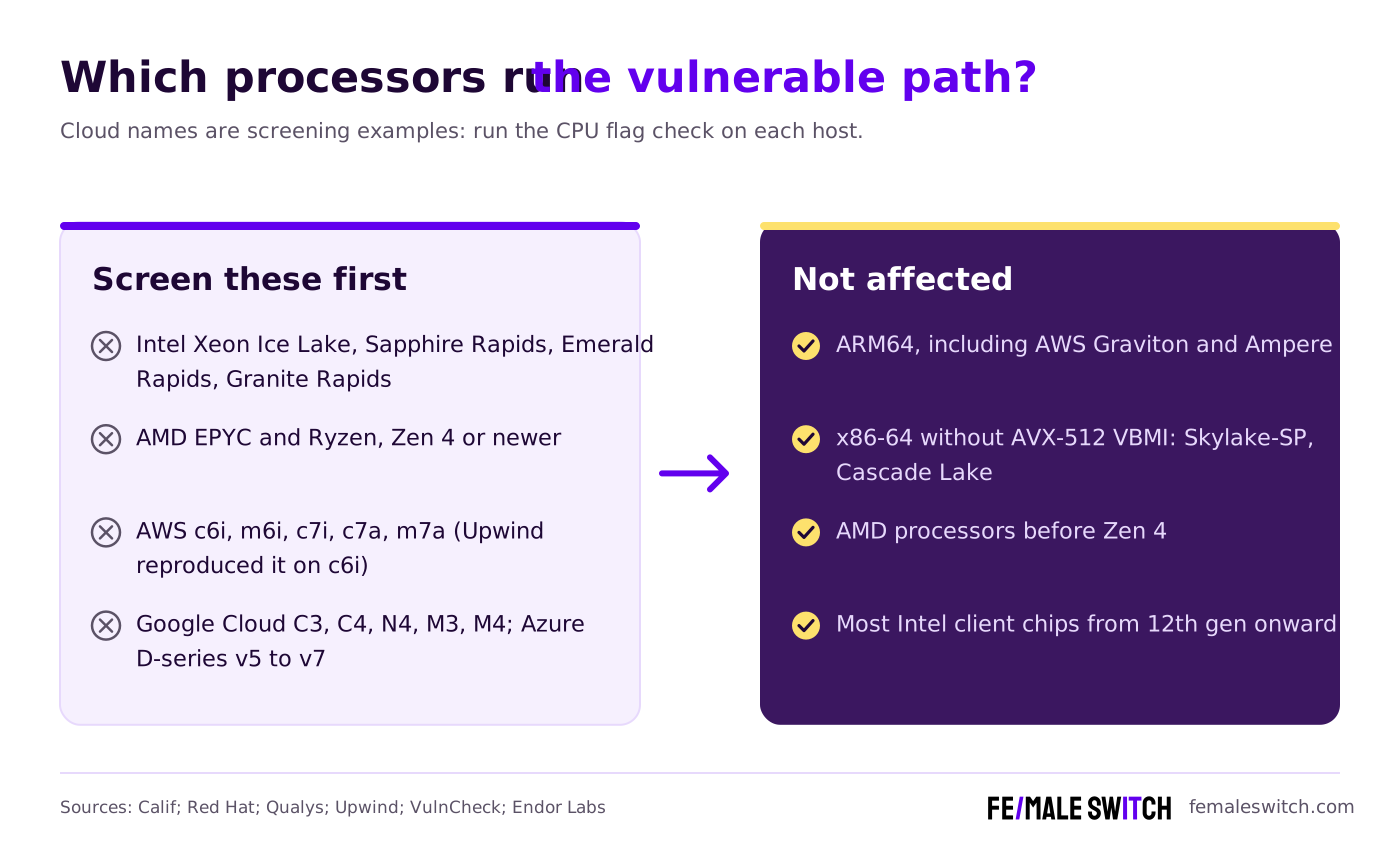
Sources name these as screening examples; only the CPU check confirms exposure.
- AWS: c6i, m6i, r6i, c7i, m7i, r7i, c7a, m7a and r7a. Upwind reproduced the bug on a c6i, and Graviton is not affected.
- Google Cloud: C3, C3D, C4, C4D, N4, N4D, M3 and M4.
- Azure: Intel D-series v5 to v7, AMD D-series v6 and v7.
Resizing a VM can land it on an affected CPU (Qualys), so recheck after every change.
What signs of attack should you look for in logs?
- JVM crashes or restarts, and new hs_err_pid*.log files.
- Bursts of IllegalArgumentException from java.util.Base64$Decoder.
- Base64 tokens of 32+ characters ending in = with a length that is not a multiple of 4 (Upwind).
- Java processes starting shells or new outbound connections, or Java runtimes nobody installed.
The Swiss NCSC warns: "A security update does not remove an existing compromise." If you find signs, rotate the passwords and tokens on that server, as in our guide to handling stolen AI API credentials.
What we don't know yet
- Update 19 Nov: Red Hat, Ubuntu, Microsoft, Azul and Temurin (Linux) shipped fixed builds; Jenkins says update the controller's Java to 17.0.21.1, 21.0.13.1 or 25.0.5.1 and restart; Keycloak's 26.8.2-3 image and later are fixed; Atlassian Cloud needs no action and Data Center gets the -XX:UseAVX=2 mitigation for now. Still open: Debian stable, Temurin for Windows, macOS and Docker images, GraalVM, JFrog Artifactory and Ping Identity.
- When product exploit chains go public, and whether the probing that started by 19 November turns into successful attacks.
- Who leaked the details before the fix.
- Which AI found it. Calif names Codex, reports based on The New York Times name OpenAI's GPT-6 Cyber, and no source links the two.
Timeline
What this means for you
Clients on Java 17 or newer with recent Intel or AMD servers need the inventory today. Tell them before the news does.
A short message to send clients today
Subject: Java4Shell security fix on your servers
Hi [name], a Java security flaw (CVE-2026-114938, nicknamed Java4Shell) was published on 17 November. Today we are checking [systems], installing fixed Java builds and restarting the services at [time]. Where a vendor fix is missing, we apply a temporary setting and limit internet access. A written summary follows by [date].
How to offer Java4Shell work inside a maintenance plan
- Runtime register: every client server and image with CPU flags, Java version and bundled runtimes, kept beside the script register from our Content Security Policy guide for freelancers.
- Emergency patch clause: how fast you act on a published security fix.
- Billing: first inventory as a one-off project, rechecks in the monthly fee, out-of-hours patching at your hourly rate, as in the care plan from our PHP vulnerability guide for freelancers.
- Written report: what you checked and changed, and which vendors still owe a fix.
Turn your skills into your first startup
The Fe/male Switch startup game takes you from idea to first paying customers in weekly quests, with an AI co-founder and a community of founders.
👉 Start the game
FAQ: Java4Shell patch questions from freelancers and agencies
Does Java4Shell affect Java 8 and Java 11?
No. Red Hat, Eclipse Temurin, Ubuntu and Azul confirm OpenJDK 8 and 11 are not affected; Oracle names only the Java 8 Performance Pack (fixed in 8u513-perf). Their November updates fix other CVEs, so roll them out anyway.
Is a Mac or an ARM server affected?
ARM64 is not affected, Graviton and Ampere included; Endor Labs, the only source naming Apple Silicon, lists it as unaffected. VulnCheck lists 2019-2021 Intel laptop chips (Ice Lake, Tiger Lake, Rocket Lake) as affected.
Are Atlassian's 17 November updates the Java4Shell patch?
No. That bulletin fixes other CVEs and never mentions CVE-2026-114938.
Is Java4Shell being exploited in the wild?
Probing started by 19 November: GreyNoise counted 187 Java4Shell-shaped requests from 5 IP addresses and no successful intrusion. It is not in CISA's Known Exploited Vulnerabilities catalogue yet. Calif plans to publish its exploit chains later.
Do I need to restart after the Java4Shell patch?
Yes. Every source says the JVM must restart and container images need rebuilding.
Will a reverse proxy or input validation stop it?
CISA suggests validating Base64 input and limiting unauthenticated access. Qualys says validation alone fails because the malicious input is very short, and calls reverse proxies unreliable.
About the Author
Violetta Bonenkamp, also known as MeanCEO, is an experienced startup founder with an impressive educational background including an MBA and four other higher education degrees. She has over 20 years of work experience across multiple countries, including 5 years as a solopreneur and serial entrepreneur. Throughout her startup experience she has applied for multiple startup grants at the EU level, in the Netherlands and Malta, and her startups received quite a few of those. She’s been living, studying and working in many countries around the globe and her extensive multicultural experience has influenced her immensely.

