
TL;DR: online marketplace VAT for UK sellers from October 2027
Online marketplace VAT rules change for UK sellers in October 2027: platforms such as Amazon and eBay will collect and pay the VAT on your sales, a job sellers do themselves today. The rule covers every VAT-registered UK seller, whatever they sell on the platform, and unregistered UK sellers with more than £90,000 a year of sales on one platform. Personal sales, second-hand goods and sales to business buyers stay outside. You keep reclaiming VAT on your costs, so many registered sellers will flip from paying HMRC to waiting for refunds. Plan that cash gap now.
Here is everything the Autumn Budget 2026 changed for small businesses, from the minimum wage to business rates, on the Fe/male Switch Foundation blog. This guide covers the change UK online sellers have been searching for since Chancellor John Healey's speech: online marketplace liability, the rule that makes the platform, and no longer the seller, account for VAT on each sale.
What did Budget 2026 announce about online marketplace VAT?
On Wednesday 28 October 2026 HMRC published a policy paper on extending VAT online marketplace liability alongside the Budget. From October 2027, online marketplaces will be responsible for collecting VAT on sales by UK VAT-registered businesses and by any other UK business with sales of more than £90,000 a year on that platform. Healey told MPs that sellers "cannot avoid paying VAT when they sell online", as Reuters reported.
Status check: this is announced, with the law still to come. HM Treasury will legislate in Finance Bill 2026-27, and regulations in 2027 will fix the exact start date and how the threshold works. The Budget's costings table gives 1 October 2027; HMRC's own papers say "from October 2027". The same Budget also put money behind women founders: £200m over two years for women-led businesses and funds, and a scale-up programme for women founders.
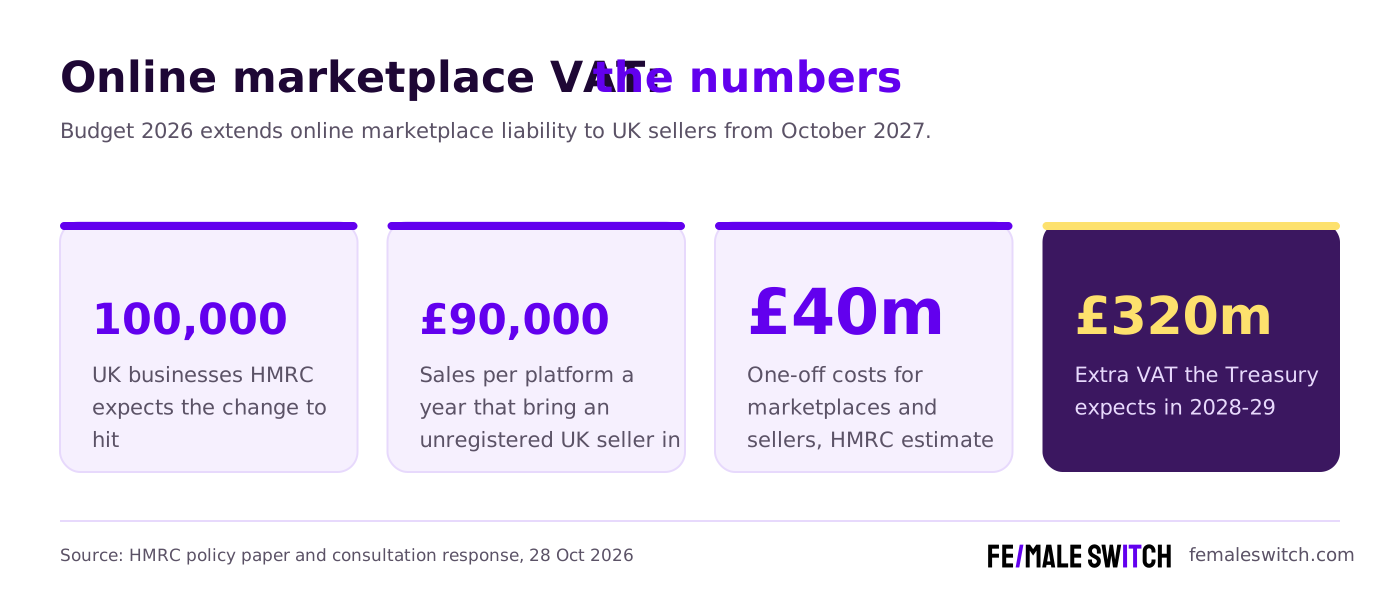
Three numbers frame it. HMRC expects the change to affect about 100,000 businesses, puts one-off costs for platforms and sellers at £40 million, and the Treasury expects it to raise £165 million in 2027-28 and £320 million in 2028-29. That money pays for the business rates package in the same Budget, including an extra 20% cut for pubs, music venues and social clubs.
Why is the government making marketplaces collect VAT?
Overseas sellers have been under the same rule since 2021, when marketplaces started collecting VAT on their UK sales. HMRC's consultation says those reforms have raised more than £8 billion so far and still bring in about £1.8 billion a year, together with the end of low value consignment relief.
UK sellers are the gap. According to the government's consultation response, tens of thousands of UK marketplace sellers are not compliant, costing hundreds of millions of pounds in VAT every year. The stated aim is to level the playing field with high street shops that already charge and pay VAT.
Who falls under the new online marketplace VAT rules?
The rules split UK sellers into three groups. Find yours in the table, then read the notes under it.
Sources: HMRC policy paper and summary of consultation responses, 28 October 2026.
Registered sellers are in from the first sale. HMRC's response is plain on this: VAT-registered UK sellers are in scope regardless of the value of their sales through the platform. The £90,000 line only matters for sellers who are not registered.
The £90,000 counts per platform. ICAEW, the chartered accountants' body, points out that a seller can pass £90,000 in total and still stay under it on each platform. That seller already has to register for VAT under the normal rules, because the change does not alter anyone's registration duties. Once registered, every marketplace sale is in scope.
Which platforms count? The 2021 test applies: a marketplace sets the terms of sale, takes part in payment, and takes part in ordering or delivery. Sites that only list or advertise goods, or only process payments, are not marketplaces under it. Reuters named Amazon, eBay, Temu, Shein and Alibaba in its report. Government papers name no platform, so for Etsy, Vinted, TikTok Shop and the rest the test decides, and HMRC guidance will settle the edge cases.
How does marketplace VAT collection work for a UK seller?
Let's break it down with the model HMRC describes in its consultation, the same one overseas sellers have used since 2021:
- A customer buys your product on the platform.
- For VAT purposes, you make a deemed zero-rated supply to the marketplace: a sale at 0% VAT, on paper, from you to the platform.
- The marketplace is treated as selling to the customer, charges the VAT and pays it to HMRC on its own VAT return.
- You still reclaim input tax, the VAT you pay on stock, packaging, fees and tools, on your own VAT return as you do now.
Your other channels stay as they are. Sales through your own website, a Shopify store or a market stall keep the normal VAT rules, so a seller with several channels runs two systems side by side. Our guide to marketplace business models for founders explains why platforms take on jobs like this in the first place.
What does online marketplace VAT do to your cash flow?
Here is the part most sellers miss. Today a registered seller collects VAT on sales, subtracts the VAT on costs and pays the difference. From October 2027 the output VAT on marketplace sales leaves your hands, and the VAT on your costs stays reclaimable. HMRC's consultation response confirms that some sellers expect to move into a repayment position, where HMRC owes them money each return.
Our example, with round numbers: a VAT-registered maker sells £6,000 a month of candles on Amazon before VAT, so customers pay £7,200 with 20% VAT. Her stock, packaging and platform fees carry £600 of VAT a month.
Sources: mechanism from HMRC's consultation and response; figures are our example.
Her profit in that example stays the same, and the timing shifts: £600 that she used to hold for a few weeks before paying HMRC now sits with HMRC until her refund arrives. The government's answer is that sellers in scope can apply to move onto monthly VAT returns, which shortens the wait. Build that into the habits from our guide to managing cash flow in an early-stage startup before the change lands.
What happens to the Flat Rate Scheme, second-hand goods and business buyers?
Flat Rate Scheme (FRS). The FRS lets businesses trading under £150,000 pay a fixed percentage of turnover as VAT and claim back almost no input tax. The consultation asked FRS users about losing access to the scheme, and the government's response says it "will take more time to consider" how the scheme works with the new rules. If you use it, this is the biggest open question for you: model your costs both with the scheme and on standard VAT accounting.
Second-hand goods. They are out, after respondents warned that the margin scheme, which charges VAT only on the dealer's profit, would break. HMRC has not defined "second-hand" yet and will publish detailed guidance to stop sellers labelling new goods as used.
Business buyers. Business-to-business sales are excluded. Under the 2021 rules a marketplace charges no VAT when the buyer gives a VAT number; how buyers prove business status under the new regime is still to be set.
What changed between the consultation and the Budget?
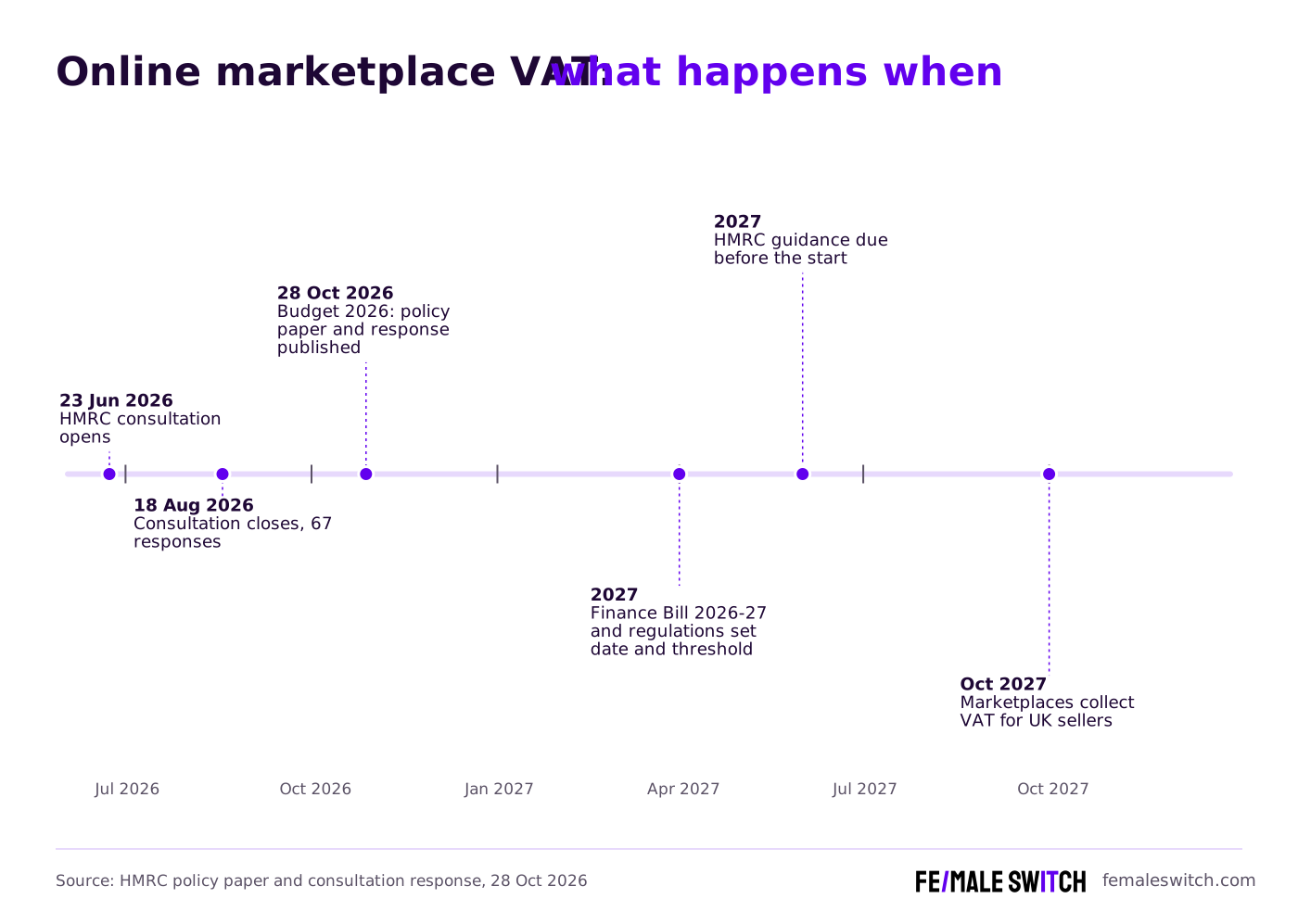
HMRC consulted from 23 June to 18 August 2026 and received 67 responses: 19 from sellers, 17 from marketplaces, 14 from representative bodies, 4 from advisers, 3 from individuals and 10 from others. Read the consultation and summary of responses for the full list. Four outcomes matter for sellers:
- No lower threshold. 11 of the 13 sellers who answered had serious concerns about one, and the government kept £90,000, the same figure as the VAT registration threshold.
- No VAT rate relief for small sellers. The idea was dropped.
- Second-hand goods excluded, to protect the margin scheme.
- Flat Rate Scheme decision deferred.
Respondents also asked for at least 12 months between the final guidance and the start date, to update software and reconcile sales across channels. HMRC has promised guidance before the rules take effect, without a date.
What do sellers, platforms and advisers say?
ChannelX, which covers marketplace selling, reports that eBay and Amazon welcomed the change, while Trojan Commerce warned about cash tied up for sellers. The law firm RPC told The Grocer the rules need to be introduced clearly and proportionately. ICAEW criticised the per-platform threshold, since a seller can stay under it on every platform while trading well above £90,000 in total.
Our take: the per-platform design matters less than it looks. The sellers it misses are the ones who should already be VAT-registered, and once registered they are in scope everywhere. The real work for an honest small seller is cash flow and bookkeeping, and both start a year before the rules do.
What should UK marketplace sellers do before October 2027?
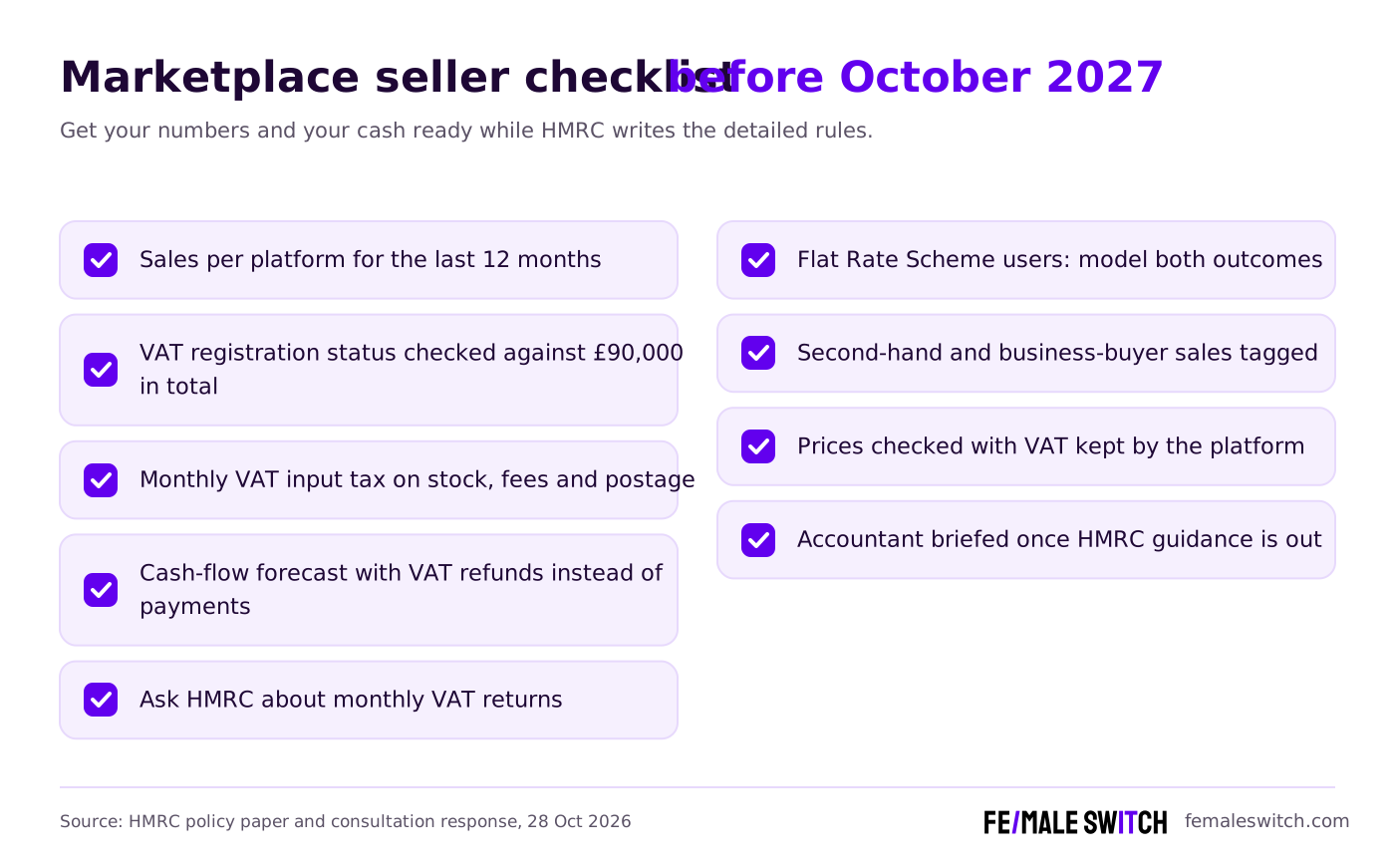
- Pull your sales per platform for the last 12 months: Amazon, eBay, Etsy, your own site. You need the per-platform numbers for the £90,000 line and the total for VAT registration.
- Check your registration. If your total taxable sales passed £90,000, you already have to register. Fix that now, before the platforms start asking.
- Add up your monthly input tax on stock, packaging, postage, ads and platform fees. That figure becomes your likely refund per month.
- Rebuild your cash-flow forecast with refunds coming in where VAT payments used to go out, and plan for the gap.
- Ask about monthly VAT returns once you are sure you will be in a repayment position.
- On the Flat Rate Scheme? Model both outcomes now and decide quickly once HMRC rules on it.
- Tag second-hand and business-buyer sales in your records, since both stay outside.
- Check your prices and margins with an adviser once guidance shows how platforms will handle the VAT in payouts; our pricing strategy guide for female-led startups helps with the maths.
- Brief your accountant when HMRC publishes guidance, or pick one with our guide to which tax professional your startup needs.
Good records make every step easier. Compare tools in our list of online bookkeeping services for solopreneurs, and if you sell abroad as well, our guide to cross-border e-commerce for female founders covers the other side of the counter.
What does online marketplace VAT mean for you?
Side seller under £90,000 and not registered? Nothing changes on the platform, and from 6 April 2027 the trading allowance rises to £3,000, which matters more to you this year. Full-time sole traders will find every other Budget change in our MeanCEO list of self-employed tax changes.
VAT-registered maker or reseller? You are in from October 2027. Your profit stays the same in principle, your VAT return changes shape, and you will likely wait for refunds. Start the cash plan this winter.
Building an e-commerce brand? Weigh platform sales against your own shop, since the two now run on different VAT mechanics. Our guides to e-commerce startups for female founders, selling handmade jewellery online and running Etsy shops help you decide the mix, and testing an idea on Amazon still works as a cheap first step.
Running a SaaS or billing tool for sellers? The VAT changes stack up: overseas services from April 2027, marketplaces from October 2027 and UK e-invoicing from April 2029 on MeanCEO. More tax planning ideas are in our guide to tax planning for female-led startups.
Test your online shop idea before October 2027
The Fe/male Switch startup game takes you from idea to first paying customers in weekly quests, with an AI co-founder that drafts, checks and plans with you, including your pricing and cash flow. Start with our free business plan generator, then play the game.
👉 Start the game
Conclusion
Online marketplace VAT moves the job of collecting VAT from about 100,000 UK sellers to the platforms they sell on, from October 2027. Registered sellers are in from the first sale, unregistered sellers above £90,000 on a platform join them, and personal, second-hand and B2B sales stay out. The open questions, from the Flat Rate Scheme to how the threshold is measured, will be settled in 2027 regulations and HMRC guidance. The cash-flow shift is already clear, so plan for refunds, consider monthly returns and keep clean records per platform. Other Budget founders' changes, such as the new Founders' Relief and £5bn for the British Business Bank, are in the reports below.
- Autumn Budget 2026: What It Changes for Small Businesses and First-Time Founders, From the £13.21 Wage to a £3,000 Trading Allowance (Fe/male Switch Foundation)
- Trading Allowance Triples to £3,000 From 6 April 2027: What Budget 2026 Means for Your Side Hustle (Fe/male Switch)
- UK E-Invoicing From April 2029: What the Budget 2026 Plan Means for SaaS Founders, Plus the Two VAT Changes That Land in 2027 (MeanCEO)
- British Business Bank Gets £5bn in the Autumn Budget 2026: £450m Venture Debt, £1.4bn Equity and £6.5bn of Guaranteed SME Loans (grant-grants.com)
- Founders' Relief: A 10% CGT Rate on Up to £10 Million From April 2027, the Proposed Tests Most Startups Won't Pass, and the BADR Cut for Everyone Else (MeanCEO)
- Self-Employed Tax Changes in Budget 2026: The Full List for Sole Traders and Freelance Founders, From April 2027 to 2029 (MeanCEO)
FAQ: online marketplace VAT rules for UK sellers
What are the new online marketplace VAT rules in the UK?
From October 2027, online marketplaces must collect and pay the VAT on sales by UK VAT-registered sellers and by unregistered UK sellers with more than £90,000 a year of sales on that platform. Budget 2026 announced it on 28 October 2026.
When do marketplaces start collecting VAT for UK sellers?
From October 2027. The Budget's costings table gives 1 October 2027, and 2027 regulations will confirm the exact date and threshold rules.
Does it apply to me if I am VAT-registered but sell little on Amazon or eBay?
Yes. VAT-registered UK sellers are in scope whatever the value of their sales through the platform.
I am not VAT-registered and sell under £90,000. Does anything change?
Not on the platform side. The rules reach unregistered sellers only above £90,000 of annual sales on one platform. Your normal VAT registration duties still apply to your total sales.
Can I still reclaim VAT on my costs?
Yes. HMRC says sellers keep recovering input tax as they do now, which is why some will receive refunds instead of paying VAT. Sellers in scope can apply for monthly VAT returns.
Are second-hand goods and Vinted-style personal sales included?
No. Personal (non-business) sales, second-hand goods and business-to-business sales are excluded. HMRC will define second-hand goods in guidance.
What happens to the VAT Flat Rate Scheme?
Undecided. The government says it will take more time to consider how the Flat Rate Scheme works with the new rules.
Which platforms are covered?
Platforms that set the terms of sale and take part in payment and in ordering or delivery, the test used since 2021. Reuters named Amazon, eBay, Temu, Shein and Alibaba; the government named none.
About the Author
Violetta Bonenkamp, also known as MeanCEO, is an experienced startup founder with an impressive educational background including an MBA and four other higher education degrees. She has over 20 years of work experience across multiple countries, including 5 years as a solopreneur and serial entrepreneur. Throughout her startup experience she has applied for multiple startup grants at the EU level, in the Netherlands and Malta, and her startups received quite a few of those. She’s been living, studying and working in many countries around the globe and her extensive multicultural experience has influenced her immensely.

