

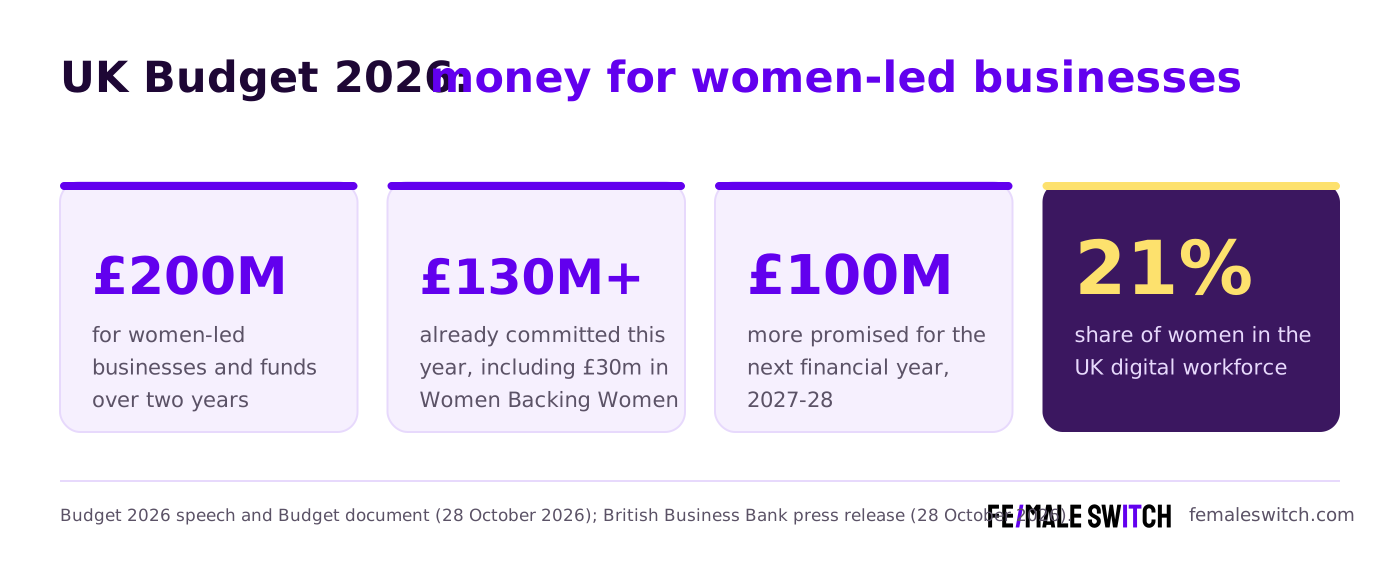
The UK government will put £200 million into women-led businesses and funds through the British Business Bank, but the money is spread over two years and goes to funds, not to founders as grants. Chancellor John Healey announced it in his Budget on Wednesday, 28 October, together with a new scale-up programme for women founders. Two days later, the programme still has no start date or budget, and the same Budget halves the lifetime limit of the tax relief many small business owners use when they sell.
Cover photo: Nikita Khavkin on Unsplash. The Royal Exchange and Bank junction in the City of London.
What happened
In the Budget speech, the Chancellor said: "And as recommended by the Women in Tech taskforce, I'm also announcing a new scale-up programme to support female founders, and the British Business Bank will double its commitments to women-led businesses and funds to £200m."
The detail sits in two other documents published the same day. The British Business Bank's press release describes "a further £100m commitment next financial year to support women-led businesses and funds, building on £100m planned for this year". It adds that the bank "has committed more than £130 million this year", including a £30 million anchor investment in the Invest in Women Taskforce's "Women Backing Women" fund of funds.
The Budget document (the Red Book) gives a third figure: the bank "has developed a pipeline of commitments to women-led funds of over £100 million", including first-time fund managers found through its Investor Pathways Capital programme. Read together, the £200m is about £100m this financial year plus £100m in 2027-28, not a new single pot.
What is decided, and what is not
Policy status of each Budget item that affects women founders and self-employed women in the UK:
The scale-up programme "will test how best to overcome barriers to fundraising and investment for women founders, which could include peer learning, investor networks and practical support on finance and governance", according to the Red Book. The two standards come from the Women in Tech Taskforce. The government says they will help tackle "the barriers women face raising capital and working in the technology sector", and notes that women make up just 21% of the digital workforce.
Funds, not grants
The money goes through the British Business Bank, which invests in funds and lenders that then back companies. "This funding will be deployed through investment commitments to businesses and funds, rather than being distributed as direct grants to individual founders," WeAreTechWomen noted, adding that the standards' full criteria "have yet to be published".
For a founder, that means the route to this money is a fund that the bank backs, such as Women Backing Women, or an angel syndicate, not an application form. The bank is also building more angel capacity: its Diverse Angel Syndicate programme opens for applications on 11 November.
The UK Business Angels Association called the £200m "a welcome additional commitment to women founders and women investors" that builds on the Invest in Women Taskforce and the Investing in Women Code. Michelle Ovens, founder of Small Business Britain, told Startups Magazine that "support for female entrepreneurs through the British Business Bank is an important step towards unlocking the potential of women in business".
The gap the money is meant to close is wide. All-female founder teams got 6.7% of UK equity deals and 1.7% of the money invested in 2025, according to the bank's Small Business Equity Tracker, as cited in the Investing in Women Code annual report 2026.
Selling your company: Founders' Relief and a smaller BADR
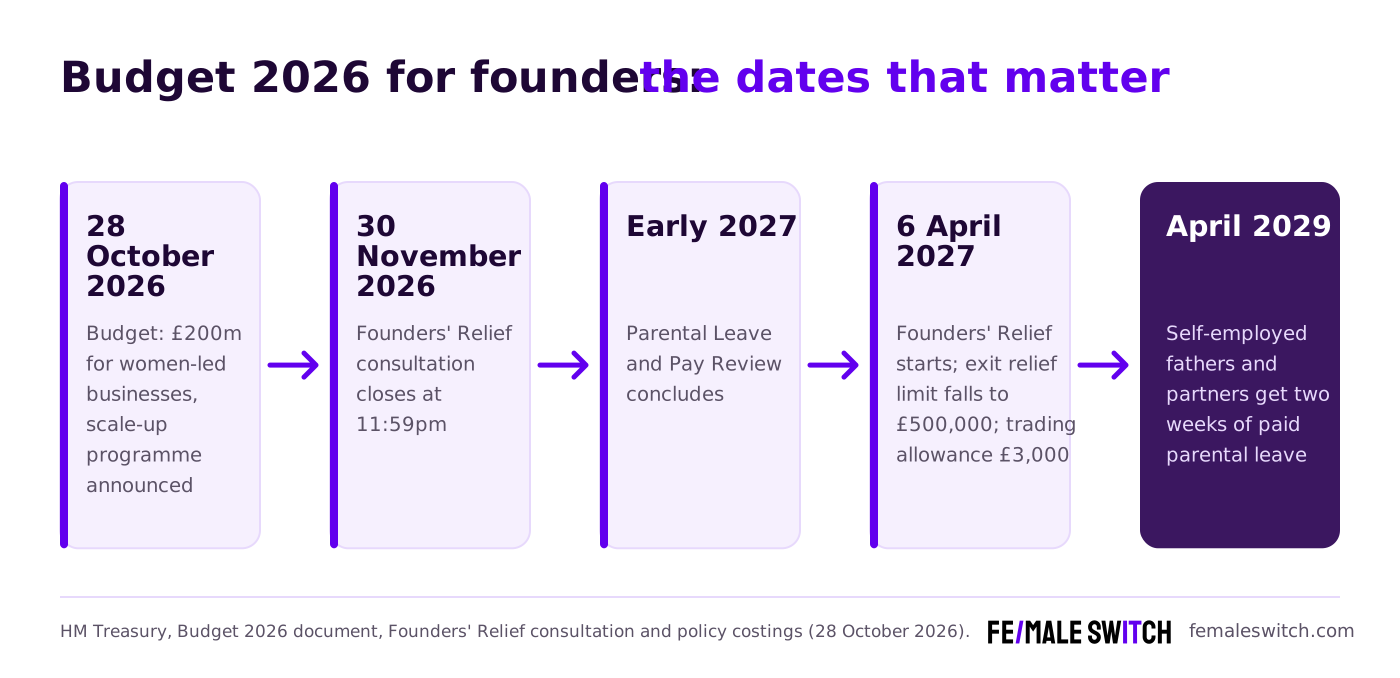
The Chancellor also announced Founders' Relief: "A 10% rate on lifetime gains of up to £10m for the founders of our most successful firms." It would apply to sales of shares from 6 April 2027, and the technical consultation is open until 11:59pm on 30 November 2026.
The bar is high. Under the consultation, the founder must have held 25% of the company's ordinary shares when trading began, held the shares for at least five years, and been UK resident for five years. The company needs at least £10 million of turnover and 15 qualifying full-time employees, and must pass two of three tests: 25% a year growth in turnover, 25% a year growth in headcount, or at least £1.5 million spent on research and development with tax relief claimed.
The 25% rule matters for women in larger founding teams. In an equal four-way split each founder holds exactly 25%; in a five-way split, nobody qualifies (our reading of the draft rules; the consultation asks whether the conditions are right).
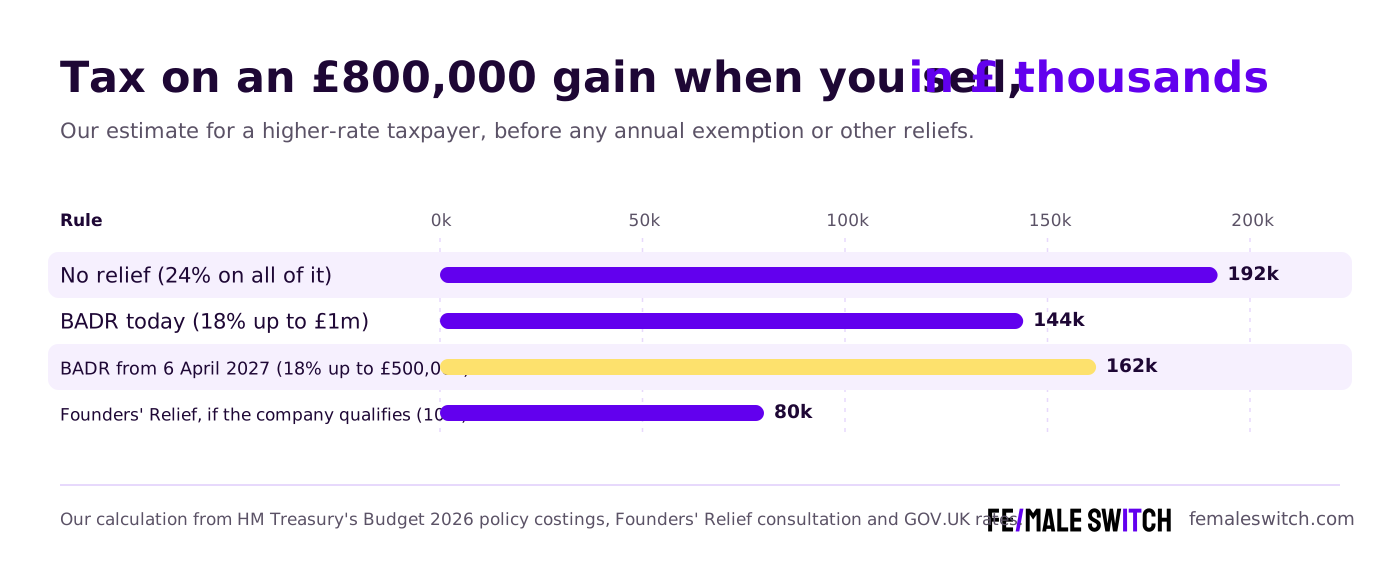
Most small business owners will use Business Asset Disposal Relief (BADR) instead. The speech confirmed: "I am reducing the threshold for Business Asset Disposal Relief in Capital Gains Tax from £1m to £500,000, meaning no change for 3 in 4 claimants." BADR's rate rose to 18% on 6 April 2026, according to GOV.UK; the lower limit applies from 6 April 2027, and gains above it are taxed at the normal rate, 24% for higher-rate taxpayers.
Our example: a founder who sells her company in 2028 with an £800,000 gain and pays higher-rate tax. Under today's £1m limit she would pay 18% on all of it, £144,000. From April 2027 she pays 18% on £500,000 (£90,000) and 24% on £300,000 (£72,000), so £162,000, or £18,000 more (our estimate, before any annual exemption or other reliefs).
The tax changes come as the Treasury's first entrepreneurship adviser, Alex Depledge, leaves her post the day after the Budget. Ourreport on her exit has the background.
Self-employed parents: fathers gain, mothers wait
The Chancellor said: "I will make self-employed fathers and partners eligible for paid parental leave for the first time." From April 2029, self-employed fathers, partners and adopters in Great Britain can get two weeks of a new Parental Allowance, modelled on Maternity Allowance, paid between £27 and the statutory rate. The Red Book says this will benefit over 150,000 parents a year.
For self-employed mothers, nothing changes yet. Maternity Allowance stays at "between £27 to £194.32 a week for up to 39 weeks", according to GOV.UK. The Red Book says the government's Parental Leave and Pay Review "will conclude in early 2027". The other parent's leave still matters to self-employed women: it is often the partner who takes over at home while the mother keeps the business running.
How the UK compares with other European countries for a self-employed mother:
Sources: GOV.UK; Citizens Information (Ireland); Ameli (France); Seguridad Social (Spain); INPS (Italy); UWV (Netherlands); INASTI (Belgium); Familienportal (Germany); rates checked on 28 October 2026 for our comparison of maternity support for the self-employed.
Other Budget changes for women who work for themselves
- Trading allowance: "I'm tripling the trading allowance - the amount you can earn from a new venture tax-free – from £1,000 to £3,000," the Chancellor said. It starts on 6 April 2027; our trading allowance guide has worked examples for side businesses.
- Young Entrepreneurs Allowance: a new allowance "which will cover a year of living costs for young founders while they turn their ideas into businesses". The Budget document says it will be piloted in England, for successful applicants.
- Online marketplaces: marketplaces will collect VAT on sales by UK businesses that sell more than £90,000 through them; see our online marketplace VAT explainer.
- Pay transparency: "I have heard calls for pay transparency on job adverts to close the gender pay gap. And we will act soon to make sure women are paid and promoted fairly." No measure or date yet.
Our sister site has a full rundown of everything the Autumn Budget 2026 changed for small businesses.
What this means for you
- If you are raising money, look for funds the British Business Bank backs rather than a grant scheme. Ask funds directly whether they are part of Women Backing Women or the bank's women-led fund pipeline. Our guide to female founder funding covers how to approach them.
- If you plan to sell within a few years, check your numbers against the £500,000 BADR limit before 6 April 2027, and talk to an adviser about timing. If your company could meet the Founders' Relief tests, you can answer the consultation until 30 November.
- If you are setting up a company with co-founders, note the 25% founding-stake condition in the draft Founders' Relief rules when you split equity.
- If you are self-employed and planning a family, check your Class 2 National Insurance record now, because Maternity Allowance depends on it, and watch the Parental Leave and Pay Review in early 2027.
- If you need non-dilutive money, our list of grants and funding for female entrepreneurs covers UK and European options.
FAQ
How much did the UK Budget 2026 give to women founders?
The British Business Bank will commit £200 million to women-led businesses and funds over two years: £100 million planned for 2026-27 (the bank says more than £130 million is already committed) and a further £100 million in 2027-28.
Can I apply for the £200m as a grant?
No. The money is invested through funds and businesses that the British Business Bank backs, not paid as grants to individual founders. Founders reach it by raising from those funds.
When does the scale-up programme for women founders start?
No date has been given. The Budget document says the programme will test ways to help women founders with fundraising and investment, such as peer learning, investor networks and support on finance and governance.
What is Founders' Relief?
A proposed 10% Capital Gains Tax rate on up to £10 million of lifetime gains for founders of high-growth UK companies, from 6 April 2027. The founder must have held 25% of the shares when trading began, and the company must meet turnover, headcount and growth tests. The consultation closes on 30 November 2026.
What changes for Business Asset Disposal Relief?
From 6 April 2027 the lifetime limit falls from £1 million to £500,000. The rate stays at 18%; gains above the limit are taxed at the normal Capital Gains Tax rate.
Did self-employed mothers get anything in the Budget?
No direct change. Maternity Allowance stays at £27 to £194.32 a week for up to 39 weeks. Self-employed fathers and partners get two weeks of paid parental leave from April 2029, and a wider review of parental leave and pay ends in early 2027.
About the Author
Violetta Bonenkamp, also known as MeanCEO, is an experienced startup founder with an impressive educational background including an MBA and four other higher education degrees. She has over 20 years of work experience across multiple countries, including 5 years as a solopreneur and serial entrepreneur. Throughout her startup experience she has applied for multiple startup grants at the EU level, in the Netherlands and Malta, and her startups received quite a few of those. She’s been living, studying and working in many countries around the globe and her extensive multicultural experience has influenced her immensely.

