
TL;DR: how do you write a startup business plan?
A startup business plan explains what problem you solve, for whom, how big the market is, how you will reach customers, who is on the team, what the next three years look like in numbers and how much money you need. Use the 10-section template below: fill in each section, check it against what investors look for, and compare it with the filled example for a fictional startup. Start with a one-page version or a business model canvas, and write the full plan only when a bank, grant panel or investor asks for it.
👉 Get a first draft from the free Fe/male Switch Business Plan Generator
Most first business plans fail for the same reason: they describe the founder’s hopes, not the evidence. This guide gives you a startup business plan template you can copy, section by section, with prompts to fill in and a short note on what investors look for in each part. To make it concrete, every section has a worked example for Crèchly, a fictional booking and billing app for small private nurseries. Crèchly, its founders and all its numbers are invented for illustration.
If you are looking for software rather than a method, we compare options in our list of the best startup business plan tools and in free business plan generators for startups. This article is about what goes into the plan itself.
What Is a Startup Business Plan and Who Reads It?
The UK government’s business plan guidance describes a business plan as a written document that covers your objectives, strategies, sales, marketing and financial forecasts. It helps you clarify the idea, spot problems, set goals and measure progress, and you will need one to secure investment or a bank loan.
The US Small Business Administration’s guide to writing a business plan splits plans into two formats. A traditional plan is detailed, can run to dozens of pages and is what lenders and investors commonly request. A lean startup plan covers only the key elements, is typically one page and can take as little as an hour to write.
A startup plan differs from a plan for a bakery or a consultancy in one way: most of it is still a set of guesses. Investors know that. They read a startup business plan to see how clearly you think, what proof you already have and whether the money you ask for buys real progress. Grant panels read it to check that the project is feasible; if you apply for public funding, our sister site explains how to write an executive summary for grant proposals.
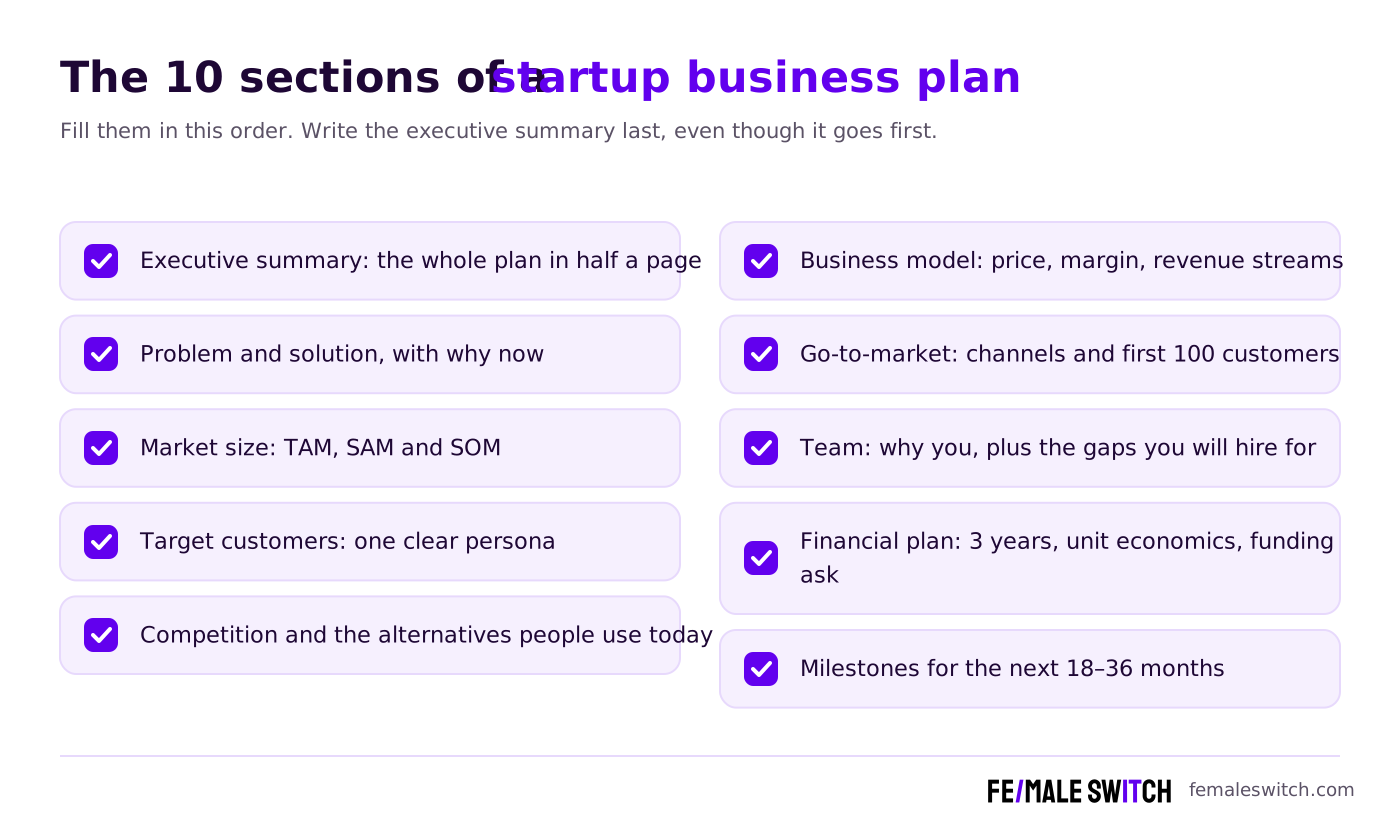
Startup Business Plan Template: 10 Sections to Fill In
The outline below follows the sections the SBA lists for a traditional plan and the order in Sequoia Capital’s guide to writing a business plan (Sequoia says the Airbnb founders used it), which runs from company purpose, problem and solution through market, competition, business model and team to financials. Fill in the prompts in your own words, then compare your draft with the Crèchly example.
Meet Crèchly (fictional example)
Crèchly is an invented startup used in this guide. It sells a booking, billing and parent-messaging app to small private nurseries with 10–80 children for €59 a month. Founders: Amira, who ran her own nursery for eight years, and Lena, a software developer. Every number below is made up to show the method, not market data.
1. Executive Summary
Fill in:
- What the company does, in one sentence
- The problem, the customer and your solution
- Proof so far: interviews, waitlist, pre-sales or revenue
- The size of the opportunity in one number
- How much you are raising and what it will achieve
What investors look for: a summary they can repeat to a partner after one read. Sequoia’s guide asks founders to define the company “in a single declarative sentence”. Write this section last, keep it under half a page and put your strongest proof in the first three lines.
Example (fictional startup Crèchly): Crèchly is a booking, billing and parent-messaging app for small private nurseries. Owners of nurseries with 10–80 children told us in 40 interviews that they spend about six hours a week on WhatsApp messages, paper registers and invoices. Crèchly replaces all three for €59 a month. Nine nurseries have pre-paid three months and 85 are on the waitlist. We are raising €400,000 to reach 450 paying nurseries and €26,550 in monthly recurring revenue by the end of 2028.
2. Problem and Solution
Fill in:
- Who has the problem and how often
- How they solve it today and what that costs them
- Your solution and the one thing it does better
- Why now: what changed that makes this possible or urgent
What investors look for: a painful, frequent problem described in the customer’s words, not a list of features. Show how people cope today; if they don’t bother coping, the problem may be too small. A clear “why now” matters too: why hasn’t this been built before?
Example (fictional startup Crèchly): Problem: nursery owners juggle bookings in spreadsheets, attendance on paper and parent questions in WhatsApp groups, mostly in the evening. Late invoices hurt cash flow. Solution: one app where parents book sessions, see invoices and receive updates, and where the register fills itself in. Why now: parents now expect to book and pay on their phone, and the founders found no tool priced for a 20-child nursery.
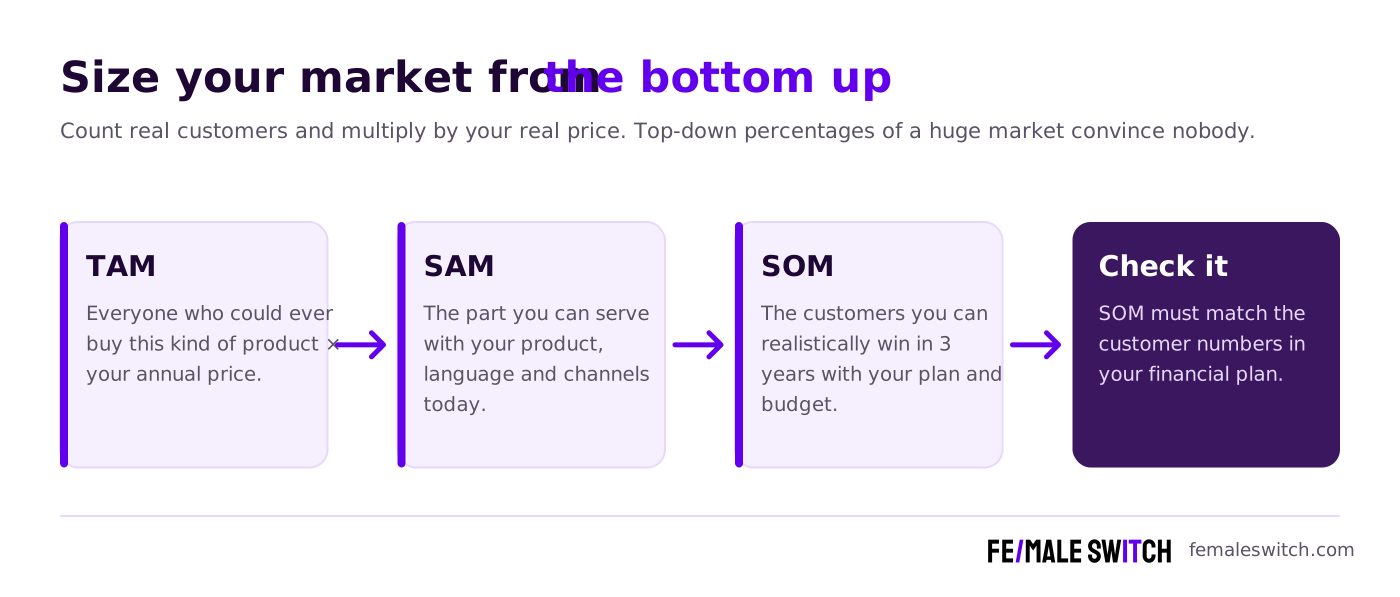
3. Market Size: TAM, SAM and SOM
Fill in:
- TAM: everyone who could buy this kind of product × annual price
- SAM: the part you can serve today (country, language, segment)
- SOM: what you can realistically win in three years
- Your sources and assumptions, written out
What investors look for: bottom-up numbers they can check: number of customers multiplied by your price, not “1% of a huge market”. Your SOM should match the customer numbers in your financial plan. Our founder’s guide to market size: TAM, SAM and SOM explains the three terms in detail, and the free Market Size Calculator returns a TAM/SAM/SOM estimate from a short description of your business.
Example (fictional startup Crèchly): Assumed for the example: 150,000 small private nurseries in Europe × €708 a year = TAM €106.2 million. About 30,000 of them are in the three launch countries, have 10–80 children and use no booking software: SAM €21.2 million. Winning 1,000 nurseries in three years gives a SOM of €708,000 in annual recurring revenue, about 3% of SAM.
4. Target Customers
Fill in:
- Your first customer segment, described as one person
- What they do now, what it costs them, who decides and who pays
- Where they gather online and offline
- Evidence: interview notes, survey answers, waitlist sign-ups
What investors look for: a narrow first segment you can actually reach, with evidence that you have spoken to these people. “Everyone with children” is not a segment. The free User Persona Generator gives you a draft persona with eight elements from a short description of your idea; check it against real interviews.
Example (fictional startup Crèchly): Owner-manager of one private nursery with 20–60 children, usually aged 35–55. She does the admin herself after closing time, decides alone and pays by card. She finds suppliers through her local owners’ association and Facebook groups for nursery owners.
5. Competition and Alternatives
Fill in:
- Direct competitors and their prices
- Indirect alternatives, including spreadsheets, paper and doing nothing
- What you do better for your first segment
- What stops a bigger player from copying you
What investors look for: an honest map of the alternatives and a plan to win. “We have no competitors” tells investors you haven’t looked. A simple table of the options against the three things your customer cares about most works well; our guide to competitor analysis tools and frameworks shows how to build one.
Example (fictional startup Crèchly): WhatsApp plus spreadsheets: free but messy, with no billing. Childcare suites built for chains: powerful, but priced and designed for groups of nurseries and slow to set up. Generic school apps: messaging only. Crèchly’s edge: set up in one afternoon, designed by a former nursery owner, and priced for a 20-child nursery.
6. Business Model
Fill in:
- Who pays, how much and how often
- Revenue streams now and later
- Gross margin per customer
- Your pricing logic: value to the customer, not cost plus
What investors look for: a model that makes money per customer before scale, with a gross margin you can explain. Show your price and how you tested it.
Example (fictional startup Crèchly): Subscription of €59 a month per nursery, or €590 a year paid upfront (two months free). Gross margin of 85% after hosting, text messages and support. Later revenue stream: an optional online payments add-on, not included in the projections.
7. Go-to-Market Plan
Fill in:
- Your first three channels, ranked
- How you will win the first 100 customers
- Sales process: trial, demo, onboarding
- Marketing budget and the customer acquisition cost (CAC) you expect
What investors look for: a specific route to the first customers and a CAC that fits the price. A list of every channel that exists is a warning sign. Put the detail in a separate marketing plan; our startup marketing plan template walks you through one.
Example (fictional startup Crèchly): 1) Talks and stands at nursery owners’ association meetings; 2) partnerships with accountants who serve nurseries, paid 20% of first-year revenue; 3) a free 30-day trial with a set-up call. Referral credit of €100 for each new nursery. Expected blended CAC: €350. First-year marketing budget: €40,000.
8. Team
Fill in:
- Founders: role, relevant experience, time commitment
- Why this team can win in this market
- Gaps and the hires you plan
- Advisors, mentors or partners
What investors look for: founder-market fit: why you are the people to solve this. Experience with the customer often counts as much as a famous CV. Be open about gaps and when you will fill them.
Example (fictional startup Crèchly): Amira (CEO) ran a 45-child nursery for eight years and knows the admin pain first-hand. Lena (CTO) has six years of experience building software for small businesses. Both work full time on Crèchly. Next hire: a customer success lead in the third quarter of 2027. Advisor: an accountant who serves 60 nurseries.
9. Financial Plan: 3-Year Projections, Unit Economics and Funding Ask
Fill in:
- Three-year projection: customers, revenue, costs and net result per year, with the first year by month
- Unit economics: price, gross margin, CAC, churn, customer lifetime value (LTV) and payback period
- The funding ask: amount, type (equity, loan, grant), runway and use of funds
- Your key assumptions, so a reader can change them
What investors look for: numbers that follow from your go-to-market plan, not a hockey stick drawn first. The SBA asks for projections over five years with the first year by quarter or month and wants the funding request to match them; for an early-stage startup, three years is usually enough, because forecasts further out are guesswork. Investors check that LTV is well above CAC and how quickly a customer pays back their acquisition cost. Our guide to unit economics for startups shows how to calculate CAC, LTV and payback. If spreadsheets scare you, start with financial projections without a finance background on femaleswitch.org.
Example (fictional startup Crèchly), three-year projection:
All figures invented for illustration. Revenue uses the average number of paying nurseries in each year × €708.
Unit economics (fictional): price €59 a month; gross margin 85%, so about €50 gross profit per nursery per month; monthly churn 2%, so the average nursery stays about 50 months. LTV is about €2,500 against a CAC of €350, roughly 7 to 1, and CAC is paid back in about 7 months.
Funding ask (fictional): €400,000 pre-seed in early 2027 for 18 months of runway. Use of funds: 50% product, 30% sales and marketing, 20% operations and buffer. Goal: 450 paying nurseries by the end of 2028, then a seed round. Crèchly reaches monthly break-even at about 1,000 nurseries, at the end of 2029.
10. Milestones
Fill in:
- The next 18–36 months, by quarter
- One measurable target per milestone (customers, revenue, product)
- Which milestones the funding pays for
- What you will do if a milestone slips
What investors look for: a short list of dated, measurable targets that link the funding ask to the next round. Milestones are how investors will judge you in a year, so choose ones you control.
Example (fictional startup Crèchly): Q1 2027: 20 paying pilot nurseries. Q2 2027: parent app live, 50 paying nurseries. Q4 2027: 120 nurseries, €7,080 monthly recurring revenue, churn under 2% a month. Q2 2028: launch in a second country. Q4 2028: 450 nurseries, seed round. Q4 2029: 1,000 nurseries, €59,000 monthly recurring revenue, monthly break-even.
Want a first draft in minutes?
The free Business Plan Generator turns a short description of your business into a personalised business plan in about 10 seconds. Elona, the AI Business Plan Creator, works the same way: describe your startup idea and she drafts your business plan in a few seconds. Use either draft as raw material for the template above, and replace every generic sentence with your own evidence.
👉 Ask Elona, the AI Business Plan Creator, for your plan
Copy-and-Paste Startup Business Plan Template
Copy this outline into a document and replace each bracket. Aim for one to two pages per section in a full plan, or one or two lines per section in a one-page plan.
One-Page vs Full Startup Business Plan: Which Do You Need?
You rarely need the full version first. Write the one-page plan to think clearly and to test the idea on mentors and early customers; expand it into a full business plan when a bank, grant programme or investor asks for one.
Sources: SBA business plan guide for length and writing time; the other rows are Fe/male Switch editorial guidance.
Investors often ask for a pitch deck before any plan. The deck tells the same story in about a dozen slides; Elona’s pitch deck creator asks ten questions about your business plan and emails you a draft deck.
Lean Plan Alternative: Business Model Canvas and Lean Canvas
If a full business plan feels premature, start with a canvas. The lean plan the SBA describes is built from the nine blocks of the Business Model Canvas: key partnerships, key activities, key resources, value proposition, customer relationships, customer segments, channels, cost structure and revenue streams. The Lean Canvas swaps some blocks for problem, solution, key metrics and unfair advantage, which suits an idea you have not yet tested.
Read our Business Model Canvas guide to fill in the nine blocks, or let the free Business Model Canvas AI generator do a first pass: answer at least the two required questions, about the problem and who you solve it for, and you receive a filled canvas as a PDF, a written description with advice on validation and an editable Google Sheets version by email. For the problem-first format there is the Lean Canvas tool. When you are ready to turn the canvas into a plan, see business model canvas vs business plan for how the two fit together.
How to Write a Business Plan for a Startup in 5 Steps
- Validate before you write. Talk to customers, test a landing page and try to pre-sell. The 30-day validation sprint gives you a day-by-day plan, and its results become the proof in your executive summary.
- Fill in a canvas. One page, one afternoon. It shows the gaps before you write paragraphs.
- Draft the 10 sections. Use the template above, or start from a generated draft and rewrite it with your own evidence.
- Build the numbers last. Turn your channels, prices and hires into a three-year projection, then check that SOM, customer numbers and costs agree.
- Test the plan on three readers. A founder, someone from your target customer group and someone who invests or lends. Fix whatever confuses them, then write the executive summary.
Common Startup Business Plan Mistakes
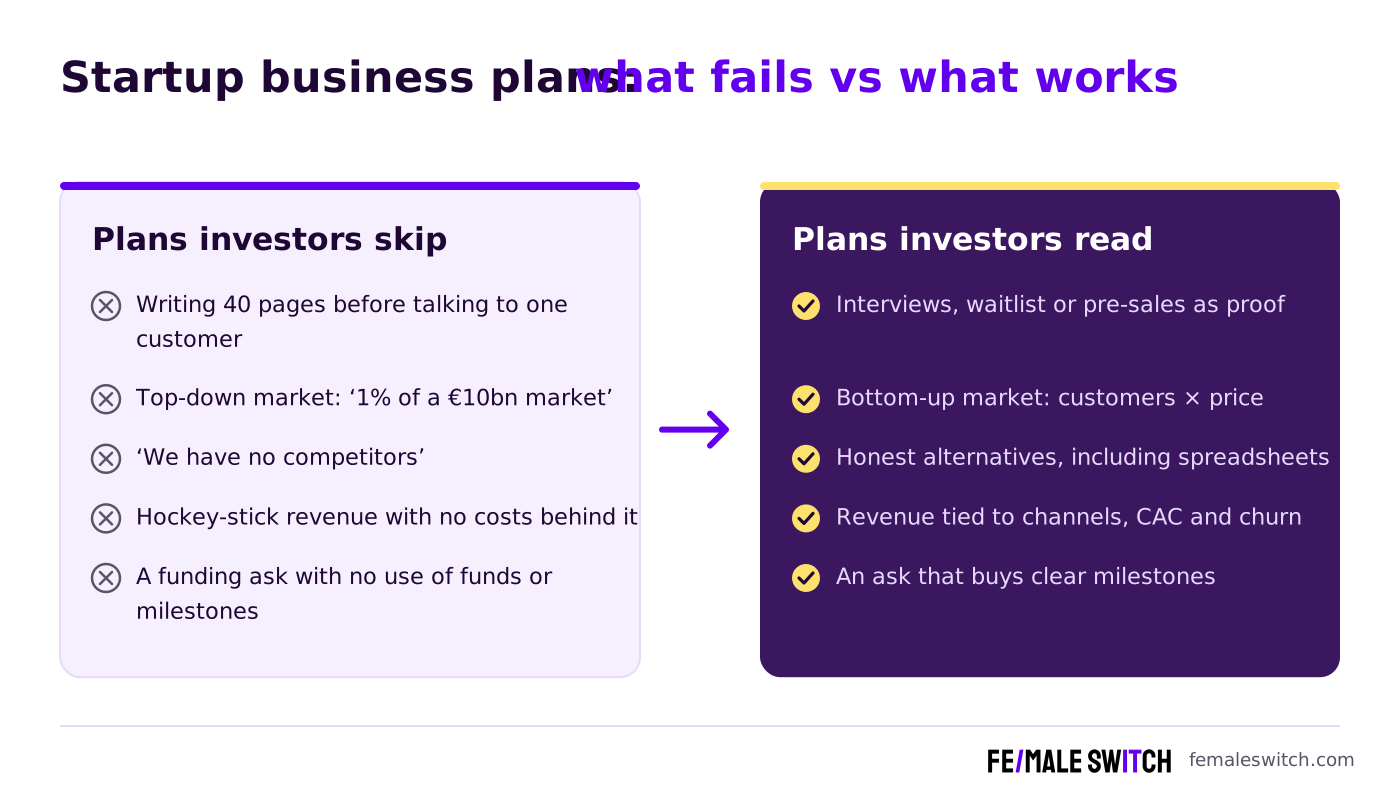
- Writing the plan before talking to customers. A long plan built on untested assumptions is fiction with page numbers.
- Top-down market sizing. “If we get 1% of a €10 billion market” tells a reader nothing. Count customers and multiply by price.
- Ignoring alternatives. Your real competitor is often a spreadsheet, an agency or doing nothing.
- Revenue without costs. Every new customer in the projection needs a channel, a CAC and the people to serve them.
- A funding ask with no milestones. Say what the money buys and where it gets you by when.
- Too long, too vague. Cut adjectives, add numbers. If a section has no evidence, say what you will do to get it.
- Writing it once. A startup plan is a working document. Update it whenever a big assumption changes.
Learn to plan by building a real startup
In the Fe/male Switch startup game you work through validation, your business model, pricing and your first customers step by step, with Elona as your AI co-founder. The plan you write afterwards is based on evidence, not guesses.
👉 Build your first startup with an AI co-founder
Conclusion: Start Small, Then Write the Full Plan
A good startup business plan is short, specific and honest about what is still a guess. Start with a canvas or the one-page version, collect evidence, then fill in the 10 sections of the template and build the numbers so they agree with your market size and go-to-market plan. Write the executive summary last, and update the plan whenever a big assumption changes. When you need a first draft fast, the free generator gives you something to edit; the evidence has to come from you.
FAQ: Startup Business Plan
What should a startup business plan include?
Ten sections: executive summary, problem and solution, market size (TAM, SAM, SOM), target customers, competition, business model, go-to-market plan, team, financial plan with a funding ask, and milestones.
How long should a business plan for a startup be?
A one-page plan is enough to test an idea and talk to mentors. A full plan for a bank, grant panel or larger investment round usually runs to dozens of pages plus a financial model. Keep the executive summary under half a page either way.
Is there a free startup business plan template?
Yes. Copy the 10-section template in this article. The UK government’s business plan page also points to free templates from The King’s Trust and Start Up Loans, and the SBA offers downloadable example plans.
How do I write a business plan for a startup with no experience?
Validate the idea with customers first, fill in a business model canvas, then draft the 10 sections one at a time using the prompts. Build the numbers last and ask three people to read the plan before you send it.
Do investors still read business plans?
Many early-stage investors ask for a pitch deck first and a fuller plan or financial model during due diligence. Banks and grant panels more often ask for a written plan. The thinking is the same either way.
How many years of financial projections does a startup need?
Three years is usually enough for an early-stage startup, with the first year by month. The SBA suggests five years for traditional plans used to request financing, with the first year by quarter or month.
What do investors look for in a startup business plan?
A real problem, evidence that customers want your solution, a market that is big enough, a credible plan to reach customers, a team that fits the problem, unit economics that work, and a funding ask that buys clear milestones.
Is a business model canvas a business plan?
No. A canvas summarises your business model on one page, while a business plan adds the detail, numbers and milestones. Read more in is a business model canvas a business plan?.
What is the difference between a business plan and a pitch deck?
The pitch deck tells your story in about a dozen slides to get a meeting. The business plan holds the detail behind those slides: market research, customers, go-to-market, finances and milestones.
Can AI write my startup business plan?
AI can give you a solid first draft. Fe/male Switch’s free Business Plan Generator and Elona’s Business Plan Creator draft a plan from a short description of your idea. Replace the generic parts with your own evidence and numbers before anyone reads it.
About the Author
Violetta Bonenkamp, also known as MeanCEO, is an experienced startup founder with an impressive educational background including an MBA and four other higher education degrees. She has over 20 years of work experience across multiple countries, including 5 years as a solopreneur and serial entrepreneur. Throughout her startup experience she has applied for multiple startup grants at the EU level, in the Netherlands and Malta, and her startups received quite a few of those. She’s been living, studying and working in many countries around the globe and her extensive multicultural experience has influenced her immensely.

