
TL;DR: what goes into a startup marketing plan?
A startup marketing plan is a one-page document that says who you sell to, why they should pick you, which two or three channels you will use, how much you will spend and which numbers you will check every week, for the next 90 days. Below you get a fill-in template with eight sections, a filled example for a fictional startup, a table of marketing channels by cost and time to results, and a 90-day timeline. If you want a first draft in minutes, our free generator gives you 20 marketing ideas from a short description of your business.
👉 Get your free marketing plan with the Fe/male Switch Marketing Plan Generator
Most first-time founders either skip the marketing plan or write a 30-page document nobody opens again. Both fail for the same reason: there is no clear goal and no weekly routine. A good marketing plan for startups is short, specific and tied to the next 90 days. Copy the template below, fill it in with your own numbers, and put the first actions in your calendar today.
What Is a Startup Marketing Plan?
A startup marketing plan turns your idea into a short list of decisions: one target customer, one message, a few channels, a budget limit and a few numbers to watch. It is not a forecast and not a branding exercise. It is a working document you update every week.
It is also not the same as a business plan. A business plan covers the whole company: the problem, the team, operations, finances and funding. The marketing plan is one part of it, written in more detail and for a shorter time. If you still need the bigger picture, start with our startup business plan template and come back here for the marketing part.
A go-to-market strategy sits in between. It describes how you will enter a market for the first time: which segment, which price, which launch. Our guide to startup go-to-market strategy covers that. The marketing plan is what you do every week once the strategy is set.
Startup Marketing Plan Template: 8 Sections on One Page
Here is the startup marketing plan template we use with first-time founders. Each section answers a few questions. Keep each answer to two or three sentences; if a section needs a full page, you have not decided yet.
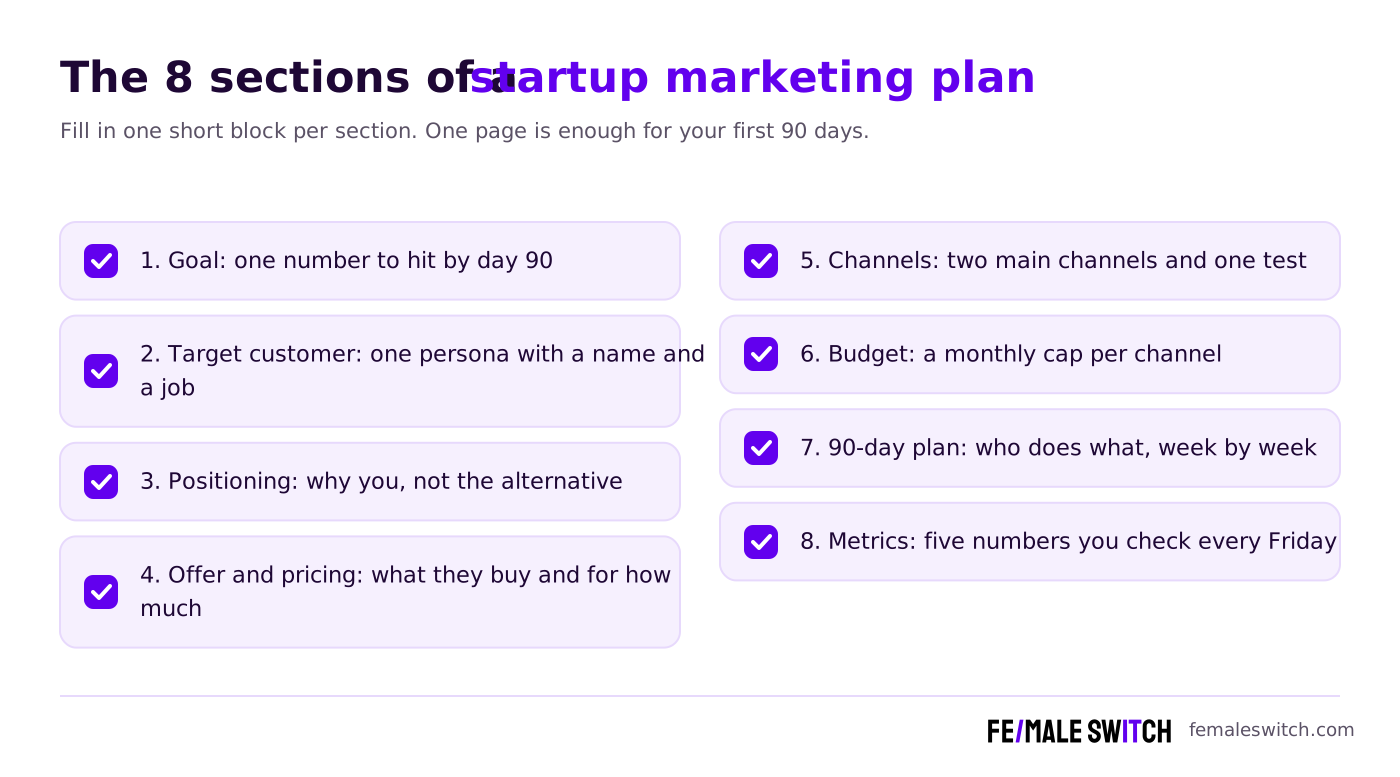
Copy the table into a document or a spreadsheet and replace each question with your answer. The rest of this guide shows what a good answer looks like.
Marketing Plan for a Startup: A Filled Example
Fictional example. Tidyslot is an invented startup. Its name, prices, customers and numbers are made up to show how to fill in the template. They are not real data or benchmarks; use your own.
Tidyslot is a booking page with payments built in, for independent yoga and Pilates teachers. The founder runs it alone, part-time, with an MVP live and 12 paying teachers, all from her own network. Here is her plan, section by section.
1. Goal and Summary
What to write: what you sell, to whom, and one measurable goal for day 90. Pick a number you control, such as paying customers or booked demos. "Brand awareness" is not a goal.
Tidyslot example: Tidyslot is a booking page with payments for independent yoga and Pilates teachers, €19 a month after a 30-day free trial. Goal for day 90: grow from 12 to 60 paying teachers. Second goal: 300 teachers on the email list.
2. Target Customer (Persona)
What to write: one specific person, not a demographic range. Describe her job, her problem in her own words, where she spends time, what makes her buy now and what makes her hesitate. Base it on real conversations; our guide to finding your first 10 customers shows how to run them. For a first draft, try the free User Persona Generator: you describe your business idea and get a persona with eight elements.
Tidyslot example: Marta, 34, teaches 10 classes a week in rented studios and a park. She takes bookings in WhatsApp and payments by bank transfer. Her problem: "I spend Sunday evenings chasing payments and fixing double bookings." She spends time on Instagram, in two local teacher WhatsApp groups and in her teacher-training school's alumni group. She buys when she starts a new class. Her objection: "My students won't download an app."
3. Positioning and Competitors
What to write: what your customer uses today (often a spreadsheet, WhatsApp or doing nothing), and one sentence on why you are the better choice for her. Use this format: For [customer] who [problem], [product] is a [category] that [main benefit]. Unlike [alternative], it [key difference]. The free Value Proposition Generator can help you name the problems and the outcome your customer wants.
Tidyslot example: For independent yoga and Pilates teachers who manage bookings in WhatsApp, Tidyslot is a booking page with payments built in that takes ten minutes to set up. Unlike studio software built for gyms with staff, it is priced for one teacher, and students book from a link, with no app to install. Alternatives: WhatsApp plus bank transfer (free but messy), studio software (too big), generic calendar tools (no class limits or payments).
4. Offer and Pricing
What to write: what the customer gets, the price, and how you lower the risk of trying: a free trial, a guarantee or a founding-customer price. Add one reason to act now.
Tidyslot example: €19 a month, 30-day free trial, no card needed. Founding-teacher offer: €9 a month for the first three months, for the first 50 teachers. Referral: one free month for both teachers.
5. Channels
What to write: two main channels where your persona already spends time, plus one test channel. Write down which channels you are not using yet, so you stop worrying about them. Our channel-by-channel guide to finding your first 100 users and this overview of distribution channels in the business model canvas help you choose.
Tidyslot example: Main channel 1: direct outreach to teachers on Instagram and in teacher groups, 10 messages a day. Main channel 2: partnerships with three teacher-training schools that offer Tidyslot to graduates. Test channel: four how-to articles, starting with "how to take yoga class bookings online". Not now: paid ads, TikTok, press.
6. Budget
What to write: a monthly limit per channel in money and in hours. Early on, your time is the bigger cost. Set a cap you can afford to lose if the test fails. The free Marketing Budget Calculator gives you a personalised budget from your product, audience and average revenue, and mean.ceo shows one way to split a €500 monthly marketing budget.
Tidyslot example: Total €900 for 90 days. Partnerships: €400 (printed cards and a sponsored workshop at each school). Content: €300 (a freelance editor for four articles). Paid test: €200, only in month three, to boost the best-performing post. Founder time: 8 hours a week.
7. 90-Day Action Plan
What to write: what happens each week, who does it and by when. Put the first two weeks in your calendar before you finish the plan. The timeline in the next section gives you a structure.
Tidyslot example: Weeks 1–2: interview 10 teachers, finish the landing page, set up tracking. Weeks 3–4: 10 outreach messages a day, first call with each school. Weeks 5–8: one partnership live, two articles published, weekly review every Friday. Weeks 9–12: keep what works, run the €200 paid test, write the next 90-day plan.
8. Metrics and Weekly Review
What to write: five numbers at most, checked on the same day every week, plus a rule for when you change course. Free tools are enough at this stage: a spreadsheet, Google Analytics (free of charge) and Google Search Console (a free Google service). Our guide to a growth metrics dashboard for founders shows what to track later.
Tidyslot example: Every Friday: new trials, trial-to-paid conversion, paying teachers, cost per paying teacher by channel and cancellations. Rule: if a channel brings no trials after four weeks of steady effort, stop it and move the time to the other one.
Marketing Channels for Startups by Cost and Time to Results
The hardest choice in any marketing plan for startups is which channels to use. This table compares common channels by the cash you need to start, how fast you usually see first results, and how much founder time they take.
The ratings are our editorial judgement from building startups, not measured data. Your results depend on your market, offer and skills.
Two patterns matter. The free channels cost time, and the fast channels cost money. Content and SEO are slow but keep working after you stop: Google's own SEO Starter Guide says some changes take effect in a few hours and others take several months, and suggests waiting a few weeks before judging. That makes SEO a good second channel, not your only one in the first 90 days. When you are ready, read SEO for female founders and our content marketing strategy for startups.
If your budget is zero, start with direct outreach, communities and partnerships. Our sister site has more zero-budget marketing strategies for founders, and our guide to digital marketing on a bootstrap budget shows which free tools to use.
90-Day Startup Marketing Plan Timeline
A 90-day plan is long enough to test two channels properly and short enough to change course before you waste money. Here is the structure we suggest.
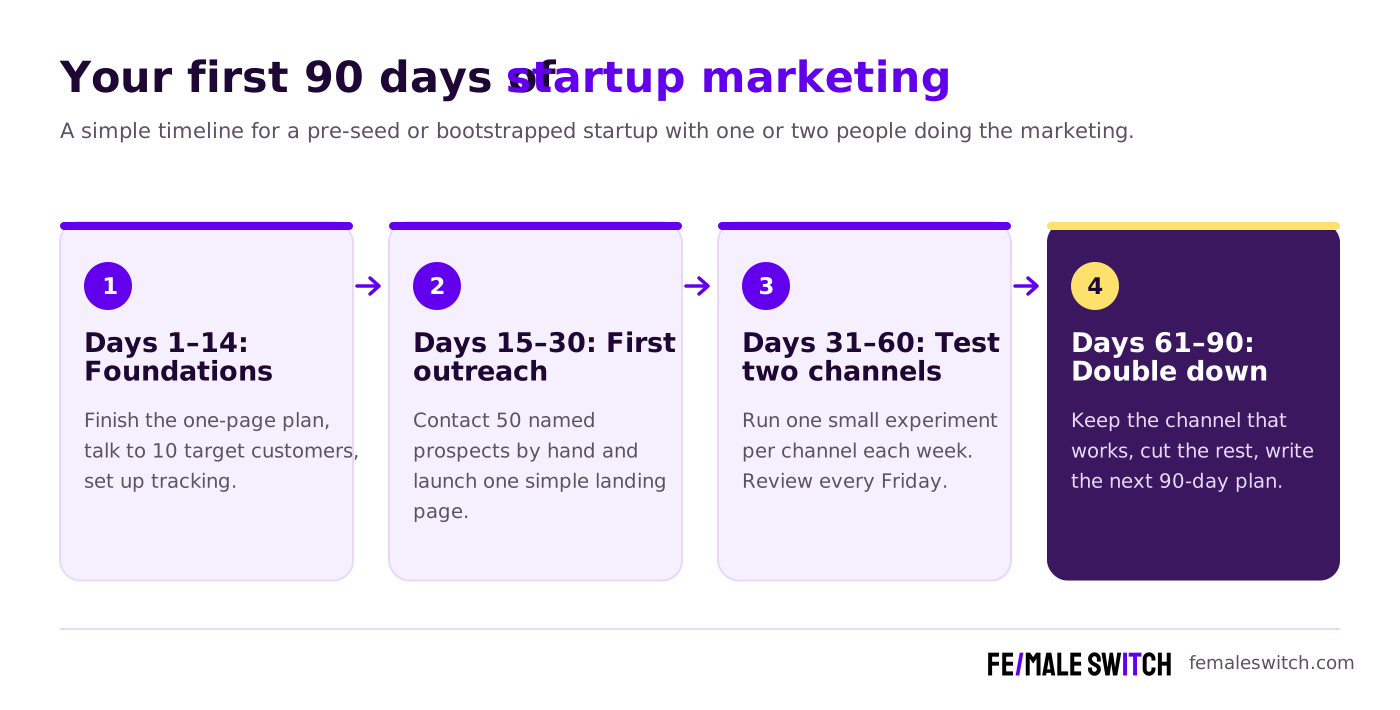
Days 1–14: Foundations
- Fill in the eight sections of the template, in draft.
- Talk to 10 people who match your persona, and change the persona if they surprise you.
- Set up tracking: analytics on your site, a spreadsheet for the five weekly numbers, and a way to ask every new customer where they heard of you.
Days 15–30: First Outreach
- Write a list of 50 named prospects and contact them by hand. Manual outreach teaches you the words customers use.
- Launch one landing page with one clear call to action.
- Start your first partnership conversation.
Days 31–60: Test Two Channels
- Run one small experiment per main channel each week: a new message, a new group, a new offer.
- Review the numbers every Friday, in 30 minutes, with the same spreadsheet.
- If you launch in this window, follow our startup launch playbook so the launch feeds your channels instead of being a one-day spike.
Days 61–90: Double Down or Cut
- Put most of your time into the channel that brought paying customers.
- Stop the channel that brought nothing after four steady weeks.
- Write the next 90-day plan. If content is your next channel, mean.ceo has a detailed plan for content marketing in your first 90 days.
How to Write Your Marketing Plan Faster with Free Tools
You don't need paid software to write a startup marketing plan. Here is the fastest route we know:
- Get a first draft. Open the free Marketing Plan Generator, describe your product, your audience, your business stage and the language you want, and you get a list of 20 marketing ideas in about ten seconds. Pick the three that fit your persona best.
- Sharpen the persona. Run the persona and value proposition generators, then check the result against two real customer conversations.
- Set the budget. Use the budget calculator, then lower the number to what you can afford to lose in a 90-day test.
- Fill in the template. Copy the eight-section table above and replace each question with your answer.
- Book the first two weeks. Put the outreach, interviews and the Friday review in your calendar.
Want to compare tools first? We reviewed 10 free marketing plan generators for startups. Whatever you use, treat the output as a draft: the decisions are still yours.
Learn marketing by building a real startup
In the Fe/male Switch startup game you build your first business step by step, with AI co-founder tools for ideas, names and a business model canvas, and you learn to use Canva, Tilda, Make and Bubble. You don't need business or technical skills to start.
👉 Build your first startup with Fe/male Switch
Common Startup Marketing Plan Mistakes
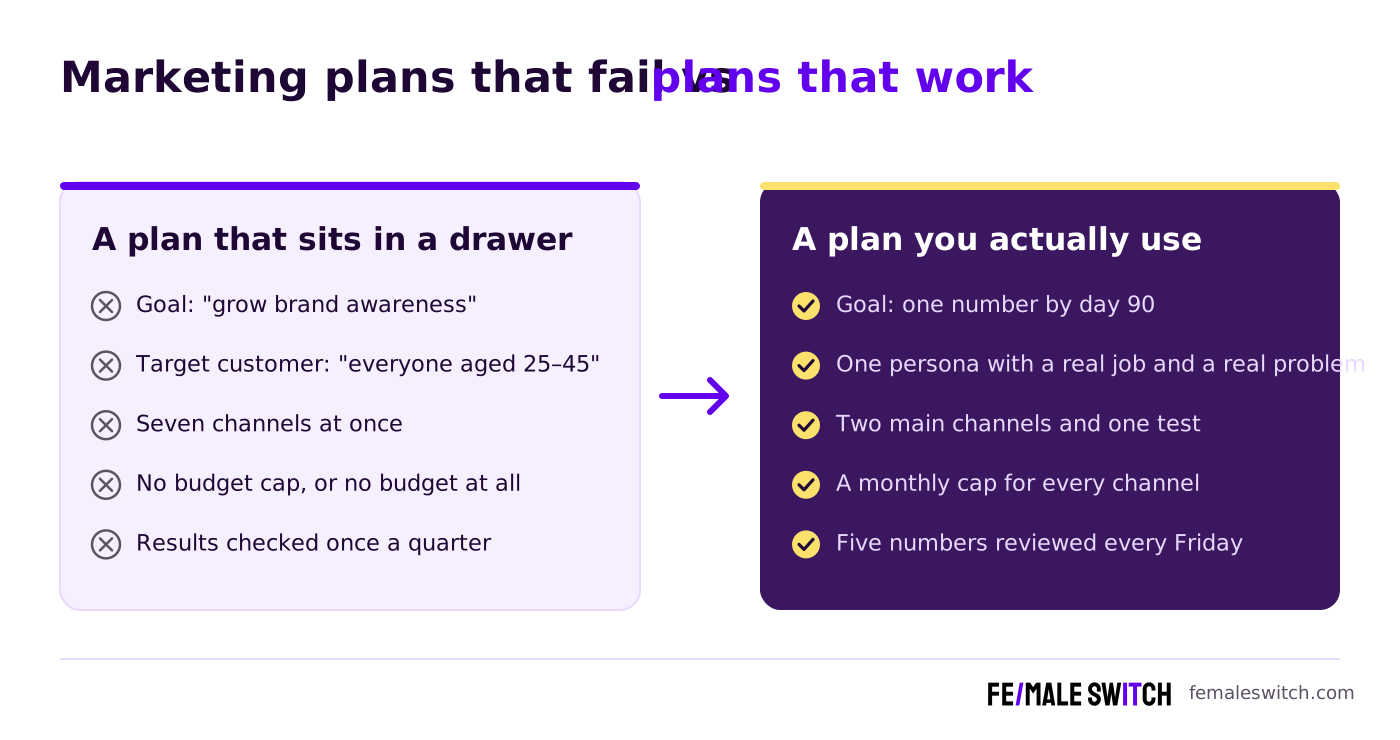
- A goal you can't count. "Grow awareness" can't fail, so it can't teach you anything. Use paying customers, demos booked or sign-ups.
- Everyone as the target customer. A plan for everyone has no message and no channel. Pick one persona; you can add a second next quarter.
- Too many channels. Seven channels at a little effort each tells you nothing. Two main channels and one test is plenty for 90 days.
- Paying for ads before the message works. If people you talk to don't get it, ads only show the wrong message to more people. Test the message by hand first.
- Copying big-company plans. SWOT pages and brand guidelines are fine later. Early on, the plan has to produce customers this quarter.
- No budget cap. Without a limit per channel you either spend nothing or spend too much on one test.
- Writing it once. A plan you don't review weekly stops being a plan after a month. Book a 30-minute Friday review.
- Ignoring your own time. Your hours are the real budget. If a channel needs 20 hours a week and you have 8, it isn't the right channel yet.
Conclusion: Write It Today, Review It Every Friday
A startup marketing plan doesn't need to be long. It needs one goal, one customer, a clear reason to choose you, two channels, a budget cap and five numbers you check every week. Copy the template, fill it in using the Tidyslot example as a guide, and book your first two weeks today. In 90 days you will know which channel works for your startup, which is worth more than any perfect plan.
FAQ: Startup Marketing Plan
What should a startup marketing plan include?
Eight sections: a goal and summary, the target customer, positioning, offer and pricing, channels, budget, a 90-day action plan, and metrics with a weekly review. Keep each section to a few sentences.
Is there a free startup marketing plan template?
Yes. The eight-section table in this guide is a free template you can copy into a document or spreadsheet. For a quick first draft, the free Fe/male Switch Marketing Plan Generator gives you 20 marketing ideas from a short description of your business.
What is a good example of a marketing plan for a startup?
See the Tidyslot example above. It is fictional, but it shows a filled plan: one goal for day 90, one persona, a positioning statement, a founding-customer offer, two main channels plus one test, a €900 budget for 90 days and five weekly numbers.
How long should a startup marketing plan be?
One page is enough for your first 90 days. Early-stage plans rarely need more than five pages. If a section grows longer than a few sentences, it usually means a decision is still open.
What is the difference between a marketing plan and a business plan?
A business plan covers the whole company: problem, team, operations, finances and funding, usually for one to three years. A marketing plan covers only how you reach and win customers, in more detail and usually for the next 90 days.
How much should a startup spend on marketing?
There is no single right number. Start with an amount you can afford to lose in a 90-day test, split it by channel with a monthly cap, and count your own hours as part of the budget. The free Marketing Budget Calculator can help you set a starting figure.
Which marketing channels work best for startups?
It depends on where your customers already spend time. With little money, direct outreach, communities and partnerships usually give the fastest feedback. Content and SEO take months but keep working. Paid ads are fast but cost money from day one.
Should I validate my idea before writing a marketing plan?
Yes, at least roughly. A plan built on an untested idea markets something nobody may want. A quick smoke test is a cheap first step; our guide to smoke test marketing shows five ways to check demand before you build.
Can AI write a marketing plan for my startup?
AI can give you a fast first draft and ideas. The Fe/male Switch Marketing Plan Generator, for example, returns 20 marketing ideas in about ten seconds. You still have to choose the customer, the channels and the budget, and check them against real conversations.
How often should I update my marketing plan?
Review the numbers every week and adjust the actions. Rewrite the plan every 90 days, keeping the channels that brought customers and dropping the ones that didn't.
About the Author
Violetta Bonenkamp, also known as MeanCEO, is an experienced startup founder with an impressive educational background including an MBA and four other higher education degrees. She has over 20 years of work experience across multiple countries, including 5 years as a solopreneur and serial entrepreneur. Throughout her startup experience she has applied for multiple startup grants at the EU level, in the Netherlands and Malta, and her startups received quite a few of those. She’s been living, studying and working in many countries around the globe and her extensive multicultural experience has influenced her immensely.

