

TL;DR: Jab, Jab, Jab, Right Hook summary in one paragraph: Gary Vaynerchuk's 2013 book says you earn the right to sell on social media by giving value first. "Jabs" are useful, entertaining or caring posts; the "right hook" is the ask, such as a sale, sign-up or download. The core idea still holds in 2026. The platform chapters don't: Google+ and Vine are gone, Twitter is now X, and TikTok, LinkedIn and AI assistants matter more than Tumblr. Below you'll find a 2013-vs-2026 platform table, a copyable jab-to-hook audit for your last 20 posts and a 30-day plan for founders.
Jab, Jab, Jab, Right Hook is the social media book many founders pick up when their launch posts get no reaction. Gary Vaynerchuk published it with HarperBusiness in 2013, when Facebook pages, Instagram photos and Vine videos were the new frontier.
Most summaries simply retell the book. This one is written for founders who have to sell with a tiny team in 2026: what to keep, what to skip and how to turn the idea into a weekly routine.
Jab, Jab, Jab, Right Hook summary in five ideas

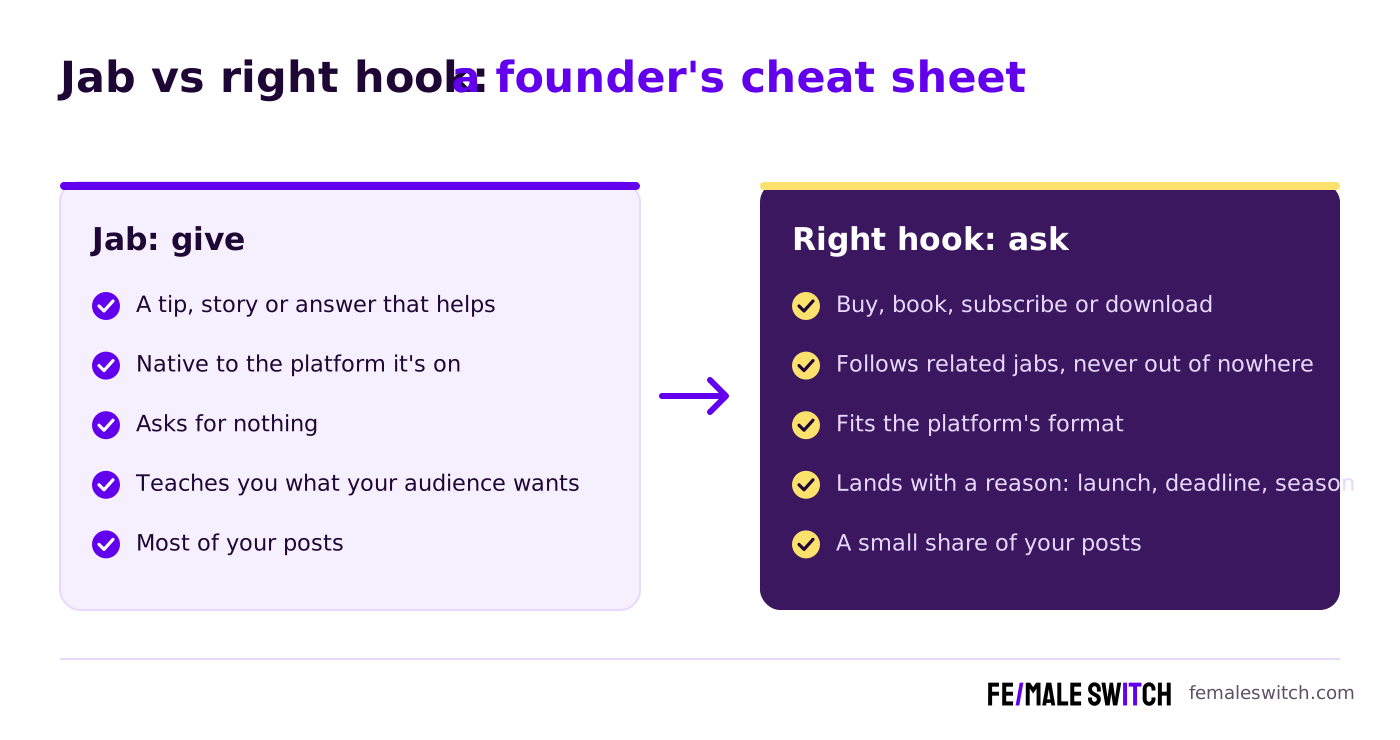
- Jabs build the relationship, right hooks cash it in. A jab is content that gives something: a tip, a laugh, a behind-the-scenes moment, a reply to a customer. A right hook asks for something: buy, book, subscribe, download. Most of your posts should be jabs.
- Native beats generic. The same post copied to every network fails. Each platform has its own format, tone and culture, and content has to look like it belongs there.
- Context decides. Great content in the wrong place, at the wrong time or for the wrong audience still misses. Timing and audience matter as much as the idea.
- Story over slogans. People share stories, not product specs. Even small, everyday moments from your business can carry a story.
- Small companies can win. A founder who replies personally, posts consistently and cares about each customer can out-perform big brands with bigger budgets.
📘 Free e-book: Startup Idea Validation the Right Way. Before you market or build anything, make sure people want it. Violetta Bonenkamp's free e-book shows first-time founders how to test demand with minimal resources, track the metrics that matter and reach their first customers without giving away equity, with downloadable templates and checklists. Read about the book and get your free copy →
The part most summaries miss: jabs don't buy you a sale
Years after the book came out, Vaynerchuk wrote on his own blog (in 2016) that one point had been misunderstood: throwing jabs does not guarantee that your right hook lands. Paraphrasing his clarification:
- Jabs earn you the right to ask. They don't earn you the sale.
- Expect some right hooks to fail, even after months of good jabs.
- Judge the strategy over years, not weeks. One right hook that lands every six to twelve months can justify a year of jabs.
- When a hook misses, look back at your jabs: did they lead naturally to the ask, or did the ask come out of nowhere?
For founders this is the most useful lesson in the whole book. It's why we built the diagnosis checklist further down.
What aged badly: the 2013 platforms vs 2026
The 2013 cover shows nine platform icons. Here is where each one stands for a founder today.
And the channels the book couldn't cover:
- TikTok and YouTube Shorts: today's short-video jab machines. Educational and behind-the-scenes clips work well for founders.
- Threads: Meta's text network, launched in 2023. Worth a test if your audience already uses Instagram.
- AI assistants and AI search: people now ask ChatGPT, Perplexity or Google's AI answers for recommendations. Here a "jab" is a genuinely useful, specific article or guide that an assistant can cite, and the "right hook" is the click to your site.
Jab-to-hook audit: score your last 20 posts
The book doesn't prescribe a fixed ratio, and neither do we. But you can't fix what you don't measure. Copy this template into a doc or spreadsheet and fill it in for your last 20 posts across all channels.
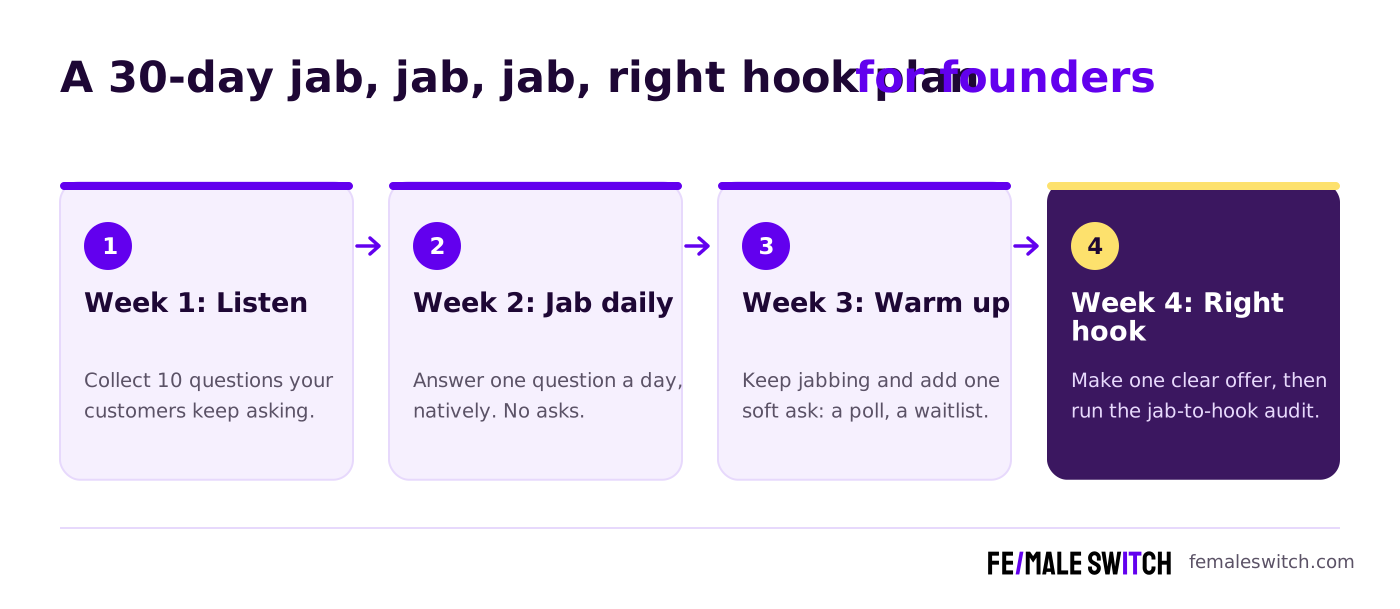
A 30-day jab, jab, jab, right hook plan for founders
If you're still testing whether your idea is worth marketing at all, start with our startup game with an AI co-founder, and validate before you promote, as in the startup idea validation guide.
When a right hook misses: a diagnosis checklist
- Did the jabs connect to the hook? Ten posts about productivity and then an offer for accounting software is a hook out of nowhere.
- Was the hook native? A link dumped into a video platform, or a long sales post on a visual channel, rarely works.
- Did the jabs teach you anything? Look at which jabs got replies. Those topics are what your audience actually wants to buy.
- Was it the right moment? Launch hooks work around a reason: a new feature, a deadline, a season.
- Did you give it time? One missed hook isn't a verdict. Judge over quarters, not days.
Who should read Jab, Jab, Jab, Right Hook (and who can skip it)
Read it if you are a first-time founder or a small team that posts without a plan, sells too early or copies the same post everywhere. The core metaphor alone will change how you plan your content.
Skim or skip it if you need detailed, current platform tactics. The examples and platform chapters are from 2013, so pair the book with up-to-date guides such as The Bootstrap AI Revolution, which covers marketing a new business with AI.
Related startup books for founders
- Hooked: How to Build Habit-Forming Products: what keeps users coming back once your jabs bring them in.
- The Lean Startup: test the offer behind your right hook before you scale it.
- The Mom Test: ask customers the right questions, and you'll know what to jab about.
- Free Bootstrapping with AI Guide: build and market a startup without funding.
FAQ
What is the main idea of Jab, Jab, Jab, Right Hook?
Give value before you ask for anything. "Jabs" are posts that help, entertain or engage your audience, and the "right hook" is the call to action. Most of your content should be jabs, and each platform needs content made for it.
What is a jab in marketing?
A jab is content that gives without asking: a tip, a story, a behind-the-scenes moment or a helpful reply. Jabs build trust and teach you what your audience cares about.
What is a right hook in marketing?
A right hook is the ask: a sale, a sign-up, a booking, a download. It lands best after several related jabs and when it fits the platform.
Is Jab, Jab, Jab, Right Hook still relevant in 2026?
The core idea is: give value first, make native content and ask at the right moment. The platform chapters are dated, because Google+ and Vine are gone, Twitter is now X, and TikTok, LinkedIn and AI search have become central.
How many jabs should you throw before a right hook?
The book doesn't set a fixed number. Track your own ratio with the audit above and make sure every hook has a few related jabs before it. Vaynerchuk later stressed that even many jabs don't guarantee a hook lands.
Is Jab, Jab, Jab, Right Hook a good book for startup founders?
Yes, especially for first-time founders who sell too early or post without a plan. Read it for the mindset, and use current guides for platform tactics.
About the Author
Violetta Bonenkamp, also known as MeanCEO, is an experienced startup founder with an impressive educational background including an MBA and four other higher education degrees. She has over 20 years of work experience across multiple countries, including 5 years as a solopreneur and serial entrepreneur. Throughout her startup experience she has applied for multiple startup grants at the EU level, in the Netherlands and Malta, and her startups received quite a few of those. She’s been living, studying and working in many countries around the globe and her extensive multicultural experience has influenced her immensely.

