

TL;DR: The Mom Test summary in one paragraph: Rob Fitzpatrick's short 2013 book says that asking people whether your idea is good gets you polite lies, from your mom and from everyone else. Instead, ask about their life, ask about specific things they did in the past, and listen far more than you talk. Then judge a conversation by the commitment it ends with, not by the compliments. The method matters even more in 2026, when AI can build a product in a weekend and "synthetic users" praise anything. Below: a copyable interview script, a bad-question rewrite table, a 14-day sprint and a worked founder example.
The Mom Test is the customer interview book that founders keep recommending to each other, mostly because it is short enough to read in an evening and practical enough to use the next morning. Rob Fitzpatrick self-published it in 2013, after learning with his own startups how little encouraging feedback can mean.
Most summaries list the three rules and stop. This one shows founders in 2026 how to run the interviews with a tiny team, what AI changed, and how to tell whether ten conversations validated anything.
The Mom Test summary in six ideas
- The problem is the question, not the person. Your mom lies because you asked her to judge your idea. Anyone asked that question will soften the truth. Ask better questions and even your mom becomes a useful source.
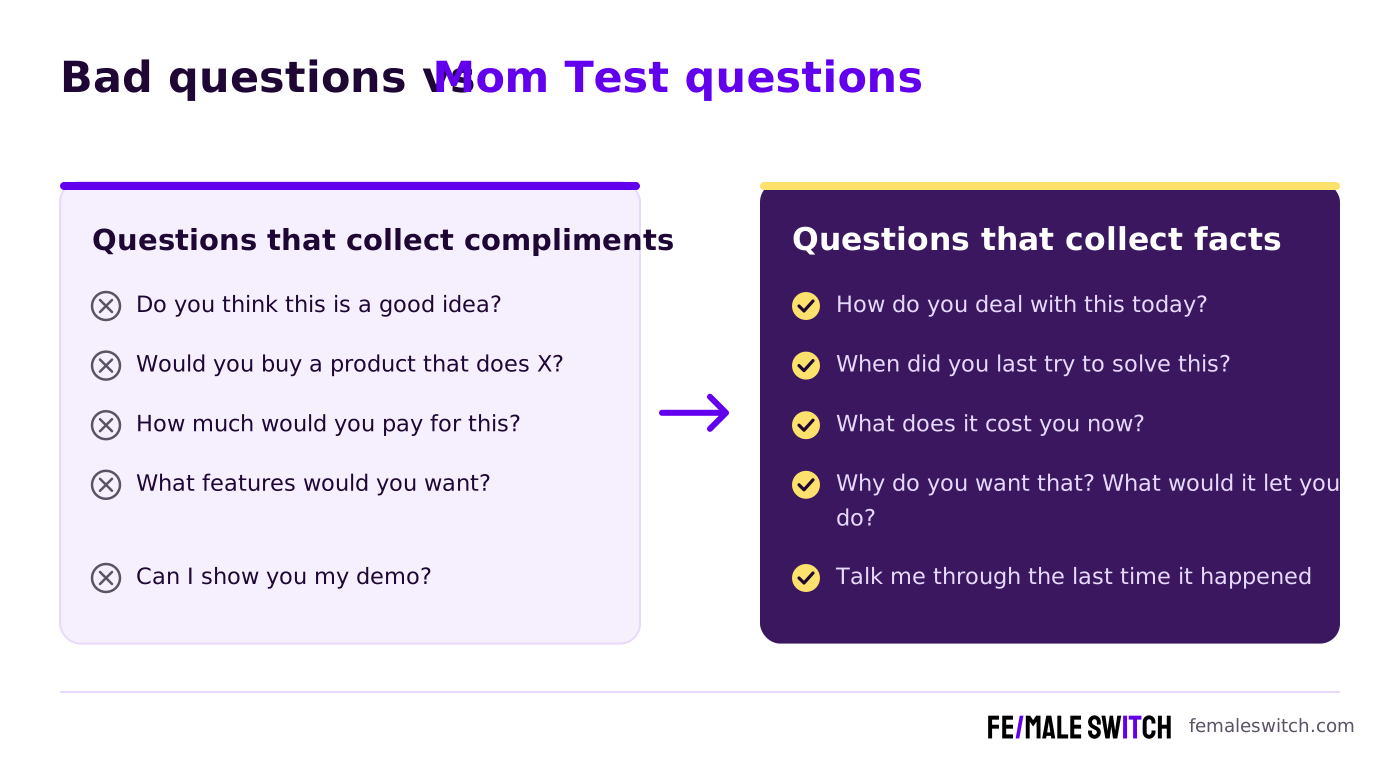
- Talk about their life, not your idea. The moment you pitch, people switch into polite-listener mode. Ask how they handle the problem today, what it costs them and what they have already tried.
- Ask about specifics in the past, not opinions about the future. "Would you use this?" invites a kind guess. "When did this last happen, and what did you do?" gets you facts.
- Talk less, listen more. If you are explaining, you aren't learning. The book's best interviews feel like casual chats where the customer does most of the talking.
- Ignore compliments, fluff and feature requests. Praise, vague statements ("I always...", "I would...") and wish lists feel like progress but tell you little. Dig underneath them: why do they want that, and what happens without it?
- Every meeting should end with a commitment or a clear no. A real signal costs the customer something: time (a follow-up meeting, a trial), reputation (an intro to their boss) or money (a pre-order, a deposit, a letter of intent). "Sounds great, keep me posted" is a polite no.
📘 Free e-book: Startup Idea Validation the Right Way. Before you market or build anything, make sure people want it. Violetta Bonenkamp's free e-book shows first-time founders how to test demand with minimal resources, track the metrics that matter and reach their first customers without giving away equity, with downloadable templates and checklists. Read about the book and get your free copy →
Bad questions and their Mom Test versions
The fastest way to absorb the book: rewrite the questions you were about to ask.
What changed by 2026: AI, synthetic users and cheap MVPs
The book was written before founders could build a working app with an AI coding tool in a few days. That changes the stakes in both directions.
- Building is cheap, so skipping interviews feels tempting. But a launch with no users teaches you almost nothing about why. Ten honest conversations tell you which problem to build for, for less than a month of ads.
- "Synthetic users" fail the Mom Test by design. Asking a chatbot to role-play your customer gives you the purest fluff there is: generic, hypothetical and agreeable. Use it to draft questions, never as evidence of what real people do or pay for.
- AI is a great note-taker, a weak interviewer. Transcription and summary tools save hours. But summaries tend to keep the opinions and lose the specifics, so re-read the transcript for past behaviour, numbers and workarounds before you trust the summary.
- Commitments can be tested faster. A pre-order page, a waitlist with a deposit or a paid pilot takes an afternoon to set up now. That makes the book's "commitment and advancement" idea easier to apply than in 2013.
Fitzpatrick has since written Write Useful Books, and Simon & Schuster lists a revised and expanded edition of The Mom Test, with release dates from late 2026 that vary by retailer.
Copyable Mom Test interview script and note sheet
Copy this into a doc before each call. Keep it to 20–30 minutes and don't mention your idea until the last five.
How to tell if your interviews validated anything
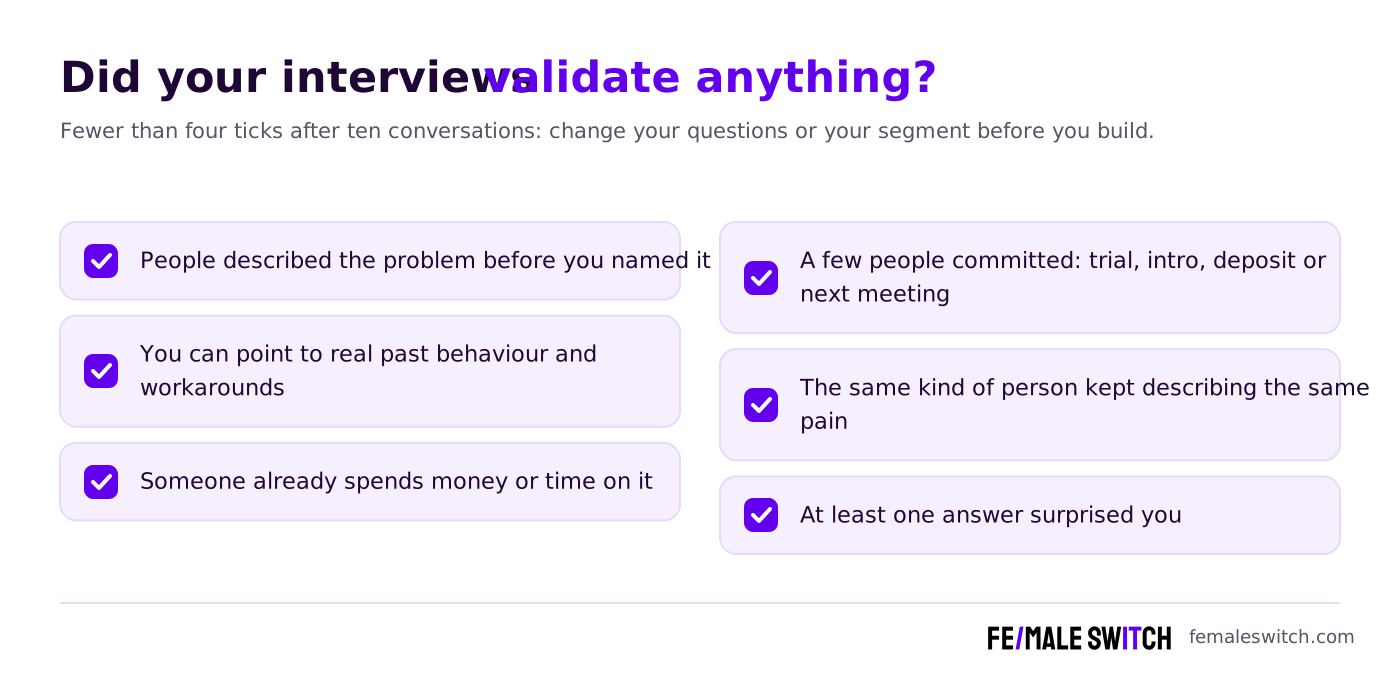
After every five to ten conversations, run this checklist. A meeting that felt great but ended with no next step usually means you collected compliments.
- Did people describe the problem before you named it? If you had to lead them to it, it may not be a priority for them.
- Can you point to real past behaviour? Workarounds, spreadsheets and paid tools are evidence. "I'd love that" is not.
- Is someone already spending money or time on it? Existing spend is the strongest sign that a budget exists.
- Did at least a few people commit? Count trials, intros, deposits and second meetings, not nice words.
- Did you hear the same pain from the same kind of person? If not, narrow your segment to a specific type of person you can find.
- Did anything surprise you? If every answer confirmed what you thought, you were probably pitching, not listening.
A worked founder example: the bakery scheduling app
A founder wants to build a staff scheduling app for small bakeries. In her first three calls she asks whether owners would use one. Everyone says yes. Nobody joins the waitlist.
She rewrites her questions. In the next seven calls she asks owners to describe last week's schedule. Five of them do it on paper or in a group chat and say it takes about an hour a week, which they don't mind. Two say the real pain is last-minute sick calls on weekends, when they spend the morning phoning staff instead of baking. Both already pay a temp agency for emergency cover.
She stops building a scheduling app. She tests a much smaller offer instead: a shared "who can cover today" list for a small group of nearby bakeries. She asks both owners for a small paid pilot. One agrees, the other introduces her to a bakery owners' group: money and reputation on the line.
A 14-day Mom Test sprint for a tiny team
You can practise this loop with an AI co-founder in our startup game, which walks first-time founders through customer discovery before they build.
Who should read The Mom Test (and who can skip it)
Read it if you are about to build, have started building without talking to customers, or keep hearing "great idea" without any sales. Product managers and consultants who run user interviews benefit too. It takes about two hours.
Skip it if you already run regular customer interviews and track commitments. You will know most of it. In that case, spend the time on the next step, such as testing demand with a landing page or pre-sale, as in the startup idea validation e-book, or building lean with the Free Bootstrapping with AI Guide.
Related startup books for founders
- The Lean Startup: the build-measure-learn loop that Mom Test interviews feed into.
- Jobs to be Done: Theory to Practice: a framework for the "why" behind what customers told you.
- Rework: stay small and charge early, which pairs well with asking for commitments.
- Hooked: once people sign up, how to make the product part of their routine.
FAQ
What is the main idea of The Mom Test?
Don't ask people whether your idea is good, because they will be polite rather than honest. Ask about their life, their past behaviour and what they already spend, and judge each conversation by the commitment it ends with.
What are the three rules of The Mom Test?
Talk about their life instead of your idea, ask about specifics in the past instead of opinions about the future, and talk less, listen more.
What are good Mom Test questions to ask customers?
"Talk me through the last time this happened", "What did you try to solve it?", "What does it cost you now?" and "Who else should I talk to?" All of them ask about real past behaviour instead of opinions.
How many customer interviews do you need?
The book doesn't set a fixed number. Many founders start with about ten per customer segment and stop when the answers repeat.
Is The Mom Test still relevant in 2026?
Yes. AI makes building cheap, so building something nobody wants is easier than ever. AI helps with notes, not with talking to real customers.
Can I use ChatGPT or synthetic users instead of customer interviews?
Not for validation. A simulated customer gives generic, hypothetical answers, exactly the fluff the book warns against. Use AI to prepare, then talk to real people.
About the Author
Violetta Bonenkamp, also known as MeanCEO, is an experienced startup founder with an impressive educational background including an MBA and four other higher education degrees. She has over 20 years of work experience across multiple countries, including 5 years as a solopreneur and serial entrepreneur. Throughout her startup experience she has applied for multiple startup grants at the EU level, in the Netherlands and Malta, and her startups received quite a few of those. She’s been living, studying and working in many countries around the globe and her extensive multicultural experience has influenced her immensely.

