

TL;DR: Super Founders summary in one paragraph: Silicon Valley VC Ali Tamaseb spent four years hand-building a dataset of about 30,000 data points on 200+ billion-dollar startups founded between 2005 and 2018, then compared them with a control group of startups that raised money but stayed smaller. The data debunks several startup "rules": most unicorn founders had no industry experience, roughly half were over 35, going solo didn't hurt, fewer than 15% went through an accelerator and over half had strong competitors on day one. The 2021 book missed the AI unicorn wave. Below you'll find a 2021-vs-2026 table, a founder self-audit, a diagnosis checklist for "conventional" startup advice and a 30-day plan to use the data without a VC budget.
Super Founders is the book people hand you when you've been told you are "too late", "too old", "not technical enough" or "not a serial founder" to start a company. Ali Tamaseb, a partner at the deep-tech venture firm Data Collective (DCVC), published it with PublicAffairs in 2021.
Most summaries repeat the famous bullet points. This review is written for a founder in 2026 who is more likely bootstrapping than raising from Sequoia: what does the data actually mean when you have no runway, and what has the AI wave changed since the book came out?
Super Founders summary in six ideas

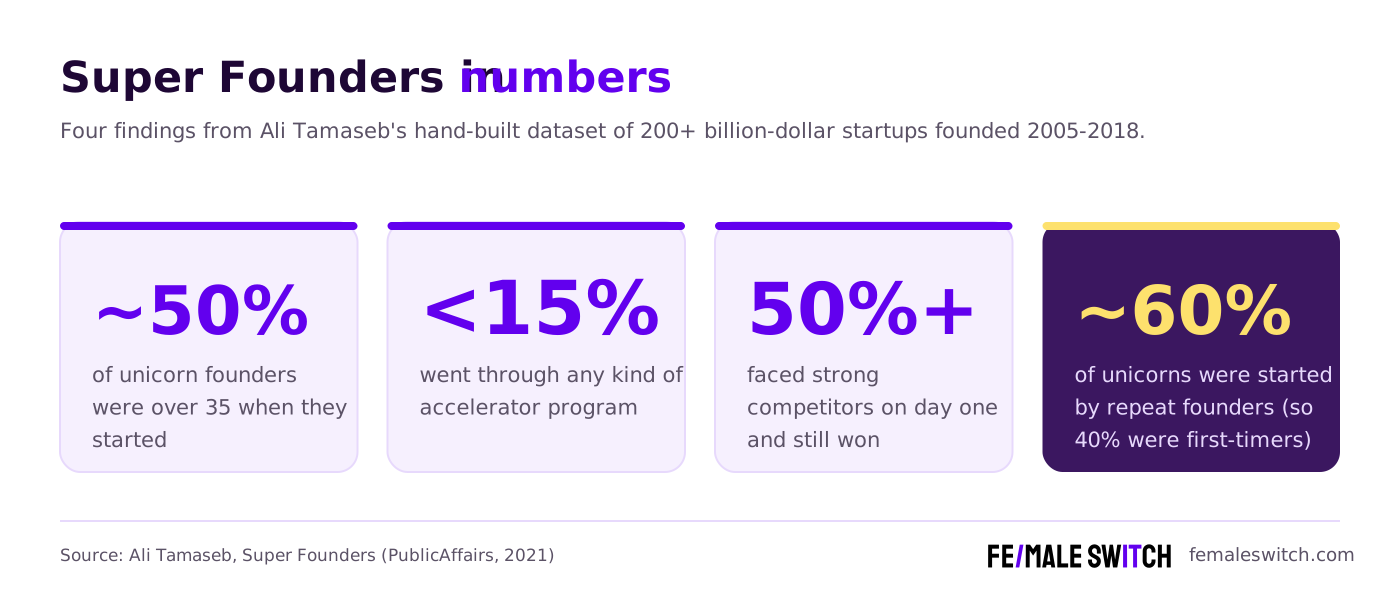
- Billion-dollar startups don't look like the stereotype. Across 200+ unicorns founded 2005–2018, the "typical" founder changes shape depending on the trait. There is no single profile.
- Age doesn't disqualify you. Roughly half of unicorn founders were over 35.
- Industry experience is overrated. Most unicorn founders had no direct work experience in the industry they disrupted. Fresh eyes matter.
- Solo and non-technical CEOs are fine. Being alone, or not being the engineer, didn't make a founder statistically less likely to win.
- Being first doesn't matter much. Over half of the unicorns had strong incumbents from day one. Timing, execution and distribution beat novelty.
- Repeat founders have an edge, but smaller than people think. About 60% of unicorn companies were started by a repeat founder, so roughly 40% were first-timers.
📘 Free e-book: Startup Idea Validation the Right Way. Before you market or build anything, make sure people want it. Violetta Bonenkamp's free e-book shows first-time founders how to test demand with minimal resources, track the metrics that matter and reach their first customers without giving away equity, with downloadable templates and checklists. Read about the book and get your free copy →
Tamaseb's own framing is that a "super founder" shows a cluster of traits: a track record of building something before, an unusual drive and a willingness to work on an idea for a decade.
What the data looks like
Over four years, Tamaseb collected about 30,000 data points on these companies, covering traits from the founder's age and university to market size, competitors, investors and fundraising time. Two caveats before you treat the findings as laws:
- Selection bias: the companies he studied are the ones that already reached a billion-dollar valuation. Lots of founders in their 40s with no industry experience never got there. The data shows what the winners looked like, and it guarantees nothing for you.
- Era bias: almost every company in the dataset was founded in a long period of cheap money (2005–2018). That changes the base rate for everything, from how fast you can raise to how long you can run on fumes.
Use the numbers to bust myths, then build your own plan on top.
What held and what the AI wave changed: 2021 vs 2026
The book came out before ChatGPT, before the Mistral and Anthropic funding rounds and before the AI-first unicorns. Here's how the main findings look five years later.
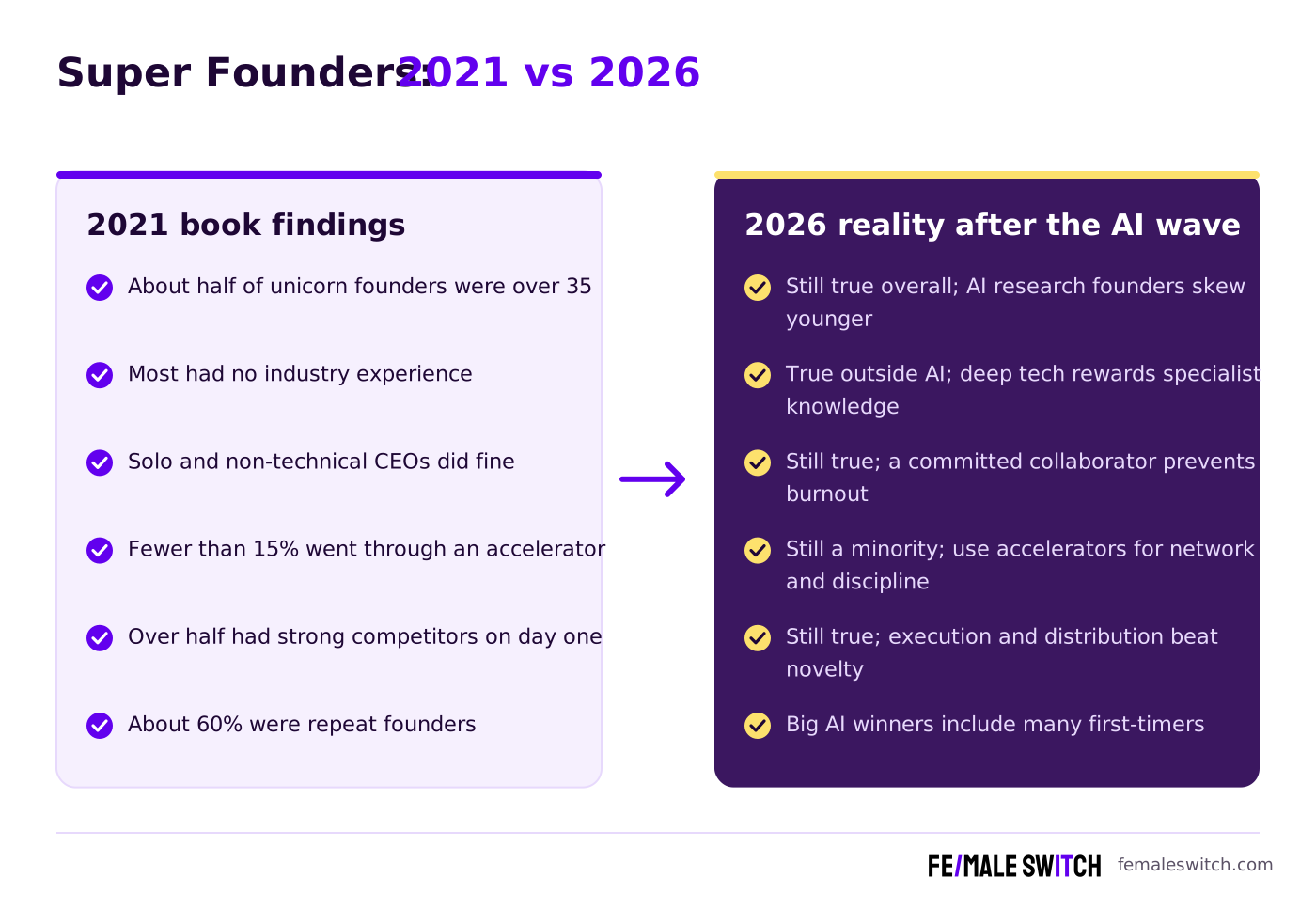
The core message of the book, that the stereotypes are wrong, has aged well. The scale of fundraising rounds and the speed of some AI winners are the biggest things it couldn't predict.
The Super Founder self-audit for first-time founders
The book's data points to a cluster of traits that keep appearing in unicorn founders. Copy this template into a doc and score yourself honestly. Use it as a mirror for where you stand today.
The point of the audit is to replace vague anxiety ("am I the right person?") with specific, fixable gaps.
Diagnosis checklist: when to ignore "conventional" startup advice
Use this to pressure-test advice you're hearing.
- Is it from a sample of winners only? Treat it as an anecdote. "Great founders drop out of college" is survivor bias.
- Does the person giving it have skin in your game? A VC urging you to raise, a bootcamp urging you to apply, a consultant urging you to hire them: discount the claim.
- Does it match the data for your category? "You must be first" is false for consumer apps and SaaS, closer to true in a new technical niche.
- Does it match your life stage? A rule written for a 24-year-old in San Francisco may be nonsense for a 42-year-old with two kids in Rotterdam.
- Is it a rule or a correlation? "Most unicorns raised seed within 12 months" is a pattern among winners that says nothing about your own timeline.
If three or more wobble, politely ignore the advice and keep walking.
A worked founder example
Imagine a 39-year-old product manager who left a large bank last year. She has never worked at a startup. She wants to build a tool for small accounting firms. The usual advice says she is too old, too corporate and in a boring market with incumbents everywhere.
Running the self-audit, she scores 7 out of 11: she has shipped internal tools used by hundreds of colleagues, she has run a two-year side newsletter for finance teams, she knows a specific user group (small firms with 2–8 bookkeepers) and she can commit for seven years because her partner's salary covers the household. Her gaps are a committed co-worker and a track record of a paid product.
She picks two six-month moves: ship a paid pilot (10 firms at €49/month) and recruit a part-time technical collaborator. The book doesn't promise her a unicorn. It does tell her the profile she worries about is not actually a problem.
A 30-day plan to use the book without a VC budget
- Week 1: audit. Run the self-audit and the "ignore the advice" checklist on everything you've saved this year.
- Week 2: pick your category honestly. List five companies in your space. Note the real "why now". If you can't name one, go back to startup idea validation first.
- Week 3: build evidence. Ship one small, paid thing to real users: a service, template, plug-in or report that moves one audit line from SORT OF to YES.
- Week 4: team and horizon. Talk to one potential collaborator and to your household. Agree on 24 months of effort and a check-in date.
To practise the full founder arc before you commit, our startup game with an AI co-founder walks you through the first ninety days of a real business.
Who should read Super Founders (and who can skip it)
Read it if you are a first-time founder, a career-switcher or an operator who has absorbed too much Twitter advice. The data quietly dismantles the imposter voice.
Skim or skip it if you need a step-by-step playbook. Pair it with a hands-on book such as The Lean Startup, or, if you have no money to lose, the Free Bootstrapping with AI Guide.
Related startup books for founders
- Zero to One: Peter Thiel's argument that monopolies build billion-dollar companies while competition erodes profits, a useful counterpoint to Tamaseb's "competition is fine" finding.
- The Hard Thing About Hard Things: Ben Horowitz on what the data in Super Founders can't show you: the parts of the job that break people.
- Lost and Founder: Rand Fishkin's painfully honest field guide, a reality check against unicorn-centric data.
- The Lean Startup: the experiment-first method behind many of the companies in Tamaseb's dataset.
- Startup Idea Validation the Right Way: Violetta Bonenkamp's free e-book on testing demand before you build.
FAQ
What is the main idea of Super Founders by Ali Tamaseb?
Billion-dollar startups don't fit a single founder stereotype. Across a hand-built dataset of 200+ unicorns, many winners were older, non-technical, solo, outside their industry or facing strong competition. The real pattern is a cluster of traits: a track record, unusual drive and a long horizon.
Who is Ali Tamaseb and why trust his data?
Ali Tamaseb is a venture capitalist at Data Collective (DCVC) in Silicon Valley. He spent four years hand-building about 30,000 data points on more than 200 billion-dollar startups and compared them with a control group of smaller startups. Treat it as a strong starting point and test it against your own situation.
What are the main findings of Super Founders?
Roughly half of unicorn founders were over 35, most had no industry experience, solo and non-technical CEOs did fine, fewer than 15% went through an accelerator, over half had strong competitors from day one, and about 60% were repeat founders.
Is Super Founders still relevant in 2026?
The core finding, that there is no single founder profile, held through the AI wave. What changed is the speed of the top AI companies and the role of specialist expertise in deep-tech niches.
Does Super Founders say first-time founders can build unicorns?
Yes. About 60% of billion-dollar companies in the dataset were started by repeat founders, so roughly 40% were first-timers. It's one of the more encouraging reads for a serious first-time founder.
Is Super Founders a good book for bootstrapping founders?
It helps your mindset more than your tactics. For step-by-step bootstrapping, pair it with a guide that covers testing and selling with no budget.
About the Author
Violetta Bonenkamp, also known as MeanCEO, is an experienced startup founder with an impressive educational background including an MBA and four other higher education degrees. She has over 20 years of work experience across multiple countries, including 5 years as a solopreneur and serial entrepreneur. Throughout her startup experience she has applied for multiple startup grants at the EU level, in the Netherlands and Malta, and her startups received quite a few of those. She’s been living, studying and working in many countries around the globe and her extensive multicultural experience has influenced her immensely.

