

TL;DR: The Lean Startup summary in one paragraph: Eric Ries's 2011 book says a startup's real job is to learn what customers want, as fast and cheaply as possible. You turn your plan into testable assumptions, run them through a build-measure-learn loop with a minimum viable product, track learning instead of vanity metrics and then decide to pivot or persevere. The mindset still holds in 2026. What changed is the cost of building: with AI tools a founder can ship a working product in days, so the risk is no longer building too slowly but building the wrong thing faster. Below you'll find a 2011-vs-2026 table, a copyable experiment card, a pivot-or-persevere checklist and a worked founder example.
The Lean Startup is the book most founders hear about before they've even registered a company. Eric Ries published it with Crown Business in 2011, drawing on his own startup IMVU, on Steve Blank's customer development method and on lean manufacturing at Toyota.
Many summaries simply retell the chapters. Our own old note on this page warned readers that more and more people call the method outdated. This review takes that question seriously: what still holds for a small, bootstrapped startup in 2026, what aged, and how to turn the book into a weekly routine.
The Lean Startup summary in six ideas

- A startup is an experiment. Ries defines a startup as a human institution building something new under extreme uncertainty. Its main output isn't the product but learning about what customers want.
- Validated learning is the unit of progress. Effort only counts when real customer behaviour proves or disproves an assumption. Shipping features, writing code or getting press doesn't count on its own.
- Start with leap-of-faith assumptions. Every plan rests on two big bets: the value hypothesis (will people get value from this?) and the growth hypothesis (how will new customers find it?). Test the riskiest one first.
- Build-measure-learn, as fast as possible. Build the smallest thing that tests the assumption (the minimum viable product), measure what people actually do and learn whether you were right. The speed of the whole loop matters, not the speed of building.
- Innovation accounting beats vanity metrics. Total sign-ups and page views always go up and tell you nothing. Ries pushes cohort analysis, split tests and a few actionable metrics tied to your assumptions.
- Pivot or persevere. At regular intervals, decide honestly: keep going, or change one fundamental part of the strategy (the customer segment, the problem, the channel, the business model) while keeping what you learned.
📘 Free e-book: Startup Idea Validation the Right Way. Before you market or build anything, make sure people want it. Violetta Bonenkamp's free e-book shows first-time founders how to test demand with minimal resources, track the metrics that matter and reach their first customers without giving away equity, with downloadable templates and checklists. Read about the book and get your free copy →
The book also covers working in small batches, the three engines of growth (sticky, viral and paid) and the "five whys" method for finding the root cause of problems. Ries even floated the idea of a long-term stock exchange in the epilogue, which he later went on to build as the Long-Term Stock Exchange.
Is The Lean Startup outdated? 2011 vs 2026
The short answer: the thinking isn't outdated, but several of its assumptions about cost and speed are. Here's how the main ideas look for a founder today.
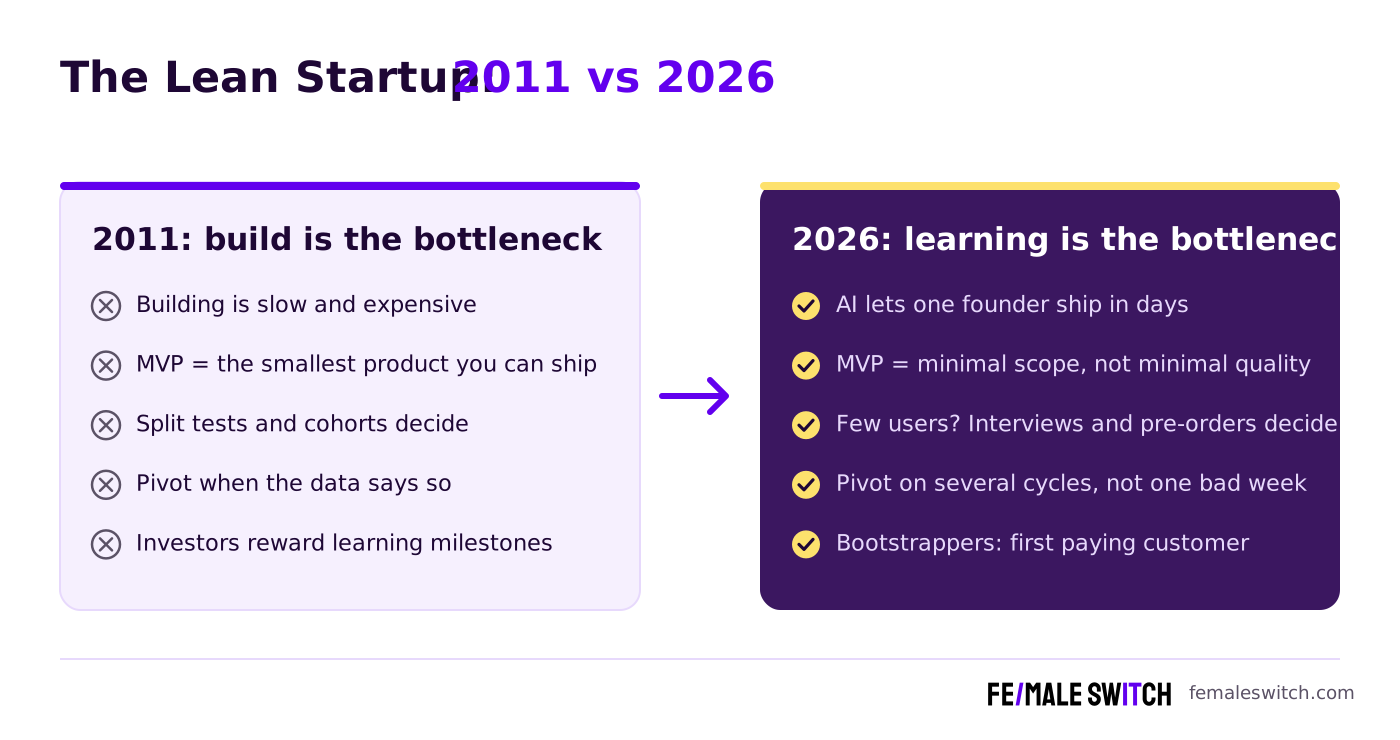
Our take: the most valuable part of the book in 2026 is the part founders skip, innovation accounting. When anyone can build, the founder who decides fastest what not to build wins.
The lean experiment card (copy this)
The book describes the loop but leaves you to design each experiment. Copy this card into a doc and fill in one per experiment before you build anything.
The "success line, set before the test" is the field most founders leave blank. Without it, every result looks like a partial success.
Worked founder example: a lean test in one month
Here's how the card works in practice for a typical (made-up) case. A solo founder wants to build an AI tool that turns a freelance designer's call notes into a client proposal.
- Leap of faith: freelance designers lose enough time on proposals to pay for this (value hypothesis), and design communities are the channel (growth hypothesis).
- Riskiest part: willingness to pay. Designers might like the idea but keep using a template.
- Smallest test: a one-page site with a short demo video and a "reserve a spot for 19 EUR/month" button, posted in three designer communities, plus five proposals written by hand for volunteers (a concierge MVP).
- Success line, set in advance: at least 15 reservations from 400 visitors, and at least 3 of the 5 volunteers reusing the hand-made proposal with a client.
- Result: 6 reservations, but 4 of the 5 volunteers used the proposal and asked for more.
- Decision: don't build the subscription product yet. The need is real but the channel or price is off. Next card: test a per-proposal price with agencies instead of freelancers (a customer segment pivot).
Note what the founder didn't do: spend six weeks building the full AI product. Even if AI could build it in a weekend, the weekend would have been spent on the wrong buyer.
Pivot or persevere: a decision checklist
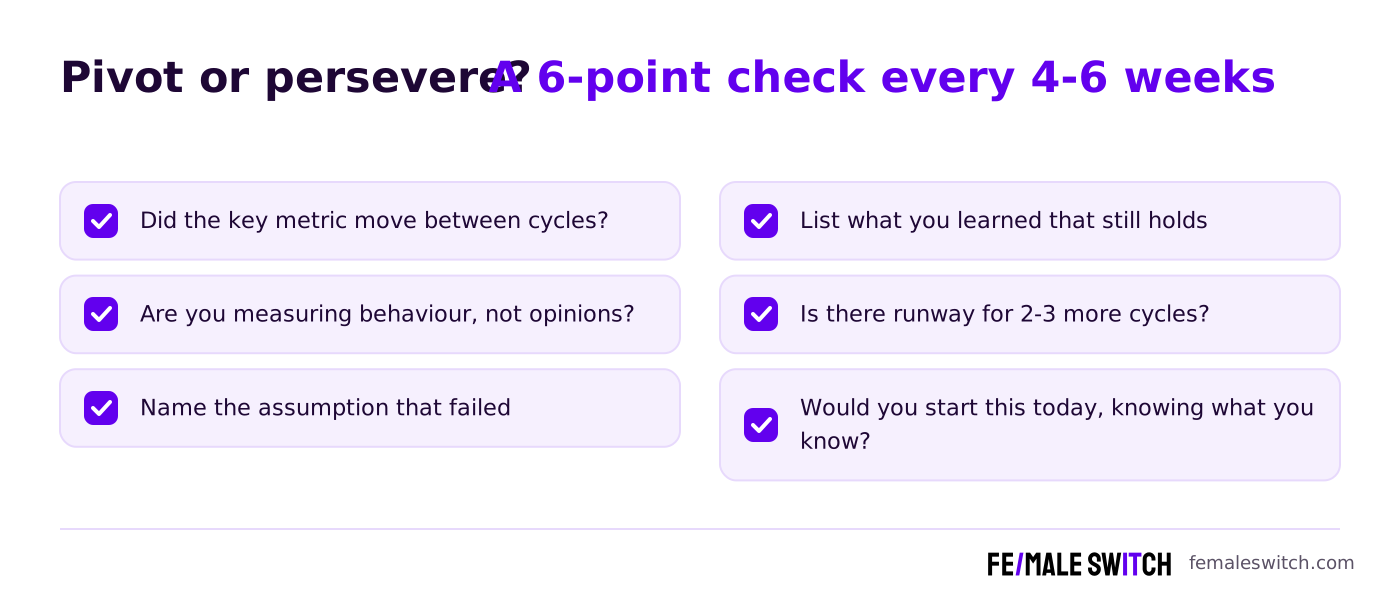
Run this every four to six weeks, not after every bad day.
- Did the numbers move between cycles? If your key metric hasn't improved after several experiments, the product tweaks aren't working.
- Are you measuring behaviour or opinions? Compliments and "I'd use that" don't count. Payments, repeat use and referrals do.
- Which assumption failed? Name it. A pivot changes one part of the strategy: the customer, the problem, the channel, the price or the engine of growth.
- What stays true? List what you learned that still holds. A good pivot keeps it.
- Is the runway enough for two or three more cycles? If not, pick the pivot with the fastest test, not the most exciting one.
- Would you start this today, knowing what you know? If the honest answer is no, it's time to pivot or stop.
Who should read The Lean Startup (and who can skip it)
Read it if you're a first-time founder about to spend months building, or a small team that keeps shipping features without knowing whether they matter. The ideas of validated learning and leap-of-faith assumptions alone will change how you plan your next month.
Skim or skip it if you already run experiments every week. The book is long, repeats its points and leans on examples from early-2010s software companies. In that case, read a short summary like this one, then go deeper with books on the specific skills: customer interviews in The Mom Test, and testing demand with AI and almost no money in The Bootstrap AI Revolution.
Want to practise the loop without risking your savings? Our startup game with an AI co-founder walks you through validating an idea step by step.
Related startup books for founders
- The Mom Test: how to run the customer interviews behind your first experiments without getting fooled by polite answers.
- Zero to One: Peter Thiel's counterpoint, which argues for bold, definite plans over constant iteration.
- Jobs to be Done: Theory to Practice: a sharper way to write the value hypothesis.
- Jab, Jab, Jab, Right Hook: test your growth hypothesis on social media.
- Free Bootstrapping with AI Guide: build and test a startup without funding.
FAQ
What is the main idea of The Lean Startup?
A startup should learn what customers want as quickly and cheaply as possible. You turn your plan into assumptions, test them with a minimum viable product in a build-measure-learn loop, track real behaviour instead of vanity metrics and then decide whether to pivot or persevere.
What are the 5 principles of The Lean Startup?
Ries lists five: entrepreneurs are everywhere, entrepreneurship is management, validated learning, build-measure-learn, and innovation accounting.
What is an MVP according to Eric Ries?
The minimum viable product is the version of a product that lets you complete one build-measure-learn loop with the least effort. It can be a landing page, a video, a manual service or a prototype, as long as it tests a real assumption with real customers.
Is The Lean Startup still relevant in 2026?
Yes, for its mindset: test assumptions, measure behaviour and decide based on evidence. Some parts aged, mostly the ones that assume building is slow and expensive. With AI tools, building is cheap, so the discipline of deciding what to test matters even more.
What is the difference between a pivot and persevere?
To persevere means you keep the strategy and keep improving the product. To pivot means you change one fundamental part of the strategy, such as the customer segment, the problem or the business model, while keeping what you've learned.
Is The Lean Startup good for non-tech or bootstrapped founders?
Yes. The examples are mostly software, but the method works for services, shops and physical products: pre-orders, hand-made first versions and small local tests are all lean experiments. Bootstrapped founders should make the first paying customer their main milestone.
About the Author
Violetta Bonenkamp, also known as MeanCEO, is an experienced startup founder with an impressive educational background including an MBA and four other higher education degrees. She has over 20 years of work experience across multiple countries, including 5 years as a solopreneur and serial entrepreneur. Throughout her startup experience she has applied for multiple startup grants at the EU level, in the Netherlands and Malta, and her startups received quite a few of those. She’s been living, studying and working in many countries around the globe and her extensive multicultural experience has influenced her immensely.

