

TL;DR: You Are a Badass summary in one paragraph: Jen Sincero's 2013 self-help bestseller argues that most of what holds you back is a set of old beliefs you picked up as a child, and that you can replace them by deciding what you want, getting uncomfortable on purpose, loving yourself as you are and taking action before you feel ready. For founders, the mindset parts are useful; the "the Universe will provide" parts are not a business plan. Below you'll find a belief-to-experiment worksheet to copy, a worked founder example, a then-vs-now table and a 30-day plan.
You Are a Badass summary first, honest opinion second. Jen Sincero, a writer and success coach, published the book with Running Press in April 2013. It started quietly, grew by word of mouth and became a #1 New York Times bestseller; the publisher says it has sold more than five million copies. Sincero has also told interviewers that she was in her early forties, broke and living in a converted garage when she decided to change how she thought about herself and money. The book is her account of what worked.
Most summaries list its 27 short, funny chapters and stop. This review asks a founder's question for 2026: which ideas actually help you start and run a company, which can hurt you, and how to turn the useful ones into small tests you can run this month.
You Are a Badass summary in seven ideas

- Your subconscious runs the show. Sincero argues that the beliefs you absorbed early (about money, about what people like you can do, about being "too much") quietly steer your choices as an adult. Change starts with noticing them.
- You are not your thoughts. The voice that says you'll fail is a habit, not a fact. You can question it, and you don't have to obey it.
- Love yourself first. Self-criticism doesn't make you work harder; it makes you hide. Accepting who you are, odd parts included, frees up energy for the work.
- Comfort zones keep you small. Fear is a sign you're doing something new, not a sign to stop.
- Decide, then act. Waiting for the perfect moment, the perfect plan or for confusion to clear is a way of not deciding. Commit first and figure out the "how" as you go.
- Money is not evil. Many people, Sincero included, carry negative beliefs about wanting money. She asks readers to notice those beliefs and choose new ones. She later expanded this into a whole book, You Are a Badass at Making Money (2017).
- Gratitude, forgiveness and your circle matter. Spending time with people who believe in you, letting go of old grudges and practising gratitude are presented as daily habits, not one-off exercises.
📘 Free e-book: Startup Idea Validation the Right Way. Before you market or build anything, make sure people want it. Violetta Bonenkamp's free e-book shows first-time founders how to test demand with minimal resources, track the metrics that matter and reach their first customers without giving away equity, with downloadable templates and checklists. Read about the book and get your free copy →
The book also leans on spiritual language. Sincero talks about "the Universe", energy and frequency, and borrows openly from the law of attraction. Founders should read those chapters as motivation, not as a method.
What founders should take, and what to leave
Keep the parts about behaviour; drop the parts that promise results without evidence.
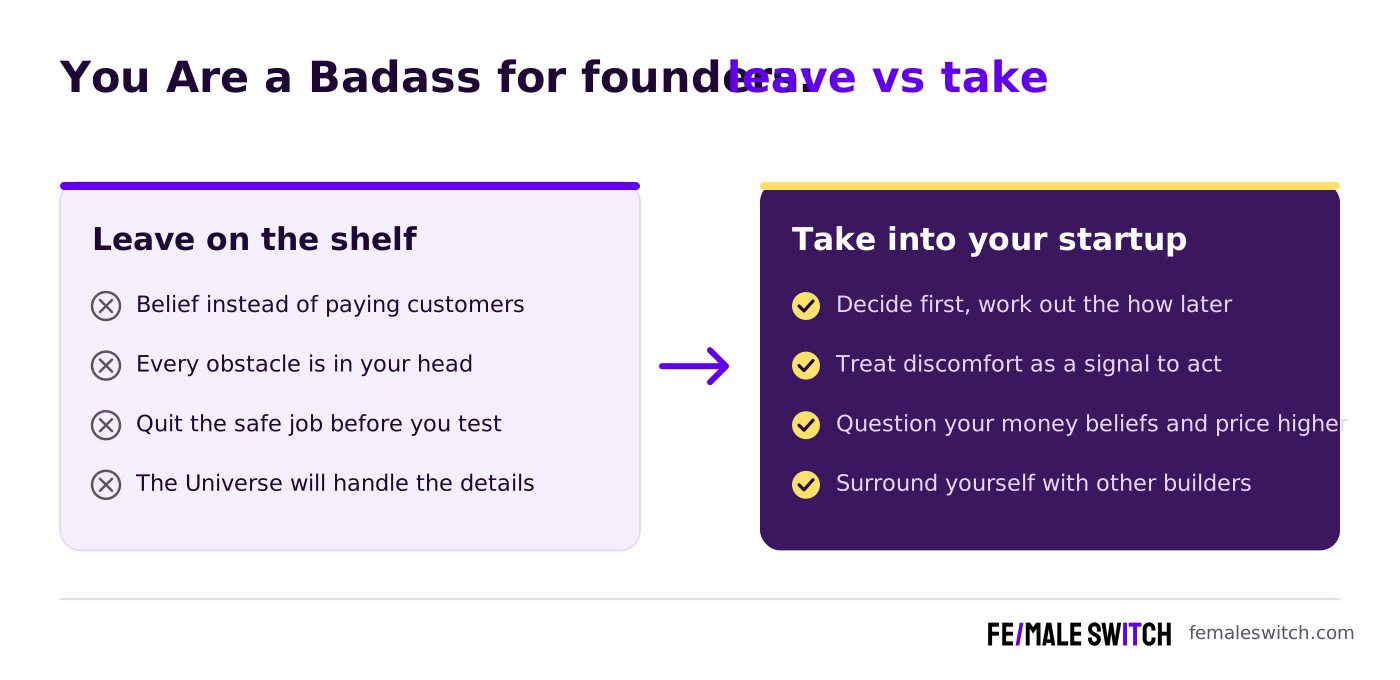
Take:
- Decisiveness. Most early-stage startups die of slow decisions, not wrong ones. "Decide, then act" is good founder advice.
- Discomfort as a signal. Cold outreach, asking for money, publishing something unfinished: all of these feel bad and are exactly the tasks founders avoid.
- Money beliefs. Many first-time founders, and many women founders in particular, underprice because charging feels greedy. Sincero's money chapter names this well.
- Your circle. Founders who surround themselves with other builders keep going longer. That's why peer groups and accelerators work.
Leave:
- "Believe it and it will come." Belief gets you to start. Customers decide whether you continue. Confidence never replaces a paying customer.
- "Every obstacle is in your head." Some are. Others are real: funding gaps, caring duties, visa rules, bias in who gets investment. Treating structural problems as mindset problems makes founders blame themselves for things they should plan around.
- "Quit the safe job and jump." The book's spirit pushes towards big leaps. For most founders, a runway plan and a part-time start are smarter.
Copy-paste belief-to-experiment worksheet
Sincero asks you to notice limiting beliefs. Founders can go one step further: turn each belief into a small, cheap test, so the market answers instead of your inner critic.
The key line is number 5. Deciding success in advance stops you from reading every result as proof that you're a failure, or a genius.
A worked founder example
Imagine a freelance bookkeeper who wants to launch a small online course and coaching service for creative freelancers who hate their finances. She has had the idea for two years and hasn't started. Using the worksheet, she writes down three beliefs:
- "Nobody would pay me; I'm not a real expert." Test: post one offer in two freelancer communities she's already in, for a €49 live workshop. Success = 5 sign-ups in 10 days. Result: 8 sign-ups. Belief proven wrong.
- "I'd have to charge almost nothing to get clients." Test: offer a three-month coaching package at €450 to the workshop attendees. Success = 1 sale. Result: 2 sales. Belief proven wrong.
- "I can't do this while working full time." Test: track the hours the workshop and two clients actually take for one month. Result: about 6 hours a week. Belief partly right: she can't scale this on evenings alone, so she plans to cut one retainer client in three months if sales hold.
She didn't wait to feel confident; the confidence came after the evidence. That's Sincero's "act before you're ready" made safe and specific.
Then vs now: You Are a Badass in 2026
The book predates AI tools and the current wave of solo founders. Here's how its ideas hold up.
The energy has aged well. The implicit promise, that the right mindset is enough, has not.
A 30-day plan to apply You Are a Badass
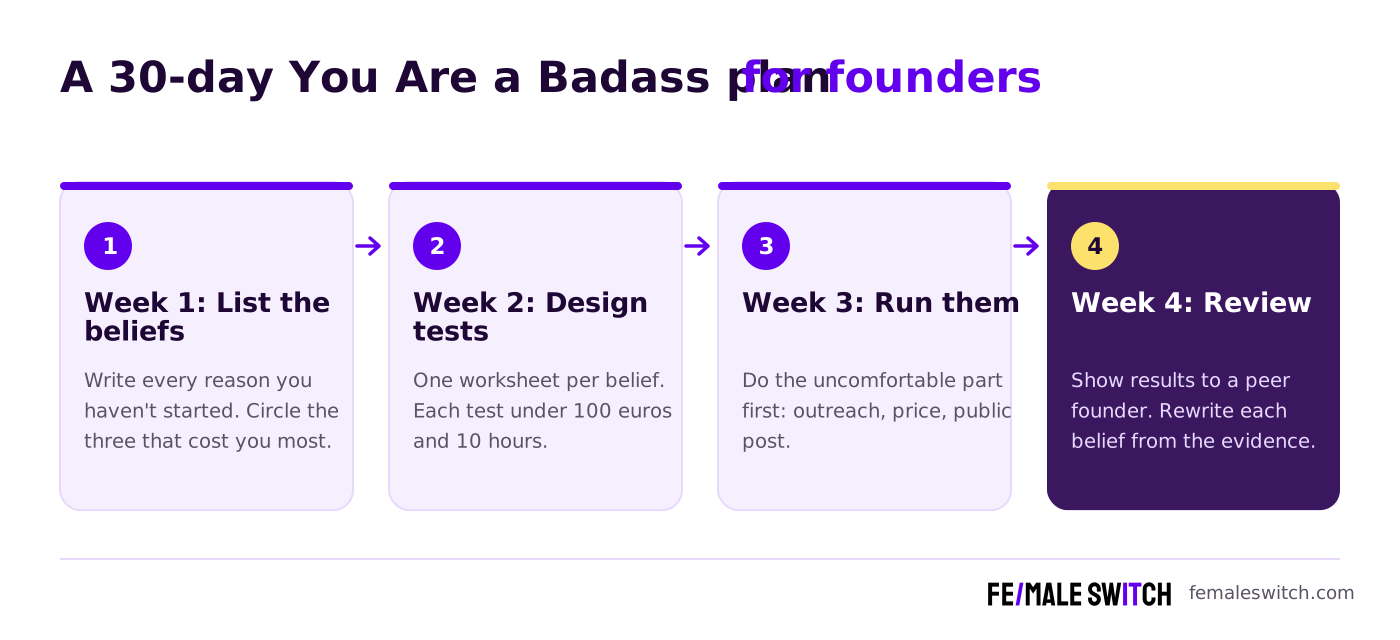
- Week 1: list the beliefs. Write down every reason you haven't started or grown faster. Circle the three that cost you the most.
- Week 2: design three tests. Fill in the worksheet for each circled belief. Keep each test under €100 and under 10 hours.
- Week 3: run them. Do the uncomfortable part first: the outreach, the price, the public post. Track results honestly.
- Week 4: review with someone. Show the results to a peer founder or mentor. Rewrite each belief based on what happened, and pick the next three.
If you want a safe place to practise these decisions before you put your own savings in, our startup game with an AI co-founder walks you through building a real business step by step.
Who should read You Are a Badass (and who can skip it)
Read it if you keep postponing your launch, feel like a fraud when you talk about your business, or struggle to charge what your work is worth.
Skim or skip it if you dislike spiritual language or swearing, or if what you need is a business method. The book won't tell you how to find customers, set prices or build a product. For that, start with Startup Idea Validation the Right Way or the Free Bootstrapping with AI Guide, and use Sincero's book for the courage to act on them.
Related startup books for founders
- The Confidence Code: Katty Kay and Claire Shipman on the confidence gap, a research-based companion to Sincero's pep talk.
- Lean In: Sheryl Sandberg on ambition and the barriers women face at work, useful for the structural side this book skips.
- Lost and Founder: Rand Fishkin's honest field guide to the startup world, the reality check after the motivation.
- Zero to One: Peter Thiel on building something new, for when you're ready to decide what to build.
FAQ
What is the main message of You Are a Badass?
The main message is that the beliefs you picked up early in life, mostly without noticing, are what hold you back. Sincero argues that you can recognise them, replace them, love yourself as you are and take action before you feel ready.
Is You Are a Badass worth reading?
Yes, if you need motivation and permission to start: it's a fast, funny read. It's weak as a practical guide to business or money, so pair it with a more methodical book.
Who wrote You Are a Badass and when was it published?
Jen Sincero, an American writer and success coach, wrote it. Running Press published it in April 2013. It later became a #1 New York Times bestseller, and Sincero followed it with You Are a Badass at Making Money, You Are a Badass Every Day and Badass Habits.
Is You Are a Badass based on the law of attraction?
Partly. Sincero openly uses ideas such as energy, frequency and asking "the Universe" for what you want, but much of the book is practical advice about habits, fear and decisions that works without the spiritual framing.
Is You Are a Badass good for entrepreneurs?
It's good for the mindset side of entrepreneurship: deciding, acting while scared and charging for your work. It isn't a startup guide. Use it to get started, and turn its advice into small experiments with real customers.
What are the criticisms of You Are a Badass?
The common criticisms are that it repackages older self-help and law-of-attraction ideas, and that it suggests obstacles are mostly in your head. That framing can ignore real barriers such as money, caring duties or bias, which founders need to plan around rather than think away.
About the Author
Violetta Bonenkamp, also known as MeanCEO, is an experienced startup founder with an impressive educational background including an MBA and four other higher education degrees. She has over 20 years of work experience across multiple countries, including 5 years as a solopreneur and serial entrepreneur. Throughout her startup experience she has applied for multiple startup grants at the EU level, in the Netherlands and Malta, and her startups received quite a few of those. She’s been living, studying and working in many countries around the globe and her extensive multicultural experience has influenced her immensely.

