

TL;DR: Zero to One summary in one paragraph: Peter Thiel's 2014 book, written with Blake Masters, argues that the valuable companies create something new (going from 0 to 1) instead of copying what works (1 to n). Competition destroys profits, so the goal is a monopoly: start in a small market you can dominate, build technology that is far better than the alternatives, add network effects, scale and a brand, and plan for distribution from day one. Below you'll find a seven-question scorecard to copy, a worked founder example, a then-vs-now table and a 30-day plan for small teams.
Zero to One summary first, opinion second: this is the most quoted startup book of the last decade, and also one of the most misread. Peter Thiel, PayPal co-founder and the first outside investor in Facebook, taught a startup class (CS183) at Stanford University in spring 2012. His student Blake Masters posted detailed notes from each lecture online, they spread fast through the tech world, and the two turned them into this book, published by Crown Business in September 2014.
Most summaries repeat the slogans ("competition is for losers") and stop. This review asks a more useful question for a 2026 founder without a venture fund behind them: which parts of Zero to One work for a small, bootstrapped startup, and how to test your idea against Thiel's checklist this week.
Zero to One summary in seven ideas

- Vertical progress beats copying. Taking something that works and spreading it (1 to n) is globalisation. Doing something nobody has done before (0 to 1) is technology, and that's where the outsized value is.
- Ask the contrarian question. Thiel's favourite interview question asks which important truth very few people agree with you on. Good companies are built on a true answer to it.
- Competition is for losers. In perfect competition, profits get competed away. Monopolies (in Thiel's sense: a company so good at what it does that nobody offers a close substitute) can afford to plan, invest and treat people well.
- Monopolies share four traits. Proprietary technology that is roughly ten times better than the next best option, network effects, economies of scale and branding.
- Start small, then expand. Dominate a tiny market first and grow into nearby ones. Being the last mover, the one who makes the final big improvement and keeps the market, matters more than being first.
- The future is a plan, not a lottery. Thiel prefers "definite optimism": a concrete plan you believe in, instead of keeping your options open and hoping something works out.
- Distribution and foundations decide the outcome. A great product without a way to reach customers fails. And a startup that gets its foundations wrong (co-founders, ownership, early team) can rarely fix them later, which Thiel calls "Thiel's law".
📘 Free e-book: Startup Idea Validation the Right Way. Before you market or build anything, make sure people want it. Violetta Bonenkamp's free e-book shows first-time founders how to test demand with minimal resources, track the metrics that matter and reach their first customers without giving away equity, with downloadable templates and checklists. Read about the book and get your free copy →
The book also covers the power law (in venture capital, one winning investment can return more than all the others combined), secrets worth looking for, why sales is a skill engineers underrate, and a long chapter on why most clean tech companies of the 2000s failed.
The seven questions every business must answer
The most practical part of the book sits in the clean tech chapter. Thiel lists seven questions that any company has to answer well, and says the clean tech failures got most of them wrong:
- Engineering: can you create breakthrough technology, not just small improvements?
- Timing: is now the right time to start this business?
- Monopoly: are you starting with a big share of a small market?
- People: do you have the right team?
- Distribution: do you have a way to deliver the product, not just create it?
- Durability: will your market position still be defensible in 10 and 20 years?
- Secret: have you found a unique opportunity that others don't see?
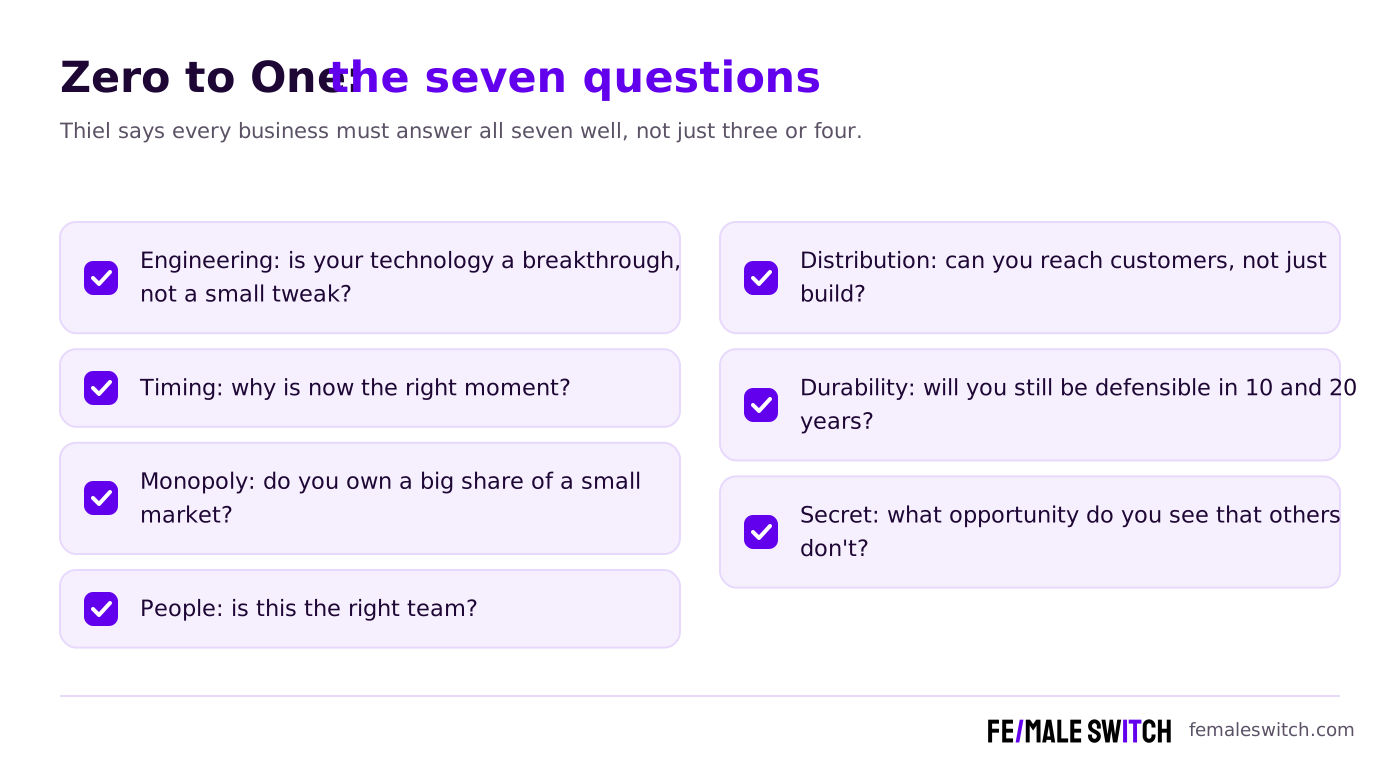
Getting three or four right, Thiel suggests, is not enough. Harsh, but useful: it shows your weakest answer before the market does.
Copy-paste seven-question scorecard
Fill this in for your idea, score each line from 0 to 2, and repeat it every quarter.
A total under 7 doesn't mean "quit". It means your next experiments should target the lowest score.
A worked founder example
Imagine a two-person team that wants to build "a project management tool for small businesses". On the scorecard it scores badly: no 10x advantage over dozens of existing tools (engineering 0), no reason why now (timing 0), a huge market with no share (monopoly 0). Total: 3 out of 14.
The founders narrow it. They've both worked in dental clinics and know a painful detail: small clinics juggle orthodontic treatment plans across spreadsheets, lab orders and patient reminders, and generic tools don't model a treatment that runs for 18 months. They rebuild the idea as a treatment-plan tracker for independent orthodontic practices in one country.
- Monopoly rises to 1: the market is a few hundred practices, and owning a large share is realistic.
- Engineering rises to 1: one screen replaces three tools for this specific job.
- Distribution rises to 2 after they sign five paying clinics through a regional association they already know.
- Secret rises to 1: they believe lab-order delays, not scheduling, drive most patient complaints, and their first customers confirm it.
The new total is 9 out of 14, and the weakest answer (durability) becomes the next quarter's work: building integrations with dental labs that a copycat would need months to replicate. That's Thiel's "start small and monopolize" applied at bootstrapped scale.
Then vs now: Zero to One in 2026
Some ideas have aged well; others assume venture money and long build cycles that many founders no longer have.
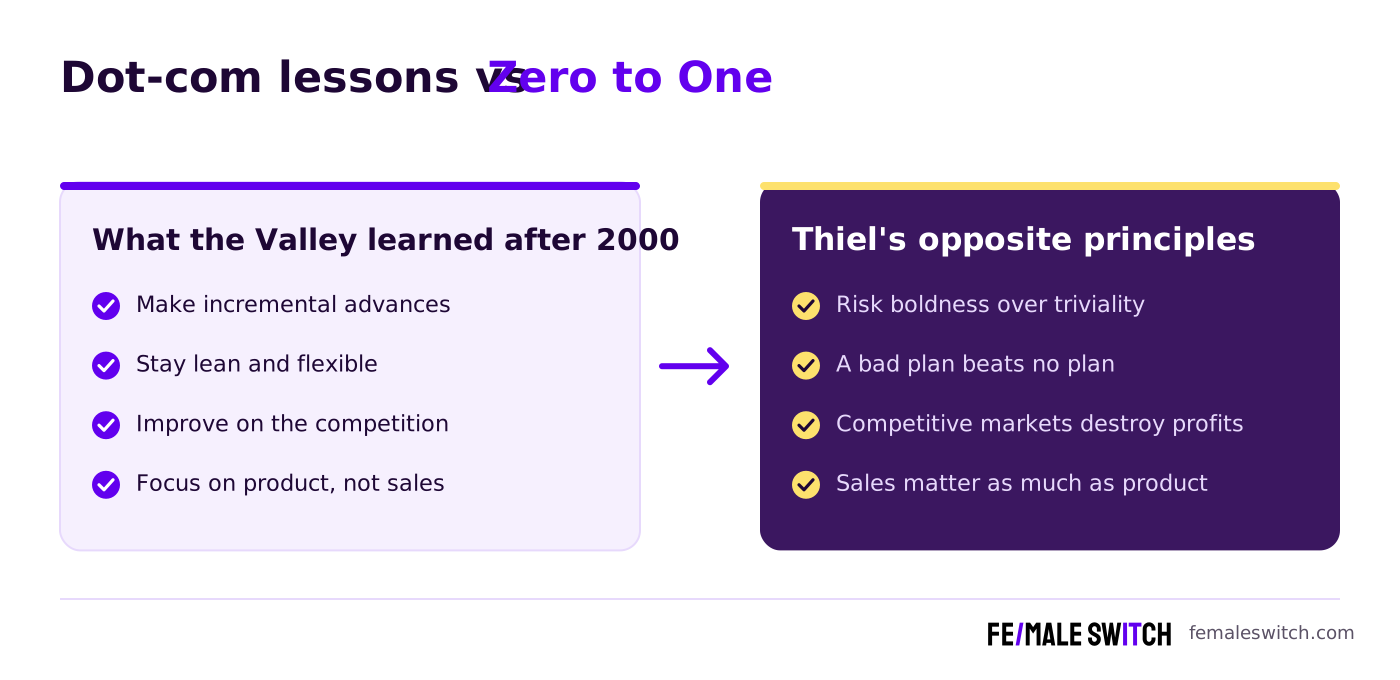
The chart above summarises one of the book's sharpest passages. After the dot-com crash, Thiel writes, Silicon Valley learned four lessons: make incremental advances, stay lean and flexible, improve on the competition and focus on product over sales. He argues that the opposite principles are probably more correct. That's a direct challenge to the Lean Startup method. In 2026 you need both: fast experiments, and a bold, specific plan so they add up to something.
A 30-day plan to apply Zero to One
- Week 1: write your secret. Answer the contrarian question in one sentence. List three pieces of evidence for it and one thing that would prove it wrong.
- Week 2: shrink the market. Define the smallest market you could dominate. Write down 20 real potential customers by name or company.
- Week 3: test distribution. Contact those 20 and try to get five conversations and two paid pilots or pre-orders. Note which channel worked.
- Week 4: score and decide. Fill in the seven-question scorecard. Pick the weakest answer and plan one experiment per week to improve it next month.
If you want to practise these decisions before you put your own money in, our startup game with an AI co-founder walks you through building a real business step by step.
Who should read Zero to One (and who can skip it)
Read it if you are choosing what to build, if your idea feels like "X but slightly better", or if you're about to raise venture capital and want to understand how investors like Thiel think about monopoly and the power law.
Skim or skip it if you want a step-by-step manual. Zero to One is a book of arguments, not methods. If you need practical steps for testing demand or building cheaply, start with Startup Idea Validation the Right Way or the Bootstrap AI Revolution, then come back to Thiel for the big-picture thinking.
Related startup books for founders
- The Lean Startup: Eric Ries's experiment-first method, the approach Thiel argues against, and the best book to read alongside this one.
- Super Founders: Ali Tamaseb's data on 200+ billion-dollar startups, a useful reality check on which founder myths hold up.
- The Mom Test: how to run the customer conversations that tell you whether your "secret" is real.
- Hooked: Nir Eyal's model for habit-forming products, one way to build the durability Thiel asks for.
- The Hard Thing About Hard Things: Ben Horowitz on what happens after the big idea, when running the company gets difficult.
FAQ
What is the main idea of Zero to One?
The main idea is that the most valuable companies create something new instead of copying what already works. Thiel calls this going from 0 to 1. Because competition drives profits towards zero, founders should aim to build a monopoly, starting in a small market they can dominate.
What does "competition is for losers" mean?
Thiel argues that when many companies sell nearly the same thing, they compete on price until nobody makes much profit. A company with no close substitute can invest in the long term. His advice is to avoid crowded markets rather than try to win them.
What are the seven questions in Zero to One?
They are engineering, timing, monopoly, people, distribution, durability and secret. Thiel says every business must answer them well, and he uses them to explain why many clean tech startups of the 2000s failed.
Who wrote Zero to One and when was it published?
Peter Thiel wrote it with Blake Masters, based on Masters' notes from Thiel's 2012 Stanford startup class (CS183). Crown Business published it in September 2014.
Is Zero to One still relevant in 2026?
Mostly, yes. The ideas about avoiding competition, starting with a small market and taking distribution seriously still hold. The parts about proprietary technology need updating, because AI tools make features easier to copy, so moats now come more from data, workflow depth and trust.
Is Zero to One good for bootstrapped founders?
Yes, if you read it as a thinking tool. The power law and venture-scale ambitions don't apply to every company, but "start small and monopolize" works especially well for bootstrapped founders who can own a narrow niche profitably.
About the Author
Violetta Bonenkamp, also known as MeanCEO, is an experienced startup founder with an impressive educational background including an MBA and four other higher education degrees. She has over 20 years of work experience across multiple countries, including 5 years as a solopreneur and serial entrepreneur. Throughout her startup experience she has applied for multiple startup grants at the EU level, in the Netherlands and Malta, and her startups received quite a few of those. She’s been living, studying and working in many countries around the globe and her extensive multicultural experience has influenced her immensely.

