
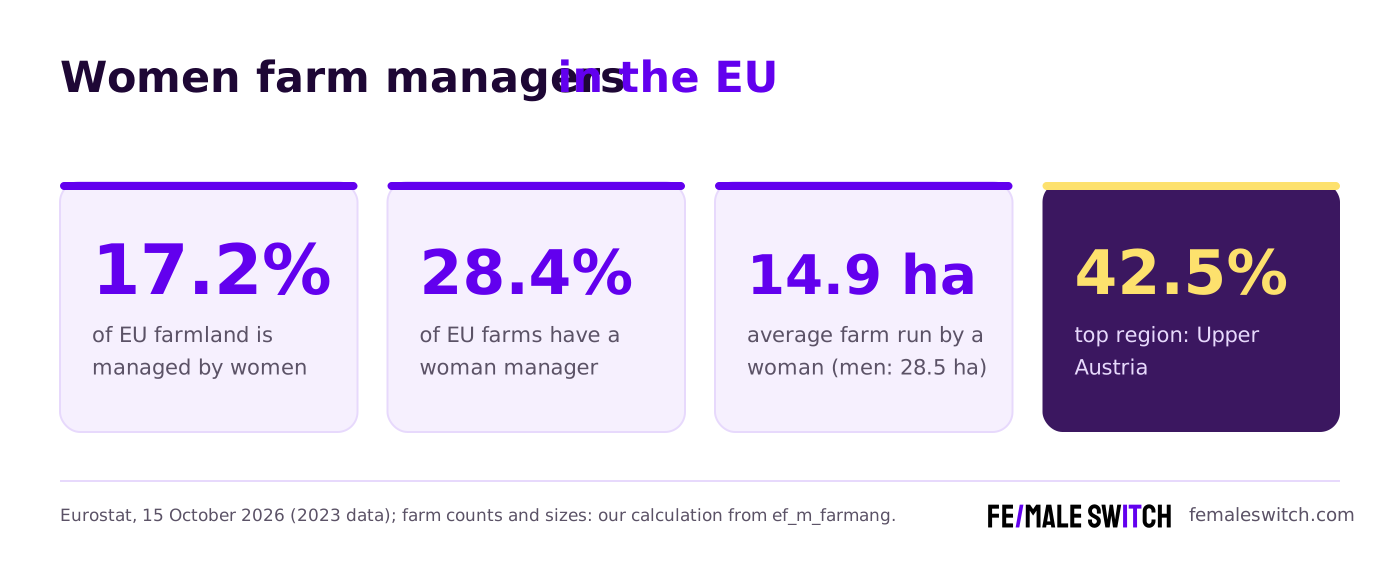
Women managed just 17.2% of the EU's farmland in 2023, Eurostat said on 15 October, the International Day of Rural Women. The gap between regions is huge: in Friesland in the Netherlands, women manage 2.7% of the land, while in Upper Austria they manage 42.5%. Our analysis of the same Eurostat dataset shows why the share is so low: women run more than a quarter of EU farms, but mostly the small ones.
Cover photo: Portraits of Modern Dairy on Unsplash.
What Eurostat published
The Eurostat release of 15 October 2026 looks at who manages the EU's utilised agricultural area, meaning the land actually used for farming. It is based on the 2026 edition of Eurostat's regional yearbook and on 2023 farm survey data. The main findings:
- 17.2% of the EU's farmland was managed by women in 2023.
- Of the 241 regions with data, 134 (55.6%) were below the EU average.
- The lowest share was in Friesland, the Netherlands: 2.7%, or about 6,000 hectares.
- The highest share was in Oberösterreich (Upper Austria): 42.5%, or about 211,600 hectares.
- 25 regions had a share of at least 28.5%: 11 in Italy, 4 in Greece, 4 in Austria and 3 in Spain.
- 12 regions were below 5%: 10 of the 12 Dutch regions, Åland in Finland (3.6%) and Syddanmark in Denmark (4.9%).
Eurostat also noted that women tend to run relatively small holdings, and that generational renewal "may gradually increase women's participation" in larger, more commercial farming. The United Nations has declared 2026 the International Year of the Woman Farmer.
More than a quarter of farms, but only a sixth of the land
We downloaded the underlying Eurostat dataset (ef_m_farmang, 2023, holdings above the survey threshold) to look behind the headline. Women manage 1,740,520 of the EU's 6,137,940 farms, or 28.4%. So why only 17.2% of the land?
- Women's farms are about half the size. The average farm run by a woman has 14.9 hectares; the average farm run by a man has 28.5 hectares (our calculation, without Luxembourg, whose figure is confidential).
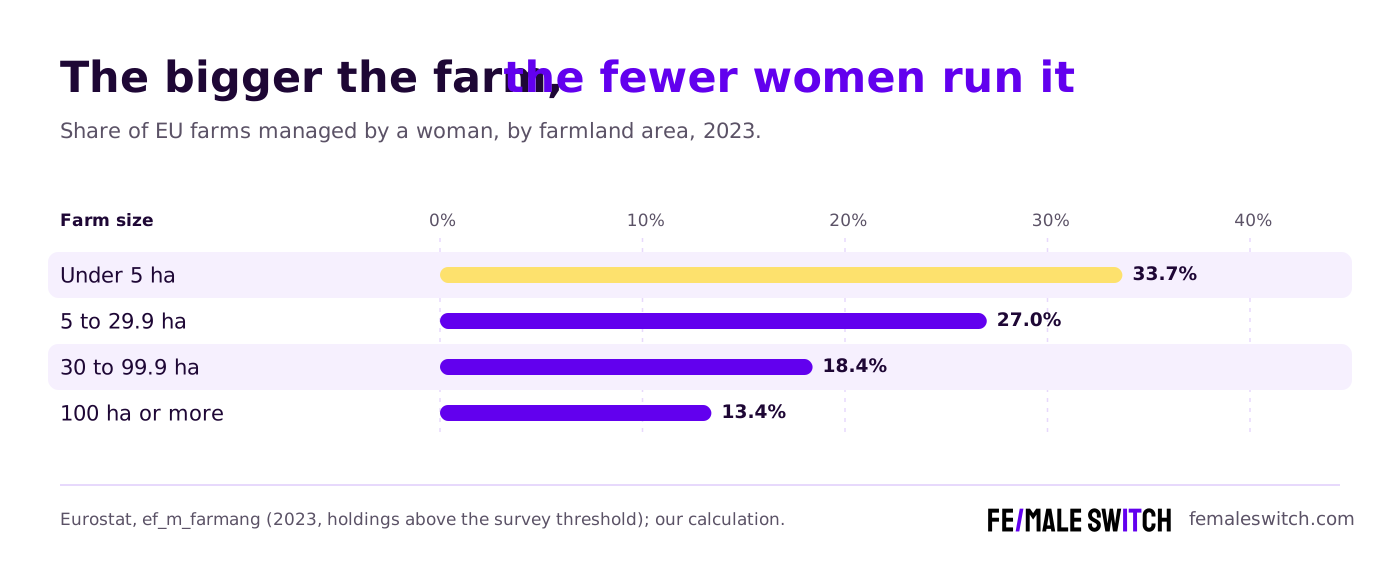
- Women run a third of the smallest farms. They manage 33.7% of farms under 5 hectares, but only 13.4% of farms with 100 hectares or more.
- The money gap is bigger still. Farms run by women produce about 14.9% of the standard output of EU farms, a measure of their economic size (our calculation, without Luxembourg). Women manage 36.4% of the farms with a standard output under €2,000, but only 14.7% of those with €100,000 or more.
Younger farm managers are less often women
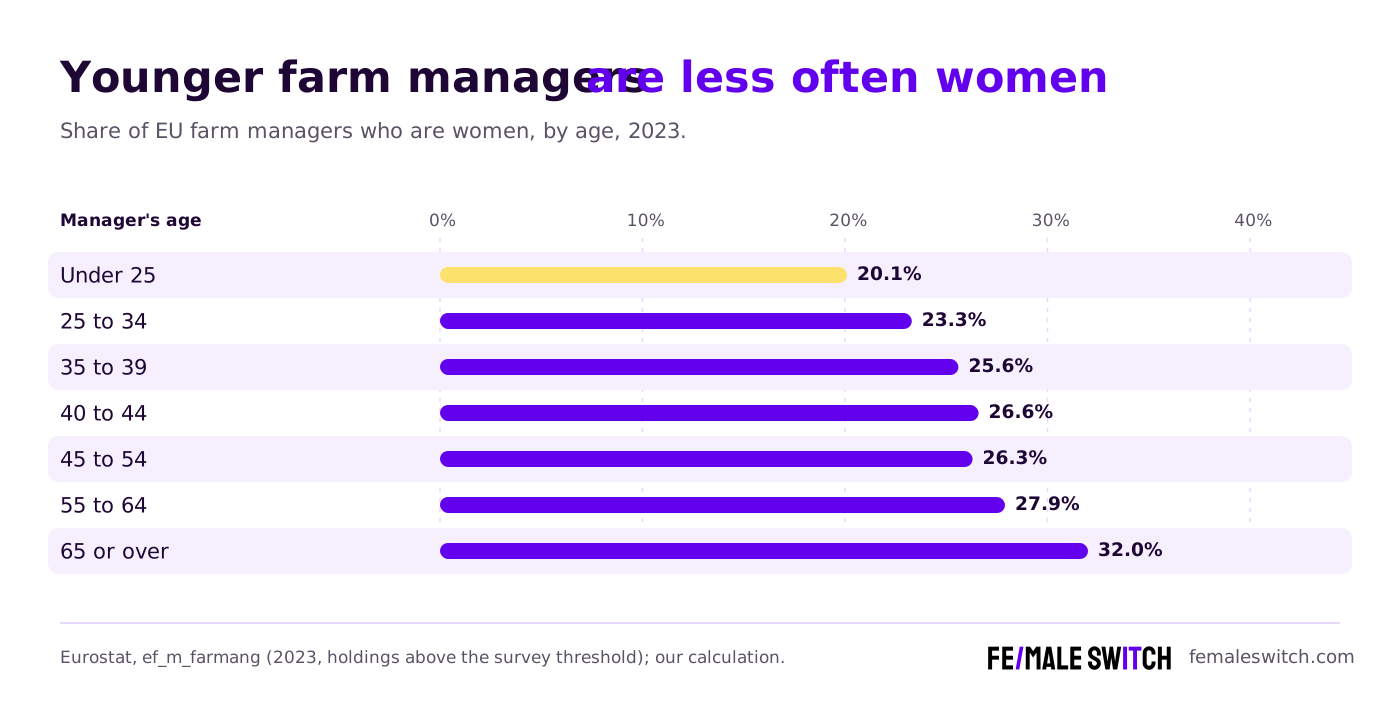
If generational renewal is going to raise women's share, the data does not show it yet. Among farm managers aged 65 or over, 32.0% are women. Among those under 25, it's 20.1%, and among those aged 25 to 34, 23.3%.
The 65-plus group is also the biggest: almost 2 million of the EU's 6.1 million farm managers are 65 or older. Only about 387,000 are under 35, and fewer than 89,000 of them are women.
Country by country
Austria leads the EU, with women managing almost a third of its farmland. Italy, Poland and Greece follow. Sweden, Germany, Finland, Cyprus, Denmark and the Netherlands are at the bottom, all below 9%. Latvia and Lithuania stand out: women run 40.5% of their farms, but only about 22% of the land, because their farms are much smaller than men's.
Source: Eurostat, ef_m_farmang, 2023, holdings above the survey threshold; our calculation. Luxembourg is left out because its figure for women is confidential.
What the EU farm policy does about it
The current Common Agricultural Policy (CAP), which runs from 2023 to 2027, is the first to name women in one of its objectives. Specific objective 8, on jobs, growth and equality in rural areas, promotes gender equality, including women's participation in farming, according to the EU CAP Network. Member states had to assess the situation of women in farming in their national CAP plans. Possible measures include extra support for women farmers and better access to loans for women's businesses.
In practice, few countries used it. Only a few national CAP plans for 2023–2027 explicitly include actions for gender equality, the EU CAP Network wrote in a review of Spain's approach. Spain is the example it highlights, with measures that include extra income support for young women farmers.
What this means for you
- If you run a small farm or food business, you're in the majority of women farm managers. Check your national CAP plan for top-ups for young or women farmers, and look at wider schemes in our list of grants and funding for female entrepreneurs.
- If you want to grow, the size gap is the gap to close. Land, machinery and credit are where women fall behind. Our guide to closing the funding gap for female founders in Europe covers loans, angels and public funds.
- If you build for farmers, women are more than a quarter of your customers. See how modern tools are shaping farming startups.
- If you're self-employed on a farm and planning a family, the gaps in maternity cover apply to you too. See what the Bundestag is debating on maternity pay for self-employed women and how the debate went.
For the wider picture, see our female entrepreneurship statistics and the data on business women in 2026.
FAQ
How much EU farmland do women manage?
17.2% of the EU's utilised agricultural area in 2023, according to Eurostat's release of 15 October 2026.
Which EU region has the most farmland managed by women?
Oberösterreich (Upper Austria), at 42.5%, or about 211,600 hectares. The lowest is Friesland in the Netherlands, at 2.7%.
Which EU country has the highest share?
Austria, where women manage 31.5% of farmland, followed by Italy (25.0%) and Poland (24.9%), by our calculation from Eurostat's 2023 data. The Netherlands is lowest, at 3.8%.
How many EU farms are run by women?
About 1.74 million of 6.14 million farms, or 28.4%, in 2023. Women's farms are smaller: 14.9 hectares on average, against 28.5 hectares for farms run by men.
Are more young women becoming farm managers?
Not yet in the data. Women are 32.0% of farm managers aged 65 or over, but 20.1% of those under 25 and 23.3% of those aged 25 to 34.
Does the EU's farm policy support women farmers?
The 2023–2027 CAP is the first to name gender equality in one of its objectives, but only a few national CAP plans include specific actions. Spain, for example, gives extra income support to young women farmers.
About the Author
Violetta Bonenkamp, also known as MeanCEO, is an experienced startup founder with an impressive educational background including an MBA and four other higher education degrees. She has over 20 years of work experience across multiple countries, including 5 years as a solopreneur and serial entrepreneur. Throughout her startup experience she has applied for multiple startup grants at the EU level, in the Netherlands and Malta, and her startups received quite a few of those. She’s been living, studying and working in many countries around the globe and her extensive multicultural experience has influenced her immensely.

