
TL;DR: where do business women stand in 2026?
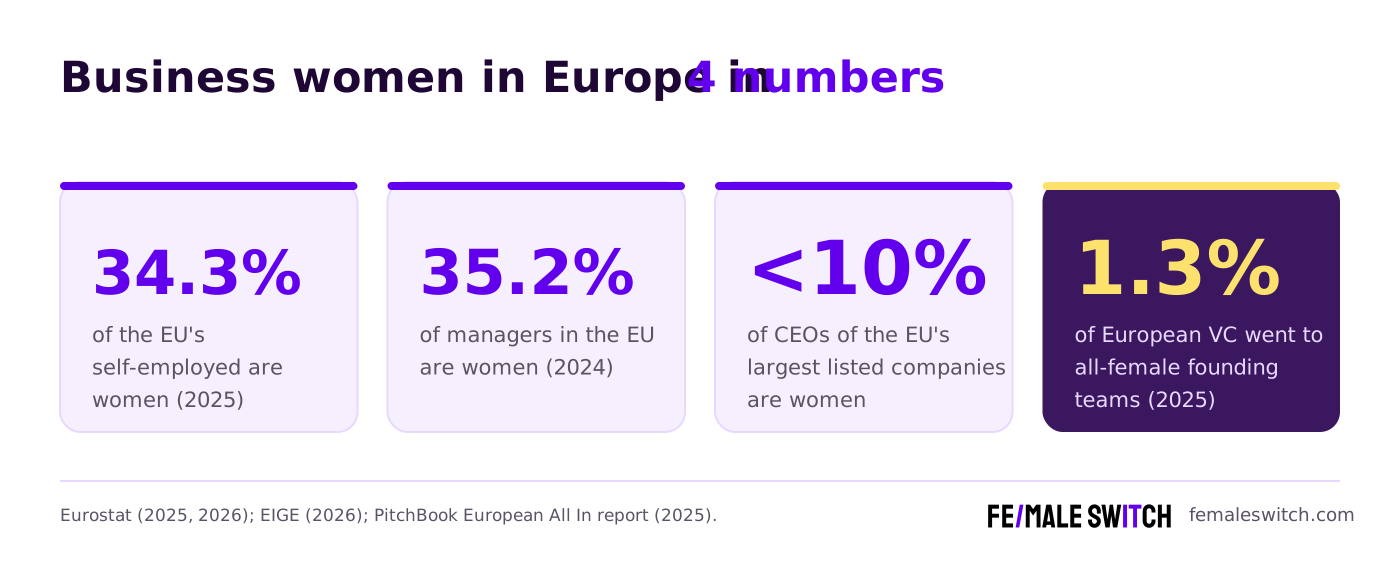
Women are 34% of the EU's self-employed and 35% of its managers, but fewer than 10% of the CEOs of its largest listed companies, and all-female founding teams got just 1.3% of European venture capital in 2025. In the US, women own 40.6% of all businesses and run 56 of the Fortune 500. The women who reached the top by building companies, from Anne Boden at Starling to Rafaela Aponte-Diamant at MSC, mostly used deep industry experience, started small and kept going through rejection.
👉 Build your own company with an AI co-founder in the Fe/male Switch startup game
Search for business women and you'll mostly find lists of American CEOs. This guide looks at the full picture: how many women own and run businesses in Europe and the US in 2026, where the gaps are, and 20 women, most of them European, who built companies from scratch. For each one you'll find what they started with, where the business is today, and the lesson to take from it. For how we got here, read the history of business women in Europe, from needing a husband’s permission to work to boardroom quotas. For the most valuable companies founded by women, ranked by their latest valuations, see female-founded companies in 2026.
Updated October 2026.
Businesswoman or business woman: what does it mean?
A businesswoman is a woman who owns, runs or holds a senior role in a business. Dictionaries spell it as one word, businesswoman (plural businesswomen), but "business women" is just as common in search. A female entrepreneur is a narrower term: a woman who starts and builds her own company. Every female entrepreneur is a businesswoman, but not every businesswoman founded the business she runs. For the women who run the world's largest companies, see female CEOs in 2026 on mean.ceo.
Business women in 2026: the numbers, Europe vs US
Sources: Eurostat, EIGE, GEM 2024/25, Wells Fargo Impact of Women-Owned Businesses 2026, Fortune, PitchBook. The US share with at least one woman is inflated by a few very large AI rounds.
How many businesses do women own?
In the EU, women are 34.3% of the self-employed and 28.0% of self-employed people with employees, according to Eurostat. Both shares have crept up by about half a point a year. In the US, women own 15.7 million businesses, 40.6% of the total, and these firms grew almost twice as fast as men-owned firms between 2022 and 2025, according to Wells Fargo's 2026 report. Most are small: only 9% have employees.
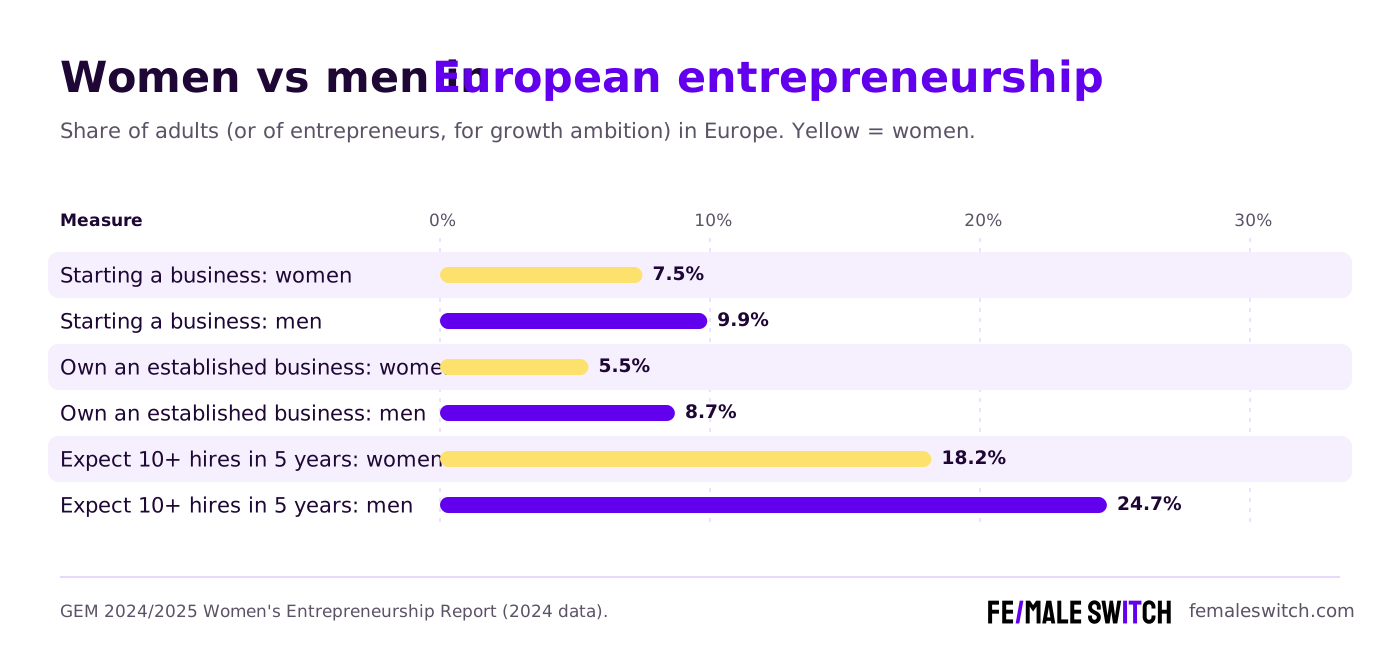
The GEM Women's Entrepreneurship Report shows the gap clearly. In Europe, 7.5% of women are starting a business against 9.9% of men, and only 18.2% of women entrepreneurs expect to hire ten or more people within five years. Globally, women are more likely to start alone (31.9% against 24.1% of men) and 47% more likely to close a business for family reasons.
How many women lead Europe's biggest companies?
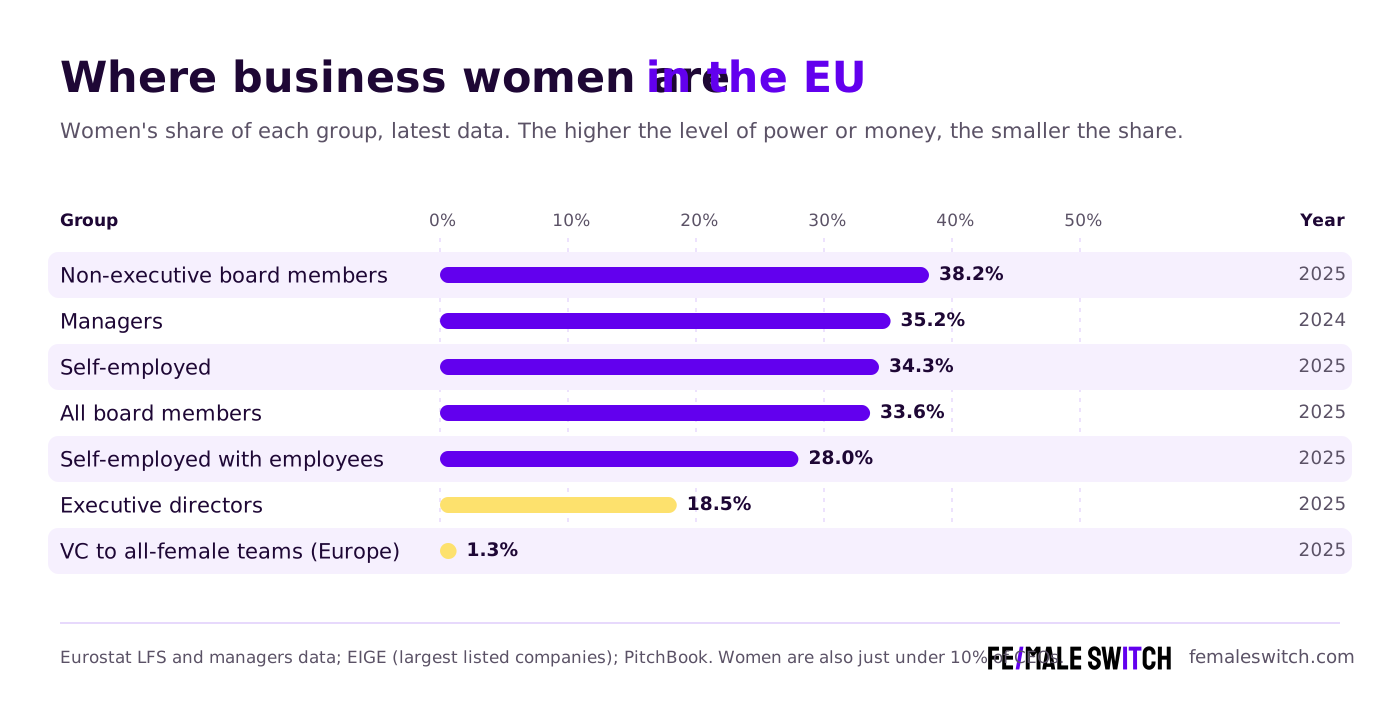
Women hold 35.2% of management jobs in the EU, from 44.4% in Sweden to 25.3% in Cyprus, according to Eurostat's 2026 release. On boards, the EU's Women on Boards Directive required listed companies to have at least 40% of non-executive seats, or 33% of all seats, held by the under-represented sex by 30 June 2026. Non-executive seats reached 38.2% in October 2025, but women are still just under 10% of CEOs and just over 10% of board chairs, according to the European Institute for Gender Equality. In the US, 56 Fortune 500 companies are run by women, a record, according to Fortune.
Where is the money gap?
Funding is the biggest gap. All-female founding teams received 1.3% of European venture capital in 2025 and 1.1% in the US, according to PitchBook. Yet a BCG study of startups in the MassChallenge accelerator found that women-founded companies generated 78 cents of revenue for every dollar raised, against 31 cents for men-founded ones. Read our guide to closing the funding gap for female founders in Europe and the list of grants for female-led startups.
Three routes to the top: founder, executive or heir
Lists of successful businesswomen often mix three very different paths. Of the 481 women on Forbes' 2026 billionaires list, only 122 made their own fortune; most inherited it.
Only the first two are open to most of us, and only the first one is open from day one. For executive lessons, see what Mary Barra and Jane Fraser teach. The rest of this guide focuses on founders.
20 business women who built companies
For more founders who started small, including Sara Blakely, Melanie Perkins, Anita Roddick and the co-founders of Vinted and Mumsnet, see great business ideas proven by real founders.
16 European businesswomen who built companies
Rafaela Aponte-Diamant, MSC (Italy / Switzerland)
Rafaela Aponte-Diamant and her husband Gianluigi Aponte founded Mediterranean Shipping Company in 1970 with a single ship bought on a loan. MSC is now one of the world's largest shipping lines, and she is the richest self-made woman in the world, according to Forbes.
Lesson: Start with one asset and reinvest.
Rosalía Mera, Zara / Inditex (Spain)
Rosalía Mera left school at 11 to work as a seamstress and co-founded Zara with Amancio Ortega in 1975, starting with bathrobes sewn at home. Inditex became the world's largest fashion group, and she became Spain's richest woman before her death in 2013.
Lesson: Know your product from the inside.
Dame Stephanie Shirley, Freelance Programmers (Xansa) (UK)
Steve Shirley, who arrived in Britain as a child refugee, founded Freelance Programmers in 1962 with £6, hiring women programmers who worked from home, decades before remote work was normal. She signed letters as "Steve" to get replies. The company later became Xansa, and 70 staff became millionaires.
Lesson: Build the company you wished existed.
Martha Lane Fox, lastminute.com (UK)
Martha Lane Fox co-founded lastminute.com in 1998, took it public in 2000 and saw it sold for £577m in 2005. She went on to campaign for digital inclusion and sits in the House of Lords.
Lesson: Ride a real change in how people buy.
Anne Boden, Starling Bank (UK)
After 30 years in banking, Anne Boden founded Starling Bank in 2014, in her fifties, and fought through funding crises to get a licence. Starling reported £887m in revenue and £217m in pre-tax profit for its 2026 financial year.
Lesson: Industry experience is an unfair advantage.
Sarah Wood, Unruly (UK)
Sarah Wood, a former academic, co-founded the video ad-tech company Unruly in London in 2006. News Corp bought it in 2015 for up to £114m.
Lesson: Pair your expertise with co-founders who complement it.
Debbie Wosskow, Love Home Swap (UK)
Debbie Wosskow founded Love Home Swap in 2011 and sold it to Wyndham for about £40m in 2017. She then co-founded AllBright, a network for women in business.
Lesson: Turn one exit into the next venture.
Kathryn Parsons, Decoded (UK)
Kathryn Parsons co-founded Decoded in 2011 to teach coding to non-technical professionals. Its first "Code in a Day" workshop had 10 people and was funded on a credit card.
Lesson: Test with a tiny paid version first.
Valentina Milanova, Daye (UK (born in Bulgaria))
Valentina Milanova founded the femtech company Daye in 2018. She pitched around 180 investors before raising a seed round, then closed a £10m Series A in 2023.
Lesson: Rejection is part of the fundraising maths.
Ida Tin, Clue (Denmark / Germany)
Danish founder Ida Tin co-founded Clue in Berlin in 2012, an app for tracking periods and reproductive health with more than 10 million users. In 2016 she coined the word "femtech" for a market that investors had ignored.
Lesson: Name the market others don't see.
Mathilde Collin, Front (France / US)
Mathilde Collin co-founded Front in Paris in 2013, moved it to San Francisco through Y Combinator, and built it into a $1.7bn company by 2022.
Lesson: Go where your customers and investors are.
Céline Lazorthes, Leetchi and Mangopay (France)
Céline Lazorthes founded Leetchi, an online money-pot, in 2009 and spun out the payments business Mangopay in 2013. Crédit Mutuel Arkéa bought a majority stake in 2015.
Lesson: The tool behind your product can be the bigger business.
Lea-Sophie Cramer, Amorelie (Germany)
Lea-Sophie Cramer co-founded Amorelie in Berlin in 2013 to make buying sex toys mainstream for women. It reached about €60m in revenue in 2019 and was sold in 2021.
Lesson: Remove the embarrassment from a category.
Miriam Wohlfarth, Ratepay, then Banxware (Germany)
Miriam Wohlfarth co-founded the payment company Ratepay in 2009, now part of the Otto Group, then Banxware in 2020, which raised more than €14m in its first year.
Lesson: Second ventures move faster.
Lea von Bidder, Ava (Switzerland)
Lea von Bidder co-founded Ava in Zurich in 2014, a bracelet that tracks fertility signals. It won FDA clearance in 2021 and was acquired by FemTec Health in 2022.
Lesson: Regulated products take longer but build a moat.
Kaidi Ruusalepp, Funderbeam (Estonia)
Kaidi Ruusalepp ran Nasdaq Tallinn before founding Funderbeam in 2013, a platform where people can invest in startups and trade their shares.
Lesson: Build on what you know from your industry.
4 businesswomen from the US and Asia
Whitney Wolfe Herd, Bumble (US)
Whitney Wolfe Herd founded Bumble in 2014, a dating app where women make the first move. When it listed in 2021 she became, at 31, the youngest woman to take a US company public. Read lessons from Whitney Wolfe Herd.
Lesson: Design the product around women's experience.
Kiran Mazumdar-Shaw, Biocon (India)
Kiran Mazumdar-Shaw started Biocon in 1978 in a garage in Bangalore with Rs 10,000 after being turned away from brewing jobs as a woman. It grew into one of Asia's largest biotech companies. Read lessons from Kiran Mazumdar-Shaw.
Lesson: A closed door can point to a better one.
Falguni Nayar, Nykaa (India)
Falguni Nayar left a senior investment banking job at about 50 to found the beauty retailer Nykaa in 2012 with $2m of her own money. Its 2021 stock market debut valued it at about $13bn.
Lesson: It's never too late to start.
Zhou Qunfei, Lens Technology (China)
Zhou Qunfei left school as a teenager to work in a watch-lens factory, opened her own workshop in 1993 and founded Lens Technology in 2003, now a supplier of glass screens to Apple and Tesla. Read lessons from Zhou Qunfei.
Lesson: Master the craft, then scale it.
What these business women did differently
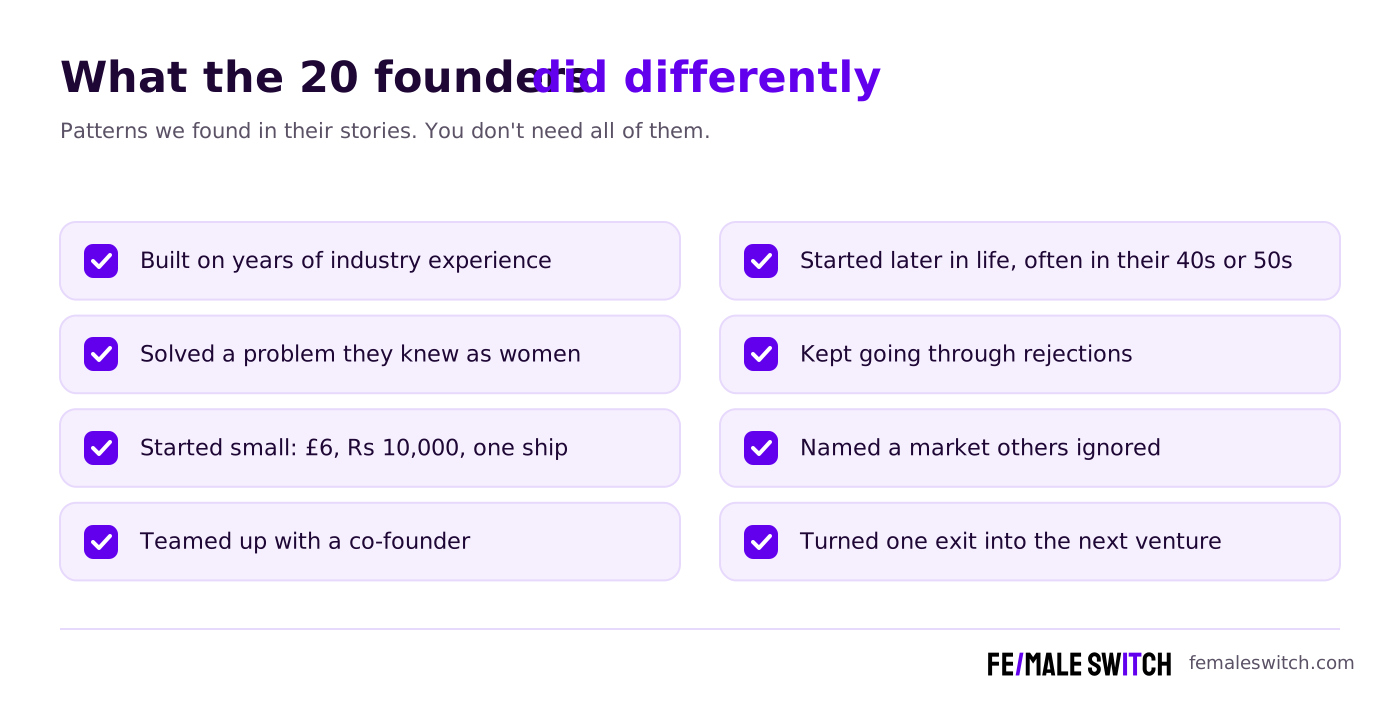
- They used what they knew. Anne Boden spent 30 years in banking and Kaidi Ruusalepp ran a stock exchange before founding. Research backs this up: founders with industry experience are about twice as likely to build a top-growth company.
- They solved problems they understood as women. Clue, Daye and Ava came from their founders' own health needs; Steve Shirley built a company for women who had to work from home.
- They started small. £6 for Steve Shirley, Rs 10,000 for Kiran Mazumdar-Shaw, one ship on a loan for MSC.
- Many started later. Falguni Nayar and Anne Boden founded their companies around 50.
- They kept going. Valentina Milanova pitched about 180 investors; Anne Boden nearly lost Starling before it got its licence.
Many of these traits are skills you can practise. See the 15 skills of an entrepreneur and the strengths women bring to startups.
Challenges business women still face
The data points to four recurring barriers: less access to funding, more caring responsibilities, smaller networks and lower confidence in their own skills. In GEM's survey, women's growth expectations were 32% lower than men's, and in many European countries far fewer women than men said they had the skills to start a business. None of these is about ability. Read the common challenges women entrepreneurs face and how to overcome them.
How to become a successful businesswoman in 2026
- Use your experience. List the problems you know from your job, industry or life that people pay to solve. Our guide to business ideas for women has 24 options with real data.
- Start small and test. Sell a first version to ten customers before you spend much. Our article on what starting a startup is really like shows what to expect.
- Build your network. Join networking events for women entrepreneurs and find a mentor through mentorship programmes for women in business.
- Plan your funding. Combine revenue, grants and angels before you approach VCs, and pitch widely; rejection is normal.
- Grow your visibility. Our sister blog has 7 tips for successful women in business on personal branding and visibility.
Start building your company today
The Fe/male Switch startup game takes you from idea to first customers, with Elona Musk as your AI co-founder and 6,000+ founders, most of them women, learning alongside you.
👉 Start your startup in the game
Conclusion: more business women, still too few at the top
Women now own about a third of Europe's small businesses and four in ten in the US, but their share shrinks at every step towards power and capital, down to about 1% of venture funding for all-female teams. The founders in this guide show that the gap can be crossed by building on what you know, starting small, finding allies and refusing to stop at the first no.
Your next step: write down the problem you understand better than most people, then test it with ten potential customers this month. For free structured lessons, join the free startup school.
Methodology
Statistics come from Eurostat, EIGE, GEM, Wells Fargo, Fortune, Forbes and PitchBook, checked in October 2026. We chose 20 women who founded or co-founded their companies (no heirs), mostly in Europe, and left out founders already covered in our great business ideas guide. Company figures come from annual reports and reputable press.
FAQ: business women
Is it businesswoman or business woman?
Dictionaries spell it as one word, businesswoman, with the plural businesswomen. The two-word form, business woman, is common but less formal.
What is the difference between a businesswoman and a female entrepreneur?
A businesswoman owns, runs or holds a senior role in a business. A female entrepreneur specifically starts and builds her own company. All female entrepreneurs are businesswomen, but not the other way round.
Who is the most successful businesswoman in the world?
By self-made wealth, Rafaela Aponte-Diamant, co-founder of shipping company MSC, worth about $44.5 billion according to Forbes in 2026. The richest woman overall is Alice Walton, who inherited her wealth.
What percentage of businesses are owned by women?
In the EU, women are 34.3% of the self-employed and 28% of self-employed people with employees (2025). In the US, women own 40.6% of all businesses, about 15.7 million firms.
How many Fortune 500 CEOs are women?
56 in 2026, or 11.2%, a record according to Fortune. In Europe, women are just under 10% of the CEOs of the largest listed companies.
Who are the most famous European businesswomen?
Founders include Rafaela Aponte-Diamant (MSC), Rosalía Mera (Zara), Anne Boden (Starling Bank), Martha Lane Fox (lastminute.com), Dame Stephanie Shirley and Ida Tin (Clue).
How much venture capital goes to women founders?
All-female founding teams received about 1.3% of European VC and 1.1% of US VC in 2025, according to PitchBook. Teams with at least one woman received 16.5% in Europe and 27.7% in the US.
What do successful businesswomen have in common?
Among the 20 founders in this guide: deep industry experience, solving a problem they understood, starting small, working with co-founders and persisting through rejection. Many started in their 40s or 50s.
How can I become a successful businesswoman?
Build on your experience, test a small version with real customers, grow your network and mentors, plan funding from several sources, and keep learning the core entrepreneurial skills.
About the Author
Violetta Bonenkamp, also known as MeanCEO, is an experienced startup founder with an impressive educational background including an MBA and four other higher education degrees. She has over 20 years of work experience across multiple countries, including 5 years as a solopreneur and serial entrepreneur. Throughout her startup experience she has applied for multiple startup grants at the EU level, in the Netherlands and Malta, and her startups received quite a few of those. She’s been living, studying and working in many countries around the globe and her extensive multicultural experience has influenced her immensely.

