

EdTech Startup Ecosystems in South America, Country by Country
An EdTech startup in South America can sell to millions of students, teachers and working adults, but each country gives founders different tools. Brazil has rolling state grants and the most EdTech companies, Chile has an equity-free public accelerator, Uruguay runs a state digital-education centre and an open funding window, and Colombia, Argentina and Peru each have their own agencies and calls. This guide covers eight South American countries and names, for each one, the public programmes and the EdTech companies we could verify on their own websites in late October and November 2026. Older lists ranked these countries with market sizes and funding shares that had no source; we removed those and kept what governments, programmes and companies publish themselves.
Quick answer: Brazil has the most young EdTech companies (according to HolonIQ, nearly half of its 2026 Latin America EdTech 100), and São Paulo state's FAPESP PIPE grants are open all year. Chile is the easiest entry for foreign founders thanks to Start-Up Chile's equity-free money. Uruguay combines ANII's open startup window with Ceibal, the state's digital-education centre. Colombia (iNNpulsa, UBITS, Platzi's community), Argentina (Coderhouse, Digital House) and Peru (StartUp Perú, Crehana) round out the list.
Write FREE SEO-optimized Blog Articles! Our Article Writer ensures your blog is loved by both Google and your readers, turning those clicks into customers.
👉 Write your article here
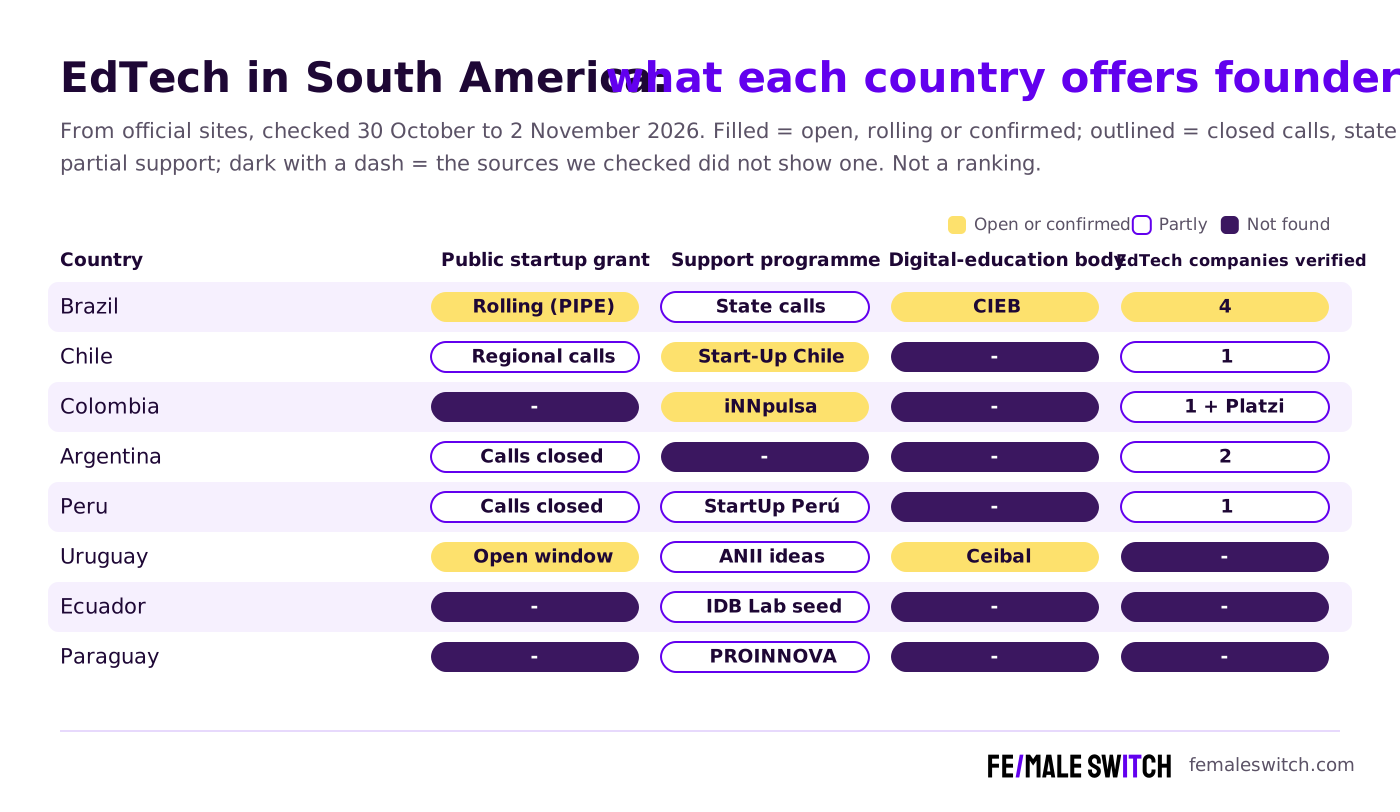
South America's EdTech Countries at a Glance
Sources: the official websites of the programmes and companies named, checked between 30 October and 2 November 2026; regional figures from HolonIQ as marked. Company self-descriptions are marked as their own claims.
What the Regional Data Says
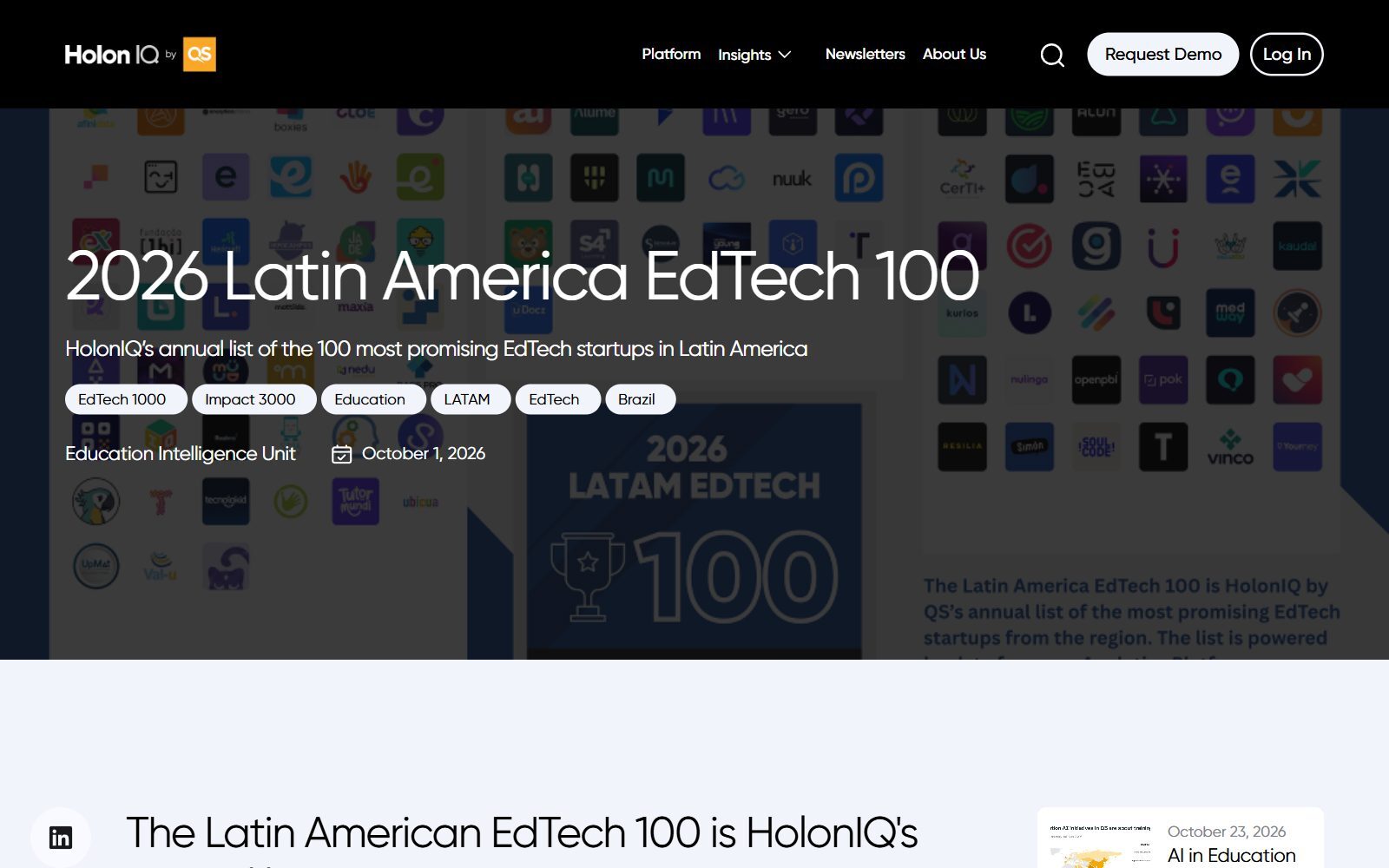
The most useful regional snapshot is the 2026 Latin America EdTech 100 published by HolonIQ (now part of QS) on 1 October 2026, a yearly list of the most promising young EdTech startups in the region. It leaves out companies founded more than 10 years ago and those that have been listed, acquired or taken over, so it shows where new companies are being built. According to HolonIQ, Brazil accounts for nearly half of the 2026 cohort, Mexico for 17%, Peru is the only other market on a clear upward path, and Ecuador and Uruguay now hold places they did not hold five years ago. K-12 (38%) and workforce training (37%) make up about three quarters of the list, and 54% of the companies sell directly to learners or families rather than to institutions.
EdTech Startups in South America by Country in 2027
1. Brazil
Brazil has the most EdTech startups in the region and several public funding routes. São Paulo state's research foundation runs FAPESP PIPE for research-based companies with up to 250 employees: up to R$ 300,000 for a 9-month Phase 1 and up to R$ 1.5 million for a 24-month Phase 2, with proposals accepted all year. In other states, Finep's Centelha programme funds new founders through state calls in 26 states and the Federal District. The non-profit CIEB (Centro de Inovação para a Educação Brasileira) works with public school networks on technology for learning at scale and publishes tools such as a matrix for evaluating digital learning resources, which shows what public buyers look for.
Among companies, Descomplica has run a digital education platform since 2011 from Barra da Tijuca in Rio de Janeiro, with Enem exam preparation, undergraduate degrees recognised by the education ministry (MEC) and postgraduate courses; it says more than 1.5 million students have studied with it. Alura, based in Vila Mariana, São Paulo, grew out of a teaching project Paulo and Guilherme Silveira started in 2004, became part of Grupo Alun in 2025 and says more than 6 million learners have used its tech courses. Geekie (Geekie Desenvolvimento de Software S/A) sells Geekie One, a platform with AI features and curriculum-aligned material from early childhood to secondary school, and Teachy, founded in 2020, builds AI tools for teachers that it says 6 million educators use.

2. Chile
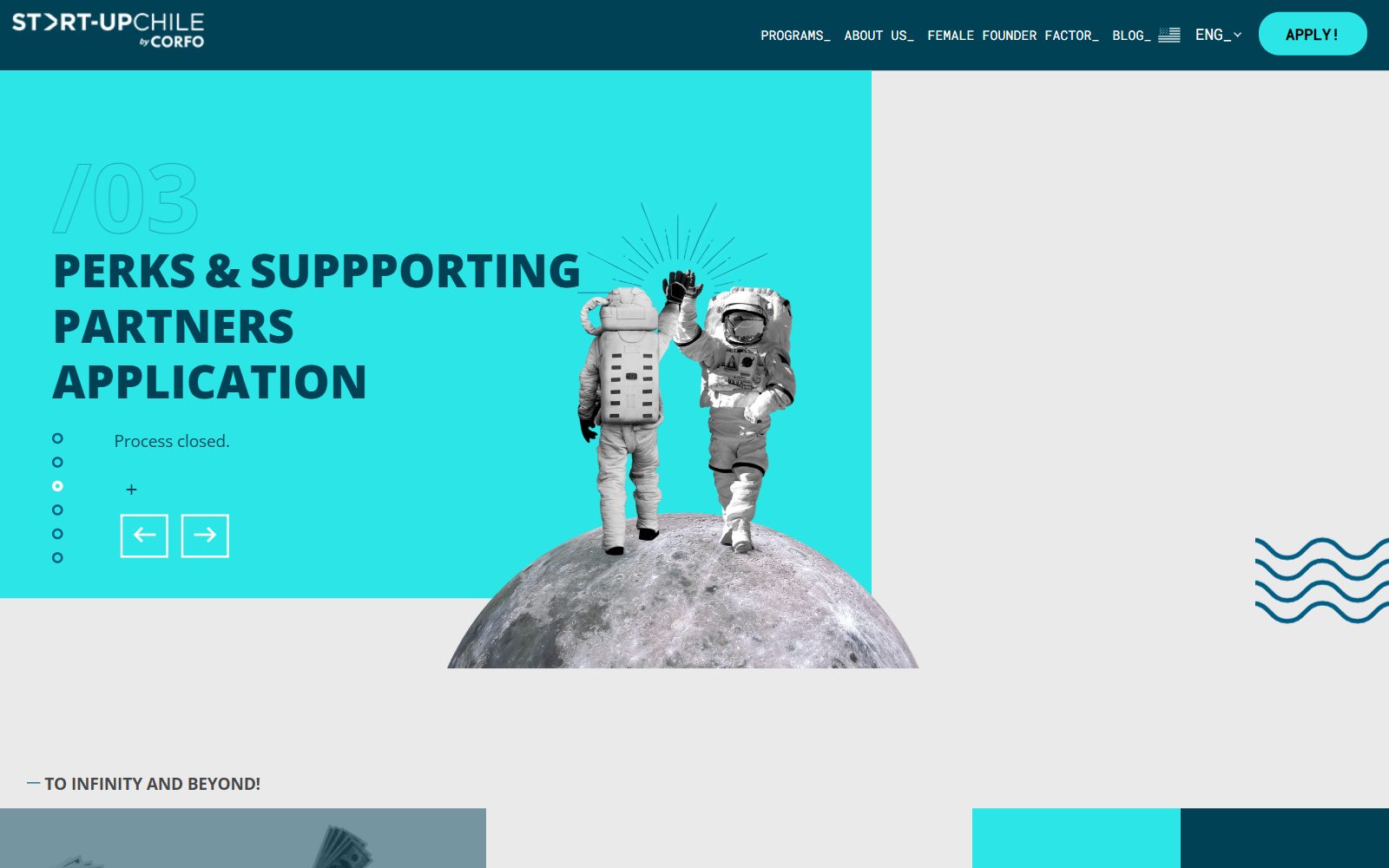
Start-Up Chile, the public accelerator of the economic development agency Corfo, gives founders of any nationality equity-free money: CLP 15 million over 4 months on its Build track and CLP 75 million over 8 months on Growth. BIG 12 is its current generation, and the BIG 13 application process was set to open on 3 November 2026 at 13:00 (GMT-3). For Chilean companies with less than 18 months of activity, Corfo's Semilla Inicia covers up to CLP 15 million (75% of the project), or CLP 17 million (85%) for women-led projects, through regional calls. A Chilean school EdTech to know is Lirmi, school management software with country sites for Chile, Brazil, Colombia, Mexico, Peru and the US; according to Diario Financiero (May 2022), it is run from La Araucanía, not Santiago, and already served more than 2,000 schools.
Boost Your SEO by listing your startup and get a FREE backlink.
Create a profile in the F/MS Startup Game, add the link to your website and submit.
👉 List your startup now!
3. Colombia
The government's entrepreneurship agency iNNpulsa Colombia, based in Bogotá, listed these calls as open at our check: Aldea+ 25 (specialised support for innovative companies by maturity), iNNpulsa Mujeres, and ZASCA Tecnologías cohorts in Kennedy (Bogotá) and Bucaramanga with in-person applications. UBITS (UBITS Learning Solutions S.A.S., registered in Bogotá) sells a talent platform with learning, recruitment, performance and survey modules; it says more than 1,000 companies in Latin America use it. Platzi calls itself the technology school of Latin America and says more than 6 million students and 4,000 companies learn with it, with an English Academy and AI courses. Be precise about its base: its terms name Platzi.com Inc. at a San Francisco address, while its yearly Platzi CONF takes place in Colombia and Mexico.
4. Argentina
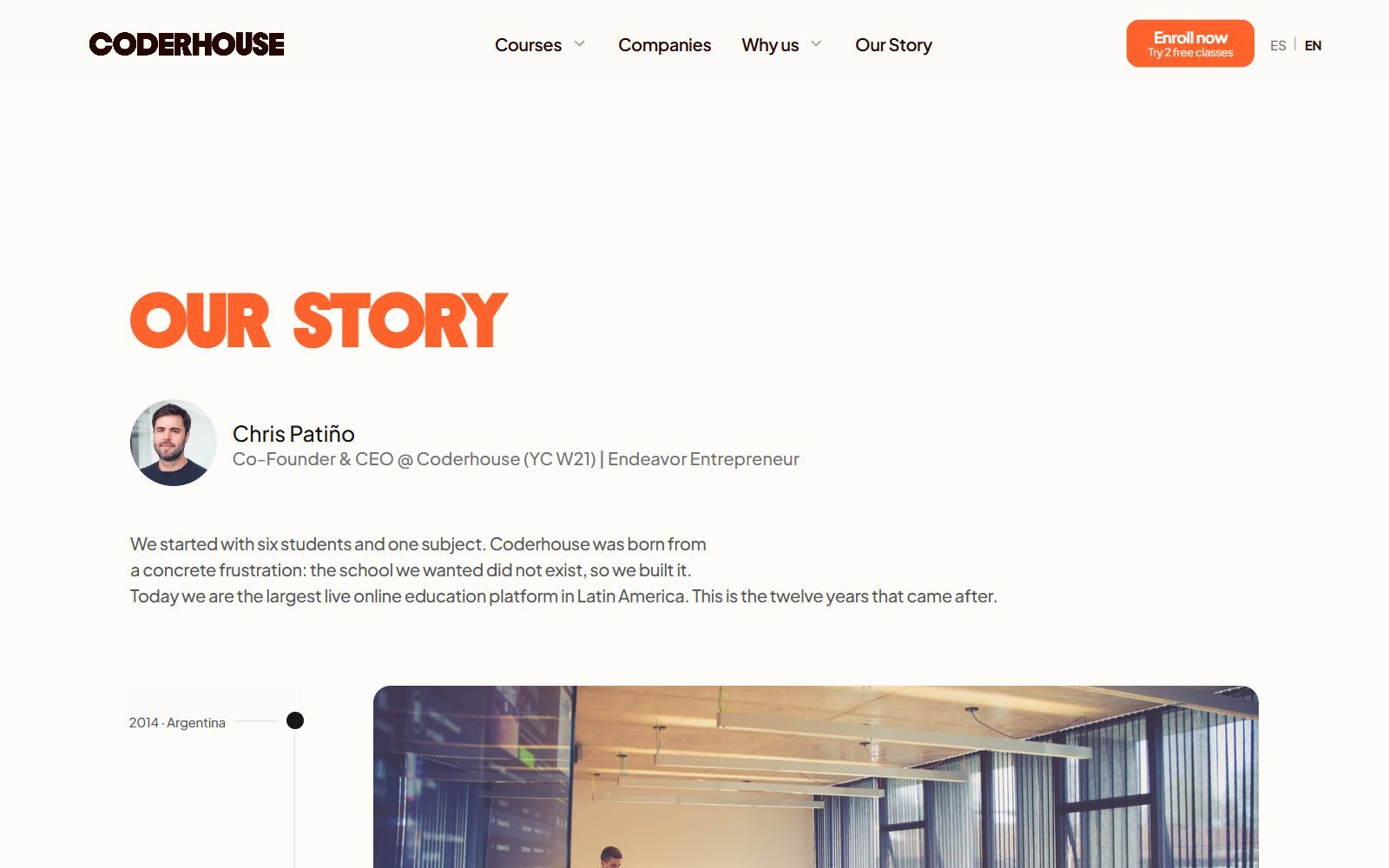
Coderhouse started in 2014 in a coworking room in Palermo, Buenos Aires, with six students and one course, then opened in Chile, Uruguay and Peru; its CEO's title on the page says it went through Y Combinator (W21), and it calls itself the largest live online education platform in Latin America, with more than 500,000 alumni. Digital House (operated by BREDAKER S.A. according to its privacy policy) teaches programming, AI, data and marketing, sells corporate training and school programmes, and offers higher education with Argentina's Universidad de San Andrés; it reports a community of more than 725,000 people and 350 partner schools, but its site gives no head-office address. Public startup money is the weak point right now: the Agencia I+D+i's Startup 2025 lines (USD 150,000 non-reimbursable for TRL 3-4 projects) are closed, so watch for the next calls.
5. Peru
ProInnóvate's StartUp Perú runs the country's startup competitions: Emprendimientos Innovadores (up to S/ 67,000 for teams up to 18 months old) and Emprendimientos Dinámicos (up to S/ 150,000 for companies 1 to 5 years old), plus lines for incubators, women's entrepreneurship networks and climate startups. Both startup competitions showed "Convocatoria Cerrada" at our last check, so plan for the next round. Crehana, founded in Peru as an online course platform, is now HR software with a learning catalogue of more than 6,300 courses, used by more than 1,200 companies in Latin America; its terms name a US parent company, Crehana Education, Inc., with a Peruvian subsidiary. According to HolonIQ, Peru is the only market besides Brazil with a clearly growing share of the region's EdTech 100. For the wider Lima scene, see our list of Lima startups to watch.
6. Uruguay
Ceibal is the Uruguayan state's centre for educational innovation with digital technologies, created by law 18.640; it runs programmes such as Ceibal EduIA and works with a separate Fundación Ceibal on learning and technology projects, which makes it the first door to knock on for an EdTech that wants to work with public schools. For money, the national research and innovation agency ANII funds young Uruguayan companies through Apoyo a Emprendimientos Innovadores: up to 80% of the project and up to UYU 3 million, or 90% for women-led or climate projects, for up to 24 months, through an open window that closes when funds run out. Projects need at least one full-time founder and a solution already validated with its market; earlier teams can use Validación de Ideas de Negocios (up to UYU 200,000 through a sponsoring institution).
7. Ecuador
According to HolonIQ, Ecuador now holds places in the regional EdTech 100 that it did not hold five years ago. Check the base of any company before you use it as a local reference: HolonIQ lists Muyu Education under Ecuador, but Muyu's own site gives an address in Melbourne, Australia. For funding, IDB Lab, the innovation arm of the Inter-American Development Bank, makes seed equity investments of US$ 200,000 to 500,000 in a group of smaller countries that includes Ecuador, Bolivia, Paraguay and Uruguay.
8. Paraguay, Bolivia and Venezuela
Paraguay's science council CONACYT runs PROINNOVA, which includes support for validating startup proposals, and Paraguay and Bolivia are both on IDB Lab's seed list. We did not find an EdTech-specific public programme or a verified EdTech company based in Paraguay, Bolivia or Venezuela, so they have no company list here.
Join F/MS: Startup Facilitator & Incubator and unlock your startup dreams today! Get your first customers, register you company in the Netherlands and get startup visas for the team.
Regional Players That Work Across Countries
Laboratoria trains women for tech jobs across 11 countries; it says it has reached more than 14,000 women since 2014 and runs a 12-week programme, Activa tu carrera, with employability coaching. It is a useful partner or customer reference for EdTech teams that build employability or upskilling products, the segment HolonIQ counts as 37% of its EdTech 100.
Removed and Changed Since the Last Version
- Mexico moved out: the old list ranked Mexico second, but it is not in South America. According to HolonIQ it holds 17% of the 2026 Latin America EdTech 100; see our Mexico City startups to watch and our sibling guide to EdTech grants in North America.
- Figures removed: the claim that Brazil takes over 50% of the region's EdTech venture funding, the regional market forecast of $3.64 billion, and labels such as "tech mecca" had no source we could verify, so they are gone.
- Links replaced: 20 search-engine redirect links were replaced with the official sites of programmes and companies.
- Companies not listed: Educabot (no country or head office on its site), Pok and Eldes (no Uruguayan base on their own sites) and Kurios (no country on its site) are left out until their sites say where they are based.
- Calls closed: Argentina's Startup 2025 lines and Peru's StartUp Perú competitions were closed at our check.
Which Country Should You Choose for Your EdTech Startup?
- You want equity-free money and can move: Chile, through Start-Up Chile, which accepts founders of any nationality.
- You need the biggest market and rolling grants: Brazil, with FAPESP PIPE in São Paulo state or a Centelha call in your state; Portuguese content is a must.
- You sell to public schools: Uruguay (Ceibal) or Brazil (start with CIEB's resources on how school networks choose digital tools).
- You build for adult learners and companies: Colombia and Argentina, where UBITS, Platzi, Coderhouse and Digital House show the size of the upskilling market.
- You are a young Uruguayan or Peruvian company: ANII's open window now, StartUp Perú when its next round opens.
How Founders Use These EdTech Ecosystems
Most EdTech founders in the region use a country for three things: a first market where they understand the curriculum, public money that does not cost equity, and pilots with schools or employers. Start with our list of grants for EdTech startups and every amount and deadline in our deep tech grants in South America guide, which covers FAPESP, Corfo, ANII and StartUp Perú in detail. When you are ready to raise, compare the VC firms that invest in EdTech, and if you plan to expand to Europe, the EdTech accelerators in Europe. Building with AI? The AI startup cities in South America guide covers national AI policies and hubs, and you can meet buyers at the top EdTech startup events. Before you build a full course platform, validate your startup idea with real teachers or learners.
FAQ About EdTech Startups in South America
Which South American country is best for EdTech startups?
It depends on what you need. Brazil has the largest market and rolling FAPESP PIPE grants, Chile has Start-Up Chile's equity-free money for founders of any nationality, and Uruguay combines ANII's open startup window with Ceibal, the state's digital-education centre.
Which country has the most EdTech startups in Latin America?
Brazil. According to HolonIQ's 2026 Latin America EdTech 100, published on 1 October 2026, Brazil accounts for nearly half of the cohort and Mexico for 17%.
Is Mexico part of this list?
No. Mexico is in North America, so we moved it out of this guide. See our Mexico City startups list and our guide to EdTech grants in North America.
Can a foreign founder get equity-free money for an EdTech startup in South America?
Yes, through Start-Up Chile, which gives CLP 15 million on its Build track and CLP 75 million on Growth without taking equity. Most other public grants, such as FAPESP PIPE, ANII and StartUp Perú, require a local company.
What grants exist for EdTech startups in Brazil?
FAPESP PIPE pays up to R$ 300,000 in Phase 1 and up to R$ 1.5 million in Phase 2 to research-based companies in São Paulo state, with proposals accepted all year. Finep's Centelha programme runs state calls for new founders in 26 states and the Federal District.
What is Ceibal?
Ceibal is the Uruguayan state's centre for educational innovation with digital technologies, created by law 18.640. It runs programmes such as Ceibal EduIA and is the main public partner for EdTech work in Uruguayan schools.
Is Platzi a Colombian company?
Platzi runs its yearly Platzi CONF in Colombia and Mexico, but its terms name Platzi.com Inc. at a San Francisco address, so we list it with that caveat.
Where is Crehana based?
Crehana was founded in Peru and keeps a Peruvian subsidiary, but its terms name a US parent, Crehana Education, Inc. It has changed from an online course platform into HR software with a learning catalogue.
Which EdTech segments are growing in Latin America?
According to HolonIQ, K-12 (38%) and workforce training (37%) make up about three quarters of the 2026 Latin America EdTech 100, and AI-native positioning in product descriptions has quadrupled since 2020.
Why did you remove the market-size and funding-share figures?
The old version quoted a regional market forecast and Brazil's share of EdTech venture funding without sources we could verify, so we replaced them with facts from official sites and HolonIQ's published list.
About the Author
Violetta Bonenkamp, also known as MeanCEO, is an experienced startup founder with an impressive educational background including an MBA and four other higher education degrees. She has over 20 years of work experience across multiple countries, including 5 years as a solopreneur and serial entrepreneur. Throughout her startup experience she has applied for multiple startup grants at the EU level, in the Netherlands and Malta, and her startups received quite a few of those. She’s been living, studying and working in many countries around the globe and her extensive multicultural experience has influenced her immensely.
