

EdTech Accelerators in Europe: 21 Programmes, Fellowships and Investors for Education Startups
An EdTech startup sells to one of the slowest buyers there is: schools, universities, ministries and training departments. That is why the best education accelerators give you more than a cheque: classroom pilots, learning scientists who check your pedagogy, and help with procurement. This guide lists 21 European accelerators, incubators, fellowships and early-stage investors for EdTech founders, with what each one offers according to its own website. We checked every programme on its official page in October 2026, wrote passed deadlines as passed, and moved closed, renamed or off-topic programmes from the old lists to a short note at the end. Building for schools in Asia instead? See our guide to EdTech accelerators in Asia.
Quick answer: for an EdTech-only accelerator, start with xEdu (Finland, Lithuania and Italy) or SuperCharger Ventures (an equity-free 12-week cohort in Malta and an online cohort). If you need classroom pilots, apply to the Helsinki Education Hub EdTech Incubator; women founders should look at the Female EdTech Fellowship. Vocational and workplace-learning startups in the UK can get grants from Ufi VocTech Trust, and Emerge and Brighteye Ventures are the specialist investors to talk to when you raise.
Write FREE SEO-optimized Blog Articles! Our Article Writer ensures your blog is loved by both Google and your readers, turning those clicks into customers.
👉 Write your article here
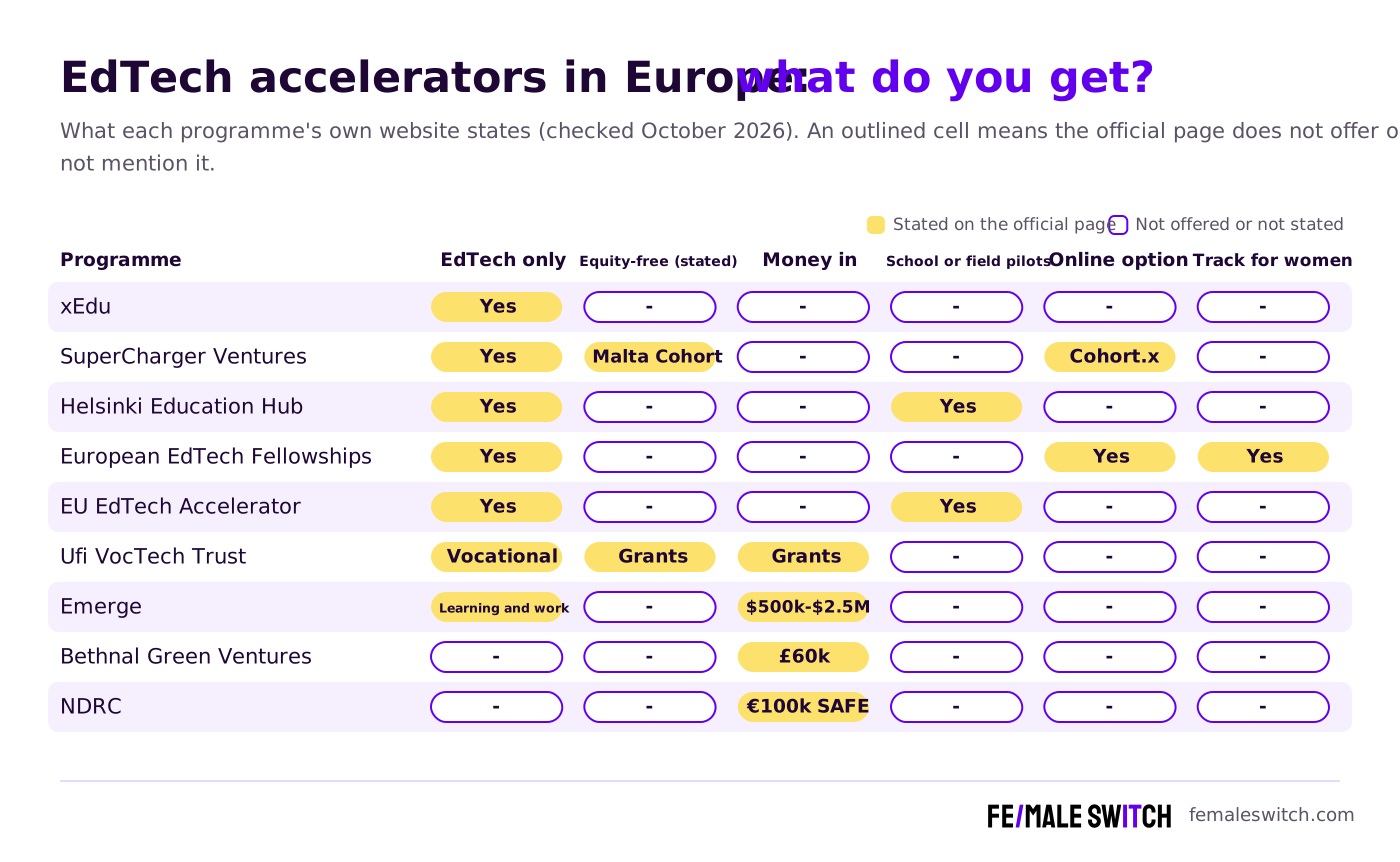
EdTech Accelerators in Europe at a Glance
Sources: each programme's official website, checked October 2026. Amounts and terms are quoted as the programmes publish them; where a page does not state terms, we leave them out.
Accelerators and Programmes Built for EdTech
1. xEdu (Helsinki, Lithuania, Turin)
xEdu is a Finnish accelerator that works only with EdTech founders and describes itself as grounded in pedagogy and learning science. By its own count it has accelerated 110 EdTech startups from more than 20 countries in 11 programmes across three countries, and its startups have raised more than €30 million. It runs the NextEdu Accelerator in Turin with Fondazione Sviluppo e Crescita CRT and OGR Torino (a four-month programme; the 2025 edition ran from October to February at OGR Tech), the Edu Challenger accelerator in Lithuania with Startup Lithuania and Civitta (its second batch ran from March to June 2025), and the Enter EdTech incubator for students, researchers and educators who want to become EdTech founders.

2. SuperCharger Ventures (Malta and online)
SuperCharger Ventures runs what it calls one of the world's leading EdTech accelerators, with hubs in Malta, Singapore, Saudi Arabia and Rwanda. For European expansion, the Malta Cohort is a 12-week, equity-free accelerator for founders who set up operations in Malta; Cohort.x is an 8-week, fully remote programme focused on fundraising; and Founders Taboo is an 8-week online "decelerator" on founder mental health with two in-person retreats. Its own figures: 200+ startups accelerated, $180M portfolio value and founders from 50+ nationalities.
3. Helsinki Education Hub EdTech Incubator (Helsinki)
The University of Helsinki's Helsinki Education Hub EdTech Incubator takes teams with a working prototype from prototype to a market-ready product in 12 weeks. You get mentors in educational sciences and business, a Lean LaunchPad product framework, school pilots for user testing, and investor connections. Founders, university researchers, teacher-led teams and student groups can apply. The autumn 2026 cohort closed applications on 7 August 2026 and runs from mid-September to mid-November 2026; watch the hub's news page for the next call.
4. European EdTech Fellowships (online, Europe-wide)
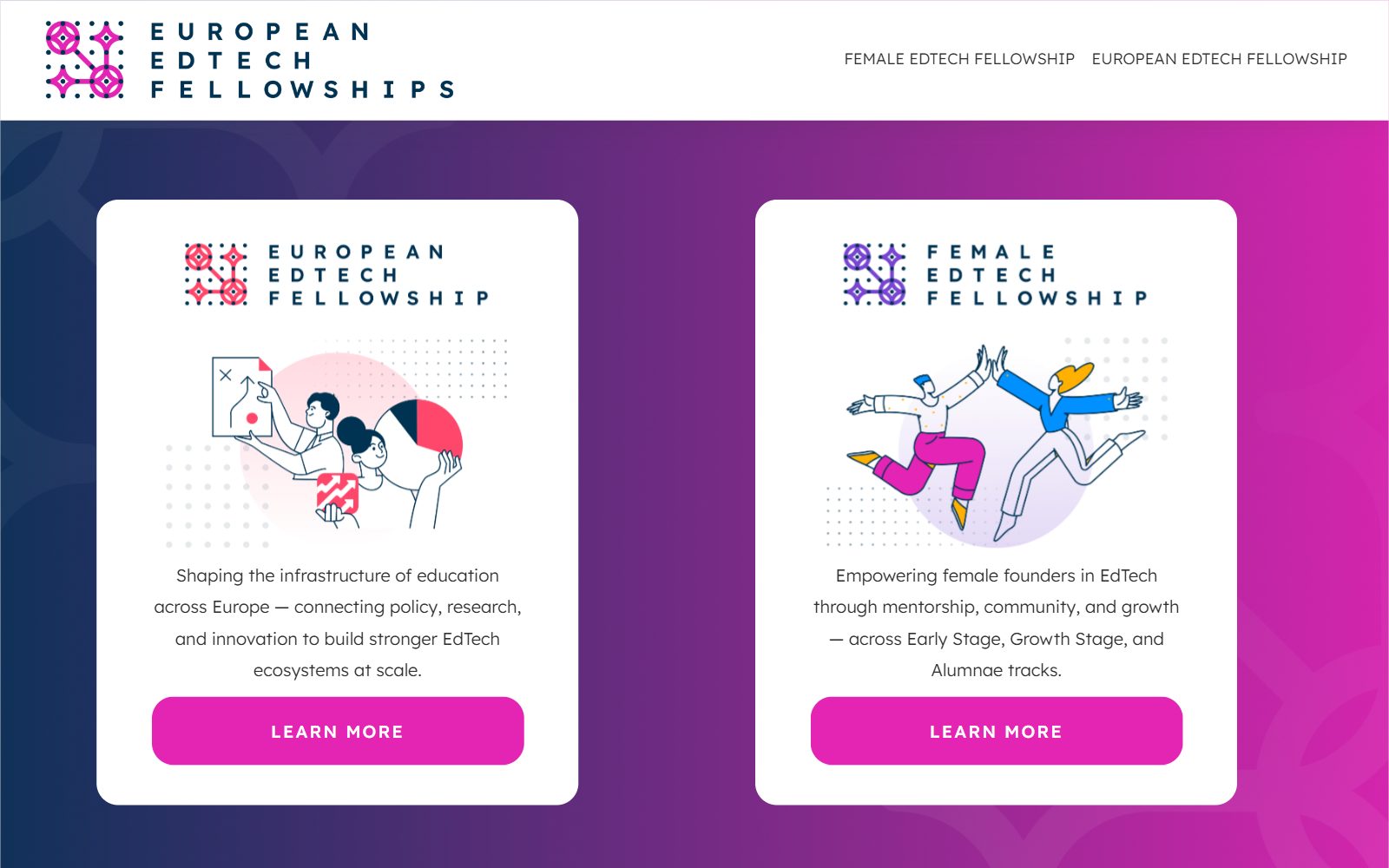
The European EdTech Alliance, a non-profit formed in 2019 that represents more than 2,600 EdTech organisations in nearly 30 countries, runs two fellowships. The Female EdTech Fellowship has an Early Stage track (four weeks online, cohorts of up to 10 to 15 fellows, €450) and a six-month Growth Stage track for women founders of seed or growth-stage EdTech startups, with monthly expert sessions and a weekend retreat; the latest cohorts started in March 2026 after a 28 February 2026 deadline. The European EdTech Fellowship is a six-month programme (one session a month, €1,000 fee) on how to sell into European education systems: procurement and tenders, evidence, GDPR and student data, and funding; its 2026 applications closed on 22 May 2026.
5. EU EdTech Accelerator (Digital Europe Programme)
The European Commission's EdTech Accelerator topic in the Digital Europe Programme funds one accelerator for European EdTech startups and SMEs, with a topic budget of €2.7 million. The winning consortium (at least four organisations from four eligible countries) must select at least three cohorts of startups through open calls, run mentoring and validation, pilot the solutions in real educational settings and help them enter the market. The consortium deadline was 1 October 2026 and has passed; startups should watch the Digital Skills and Jobs Platform for the cohort calls once the accelerator is running.
Boost Your SEO by listing your startup and get a FREE backlink.
Create a profile in the F/MS Startup Game, add the link to your website and submit.
👉 List your startup now!
6. Ufi VocTech Trust (UK)
Ufi VocTech Trust is a UK charity that funds technology for vocational learning and skills for work. It runs grant programmes (VocTech Activate, VocTech Challenge and VocTech Ignite), invests in VocTech businesses through Ufi Ventures, and has launched VocTech Together, a £2.85 million programme for the adoption of vocational technology. VocTech Ignite is by invitation only for earlier unsuccessful grant applicants and gives five days of expert input plus a small cash fund.
7. EuraTechnologies (Lille)
EuraTechnologies is one of Europe's largest startup incubators and accelerators, with 158,000 m² across five sites. It welcomes about 200 startups a year in seven business verticals, one of which is EdTech/HRtech, and also runs The Square, an international accelerator programme.
8. Emerge (pre-seed investor, formerly Emerge Education)
Emerge Education is now Emerge, a $75M pre-seed fund for founders building the future of human capital development (learning and work). It invests $500k to $2.5M and gives founders access to a community of 100+ venture partners. It no longer presents itself as an accelerator; its news page lists portfolio rounds such as Munich-based EDURINO's €17 million Series B.
9. Brighteye Ventures (EdTech and future-of-work investor)
Brighteye Ventures backs founders building what it calls the HumanOS: products that help people learn, work and adapt. It has funded 55+ companies from pre-seed to Series A and announced a $72M first close of its Fund III. It is a venture fund, not an accelerator, so approach it when you are ready to raise.
Boost Your SEO by Getting Featured in Our Blogs and get a backlink.
We publish content about startups, education, tech, funding, etc. that ranks well not only in Google but also in Perplexity, ChatGPT, Grok and other AI tools.
👉 Get featured now!
General Accelerators That Also Take EdTech Startups
10. Bethnal Green Ventures (London)
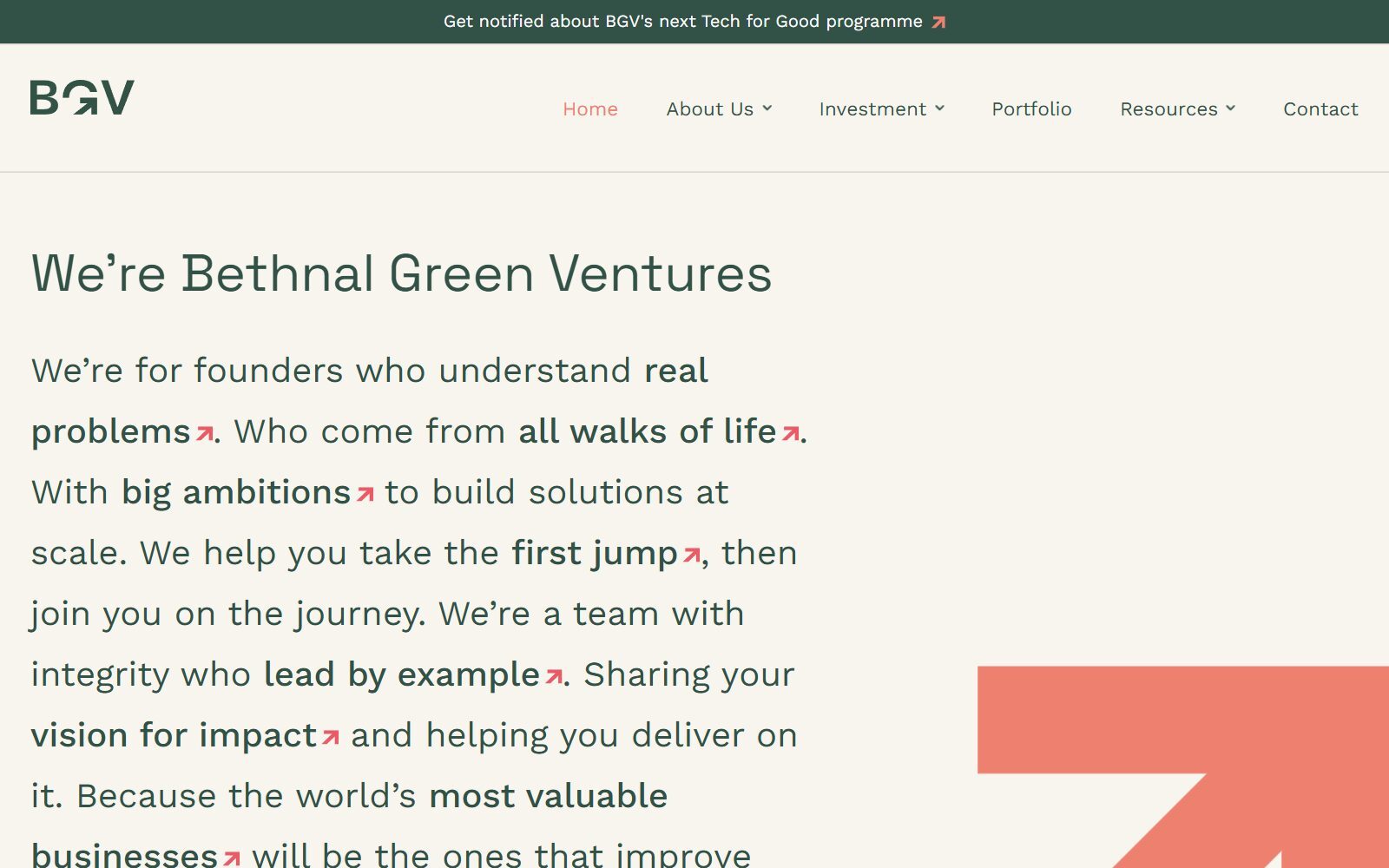
Bethnal Green Ventures (BGV) invests in tech for good, which suits EdTech startups with a social mission. Its Tech For Good Programme invests £60,000 for 7% equity, with six weeks of intensive learning followed by six weeks of coaching; it selects 10 to 15 companies twice a year. Applications for the autumn 2026 programme are closed, and BGV says the next round opens in November.
11. Kickstart Innovation (Zurich)
Kickstart Innovation is a Swiss open-innovation platform that matches well-established startups with corporate partners. New Work & Learning is one of its focus areas; one of its case studies is a digital coaching pilot between PostFinance and the learning platform Cognician. Since 2015 it says it has facilitated 400+ commercial partnerships and supported 530+ startups, whose alumni have raised over CHF 3.1 billion.
12. Founders Factory (London and global)
Founders Factory invests capital together with a four-month cohort programme and corporate partners. Its focus areas are now fintech, industrials, health and deep tech, and none of its open programmes is EdTech-specific; Perlego, an online subscription to academic books, is listed as an EdTech company in its portfolio.
13. Techstars London
Techstars London is a three-month accelerator for early-stage founders in all verticals. For the next programme the final application deadline is 18 November 2026, the accelerator starts on 8 March 2027 and Demo Day is on 3 June 2027.
14. Antler (London)
Antler backs founders at day zero, solo or in a team. In the UK it says founders start with £210k and can scale with up to £25M of follow-on investment.
15. Entrepreneurs First (London)
Entrepreneurs First invests in individuals before they have a co-founder or an idea, matches them into teams and takes them to a Demo Day in San Francisco. It says its companies typically raise $1M to $7M within weeks of that Demo Day.
16. Station F (Paris)
Station F is a Paris startup campus with in-house and partner programmes. EdTech founders usually join through its flagship Founders Program for early-stage companies or Fighters, its programme for unconventional founders with no degree required; there is no EdTech-specific programme on its current list.
17. NDRC (Dublin)
NDRC invests a €100k uncapped SAFE in founders building globally scalable technology companies, with coaching from founders, mentors and entrepreneurs in residence. It works on a rolling basis with no fixed cohorts; its rolling investment applications are closed at the time of writing, and it runs a pre-accelerator with an autumn 2026 cohort.
18. SeedRocket (Spain)
SeedRocket has accelerated early-stage tech startups in Spain since 2008 with mentoring, training and investor access through its investment club and 4Founders Capital. Its 36th founders' Campus runs in Madrid from 16 to 20 November 2026.
19. Accelerace (Copenhagen, Nordics)
Accelerace describes itself as the leading pre-seed investor and accelerator and the home of Nordic founders. It has no EdTech-specific programme on its homepage, so pitch it as a Nordic startup first.
20. Startup Wise Guys (Estonia and CEE)
Startup Wise Guys runs vertical accelerators for B2B startups and has run 45+ programmes with 800+ founders. It names an initial ticket of €100K in its flagship programmes.
21. The Family (remote)
The Family describes itself as a fellowship of founders. Twice a year it selects 50 startups worldwide for an intense six-week remote programme with office hours and an investor Demo Day, in exchange for 5% equity.
Boost Your SEO with 1,500+ Free Business Directories: increase your DA, get backlinks and traffic.
We've compiled an exclusive list of directories and websites where you can submit your business and start building high-quality backlinks to boost your website traffic and get your SEO snowball rolling.
👉 Submit your startup now!
Removed From the Old Lists and What Changed
The 2025 versions of this article (top 10, top 15, top 20 and top 25 lists) included programmes that have ended, changed or could not be found. We removed these:
- IMPACT EdTech: the EU-funded incubator-accelerator ended; its project ran from 1 December 2019 to 31 October 2022 according to the EU's CORDIS database, and its old address now redirects to an ISDI Accelerator page that returned an error.
- European Digital Education Accelerator: the accelerator of the European Digital Education Hub supported 21 digital education solutions over three years and has finished; the new EU EdTech Accelerator (number 5) is a separate programme.
- Katapult Accelerator: Katapult now describes itself as an impact ecosystem of funds, accelerators and platforms for a regenerative world, with no EdTech programme.
- Swiss EdTech Collider: its website now only loads a testbed platform, so we could not confirm its old co-working and community programme.
- SEK Lab EdTech Accelerator: its domain is now parked and for sale.
- APX: now an earliest-stage VC in Berlin, without the old three-month programme. NUMA: now a management and sales training company.
- Startupbootcamp, Microsoft Accelerator, Leapfunder and EIT Culture & Creativity: no EdTech track today, no current programme page found, an angel investment platform rather than an accelerator, and a cultural and creative sector programme, in that order.
- High Tech XL: a deep tech venture builder; it is in our list of deep tech accelerators in Europe.
- EdTech Sweden, Go-Together EdTech Accelerator, Edtech Southeast, Innovation Lab, Next Education, Masterclass Accelerator, UCL Accelerator, Wellcome Trust Accelerator, The Hive, Better Startup and EdTech Innovation Fund: we could not find an official page that confirms a current European EdTech programme under these names.
We also replaced the old programme lengths and investment terms with what each website publishes now, or left them out when they are not published. Emerge Education is listed under its new name, Emerge.
Which EdTech Accelerator Should You Choose?
- You want an accelerator that only works with EdTech: xEdu or SuperCharger Ventures.
- You have a prototype and need classroom pilots: the Helsinki Education Hub EdTech Incubator; later the cohorts of the EU EdTech Accelerator.
- You are a woman founding an EdTech startup: the Female EdTech Fellowship, then a general programme such as BGV or Antler.
- You sell to schools or ministries across Europe: the European EdTech Fellowship covers procurement, tenders and student data rules.
- You build vocational or workplace learning in the UK: Ufi VocTech Trust grants.
- You want to keep all your equity: SuperCharger's Malta Cohort or a grant; most other programmes here take equity.
- You need a larger cheque: Antler, NDRC or Startup Wise Guys at the start, then Emerge or Brighteye Ventures as specialist EdTech investors.
- You sell to corporates (training and HR): Kickstart Innovation's New Work & Learning area or EuraTechnologies' EdTech/HRtech vertical.
Join F/MS: Startup Facilitator & Incubator and unlock your startup dreams today! Get your first customers, register you company in the Netherlands and get startup visas for the team.
How EdTech Founders Use Accelerators
Most EdTech founders combine a few of these: an incubator or fellowship to test the product with real teachers and learners, a grant to pay for pilots, then an accelerator or a specialist investor once schools or companies are paying. Start with our list of EdTech startup grants, and if you are a woman founder, the grants for female entrepreneurs in Europe and the wider grants for early-stage startups in Europe. Compare general programmes in our list of startup incubators in Europe; if your product is built on AI, read the accelerators for AI startups too. Pitch competitions are another way in: see the startup competitions in Europe, and meet buyers and investors at the top EdTech startup events. When you are ready to raise, our list of early-stage VC firms helps you find the next investor. Before you apply anywhere, validate your startup idea with real teachers or learners. For investors who back only education and learning startups, see our list of EdTech VC firms.
FAQ About EdTech Accelerators in Europe
What is an EdTech accelerator?
A programme for education technology startups that combines mentoring and often investment with things education buyers care about: pedagogy and learning-science advice, pilots in schools or companies, and help with procurement. Some, like xEdu and SuperCharger Ventures, work only with EdTech; general accelerators also take EdTech startups.
Which is the best EdTech accelerator in Europe?
For an EdTech-only programme, xEdu and SuperCharger Ventures are the most established on our list. The Helsinki Education Hub incubator is strongest for school pilots, and the European EdTech Alliance fellowships for founders who need to understand European education systems.
Is IMPACT EdTech still accepting applications?
No. IMPACT EdTech was an EU-funded project that ran from 1 December 2019 to 31 October 2022 and has ended. The new EU EdTech Accelerator in the Digital Europe Programme is a separate programme.
Which EdTech accelerators do not take equity?
SuperCharger Ventures says its 12-week Malta Cohort is equity-free, and Ufi VocTech Trust gives grants. The European EdTech Fellowships charge a participation fee (€450 or €1,000). Most investors on the list, such as BGV (7% for £60,000), take equity.
Is there an EdTech accelerator for women founders?
Yes. The Female EdTech Fellowship of the European EdTech Alliance has an Early Stage track (four weeks online) and a six-month Growth Stage track for women founders of EdTech startups.
How can EdTech startups get school pilots?
The Helsinki Education Hub EdTech Incubator offers school pilots in its 12-week programme, and the EU EdTech Accelerator must pilot its startups' solutions in real educational settings. Many other programmes help with introductions but do not run pilots themselves.
What happened to Emerge Education?
It now operates as Emerge, a $75M pre-seed fund for founders building the future of learning and work, investing $500k to $2.5M. It no longer presents itself as an accelerator.
Are there EdTech grants as well as accelerators?
Yes. UK vocational learning startups can apply to Ufi VocTech Trust, and our list of EdTech startup grants covers more options. EU funding usually reaches startups through consortia, such as the open calls of the EU EdTech Accelerator.
How long do EdTech accelerators last?
From a four-week online fellowship (Female EdTech Fellowship Early Stage) and an eight-week online cohort (SuperCharger Cohort.x) to 12 weeks (Helsinki Education Hub, SuperCharger Malta Cohort, BGV), four months (NextEdu, Founders Factory) and six months (European EdTech Fellowship).
Why are some accelerators from the old list missing?
We removed programmes that ended (IMPACT EdTech, the European Digital Education Accelerator), changed (Katapult, APX, NUMA), have parked websites (SEK Lab) or that we could not confirm on an official page. Can we feature your EdTech programme? We publish content about startups, education and funding, so get in touch through the guest post offer above.
About the Author
Violetta Bonenkamp, also known as MeanCEO, is an experienced startup founder with an impressive educational background including an MBA and four other higher education degrees. She has over 20 years of work experience across multiple countries, including 5 years as a solopreneur and serial entrepreneur. Throughout her startup experience she has applied for multiple startup grants at the EU level, in the Netherlands and Malta, and her startups received quite a few of those. She’s been living, studying and working in many countries around the globe and her extensive multicultural experience has influenced her immensely.
