

Open-Source Mendix Alternatives for Enterprise Low-Code Apps, Workflows and Governance You Host Yourself
Mendix is an enterprise low-code platform: you model data, pages and logic visually, add process workflows and deploy business applications with governance built in. It is also closed source, the free plan is meant for prototypes, and running apps on your own servers or Kubernetes starts with a paid plan. An open-source alternative lets you keep the platform, the apps and the data on your own infrastructure without per-app licence fees. We checked every platform below on its official website and GitHub on 4 November 2026: the exact licence, the latest release, what the free edition includes and what the paid editions cost. Three tools from the earlier list are not open source or are not app platforms, and several often-suggested platforms fail the open-source test; you will find them in a separate section.
Quick answer: for the closest open-source match to Mendix, with apps and business process workflows in one platform, use Joget (GPLv3 Community Edition). Java teams who want Mendix-style enterprise apps in real code should look at Jmix (Apache 2.0); Python teams at Frappe Framework (MIT), which runs ERPNext. For a Salesforce-style business platform use Corteza, for non-developers Budibase, and for internal apps on top of existing databases Appsmith or ToolJet.
Boost Your SEO by Getting Featured in Our Blogs and get a backlink.
We publish content about startups, education, tech, funding, etc. that ranks well not only in Google but also in Perplexity, ChatGPT, Grok and other AI tools.
👉 Get featured now!
What Mendix Offers in 2027
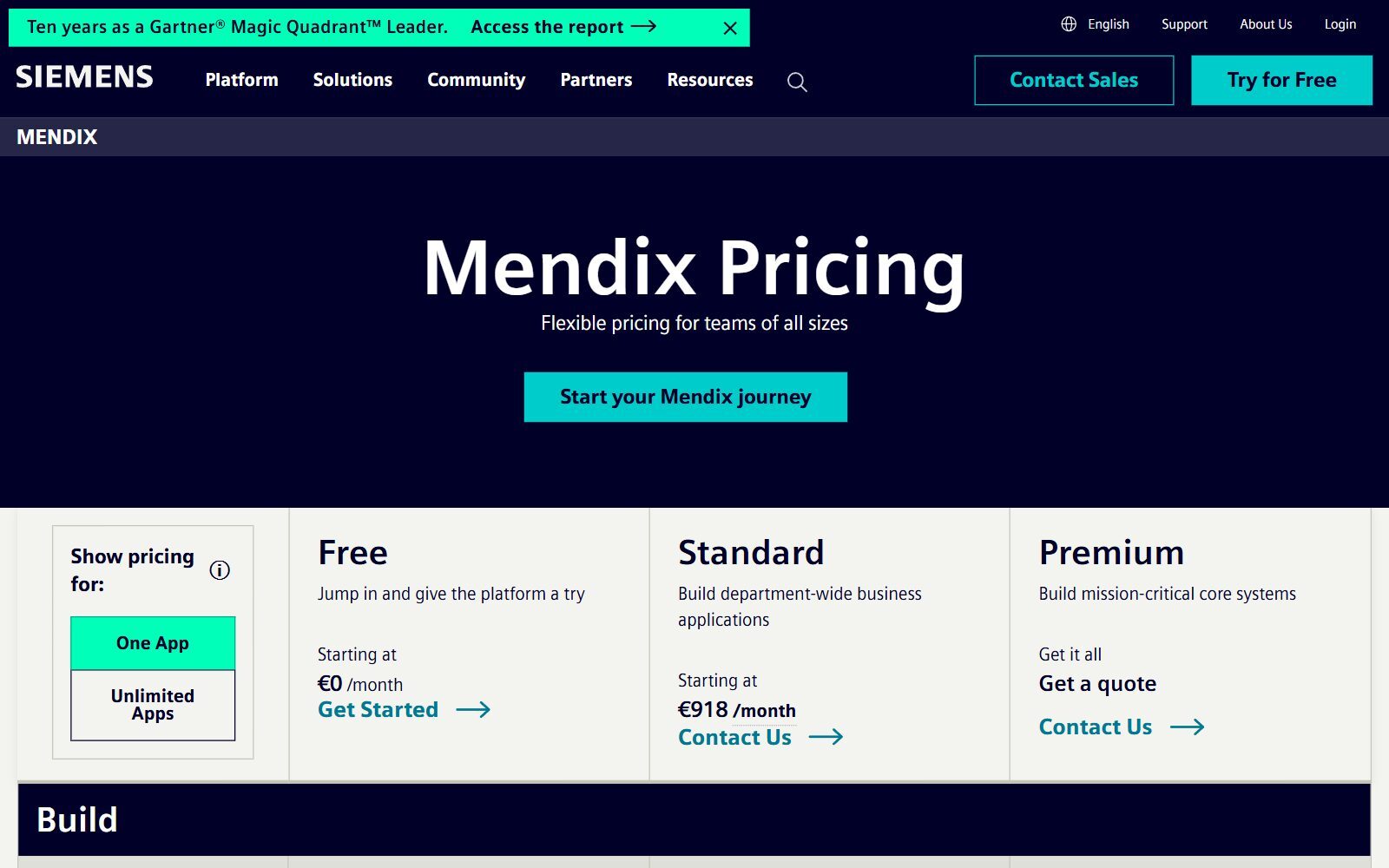
To know what you are replacing: the Mendix pricing page (checked November 2026, prices shown in euros) has a Free plan at €0 a month. Mendix says it includes everything you need to design, build and deploy demos, prototypes or small applications, with a deployment environment for each app and unlimited users, but without product support, an uptime guarantee, identity-provider integration or scaling. Standard, for department-wide business applications, starts at €918 a month for one app (€2,295 a month for unlimited apps), and Premium, for mission-critical systems, is priced by quote. Deploying to Kubernetes, Azure, SAP BTP or your own servers is listed only on the paid plans, at extra cost. Mendix does not charge for developers or anonymous users.
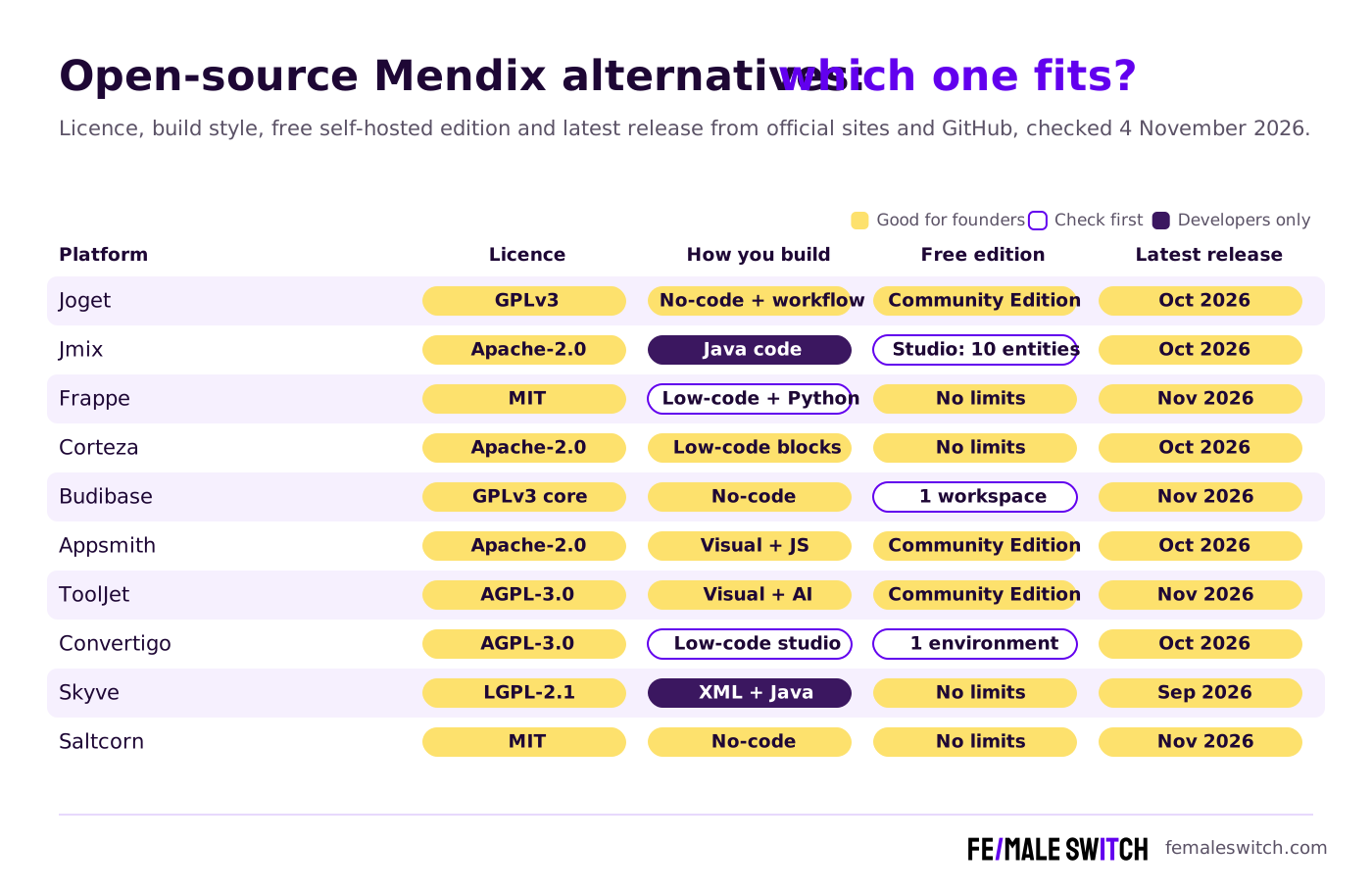
Open-Source Mendix Alternatives Compared
Sources: each project's official website, pricing page, LICENSE file and GitHub releases, checked 4 November 2026. Self-hosting is free, but you pay for the server and your own time.
The Best Open-Source Mendix Alternatives in 2027
1. Joget: the closest open-source match to Mendix
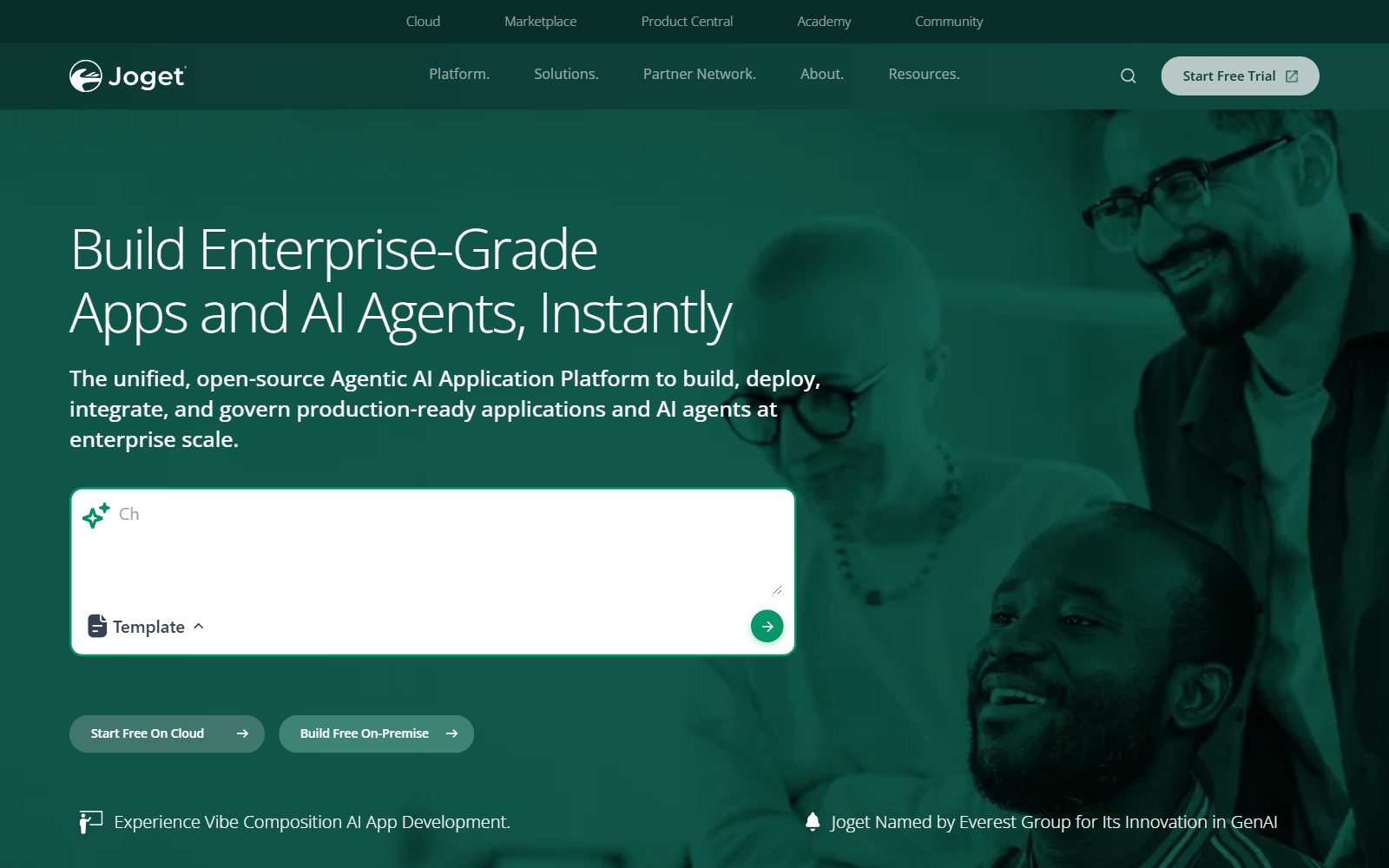
Joget now calls itself an open-source agentic AI application platform to build, deploy, integrate and govern applications and AI agents at enterprise scale. Like Mendix, it combines rapid application development with business process automation and workflow management, so business and technical teams can build full enterprise applications visually, and add plugins or ready apps from the Joget Marketplace. Its GitHub README says the Community Edition is licensed under GPLv3, while the Professional and Enterprise editions use a commercial licence. Joget describes the Community Edition as community-supported; the Enterprise Edition adds enterprise support, high availability and clustering. You can run it on your own server, with Docker or Kubernetes, or start on Joget's cloud. Version 9.1.2 of the community code was released in October 2026.
2. Jmix: enterprise apps in Java, the developer-first route
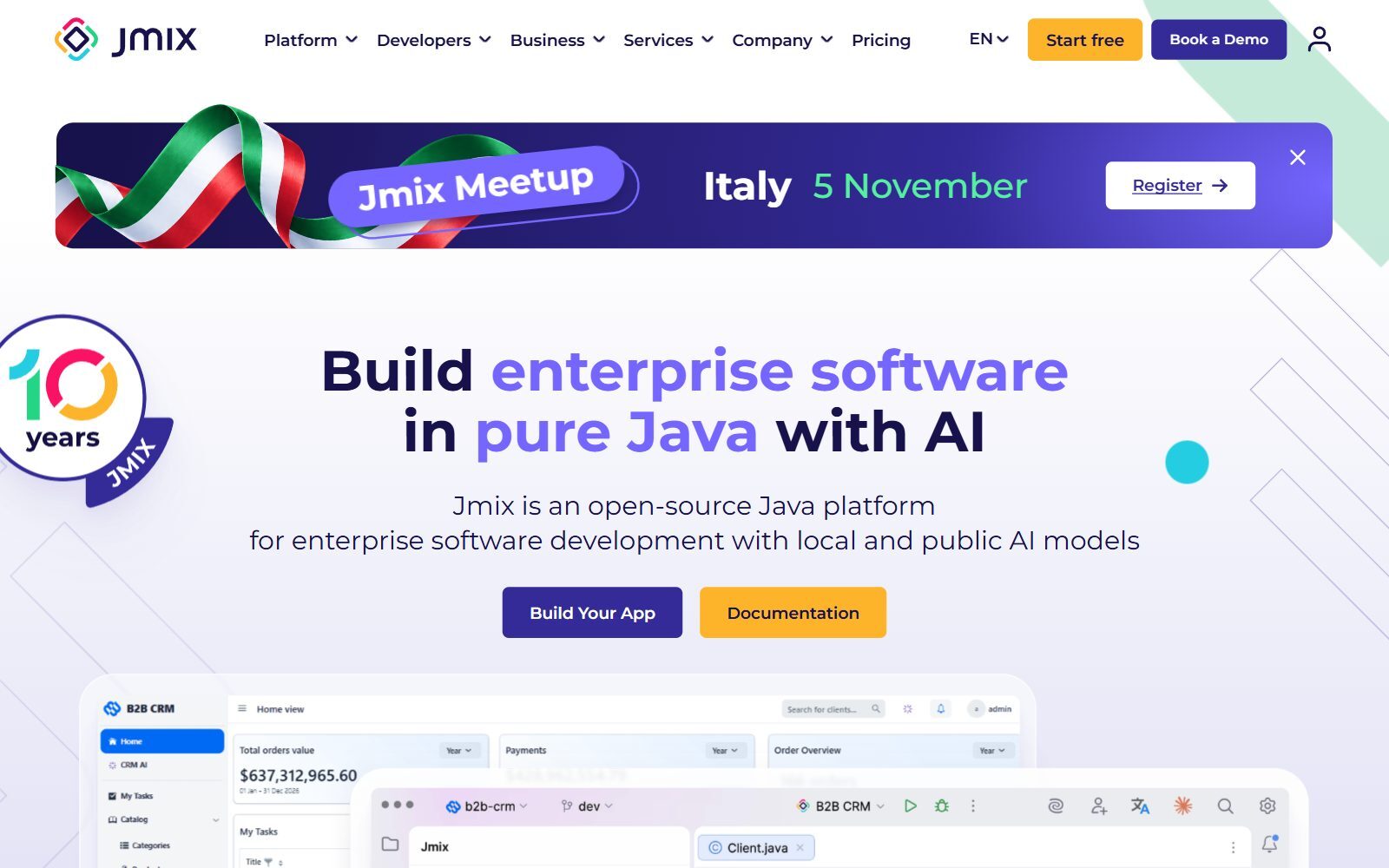
Jmix describes itself as an open-source Java platform for enterprise software development with local and public AI models. Its README calls it a full-stack framework for business applications built on Spring Boot: Jmix Studio, a plugin for IntelliJ IDEA, helps you define the data model, generate database migrations and design UI views visually, and modules add data access control, audit, reporting and BPM. The Jmix framework is Apache 2.0, and version 3.1.0 came out in October 2026. The Jmix pricing page lists a Community plan that is free forever, and the Studio's Sprint subscription is free for small projects with up to 10 entities and 10 roles. Larger projects and the BPM features need a paid per-developer subscription.
3. Frappe Framework: a metadata-driven platform that runs ERPNext
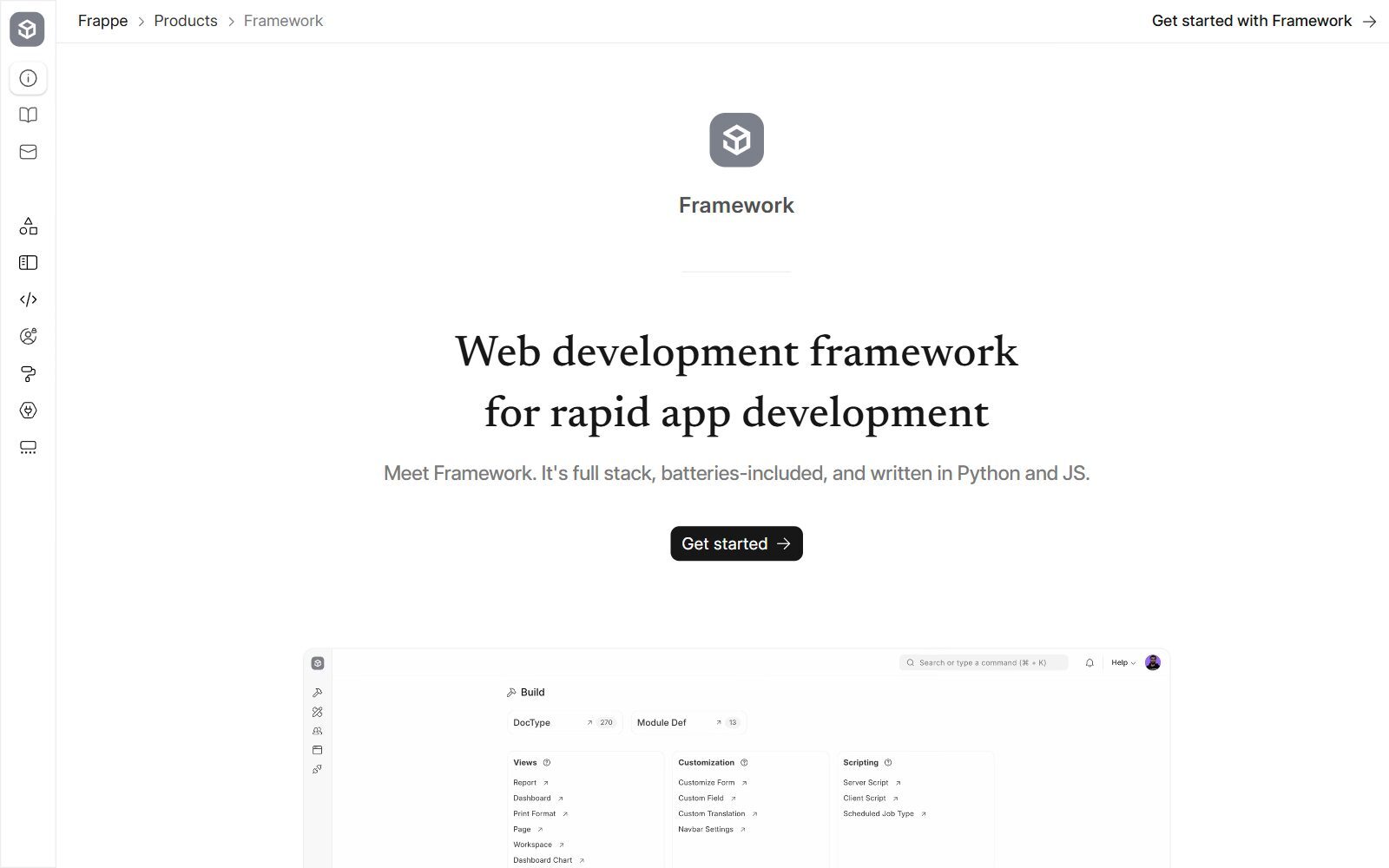
Frappe Framework is a full-stack, batteries-included web framework in Python and JavaScript, and its README calls it a low-code web framework for real-world applications. Everything is built from DocTypes: one DocType is a database table, a form and a class at the same time. Out of the box you get a form builder, list, kanban and calendar views, roles and permissions, a REST API, workflows and reports. It was built for ERPNext, an ERP with more than 700 object types, which shows how far the model scales. The code is MIT-licensed, Frappe Cloud offers managed hosting, and version 16.55 came out in November 2026.
4. Corteza: an open-source Salesforce-style low-code platform
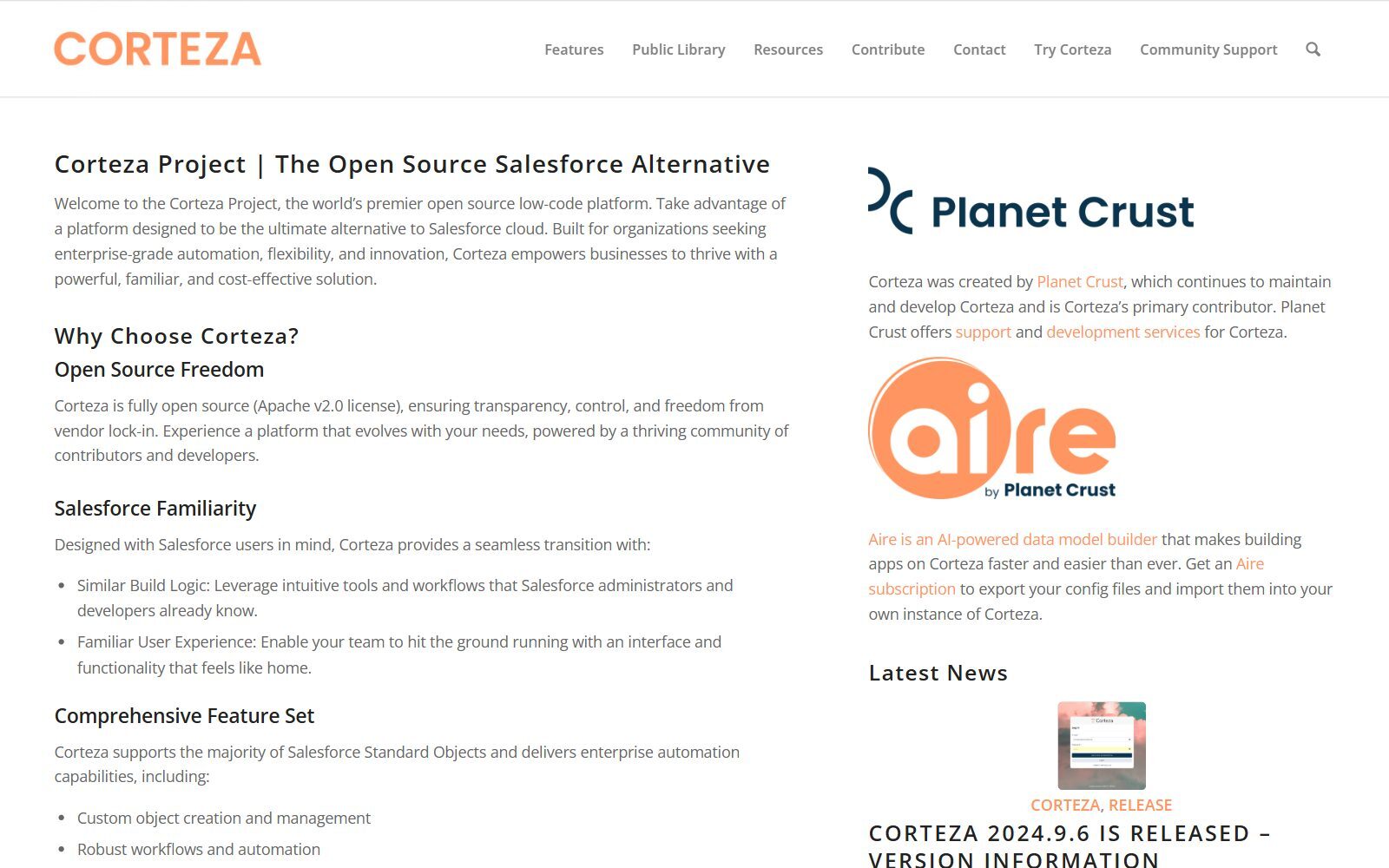
Corteza positions itself as the open-source alternative to Salesforce: a low-code platform where you create unlimited web applications and process workflows with block-based tools, with custom objects and automation for CRM-style business systems. It is fully open source under Apache 2.0. Planet Crust created Corteza and still maintains it, while the project is owned by the Commons Conservancy Foundation. Planet Crust sells support and development services, plus Aire, an AI data model builder that needs a subscription. Release 2026.9.0 came out in October 2026.
Validate your startup idea with the unique borrowed authority approach: we publish articles about your product in our blog and you get traffic and testers for your MVP
- Prove Market Demand: See real organic traffic and waitlist conversions
- Unlock High-Potential Keywords: Receive a curated list of top-performing keywords directly from Google Search Console data.
- Estimate Customer Acquisition Cost (CAC): Gain financial foresight with an estimated CAC based on real keyword performance data.
🔗 Start validating your startup now
5. Budibase: apps and automations for non-developers
Budibase is the friendliest option for teams without developers: internal apps, data tables connected to databases and spreadsheets, and automations for approvals and notifications. Its licence file says Budibase is GPLv3 overall, while paid features live in a separate package under the Business Source License. The free self-hosted open-source plan has 1 workspace with unlimited apps, automations and users. Budibase Cloud starts at $19 a month for the Pro plan. New 3.51 builds were released in November 2026.
6. Appsmith: internal apps on your databases and APIs
Appsmith is a drag-and-drop app builder with JavaScript for logic, connected to databases, SaaS tools and REST or GraphQL APIs. It is open source under the Apache 2.0 licence and can be self-hosted. For a Mendix-style rollout, check where the governance features sit: the free plan has up to 5 cloud users, Google SSO and 3 standard roles; Business ($15 per user per month, up to 99 users) adds workflows, audit logs and custom roles; Enterprise ($2,500 a month for 100 users) adds SAML or OIDC single sign-on, SCIM provisioning and CI/CD. Version 2.6.0 came out in October 2026.
7. ToolJet: AGPL internal apps with an AI app builder
ToolJet generates internal apps from a plain-English description and lets you refine them visually. The code is AGPL-3.0, and you can run the Community Edition on your own infrastructure for free. Its pricing page says workflows, with triggers, agent nodes and run logs, are available on self-hosted installs only. The cloud Free plan has 2 builders, up to 50 end users, 10 apps and 100 AI credits a month, and paid cloud plans start at $23 per builder per month. New builds come out every week; the latest arrived in November 2026.
8. Convertigo: low-code web and mobile apps with a free Community Edition
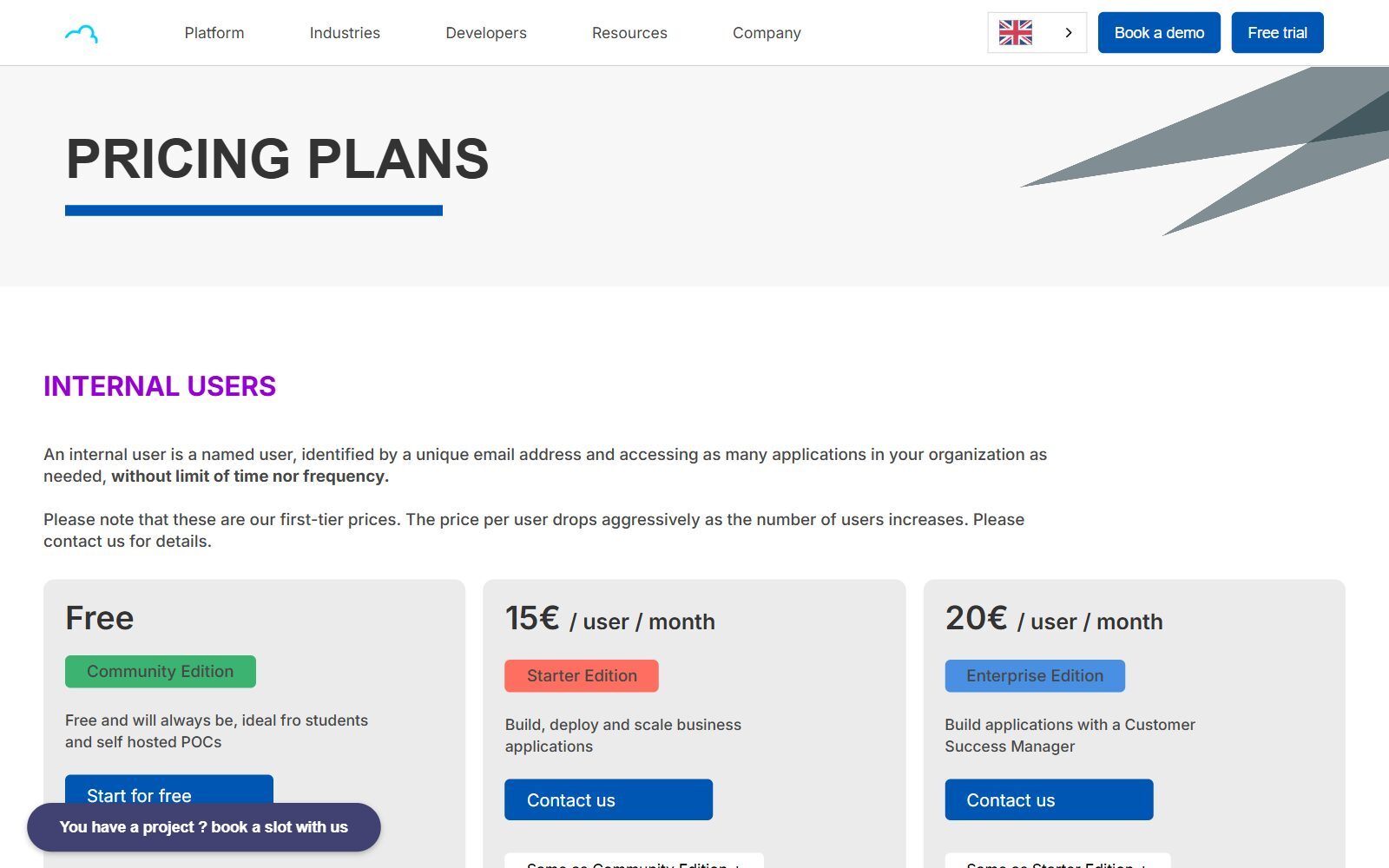
Convertigo calls itself a full-stack platform for no-code and low-code application development, and its source code is AGPL-3.0. The Convertigo pricing page says the Community Edition is free and will always be: you install it on-premises with one environment, unlimited apps and Android, iOS and PWA app generation. The paid editions are priced per internal user per month: Starter at €15 adds the no-code studio, LDAP, OAuth and OpenID sign-in, two environments and offline data, and Enterprise at €20 adds unlimited environments, a customer success manager and RPA and SAP connectors. Convertigo says these are first-tier prices that drop as the user count grows. Version 8.4.6 came out in October 2026.
9. Skyve: enterprise apps declared in metadata
Skyve is an open-source low-code platform for secure, scalable enterprise applications. Instead of generating large amounts of code, you declare an app in concise XML metadata, and the platform enforces security, renders the UI, handles persistence and evolves the database schema at runtime. The Skyve code is LGPL-2.1 and written in Java, and the website promises zero licence cost. For people who do not code, the company sells Skyve Foundry, a point-and-click cloud builder with host-based pricing. Version 9.4.4 came out in September 2026.
10. Saltcorn: a small, MIT-licensed no-code database app builder
Saltcorn is an open-source no-code database application builder (MIT) for web and mobile apps with views, layouts and actions on top of PostgreSQL. It is far smaller than Mendix or Joget, but there is nothing to pay and no user limit. Version 1.6.4 and a 1.7 beta were released in November 2026.
Join ElonaHunt (like ProductHunt but for women) and explore the coolest women-focused startups out there!
Discover your next big inspiration and connect with like-minded female entrepreneurs!
👉 Join the Hunt Here
Mendix Alternatives That Are Discontinued, Changed or Not Open Source
The 2025 version of this article listed ten tools. UI Bakery, NocoDB and Node-RED are no longer on the list, and several platforms that are often suggested as Mendix alternatives do not pass the open-source test:
- UI Bakery: offers a self-hosted edition, but we found no open-source licence for it, so it does not belong on this list.
- NocoDB: an Airtable-style database rather than an app platform, and its licence file (updated January 2026) uses the Sustainable Use License, which is not an open-source licence. Our open-source Airtable alternatives cover database-style tools.
- Node-RED: still active and Apache 2.0, but it is a flow-based tool for wiring devices, APIs and services together, not a business app builder. See our open-source Zapier alternatives for automation tools.
- NocoBase: active and free for unlimited users, but its licence (updated February 2026) adds terms to Apache 2.0 that forbid offering a public no-code, low-code or AI platform service built on it and removing its brand information, so it is not open source in the strict sense.
- Directus: uses the Monospace Sustainable Core License, so it is source-available rather than open source.
- Openblocks and ILLA Builder: Openblocks stopped in 2023 and lives on as Lowcoder (AGPL-3.0). ILLA Builder had its last release in August 2024 and its last code change in May 2025, and its website no longer loads.
- Camunda 8: its core process engine and tools now use the Camunda License 1.0, which is not an open-source licence.
- Bonita: Bonitasoft now trades as Ofelia. The engine code on GitHub is still LGPL-2.1, but the pricing page describes Bonita Free as limited to 150 process instances per month, so check the terms before you build on it.
- Flowable: its process engine is Apache 2.0 and version 8.0.0 came out in February 2026, but it is an engine for Java developers, not a visual app platform.
Which Open-Source Mendix Alternative Should You Choose?
- You want the closest Mendix replacement, with apps and approval workflows: Joget.
- Your team writes Java and wants enterprise apps it fully owns: Jmix, or Skyve if you prefer apps declared in metadata.
- Your team writes Python, or you may run ERPNext later: Frappe Framework.
- You are replacing Salesforce-style custom objects and CRM processes: Corteza.
- Nobody on your team writes code: Budibase, or Saltcorn for something very simple and fully free.
- You need internal apps on existing databases and APIs: Appsmith or ToolJet.
- You also need mobile apps from the same platform: Convertigo.
How Founders Use Open-Source Low-Code Platforms
A startup rarely needs a full enterprise platform on day one. The usual path is one painful process, such as onboarding a customer, approving an expense or handling a support request, turned into a small app with a form, an approval step and a report. Start there, connect it to a copy of your data first, and add more apps once the first one is used every day. Before you pick a platform, read the 8 biggest mistakes when choosing no-code tools, the hidden costs of no-code AI development and the future-proof features every no-code and low-code platform needs. If you are still building the product itself, compare low-code and AI coding tools for prototyping.
Low-code platforms sit next to other self-hosted tools. For admin panels and dashboards on your own database, see our open-source Retool alternatives; for apps built on spreadsheets, the open-source AppSheet alternatives. If you are moving away from Salesforce, compare the open-source Salesforce Einstein alternatives. Frappe users often add ERPNext for accounting: see our open-source QuickBooks alternatives and open-source Zoho Books alternatives. For reports on top of your app data, use one of the open-source Metabase alternatives. Before you build anything, validate your startup idea with real users, and write the help pages for your product with the F/MS AI SEO Tool so customers find them in Google and AI assistants.
FAQ About Open-Source Mendix Alternatives
What is the best open-source alternative to Mendix?
Joget is the closest match: a visual platform for enterprise apps with business process automation and workflow management, and a free GPLv3 Community Edition you can host yourself. Jmix is the strongest choice for Java teams, and Frappe Framework for Python teams.
Is Mendix open source?
No. Mendix is a commercial, closed-source platform. When we checked in November 2026, its Free plan cost €0 and was meant for demos, prototypes and small apps, Standard started at €918 a month for one app, and Premium was priced by quote.
Can I self-host Mendix for free?
No. On the Mendix pricing page, deployment to your own servers, Kubernetes, Azure or SAP BTP is not available in the Free plan and costs extra on the paid plans. Every platform on this list can be self-hosted for free.
Is there an open-source alternative to OutSystems as well?
The same platforms apply. Joget, Jmix, Frappe Framework, Corteza and Skyve are built for full business applications with data models, roles and processes, which is the job OutSystems and Mendix do.
Which open-source low-code platform has built-in workflows?
Joget combines apps with business process workflows in the free Community Edition. Frappe Framework and Corteza also include workflows, Budibase has automations, and ToolJet offers workflows on self-hosted installs. In Appsmith, workflows start on the paid Business plan.
Is NocoBase open source?
Not in the strict sense. Its licence builds on Apache 2.0 but adds terms that forbid offering a public no-code, low-code or AI platform service built on NocoBase and removing its brand information. Its Community Edition is still free for unlimited users and apps.
Is Budibase really free?
Yes. The self-hosted open-source plan is free with 1 workspace and unlimited apps, automations and users. Budibase is GPLv3 overall, and its paid features sit in a separate package under the Business Source License.
What happened to UI Bakery and NocoDB from the old list?
UI Bakery offers a self-hosted edition but no open-source licence, and NocoDB now uses the Sustainable Use License, which is not an open-source licence. NocoDB is also a database with a spreadsheet interface rather than an app platform.
Do I need developers to use these platforms?
For Joget, Corteza, Budibase and Saltcorn, not at the start. Jmix and Skyve are built for Java developers, Frappe Framework works best with someone who knows Python, and Appsmith and ToolJet go further when someone writes JavaScript.
Where can I get a backlink by writing about my startup?
You can publish a guest post in one of the Fe/male Switch startup blogs, which rank in Google and in AI tools. Get a quality backlink.
About the Author
Violetta Bonenkamp, also known as MeanCEO, is an experienced startup founder with an impressive educational background including an MBA and four other higher education degrees. She has over 20 years of work experience across multiple countries, including 5 years as a solopreneur and serial entrepreneur. Throughout her startup experience she has applied for multiple startup grants at the EU level, in the Netherlands and Malta, and her startups received quite a few of those. She’s been living, studying and working in many countries around the globe and her extensive multicultural experience has influenced her immensely.

