

Open-Source Sage Alternatives for Accounting and ERP
Sage sells accounting software for every size of business, from Sage Accounting for small firms to Sage 50, Sage 200, Sage Intacct and the Sage X3 ERP. All of them are subscription or licence products. If you want accounting software you can run on your own computer or server, read the code of and keep using without a subscription, open-source tools cover most of what Sage does. We checked every licence in each project's own LICENSE file and every latest release in its official release feed on 1 November 2026, removed the tools from the 2025 version of this list that are not open source or not accounting software, and clearly labelled the two popular tools whose licences are not open source.
Quick answer: for a sole trader or small company, GnuCash (GPL, desktop) is the simplest free replacement for Sage Accounting. If you need invoicing, stock and a team in the browser, use Frappe Books (AGPLv3) or FrontAccounting (GPL). To replace Sage 200, Sage Intacct or Sage X3 with a full ERP, look at ERPNext (GPLv3), Dolibarr (GPLv3+), Tryton (GPLv3) or iDempiere (GPLv2). Odoo Community is open source, but the full Accounting app is Enterprise only. Akaunting and Invoice Ninja publish their code but are not open source.
Boost Your SEO by Getting Featured in Our Blogs and get a backlink.
We publish content about startups, education, tech, funding, etc. that ranks well not only in Google but also in Perplexity, ChatGPT, Grok and other AI tools.
👉 Get featured now!
What Sage Sells in 2027
On the Sage UK website, the small-business products are Sage Accounting, Sage Sole Trader, Sage Payroll, Sage HR, Sage 50 Accounts and Sage 50 Payroll; for medium-sized businesses Sage lists Sage Intacct, Sage 200, Sage X3 and Sage People. The Sage US website adds Sage 100, Sage 300 and Brightpearl by Sage. The Sage Accounting page (UK, default view) lists three plans: Start for 1 user at £20 a month, Standard for 3 users at £43 and Plus for unlimited users at £59, excluding VAT, after an introductory offer of 90% off for six months. All three now include Sage Payroll and the Sage Copilot assistant.
That is good value if you want a supported cloud product. The open-source tools below trade that support for control: you own the data and the code, and you pay only for hosting or for a partner if you want help. Before you switch, check that the tool you pick handles your country's tax filing and e-invoicing rules, because that is where Sage's local editions are strongest.
Open-Source Sage Alternatives Compared
Sources: each project's LICENSE file, official website and GitHub release feed, checked 1 November 2026. Sage plans and prices from sage.com, default view.
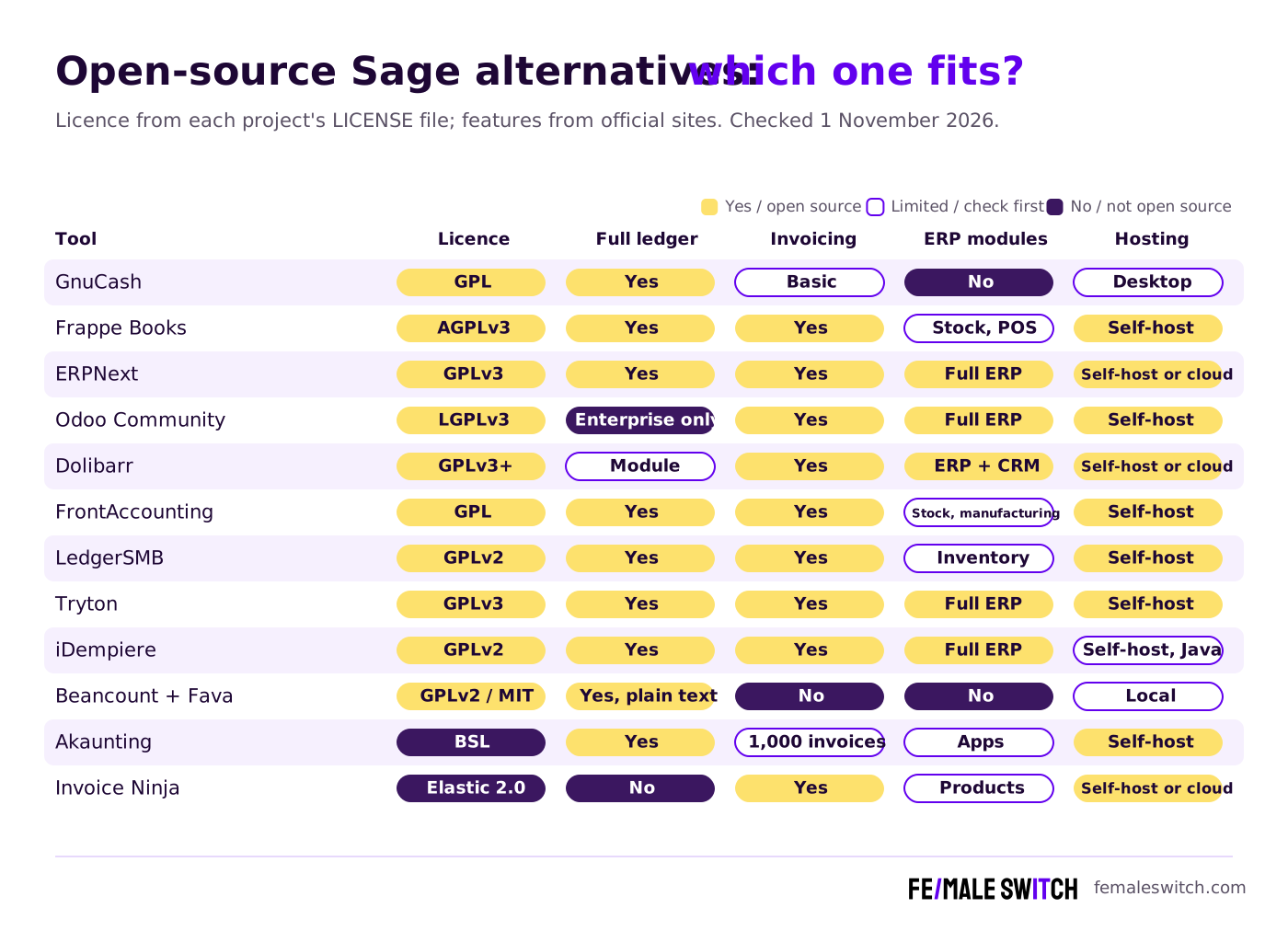
The Best Open-Source Sage Alternatives in 2027
1. GnuCash: free double-entry accounting on your computer
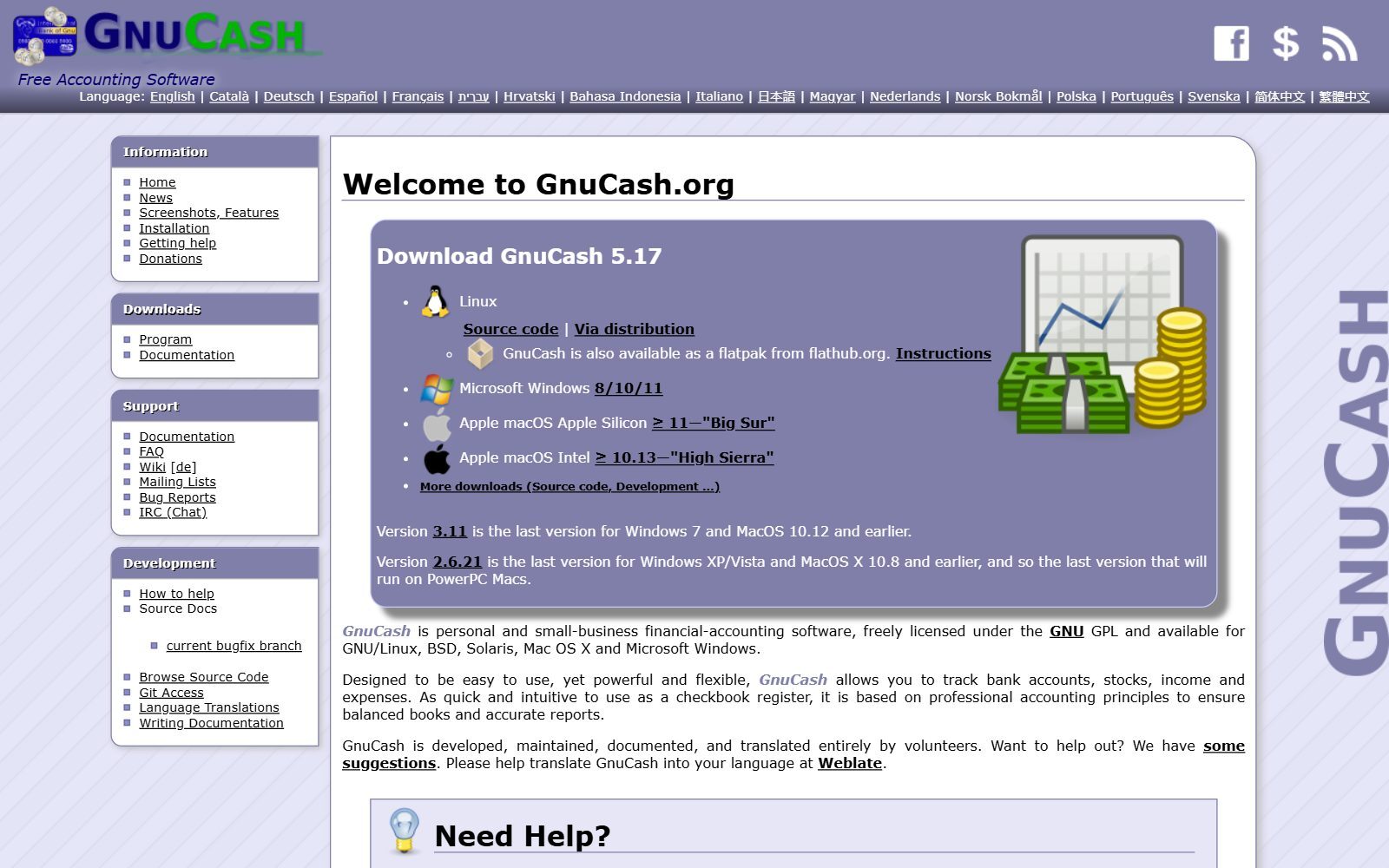
GnuCash is personal and small-business accounting software that runs on Linux, BSD, macOS and Windows. Its LICENSE file puts almost all of the code under the GNU GPL version 2 or, at your option, version 3. It is based on professional double-entry principles and tracks bank accounts, stocks, income and expenses, with small-business features for customers and vendors, jobs, invoicing, bill payment and tax terms. Volunteers develop it, and version 5.17 came out in September 2026. GnuCash is the closest open-source match for Sage Accounting Start or Sage Sole Trader: one person, one set of books, no subscription. It saves to a file on your computer, so there are no built-in bank feeds or online payments.
2. Frappe Books: modern open-source accounting, now on your own server
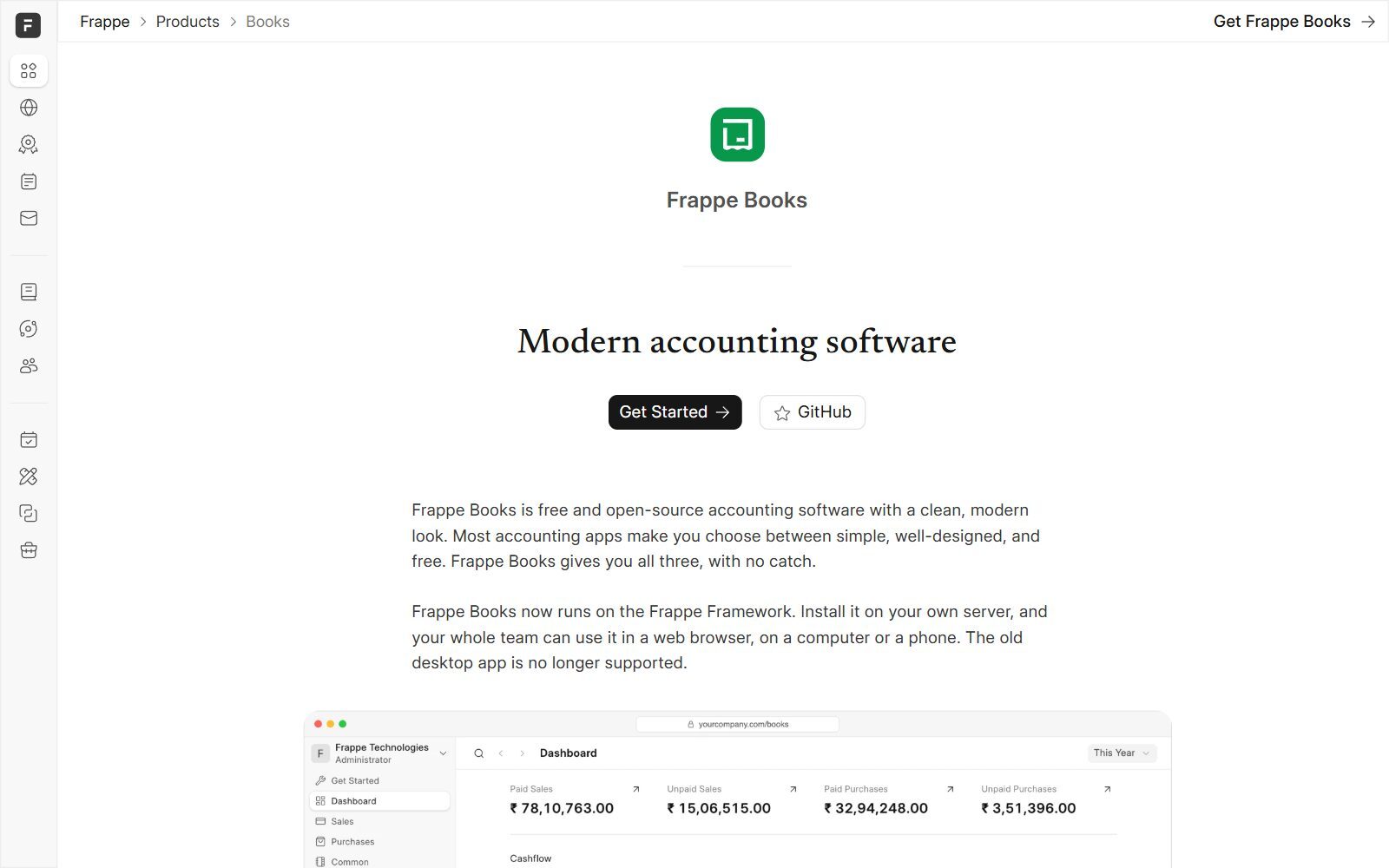
Frappe Books is free and open-source accounting software from Frappe, the company behind ERPNext. It changed a lot in the past year: Frappe Books now runs on the Frappe Framework, you install it on your own server, and your team uses it in a browser on a computer or phone. Frappe says the old desktop app is no longer supported. You can send quotes and turn them into invoices, record payments, bills and returns, manage price lists and discounts, keep stock with batches and serial numbers, sell at a point of sale, and read the profit and loss, balance sheet, general ledger and trial balance, with a ready-made chart of accounts for your country. The new frappe-books repository is licensed under the AGPLv3, and version 16.1.0 was released on 30 October 2026.
3. ERPNext: a full open-source ERP instead of Sage 200 or Sage Intacct
ERPNext is an open-source ERP licensed under the GNU GPLv3. Frappe describes it as 100% open source with no features behind a paywall, and says more than 30,000 companies use it. Accounting covers multiple subsidiaries and currencies, the general ledger, payables and receivables, financial statements, fixed assets and tax; around it sit procurement, sales, CRM, stock, manufacturing, projects, point of sale, HR and payroll. Version 16 is current (v16.53.0 came out on 28 October 2026) and version 15 still gets fixes. You can self-host it or start a hosted trial on Frappe Cloud. Choose ERPNext when you are outgrowing Sage 50 and would otherwise look at Sage 200, Sage Intacct or Sage X3.
4. Odoo Community: open-source ERP, but full accounting is paid
Odoo Community is published under the LGPLv3 licence. The Odoo editions comparison shows what that edition covers: Invoicing, Payments and Expenses are in Community, while the Accounting app with the general ledger, bank reconciliation, analytic accounting, budgets, consolidation and reports is Enterprise only, as is the mobile app. On the Odoo pricing page you can also use one app online for free (One App Free, unlimited users); all apps together are a paid per-user plan. The 2025 version of this list called it "Odoo Accounting"; that app is not open source. Odoo Community makes sense if you want its CRM, sales, inventory or website apps and keep the books in Invoicing or with an accountant.
5. Dolibarr: modular open-source ERP and CRM
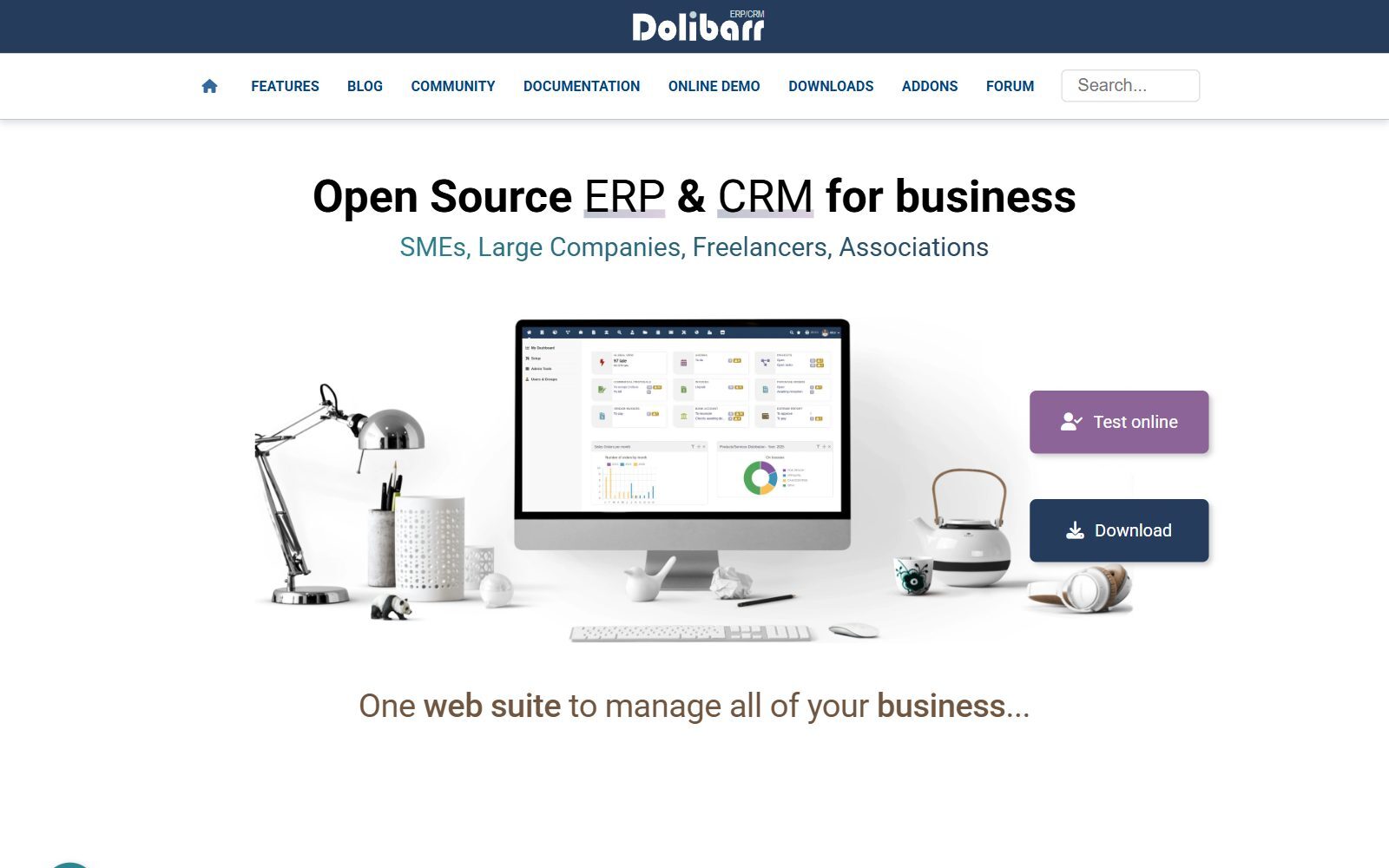
Dolibarr is an open-source ERP and CRM for small and large companies, freelancers and associations. Its README states the GNU GPL version 3 or any later version. You switch on only the modules you need, from customers, proposals and sales orders to billing and payments, bank reconciliation, double-entry accounting, stock, manufacturing, projects, HR and point of sale, and add more from its marketplace. You can install it on your own computer or server or use it as a hosted service. Version 24.0.2 came out in October 2026. Dolibarr suits a small business that would otherwise pair Sage 50 with a separate CRM.
Validate your startup idea with the unique borrowed authority approach: we publish articles about your product in our blog and you get traffic and testers for your MVP
- Prove Market Demand: See real organic traffic and waitlist conversions
- Unlock High-Potential Keywords: Receive a curated list of top-performing keywords directly from Google Search Console data.
- Estimate Customer Acquisition Cost (CAC): Gain financial foresight with an estimated CAC based on real keyword performance data.
🔗 Start validating your startup now
6. FrontAccounting: web-based accounting for small companies
FrontAccounting is web-based accounting and ERP for small companies, free and released under the GNU General Public License. It covers the whole chain: purchase orders, supplier invoices and payments, sales orders and customer invoices, inventory, manufacturing, fixed assets, dimensions for cost centres and projects, and a general ledger with budgets, in several languages, currencies and companies. A non-profit team maintains it; release 2.4.20 came out on 28 April 2026. It is a good open-source match for Sage 50 Accounts if you want it in the browser.
7. LedgerSMB: accounting and ERP for small and mid-size businesses
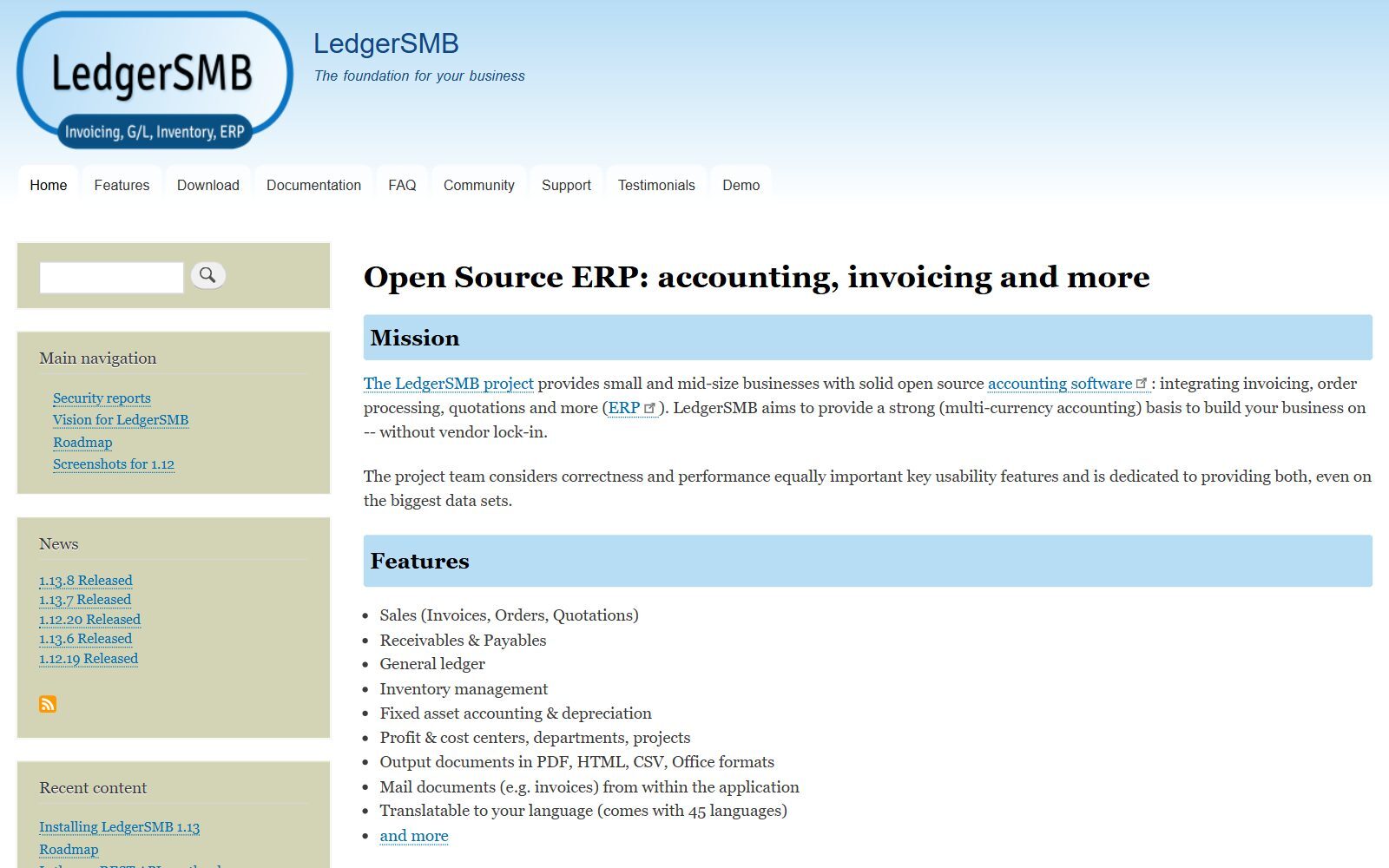
LedgerSMB provides open-source accounting for small and mid-size businesses, with invoicing, orders and quotations, receivables and payables, a general ledger, inventory, fixed asset depreciation, profit and cost centres, and output in PDF, HTML, CSV and Office formats; it comes in 45 languages. Its licence is the GNU GPL version 2. The project maintains two stable lines (1.13 and 1.12), and 1.13.8 came out in September 2026. It runs on a server with a PostgreSQL database, so it suits a business with some technical help.
8. Tryton: modular business software with long-term support
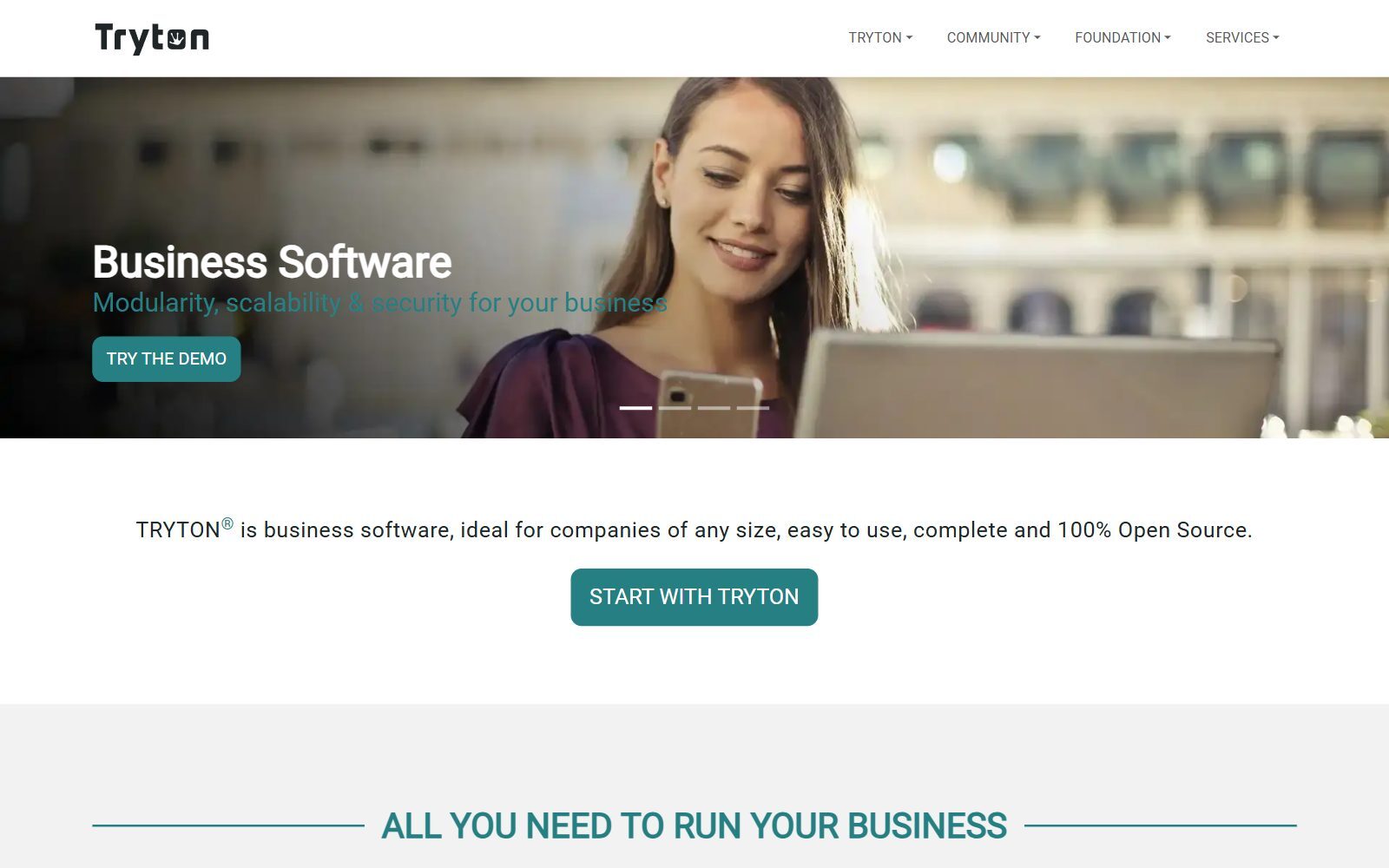
Tryton calls itself complete and 100% open-source business software; its server is licensed under the GNU GPLv3. Modules cover financial and analytic accounting, sales, purchasing, inventory, CRM, manufacturing, shipping, projects and subscription invoicing. A new series comes out every six months and is supported for a year, while new major versions get five years of long-term support; the 8.2 release was announced in October 2026. A foundation and a network of service providers stand behind it. Tryton is a strong choice to replace Sage 200 or Sage X3 if you have a partner or developer to set it up.
9. iDempiere: community ERP for multi-company accounting
iDempiere is an open-source ERP, CRM and supply-chain system founded in 2011 and run by its community. It has an enterprise-grade accounting system and supports several sets of books inside a single login, which suits groups with more than one company. It is built on Java with PostgreSQL or Oracle, its licence is the GNU GPL version 2, and iDempiere 13 LTS is the current release on its homepage. It is a heavier system, comparable to Sage X3, and you will want an implementation partner.
10. Beancount and Fava: accounting in plain text
Beancount is double-entry accounting from text files: you write transactions in a plain-text ledger and Beancount checks and reports on them. It is licensed under the GNU GPL version 2, and version 3.2.3 came out in May 2026. Fava adds a web interface for browsing and reporting on your Beancount ledger; it is MIT-licensed and version 1.30.16 came out in August 2026. This pair suits technical freelancers and founders who want version-controlled books; it has no invoicing, so it replaces Sage only for bookkeeping.
Source-Available Tools That Are Not Open Source
Two tools often appear in open-source Sage lists, but their licences do not meet the open-source definition. Akaunting publishes its code under the Business Source License: you may use it in production only with up to two users, one company and 1,000 invoices, you may not white-label it or offer it as an accounting service to others, and each version converts to GPLv3 four years after release. Version 3.3.0 came out in October 2026. Invoice Ninja uses the Elastic License 2.0; its hosted Free plan covers 5 clients, and Pro with unlimited clients costs $14 a month. Both are useful, but treat them as free-to-use products, not open source.
Removed or Changed Since the 2025 Version
- OpenPro ERP: removed. It is a commercial ERP sold with a purchase price; the site says it is built using open-source technology, but we found no public source code or open-source licence.
- Open Accounting: removed. Its site offers a free tier only for single-user personal use, multi-user is a paid subscription, and its server code has had no commits since September 2023.
- TurboCASH: removed. The old link no longer answers, the current site describes a freemium package with a paid subscription, and we could not confirm the licence of the current version.
- Formance and SplitPro: removed. Both are active open-source projects, but Formance is money-movement infrastructure for fintech developers and SplitPro is an expense-splitting app, not accounting software that replaces Sage.
- Frappe Books: the desktop app has reached end of life; Frappe Books now runs on your own server and is used in the browser.
- Odoo: the old "Odoo Accounting" entry is now Odoo Community, because the Accounting app is Enterprise only.
- Added: Dolibarr, LedgerSMB, Tryton, iDempiere and Beancount with Fava; Akaunting and Invoice Ninja are listed separately as not open source.
Which Open-Source Sage Alternative Should You Choose?
- You use Sage Accounting Start or Sage Sole Trader: GnuCash on your own computer, or Beancount with Fava if you like plain text.
- You use Sage Accounting Standard or Plus with a small team: Frappe Books or FrontAccounting in the browser.
- You use Sage 50 and also need a CRM: Dolibarr, or LedgerSMB for a strong accounting core.
- You are moving up to Sage 200, Sage Intacct or Sage X3: ERPNext first; Tryton or iDempiere if you have a partner.
- You want Odoo's apps: Odoo Community for CRM, sales and inventory, with Invoicing; budget for Enterprise if you need full accounting.
- You only need invoices and can live with a non-open licence: Invoice Ninja (5 free clients) or Akaunting (up to 2 users and 1,000 invoices).
How Founders Use Open-Source Accounting
Most founders do not need an ERP in year one. They need to send invoices, get paid, keep every income and expense in one place and hand clean books to an accountant. Start with how to set up estimates and invoices for service firms and Mean CEO's bookkeeping basics for founders. If a hosted free plan is enough, compare our free Zoho Books alternatives. Check your country's rules before you choose a tool: the UK, for example, is moving to mandatory e-invoicing, explained in UK e-invoicing: what founders must do.
Open-source accounting works best next to other open-source tools. Track spending with our open-source Expensify alternatives, take payments with the open-source Stripe alternatives, keep customers and orders in one of the open-source Airtable alternatives and connect them with open-source Zapier alternatives. When you start hiring, the open-source applicant tracking systems guide covers recruiting, and keep an eye on cash flow during rapid growth.
Join ElonaHunt (like ProductHunt but for women) and explore the coolest women-focused startups out there!
Discover your next big inspiration and connect with like-minded female entrepreneurs!
👉 Join the Hunt Here
FAQ About Open-Source Sage Alternatives
Is there an open-source version of Sage?
No. Sage Accounting, Sage 50, Sage 200, Sage Intacct and Sage X3 are all commercial products. Open-source replacements include GnuCash, Frappe Books, ERPNext, Dolibarr, FrontAccounting, LedgerSMB, Tryton and iDempiere.
What is the best free open-source alternative to Sage for a small business?
GnuCash for one person on a computer, and Frappe Books or FrontAccounting if a small team needs invoicing and stock in the browser. All three are free under GPL-family licences.
Which open-source ERP can replace Sage 200 or Sage Intacct?
ERPNext is the most complete: accounting with multi-company and multi-currency support, plus procurement, sales, stock, manufacturing, projects, HR and payroll under the GPLv3. Tryton and iDempiere are strong alternatives with a partner.
Is Odoo open source?
Odoo Community is open source under the LGPLv3 and includes Invoicing, Payments and Expenses. The full Accounting app (general ledger, bank reconciliation, budgets, reports) is only in the paid Enterprise edition.
Is Akaunting open source?
Not any more in the OSI sense. Akaunting uses the Business Source License, which allows production use with up to two users, one company and 1,000 invoices; each version becomes GPLv3 four years after release.
Is Frappe Books still a desktop app?
No. Frappe says Frappe Books now runs on the Frappe Framework on your own server and is used in a browser on a computer or phone; the old desktop app is no longer supported.
Can open-source accounting software file my taxes?
It depends on the tool and the country. Some have country charts of accounts and tax reports, but check that the tool supports your tax returns and e-invoicing rules, or work with an accountant who accepts its exports.
How much does Sage Accounting cost in the UK?
On Sage's UK page, Start costs £20 a month for 1 user, Standard £43 for 3 users and Plus £59 for unlimited users, excluding VAT, after an introductory discount. Payroll and Sage Copilot are included.
Where can I get a backlink by writing about my startup?
You can publish a guest post in one of the Fe/male Switch startup blogs, which rank in Google and in AI tools. Get a quality backlink.
About the Author
Violetta Bonenkamp, also known as MeanCEO, is an experienced startup founder with an impressive educational background including an MBA and four other higher education degrees. She has over 20 years of work experience across multiple countries, including 5 years as a solopreneur and serial entrepreneur. Throughout her startup experience she has applied for multiple startup grants at the EU level, in the Netherlands and Malta, and her startups received quite a few of those. She’s been living, studying and working in many countries around the globe and her extensive multicultural experience has influenced her immensely.

