

TL;DR: Startup Communities summary in one paragraph: Brad Feld's 2012 book argues that a thriving startup scene is led by entrepreneurs, with governments, universities and investors in a supporting role, and that it takes a long-term commitment, an open door for anyone who wants to join and a steady rhythm of activities. He called this the Boulder Thesis, after the Colorado city where he lived and invested. The core still holds in 2026, but much of a community now lives online and many ecosystem programmes are run by the "feeders" Feld warned about. Below you'll find a 2012-vs-2026 table, a community health checklist, a copyable meetup starter plan and a 30-day plan for one founder.
Startup Communities is the book people quote whenever a city asks "how do we become the next Silicon Valley?". Brad Feld, a Boulder-based investor who co-founded Foundry Group, Mobius Venture Capital and the accelerator Techstars, published it with Wiley in 2012. Wiley released a revised second edition in 2020, and the same year Feld and Ian Hathaway published a follow-up, The Startup Community Way.
Most summaries of the book are written for mayors, universities and economic development officers. This review is written for the person Feld says should actually lead: you, the founder. What does the Boulder Thesis ask of one entrepreneur in a small or mid-sized city in 2026, and what is the smallest useful thing you can start next month?
Startup Communities summary in five ideas

- Entrepreneurs must lead. Feld splits a community into leaders and feeders. Leaders are entrepreneurs. Feeders are everyone else who helps: government, universities, investors, mentors, service providers and large companies. Trouble starts when feeders try to run the show.
- Leaders commit for the long term. Feld talks about a horizon of roughly 20 years. A community built around one grant cycle, one event series or one hot funding year fades when that money or mood is gone.
- The community is open to anyone who wants in. No membership committee, no gatekeeping by age, background or sector. Newcomers, students, people who moved to town last month and founders who failed last year all count.
- Something happens all the time. Feld insists on continual activities that involve the whole "entrepreneurial stack": first-time founders, experienced operators, investors, students and supporters. Momentum comes from frequency: a small event every month beats one big annual conference.
- Give before you get. The culture Feld describes is generous and non-zero-sum: help others first, make introductions without asking what's in it for you, mentor freely and accept that experiments will fail.
📘 Free e-book: Startup Idea Validation the Right Way. Before you market or build anything, make sure people want it. Violetta Bonenkamp's free e-book shows first-time founders how to test demand with minimal resources, track the metrics that matter and reach their first customers without giving away equity, with downloadable templates and checklists. Read about the book and get your free copy →
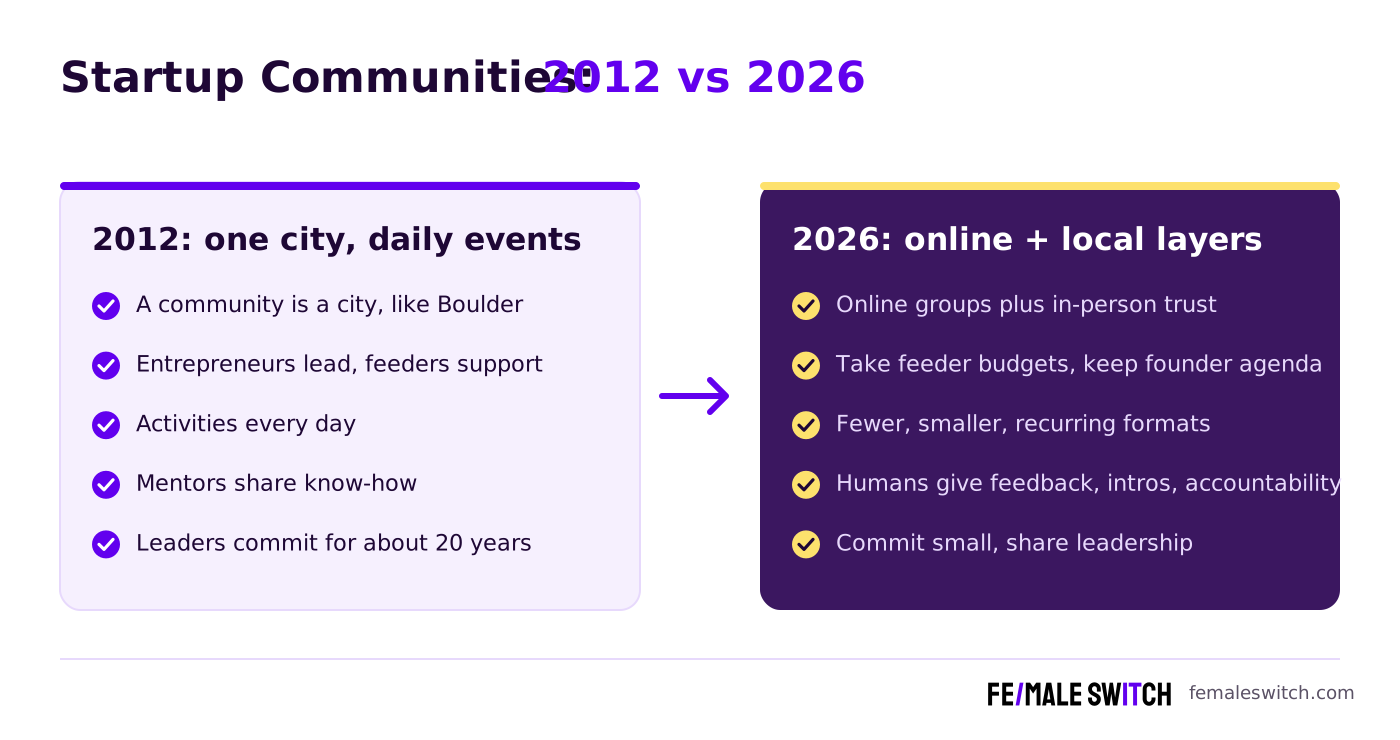
The 2020 second edition adds more on universities, large companies and rural communities. The sequel describes startup communities as complex adaptive systems: you can't plan them top-down, you can only create conditions and let them grow.
What still holds and what aged: 2012 vs 2026
The leaders-and-feeders idea has aged well. Steve Blank called the book a must-read in 2012, though he thought some of Feld's claims about the limited role of venture capital, universities and government might be too broad, and he pointed to programmes such as the NSF Innovation Corps. Others noted that the book leans heavily on one city. Here's how the main ideas look for a founder today.
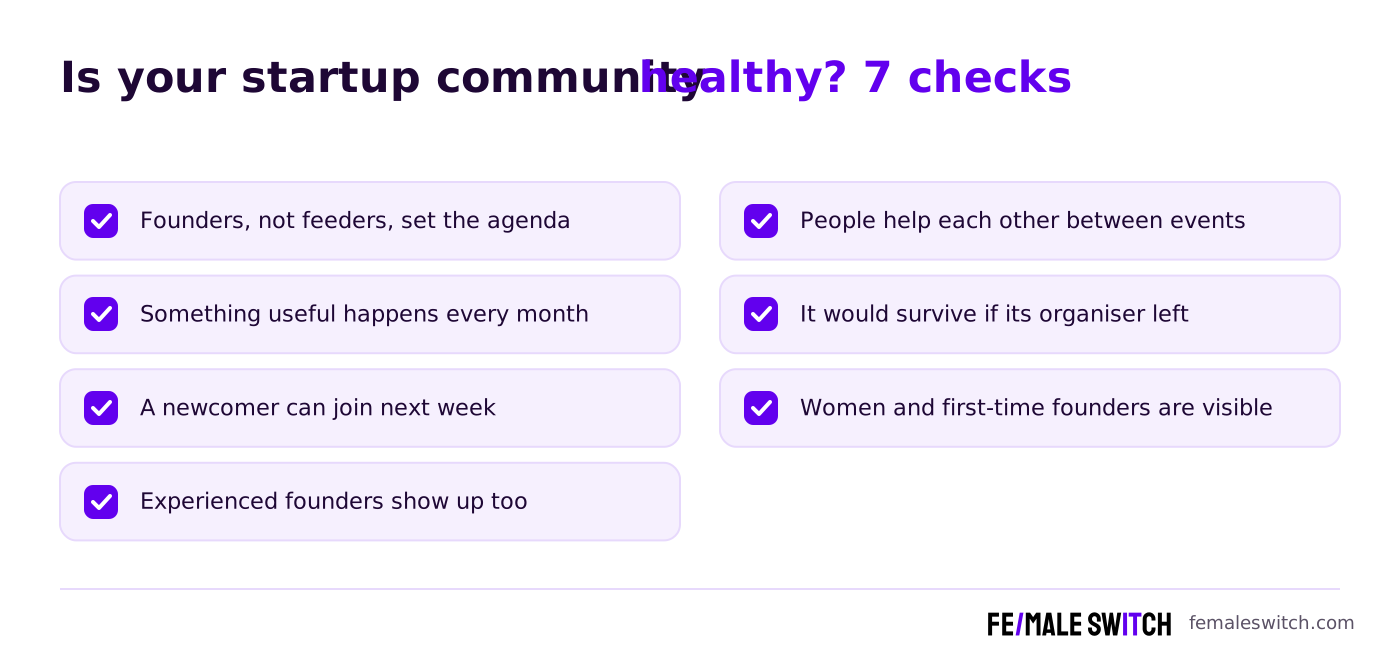
Is your startup community healthy? A diagnosis checklist
Before you start something new, look at what already exists. Run through these questions for your town or your online group. Three or more "no" answers mean there's a gap you could fill.
- Who leads? If the main events are organised by a city department, a bank or a university, and no founder has a say, the community is feeder-led.
- Is there something every month? One annual startup week doesn't count. Look for a recurring meetup, demo night or co-working day.
- Can a newcomer join next week? If you need an invitation, a fee or the right job title, the door is closed.
- Do experienced founders show up? A community of only first-timers repeats the same mistakes. A community of only veterans scares beginners away.
- Do people help each other between events? A chat group where questions get answered within a day is a good sign.
- Would it survive if its organiser left? One heroic organiser is a single point of failure.
- Are women and first-time founders visible? Look for them on stage and in the organising group as well as in the audience.
How one founder can start: a meetup starter plan
You don't need a city budget to apply Feld's book. You need a small, recurring format and two or three co-hosts. Copy this plan and fill it in.
Keep it boring and reliable: in Feld's Boulder story, the magic is that something useful happened week after week, for years.
A worked founder example
Imagine a first-time founder building a small bookkeeping tool for freelancers in a mid-sized city with a university but no accelerator. A yearly startup award and occasional agency workshops are all there is: feeder-led, nothing monthly.
Instead of waiting, she asks two other founders she met at a workshop to co-host a monthly founder breakfast. The chamber gives them a meeting room for free; the founders set the agenda. They open a chat group and invite students from the university's entrepreneurship course. After three months, a dozen people come regularly, two of them found their first customers through intros at the table, and the regional agency asks the group to help shape its next workshop.
She didn't write an ecosystem strategy or wait for funding. She started small, kept it open and kept it going.
A 30-day plan to apply Startup Communities
- Week 1: map. List every startup event, group and person you know in your area, online and offline. Mark each one as leader-run or feeder-run.
- Week 2: recruit. Ask two or three founders to co-host. Pick one format from the starter plan and a fixed date.
- Week 3: host. Run the first meeting with six to ten people. End with the give-first round: one intro or one hour of help from each person.
- Week 4: repeat and hand over. Set the next three dates, open the chat group and give each co-host one clear job. Ask a feeder for a room or coffee, and keep the agenda with the founders.
If you want to practise building a startup with a team before you build a community around it, our startup game with an AI co-founder takes you through the first steps of a real business.
Who should read Startup Communities (and who can skip it)
Read it if you want to organise founders in your town, you work for a programme that supports startups, or you keep wondering why your region's ecosystem events feel empty.
Skim or skip it if you need help with your own company first. The book is about building the community and says little about validating an idea or finding customers. Read this summary, then spend your time on books about building the business itself, such as The Lean Startup or, if you're starting with little money, The Bootstrap AI Revolution.
Related startup books for founders
- Startup Mixology: Tech Cocktail's guide to building and celebrating startups, from a team that ran startup events in many cities.
- The Lean Startup: the experiment-first method your community's founders will keep discussing over breakfast.
- Lean In: on why women need seats at the table, useful when you check who is missing from your community.
- Jab, Jab, Jab, Right Hook: the give-first idea applied to social media, close in spirit to Feld's culture of generosity.
- Free Bootstrapping with AI Guide: build and test a startup without outside funding.
FAQ
What is the main idea of Startup Communities by Brad Feld?
A strong startup community is led by entrepreneurs, while governments, universities, investors and companies support it as feeders. It needs leaders with a long-term commitment, an open door for anyone who wants to take part and a constant flow of activities that bring the whole community together.
What is the Boulder Thesis?
The Boulder Thesis is Feld's four-part framework from the book: entrepreneurs must lead the startup community, the leaders must commit for the long term, the community must be inclusive of anyone who wants to join, and it needs continual activities that engage the entire entrepreneurial stack.
What are leaders and feeders in a startup community?
Leaders are the entrepreneurs who start companies and drive the community. Feeders are everyone who supports them: government, universities, investors, mentors, service providers and large companies. Feeders matter, but Feld argues that a community goes wrong when they try to lead it.
Is Startup Communities still relevant in 2026?
Yes, for its core: founder leadership, long-term commitment and openness. What aged is the focus on one physical city and on daily events. Today a community usually mixes online groups with smaller, recurring in-person formats.
What is the difference between Startup Communities and The Startup Community Way?
Startup Communities (2012, revised in 2020) introduces the Boulder Thesis and the leaders-and-feeders model. The Startup Community Way (2020), written by Brad Feld with Ian Hathaway, builds on it and explains startup communities as complex adaptive systems that can't be controlled from the top down.
How can one founder start a startup community in a small city?
Start one small, recurring format, such as a monthly founder breakfast, with two or three co-hosts. Keep it open, add a chat group and ask local organisations for rooms while founders keep the agenda.
About the Author
Violetta Bonenkamp, also known as MeanCEO, is an experienced startup founder with an impressive educational background including an MBA and four other higher education degrees. She has over 20 years of work experience across multiple countries, including 5 years as a solopreneur and serial entrepreneur. Throughout her startup experience she has applied for multiple startup grants at the EU level, in the Netherlands and Malta, and her startups received quite a few of those. She’s been living, studying and working in many countries around the globe and her extensive multicultural experience has influenced her immensely.

