

Open-Source Asana Alternatives: Self-Hosted Project Management With Timelines, Boards and No Per-Seat Bill
Asana is not open source, and it cannot be self-hosted: its pricing page lists only cloud plans, the free one is for one or two people, and the timeline, Gantt chart, goals and portfolios that make Asana useful for a growing team sit behind paid seats. An open-source project management tool gives you the code, lets you run it on your own server and keeps your project data with you. We checked every tool below on its official website and GitHub on 10 November 2026: the exact licence, the latest release, what the free option includes and how close it gets to Asana's list, board and timeline way of working. Three tools from the earlier version of this list are no longer maintained or no longer open source; they are in a separate section.
Quick answer: the closest open-source match to Asana is OpenProject (GPL-3.0): Gantt charts, agile boards, a team planner and time tracking, with a free Community edition for unlimited users. Plane (AGPL-3.0) is the most modern alternative and has a free cloud plan for 12 users, Leantime (AGPL-3.0) suits founders who are not trained project managers, and Vikunja is the lightest self-hosted task manager with a Gantt view. Agencies should look at Worklenz, agile software teams at Taiga, and teams that also want chat and docs in one place at Huly.
Boost Your SEO by Getting Featured in Our Blogs and get a backlink.
We publish content about startups, education, tech, funding, etc. that ranks well not only in Google but also in Perplexity, ChatGPT, Grok and other AI tools.
👉 Get featured now!
What Asana Offers and Costs in 2027
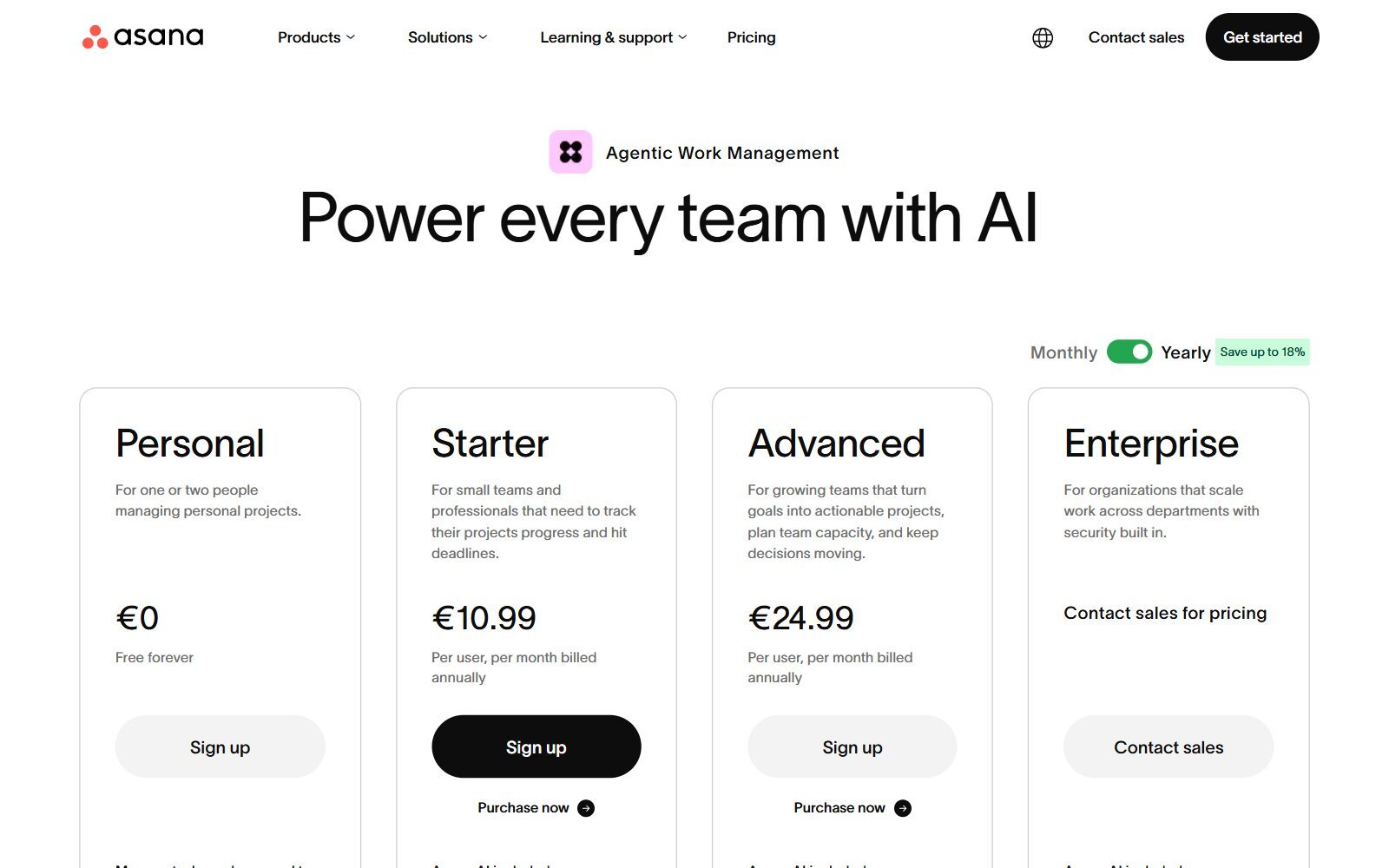
To know what you are replacing: the Asana pricing page (checked November 2026, yearly billing is the default view; from Europe the same numbers are shown in euros) lists four plans. Personal is free forever "for one or two people": 2 users, unlimited tasks and projects, list, board and calendar views, unlimited storage with a 100 MB file limit, and status updates. Starter costs $10.99 per user per month billed annually and removes the seat limit; it adds timeline and Gantt views, reporting dashboards, unlimited automations, forms, custom fields and unlimited free guests. Advanced costs $24.99 per user per month billed annually and adds portfolios, goals, resource management, approvals and proofing, and native time tracking. Enterprise is priced on request. Every paid plan now includes a monthly allowance of Asana AI requests and credits.
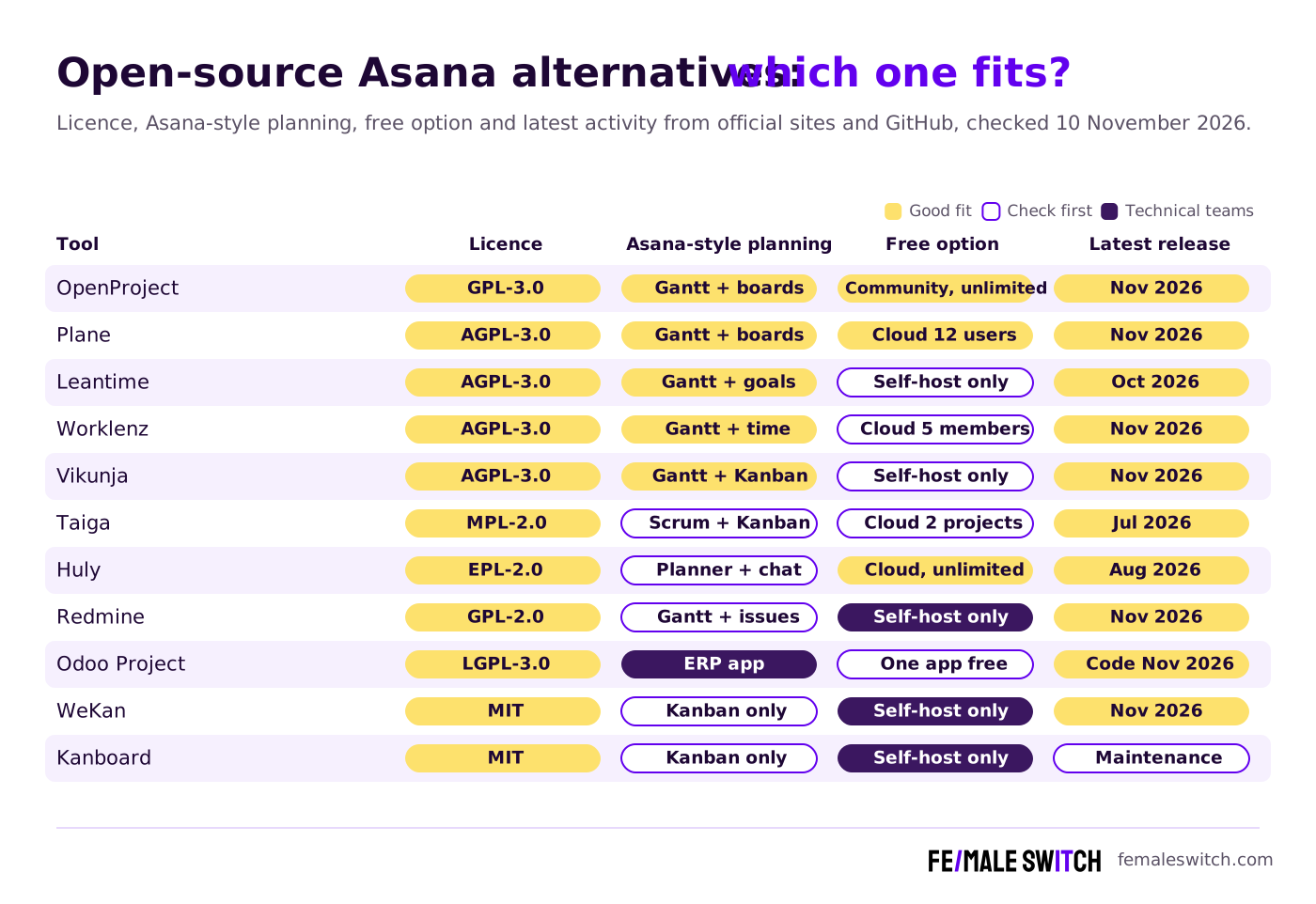
Open-Source Asana Alternatives Compared
Sources: each project's official website, pricing page (default view), LICENSE file and GitHub releases, checked 10 November 2026. Self-hosting is free in licence fees, but you pay for the server and your own time.
The Best Open-Source Asana Alternatives in 2027
1. OpenProject: the closest open-source match to Asana
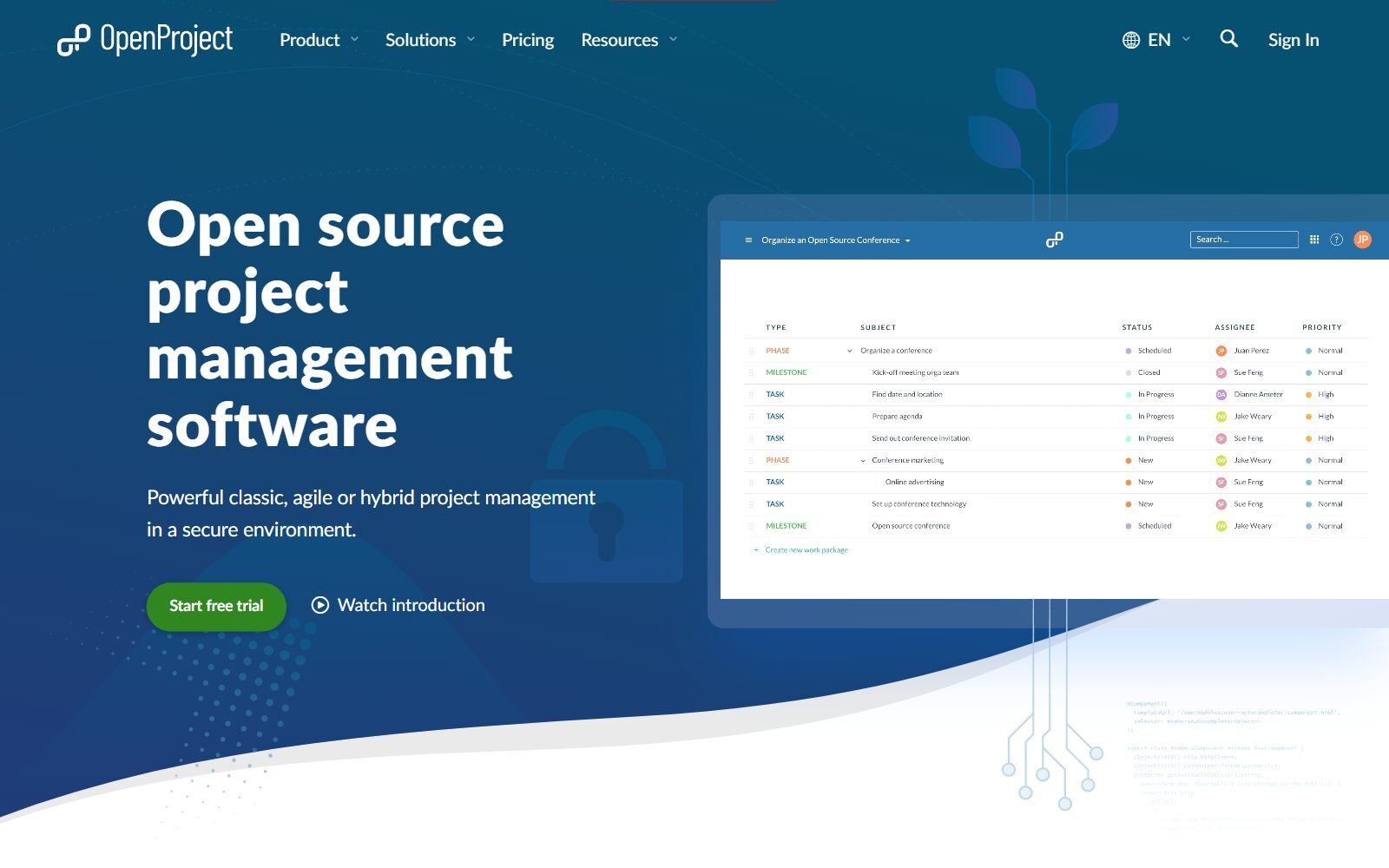
OpenProject covers what most teams use Asana for: projects broken into tasks and milestones, Gantt charts for the plan, agile boards for Scrum or Kanban, a team planner to see who works on what, time tracking with cost reporting and budgets, and meeting management. The project says it is licensed under the GNU GPL v3, and its Community edition is free of charge with unlimited users and projects, installed on Linux or with Docker. If you prefer a hosted service, the OpenProject pricing page lists the Community edition as free with no minimum users and Basic at €5.95 per user per month, with 14-day trials of the Enterprise cloud or an on-premises trial key. Version 17.9.7 came out on 9 November 2026.
2. Plane: a modern Asana alternative with a free cloud plan
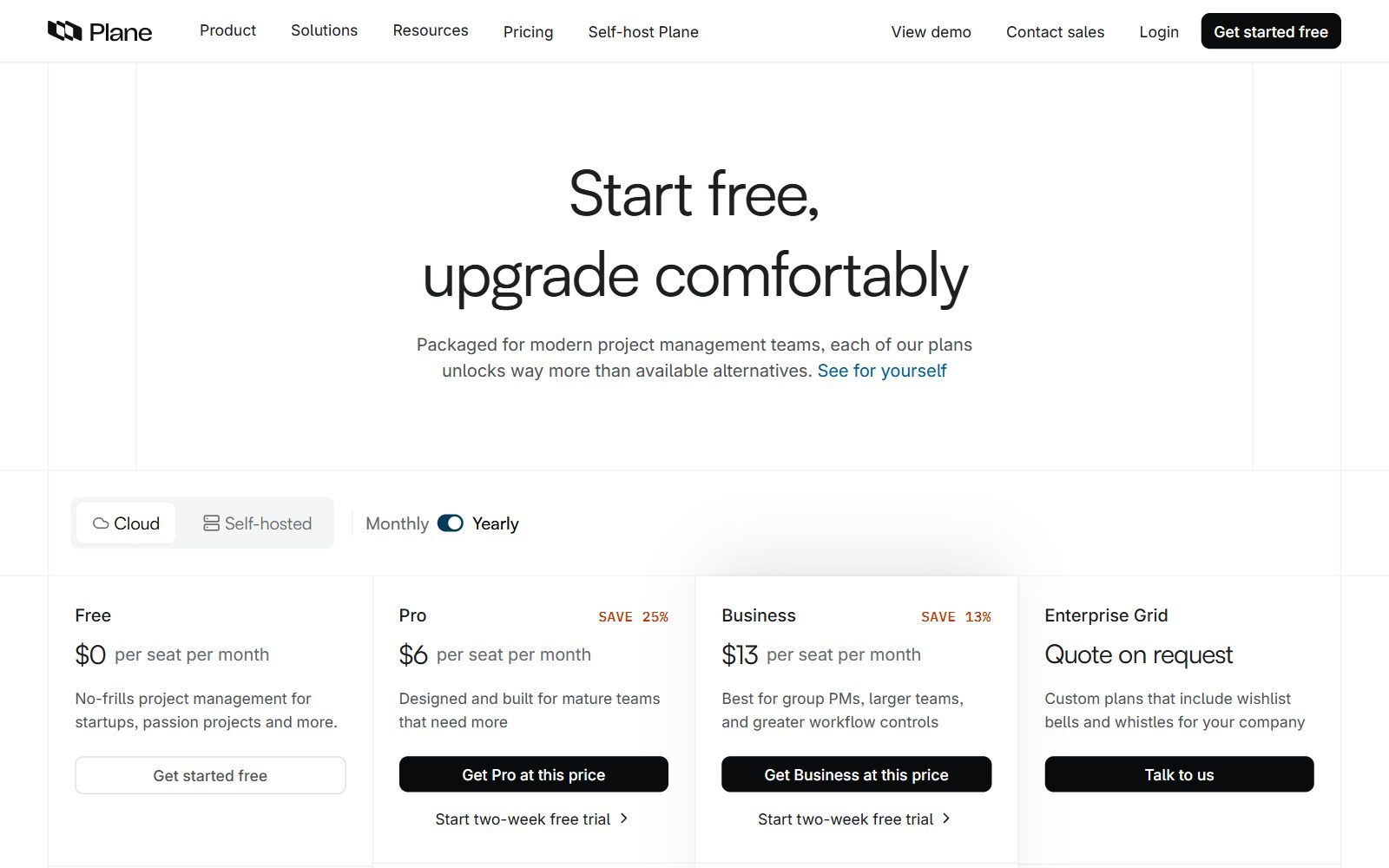
Plane looks and feels closest to the newer SaaS tools: work items in Board, Spreadsheet, List and Gantt layouts, time-boxed cycles, modules, built-in project pages and dashboards, and it runs in the cloud, self-hosted or air-gapped. The Plane code is AGPL-3.0, and its self-hosted page says importers are included on every edition, including the free Community edition. On the Plane pricing page (cloud, yearly by default), Free costs $0 for up to 12 users with five layouts, cycles, modules, intake and pages. Pro costs $6 per seat per month and adds the wiki, time tracking, dashboards and 500 AI credits per seat; Business costs $13. Version 1.4.3 came out in October 2026 and a 1.5.0 release candidate on 10 November 2026.
3. Leantime: project management for founders who are not project managers
Leantime is built for people who run projects without a project-management background, with a focus on ADHD, dyslexia and autism. Its GitHub README lists kanban, Gantt, table, list and calendar views, unlimited subtasks and dependencies, milestones, goal and metric tracking, timesheets, wikis and retrospectives, and the code is AGPL-3.0. The Leantime pricing page has no free hosted plan any more: Leantime Pro costs $10 per user per month on monthly billing, includes 500 AI credits a month and has a 14-day free trial, while the self-hosted Community Edition is free, with advanced features such as strategy and program management sold as plugins. Version 3.13.2 came out on 31 October 2026.
4. Worklenz: projects, time tracking and clients for agencies
Worklenz calls itself a free, open-source agency management platform: tasks in list, board and Gantt views, time tracking and timesheets, workload, project budgets and a client portal. The Worklenz code is AGPL-3.0 and runs with Docker. The Worklenz pricing page (cloud, monthly by default) shows a Free plan for up to 5 team members and 3 active projects, Pro at $8 per active user per month with time tracking, reports and a read-only Gantt, and Business at $12 with the client portal, project finance and full Gantt editing. Its FAQ says the self-hosted Community edition is free and supports unlimited users. Version 3.4.0 came out on 9 November 2026.
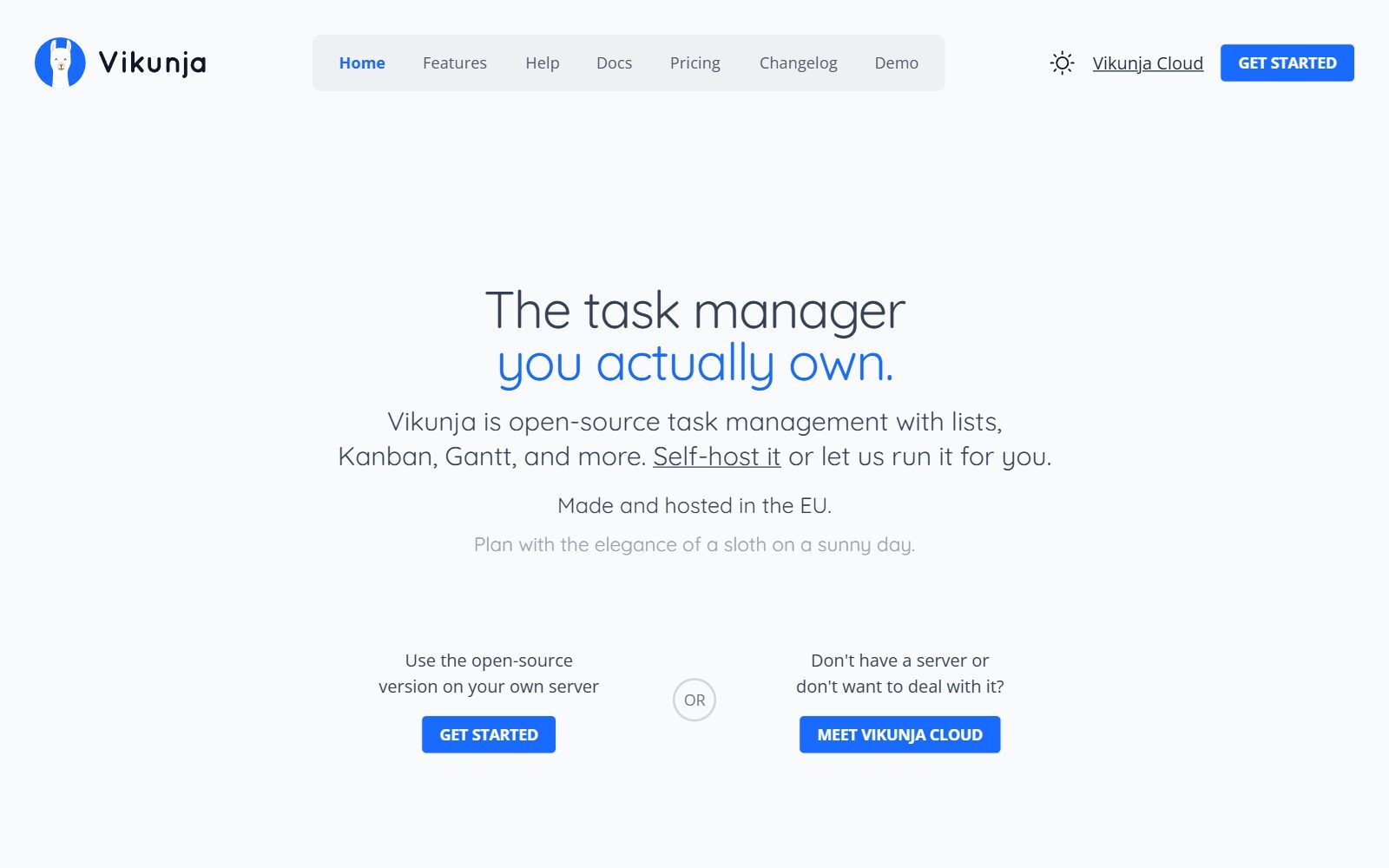
5. Vikunja: a light self-hosted task manager with a Gantt view
Vikunja is an open-source to-do and project app with list, Kanban, Gantt and table views, shared projects for teams, and imports from Todoist, Trello and Microsoft To Do. It is AGPLv3 and, in its own words, completely free to self-host. There is no free hosted plan: the Vikunja pricing page lists Personal at €4 a month and Organization at €5 per user per month, each with a 14-day trial, and the service is made and hosted in the EU. Version 2.8.0 was released on 5 November 2026. It is the right choice when Asana feels too heavy and you mostly need tasks, due dates and a simple timeline.
Validate your startup idea with the unique borrowed authority approach: we publish articles about your product in our blog and you get traffic and testers for your MVP
- Prove Market Demand: See real organic traffic and waitlist conversions
- Unlock High-Potential Keywords: Receive a curated list of top-performing keywords directly from Google Search Console data.
- Estimate Customer Acquisition Cost (CAC): Gain financial foresight with an estimated CAC based on real keyword performance data.
🔗 Start validating your startup now
6. Taiga: agile project management for Scrum and Kanban teams
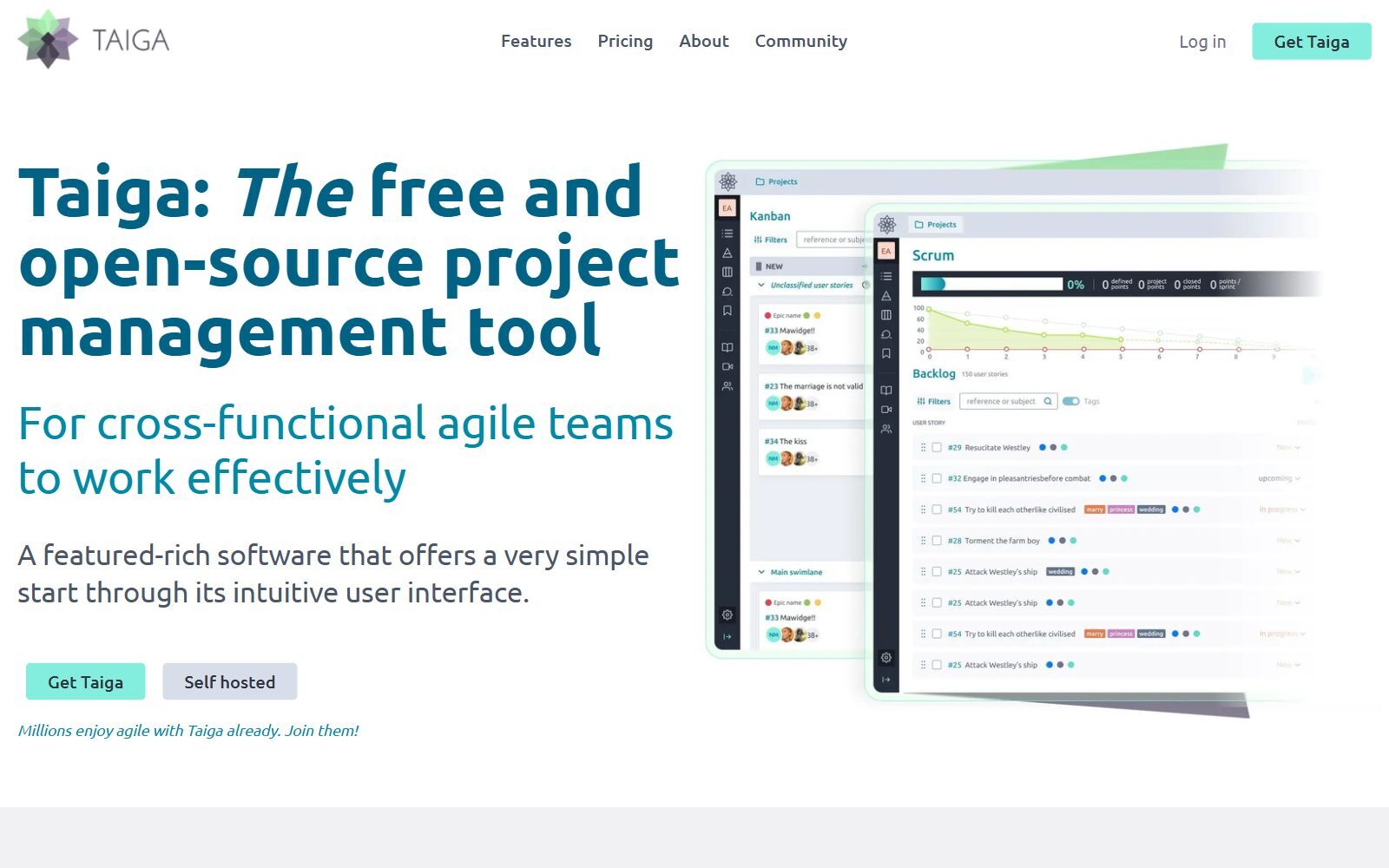
Taiga is built for cross-functional agile teams: a Kanban board with WIP limits, epics and subtasks, a Scrum backlog with sprint planning, and issue tracking, and you can switch a project between Kanban and Scrum. The backend code is MPL-2.0 and can be self-hosted for free. The Taiga pricing page lists a hosted Free plan with 1 public and 1 private project, 10 MB of storage and unlimited users, and paid plans from €5 a month (Enthusiast). The latest tagged release, 6.10.2, is from July 2026, and the code still received commits in November 2026. Taiga has no Gantt chart, so it fits sprint work better than date-driven plans.
7. Huly: tasks, chat, documents and calls in one open-source app
Huly describes itself as an open-source, all-in-one replacement for Linear, Jira, Slack and Notion: a project tracker with two-way GitHub sync, a team planner with time-blocking, documents, chat and a virtual office with video calls. The Huly code is EPL-2.0. The Huly pricing page shows a free Common plan with unlimited users and 10 GB of storage per workspace, and Rare at $19.99 a month for 100 GB. Self-hosting is heavier than for the other tools here: the official self-host guide asks for at least 2 vCPUs and 8 GB of RAM. The last tagged release is from August 2026, and the code received commits in November 2026.
8. Redmine: issue tracking with Gantt charts, wiki and time tracking
Redmine is the veteran of the list: a self-hosted project management web application on Ruby on Rails, released under the GNU GPL v2. It supports multiple projects, role-based access, issue tracking, a Gantt chart and calendar, a wiki and forums per project, time tracking, custom fields, Git and Subversion integration and issue creation by email. Versions 7.0.3, 6.1.6 and 6.0.12 were released on 1 November 2026. The interface is plain next to Asana, so it suits technical teams that live in issues rather than marketing or operations teams.
9. Odoo Project: projects inside an open-source business suite
Odoo is a suite of business apps; its core is published under the LGPLv3. The Odoo editions page ticks the Project and Timesheet apps for the open-source Community edition, while Planning is Enterprise-only. Its hosted service, Odoo Online, offers a One App Free plan (shown as €0 from Europe) with one app and unlimited users. Odoo makes sense when you also want CRM, invoicing or inventory in the same system; as a pure Asana replacement it is more than most small teams need.
10. WeKan: simple open-source Kanban boards
WeKan is an MIT-licensed, self-hosted Kanban tool: boards, lists and cards with labels, checklists, attachments, comments and due dates, plus board-level permissions. Version 13.05 was released on 10 November 2026. WeKan replaces Asana's board view, not its timelines or goals.
11. Kanboard: minimal Kanban, now in maintenance mode
Kanboard is a free, MIT-licensed Kanban board with WIP limits, subtasks with time estimates, a simple search language and automatic actions. Its README says the application is in maintenance mode, which means small fixes only, and version 1.2.57 came out in October 2026. Choose it for a stable, minimal board on a small server, not for new features.
Join ElonaHunt (like ProductHunt but for women) and explore the coolest women-focused startups out there!
Discover your next big inspiration and connect with like-minded female entrepreneurs!
👉 Join the Hunt Here
Asana Alternatives That Stopped, Changed Licence or Went Quiet
The 2025 version of this article listed ten tools. Three of them no longer pass the test of being open source and maintained:
- Focalboard: the standalone Focalboard repository says it is currently not maintained, and its last release, v8.0.0, dates from June 2024. Boards lives on as a Mattermost plugin. Plane, Vikunja or WeKan are the closest maintained replacements.
- Planka: still active, but its licence file now uses the PLANKA Community License with a "Fair Use License" (updated May 2025), and the project calls itself source available. That is not an open-source licence, so it is not on the list.
- TaskJuggler: a GPL command-line planning tool, but its last tagged release (3.8.4) and its last code change date from July 2025, more than a year ago.
- Huly stays on the list: in 2025 it was only described as "frequently listed"; we have now confirmed its EPL-2.0 licence and recent commits.
Which Open-Source Asana Alternative Should You Choose?
- You want the closest Asana replacement with Gantt charts and boards: OpenProject Community edition.
- You want a modern interface and a free hosted start for up to 12 people: Plane.
- You run projects without a project-management background: Leantime.
- You run an agency and bill for time: Worklenz.
- You mostly need tasks, due dates and a simple timeline: Vikunja.
- Your team works in sprints: Taiga.
- You want tasks, chat, docs and calls in one tool: Huly.
- Your team lives in issues and code: Redmine.
- You also need CRM, invoicing or inventory: Odoo.
- You only use Asana's board view: WeKan or Kanboard.
How Founders Use an Open-Source Asana Alternative
Asana usually starts as one person's to-do list and becomes the place where a small team plans launches, content and fundraising. Before you move, list the three Asana features you really use (most teams name the list, the board and the timeline), test them in two tools on a copy of one real project, and ask the whole team to work there for two weeks. Self-hosting is free in licence fees, so budget for a small server, backups and an hour a month of updates, or start on the tool's hosted plan and move to your own server later. For a remote team, our guide to project management for remote teams and the top 20 project management tools for startups help you set up the routine around the tool, and AI tools for female founders' productivity covers the assistants you can add on top.
If you would rather stay hosted and free, compare the free Asana alternatives and the head-to-head comparisons Asana vs Trello, Asana vs ClickUp, Asana vs Jira and Asana vs monday.com. For other self-hosted options, see the open-source ClickUp alternatives (project management features), the open-source ClickUp AI alternatives (all-in-one workspaces with AI), the open-source monday.com AI alternatives, the open-source Trello AI alternatives, the open-source Basecamp alternatives and the open-source Wrike alternatives. Personal to-do lists are covered in the open-source Todoist alternatives and free Todoist alternatives; team wikis in the open-source Notion alternatives; shared tables in the open-source Airtable alternatives; and automations between your tools in the open-source Zapier alternatives. Before you plan the next product sprint, validate your startup idea with real users, and write your launch pages with the F/MS AI SEO Tool so customers find them in Google and AI assistants.
FAQ About Open-Source Asana Alternatives
Is Asana open source?
No. Asana is closed-source software sold as a cloud service. Its pricing page lists only hosted plans: Personal (free for one or two people), Starter ($10.99 per user per month billed annually), Advanced ($24.99) and Enterprise (on request).
Can Asana be self-hosted?
No self-hosted edition is listed on Asana's pricing page. If you need project management on your own server, OpenProject, Plane, Leantime, Worklenz, Vikunja, Taiga, Huly and Redmine all have free self-hosted editions.
What is the best open-source alternative to Asana?
OpenProject is the closest match: GPL-3.0, with Gantt charts, agile boards, a team planner and time tracking, and a Community edition that is free for unlimited users. Plane is the best pick if you want a modern interface and a free cloud plan for up to 12 users.
Which open-source Asana alternative has a timeline or Gantt view?
OpenProject, Plane, Leantime, Worklenz, Vikunja and Redmine all show tasks on a Gantt chart or timeline. Taiga, WeKan and Kanboard focus on boards and have no Gantt view.
Is there a free hosted open-source Asana alternative?
Yes. Plane's cloud Free plan covers up to 12 users, Huly's Common plan is free with unlimited users and 10 GB of storage, Worklenz Free covers 5 team members and 3 active projects, and Taiga's hosted Free plan includes 1 public and 1 private project. Leantime and Vikunja no longer offer a free hosted plan.
Is Focalboard still maintained?
No. The standalone Focalboard repository says it is currently not maintained, and its last release was v8.0.0 in June 2024. Its boards live on as a Mattermost plugin.
Is Planka open source?
Not any more in the strict sense. Planka's licence file uses the PLANKA Community License with a "Fair Use License", and the project describes itself as source available.
How much does it cost to self-host an open-source project management tool?
The software is free, but you pay for a server, backups and the time to install updates. Most tools here run on a small server or with Docker; Huly's self-host guide asks for at least 2 vCPUs and 8 GB of RAM.
Which tool replaces Asana for an agency that bills by the hour?
Worklenz: it combines projects, time tracking and timesheets with project budgets and a client portal, under the AGPL-3.0, and its self-hosted Community edition supports unlimited users.
Where can I get a backlink by writing about my startup?
You can publish a guest post in one of the Fe/male Switch startup blogs, which rank in Google and in AI tools. Get a quality backlink.
About the Author
Violetta Bonenkamp, also known as MeanCEO, is an experienced startup founder with an impressive educational background including an MBA and four other higher education degrees. She has over 20 years of work experience across multiple countries, including 5 years as a solopreneur and serial entrepreneur. Throughout her startup experience she has applied for multiple startup grants at the EU level, in the Netherlands and Malta, and her startups received quite a few of those. She’s been living, studying and working in many countries around the globe and her extensive multicultural experience has influenced her immensely.

