

Open-Source Basecamp Alternatives: All-in-One Team Collaboration With Message Boards, To-Dos, Docs and Chat on Your Own Server
Basecamp's appeal is that everything about a project lives on one page: a message board instead of email threads, to-do lists, a kanban card table, docs and files, a group chat and a calendar, all for a flat monthly price with no per-user fees. It is still a hosted service you rent, though, and your client and team conversations sit on someone else's servers. If you want the same calm, all-in-one setup on a server you control, open-source software can get you there, usually by combining one suite with one chat tool. This guide is about team collaboration in Basecamp's style, not heavy project management: which open-source tools give you discussions, to-dos, files, chat and schedules, what their licences allow, and whether they are still maintained. We checked every tool on its official site and GitHub in October 2026. If you mostly need Gantt charts, sprints and time tracking, read our guide to open-source ClickUp alternatives instead.
Quick answer: for the closest all-in-one replacement with files, chat, video calls, calendar and kanban boards, use Nextcloud Hub with its Deck and Talk apps; for structured projects with a forum, wiki, meetings and documents, use OpenProject; for one modern app with tasks, documents, chat and a team planner, use Huly; for documents, mail, CRM and projects in one bundle, use ONLYOFFICE Workspace; and if you only want Basecamp's chat, 37signals' own Campfire is now free and MIT-licensed.
Boost Your SEO by Getting Featured in Our Blogs and get a backlink.
We publish content about startups, education, tech, funding, etc. that ranks well not only in Google but also in Perplexity, ChatGPT, Grok and other AI tools.
👉 Get featured now!
What Basecamp Offers in 2027 and What It Costs
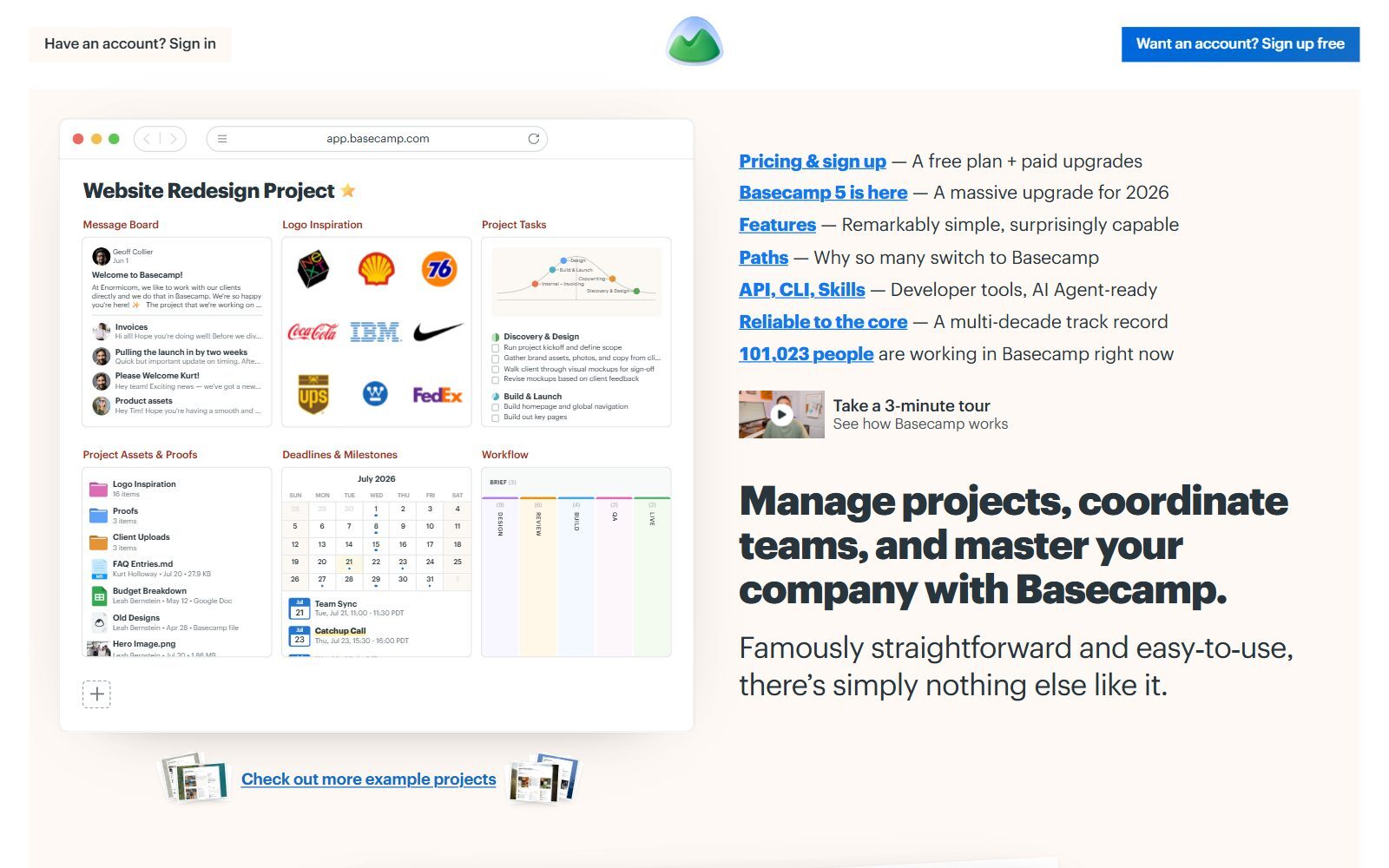
To know what you are replacing: on Basecamp's features page, every project gets its own page where you add the tools you need. Message Boards replace email for announcements and discussions, To-do Lists track assignments and due dates, Card Tables are Basecamp's take on kanban boards, Campfire chats handle quick conversations, a Calendar holds deadlines and meetings, Automatic Check-ins ask your team recurring questions, Docs and Files keeps documents and assets together, and Hill Charts show where work really stands.
On the Basecamp pricing page (default view, checked October 2026, US dollars), the free plan covers one project, 1 GB of storage and up to 3 users. Freelancer costs $29 a month for 3 active projects, 10 GB and up to 5 users; Pro costs $79 for 8 projects, 25 GB and 10 users; Pro Plus costs $99 for 12 projects, 100 GB and 15 users and adds time tracking; and Pro Unlimited costs $199 a month billed annually ($329 billed monthly) for unlimited projects and users with 1 TB of storage. Paid plans start with a 30-day free trial.
Flat pricing is Basecamp's strongest argument, so the open-source case is less about saving per-seat fees and more about owning your data, having no project or user caps and adapting the software. You pay for a server and your own time instead.
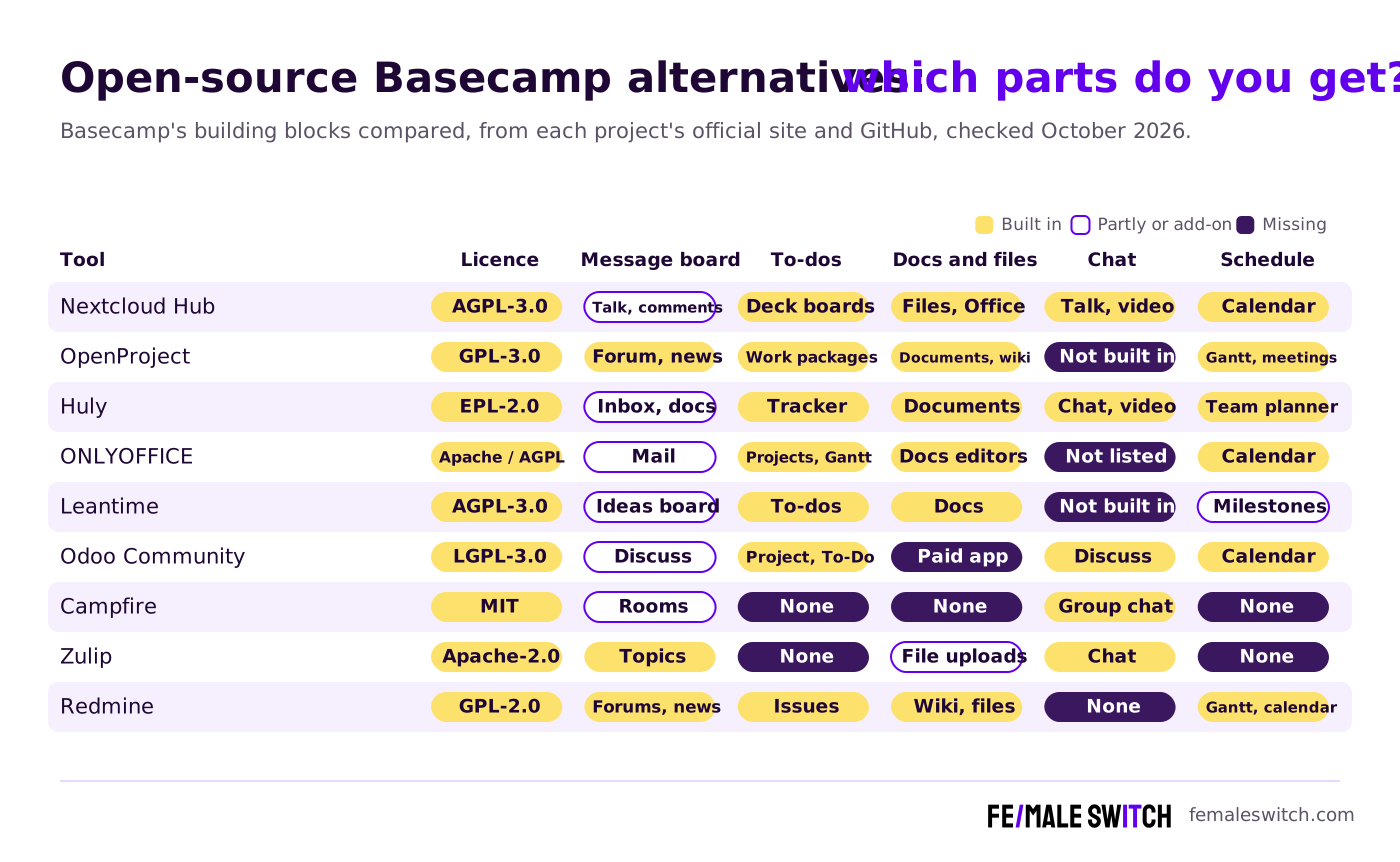
Open-Source Basecamp Alternatives Compared
Sources: each project's official website, pricing page and GitHub repository, checked October 2026. Prices as shown in each pricing page's default view; self-hosting is free, but you pay for the server and your own time.
The Best Open-Source Basecamp Alternatives in 2027
1. Nextcloud Hub: files, chat, calendar and boards in one self-hosted workspace
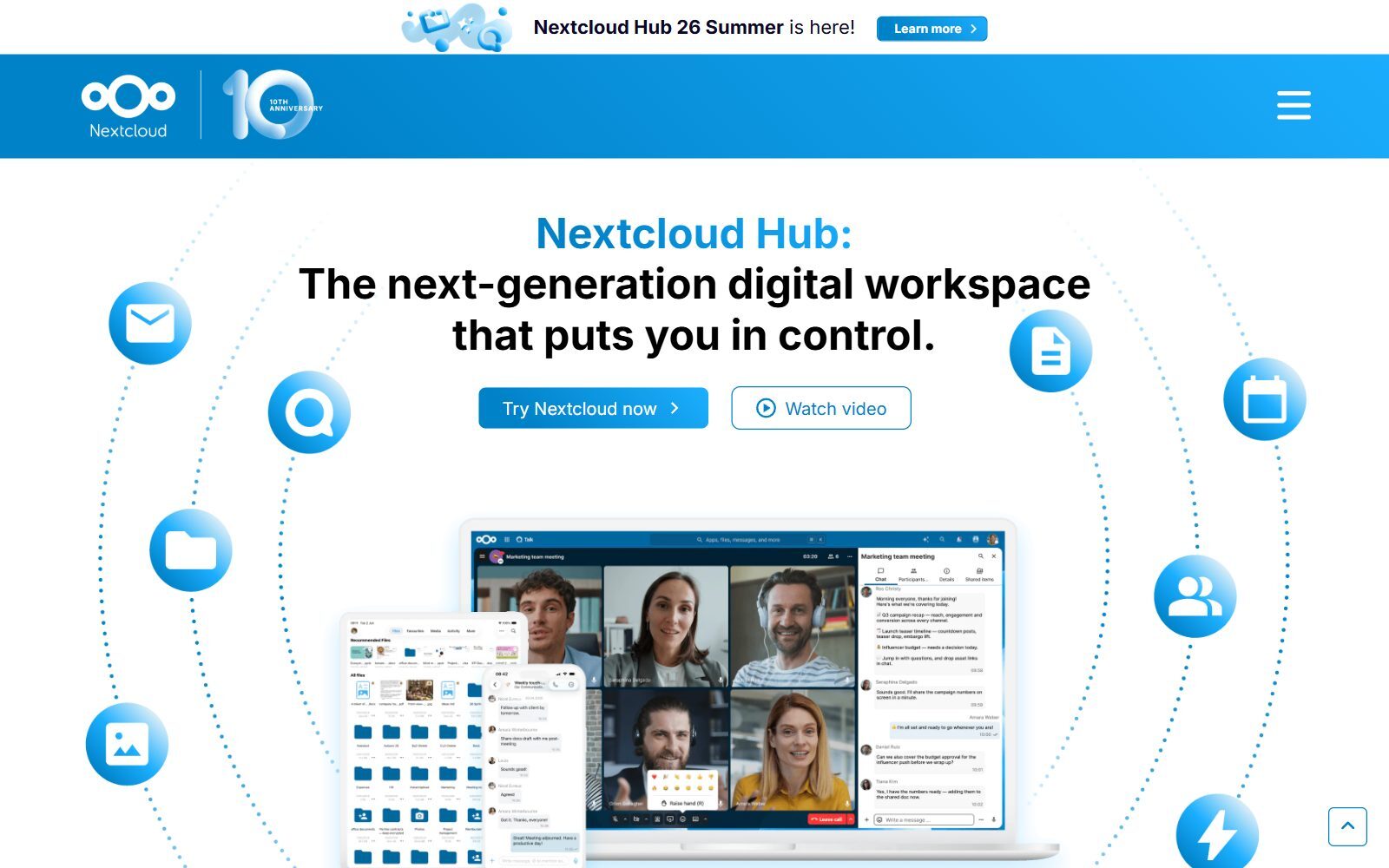
Nextcloud Hub is the nearest thing to Basecamp's one-place-for-everything idea that you can run yourself. It combines Nextcloud Files for storage and sharing, Nextcloud Talk for chat, calls and video conferencing, Groupware for calendar, contacts and mail, and Nextcloud Office for real-time document editing. For to-dos, add the free Deck app: a kanban tool where cards carry markdown notes, labels, attached files and comments, which covers Basecamp's to-dos and card tables. The server code is under the GNU AGPL v3; version 35.0.2 came out on October 15, 2026, and Deck 1.19.1 followed the same month. You can self-host it for free or get a free account at a Nextcloud provider; the Nextcloud Enterprise pricing starts at €71.29 per user per year for 100 users or more, so it is not aimed at small teams. What it lacks is a dedicated message board: discussions happen in Talk conversations and in card comments.
2. OpenProject: projects with a forum, wiki, meetings and documents
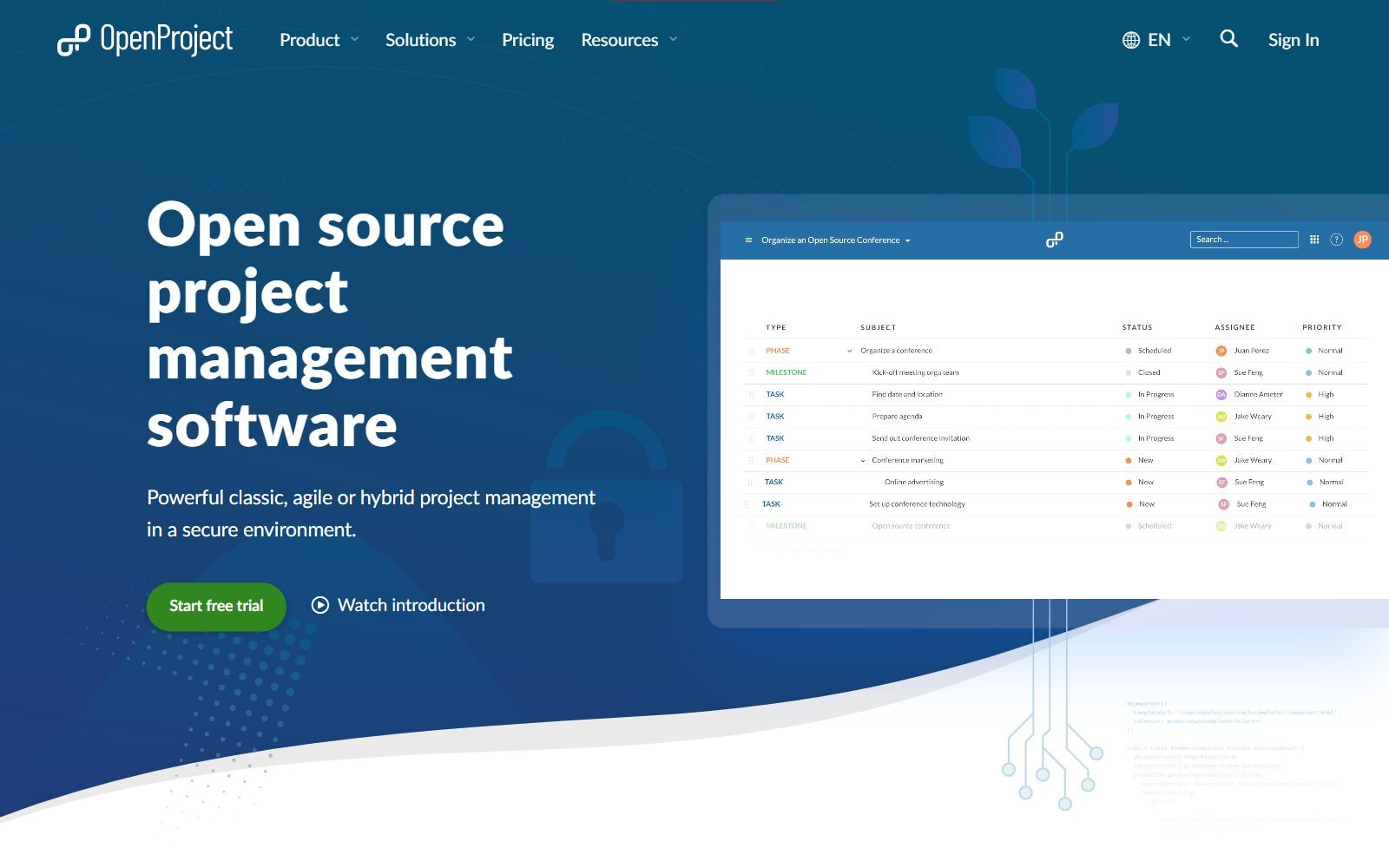
OpenProject is project management software licensed under the GNU GPL v3, and of the project tools it has the most Basecamp-like communication features. According to its team collaboration page, each project can have a wiki, a forum, news posts, meetings with agendas and a documents module, and you can connect a Nextcloud file storage so project files sit in one shared folder. You can also share single work packages with people outside the project, which helps with clients. On top of that come work packages, agile boards and Gantt charts. There is no built-in chat, so pair it with Zulip, Campfire or Nextcloud Talk. The Community edition is free with unlimited users; on the OpenProject pricing page (default view, euros) Enterprise starts at €5.95 per user per month for Basic and €10.95 for Professional, and the Enterprise cloud runs on servers in the EU or, if you wish, in Germany. Version 17.9.6 came out in October 2026.
3. Huly: tasks, documents, chat and a virtual office in one app
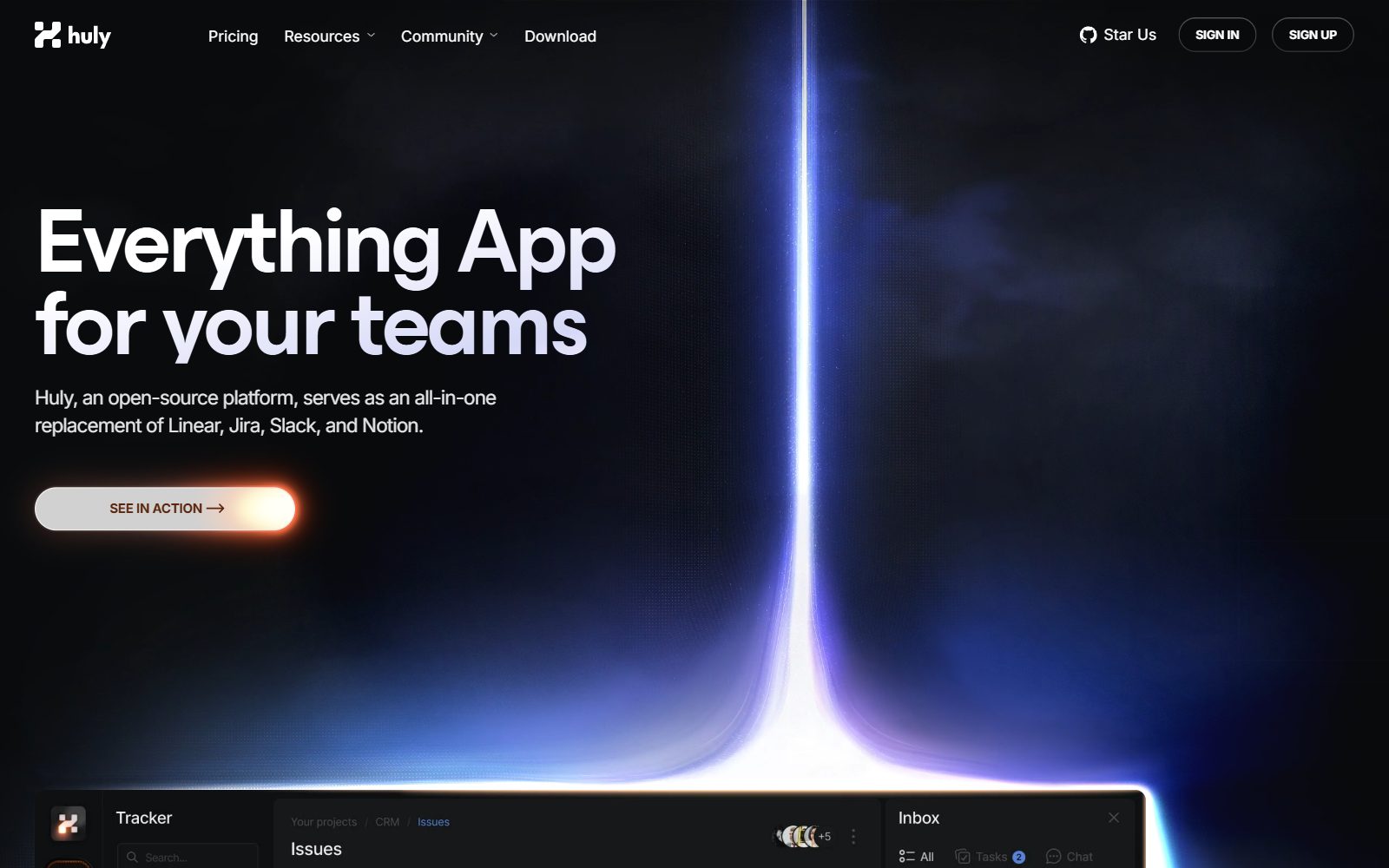
Huly describes itself as an open-source, all-in-one replacement for Linear, Jira, Slack and Notion, and its code is under the Eclipse Public License 2.0. In one app you get a project tracker with two-way GitHub sync, documents, team chat, an inbox for notifications, a team planner that shows everyone's tasks in one calendar, time-blocking for your day and a virtual office with audio and video rooms. That makes it the most Basecamp-like single app on this list, with a stronger lean towards software teams. On the Huly pricing page the free Common plan has unlimited users, 10 GB of storage per workspace and 10 GB of video and audio traffic; Rare costs $19.99 a month with 100 GB. Its latest tagged release on GitHub came out in summer 2026.
4. ONLYOFFICE Workspace and DocSpace: documents, mail, CRM and projects
ONLYOFFICE Workspace is a bundle of web apps for team management: Documents (online editors for text, spreadsheets, presentations, PDFs and forms), Mail, CRM, Projects with Gantt charts, time tracking and reports, and a shared Calendar. A free Community version is offered on its download page. The Workspace server code (CommunityServer) is under Apache 2.0, with version 12.8.0 from May 2026, while the document editors are AGPL-3.0 and reached version 10.0 in October 2026. ONLYOFFICE's newer product, DocSpace (AGPL-3.0, version 4.0.1 in October 2026), organizes work in rooms for teams, clients and data rooms; on the ONLYOFFICE pricing page its free cloud plan allows up to 3 admins, unlimited users and guests, up to 12 rooms and 2 GB of storage, and Business costs $20 per admin per month. Neither lists a team chat, so add one of the chat tools below.
5. Leantime: a calm project space for founders who are not project managers
Leantime is open-source project management built for non-project managers and neurodivergent minds, and its code is AGPL-3.0. Each project is a team space with to-dos (Kanban, table or list, with subtasks and dependencies), milestones on a timeline, ideas, docs, blueprints, reports, timesheets and retrospectives, while a personal dashboard collects your work from every project, with time blocking, notes and whiteboards. That gives you Basecamp's to-dos, docs and schedule, but not its chat. On the Leantime pricing page the cloud plan costs $8 per user per month billed yearly ($10 monthly) with a 14-day trial; the Community Edition is free to self-host under AGPLv3. Version 3.13.2 came out at the end of October 2026.
Validate your startup idea with the unique borrowed authority approach: we publish articles about your product in our blog and you get traffic and testers for your MVP
- Prove Market Demand: See real organic traffic and waitlist conversions
- Unlock High-Potential Keywords: Receive a curated list of top-performing keywords directly from Google Search Console data.
- Estimate Customer Acquisition Cost (CAC): Gain financial foresight with an estimated CAC based on real keyword performance data.
🔗 Start validating your startup now
6. Odoo Community: projects and chat inside a business suite
Odoo is a suite of business apps whose Community edition is published under the LGPLv3. According to the Odoo editions comparison, Community includes Project, Timesheet, Discuss (team chat), To-Do and Calendar, while Documents, Knowledge and Planning are Enterprise-only. It suits a startup that wants its projects next to CRM, invoicing or inventory rather than a pure Basecamp clone, and it takes more setup than the other tools here. If you prefer a hosted version, the Odoo pricing page offers One App Free: one app with unlimited users at €0. Odoo 20 is available to download.
7. Campfire: 37signals' own group chat, now free and open source
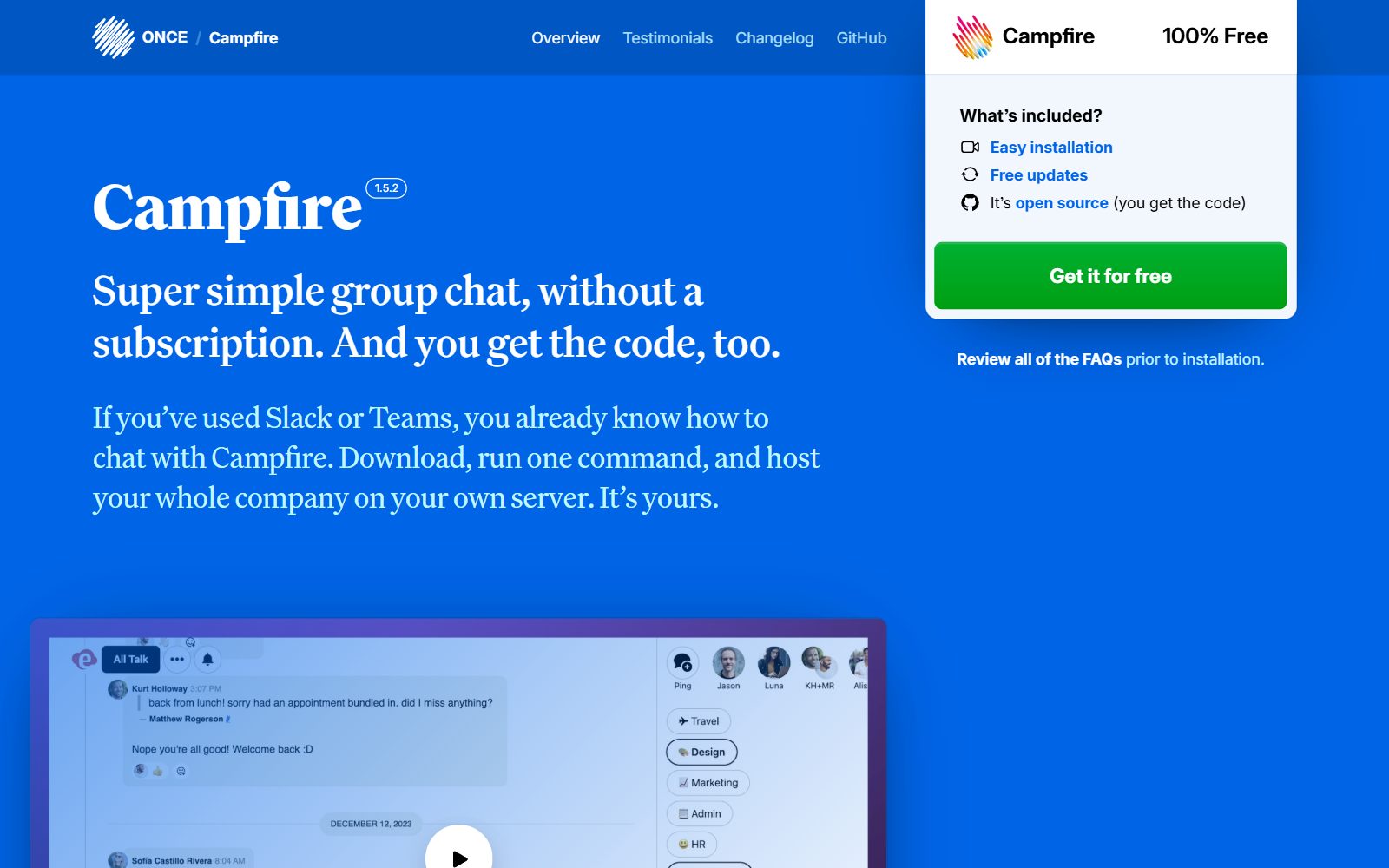
Basecamp's chat is called Campfire, and 37signals also sells, or rather gives away, a standalone Campfire under its ONCE line. It is a self-hosted group chat with rooms (open or private), direct messages, @mentions, saved searches and dark mode, and it works on phones as a progressive web app with push notifications. According to its official page, Campfire is entirely free and open source under the MIT License; you install it with one command on your own server, and it can run on air-gapped networks. 37signals lists 2 GB of RAM and 1 CPU for 250 concurrent users. It cannot import Slack or Teams history, and chatbots connect through a simple HTTP API. The GitHub repository released version 1.5.6 in October 2026. Pair it with OpenProject, Leantime or ONLYOFFICE for the project side.
8. Zulip: chat organized by topics, close to a message board
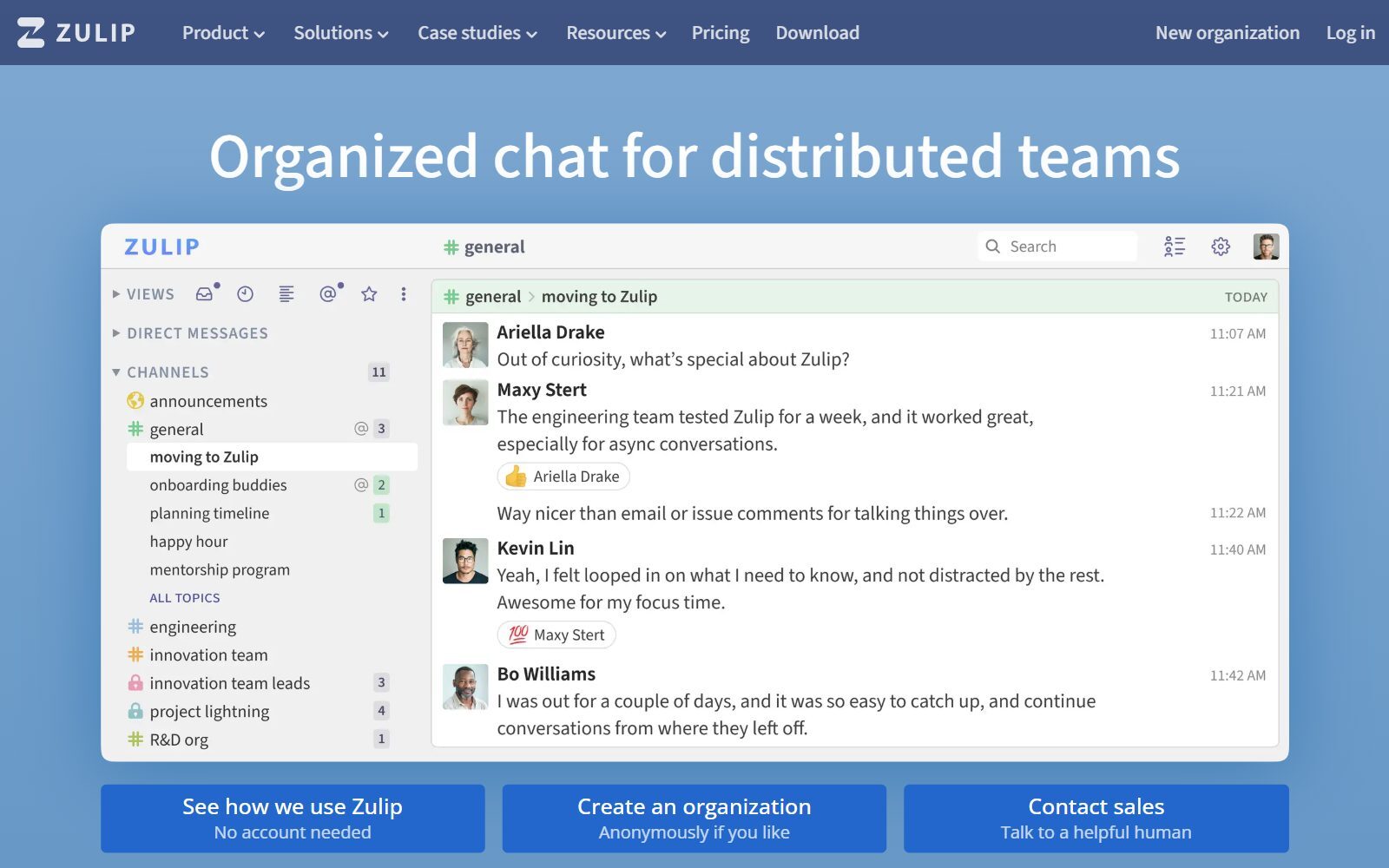
Zulip is organized chat for distributed teams: every message belongs to a channel and a short topic, so conversations read like threads on a message board and are easy to catch up on after a few days away. Its code is under the Apache 2.0 licence, and self-hosting is free. On the Zulip plans page the free Cloud plan keeps 10,000 messages of search history and up to 5 GB of file storage in total; Standard costs $6.67 per user per month billed annually and Plus $10. Zulip Server 12.3 came out in September 2026, and the first release candidate of version 13.0 followed in October 2026. For more chat options, see our open-source Slack alternatives.
9. Redmine: the veteran tracker with forums, a wiki and Gantt charts
Redmine is a self-hosted project management web application released under the GNU General Public License v2. Each project can have issues, a Gantt chart and calendar, a wiki, forums, news, file uploads and time tracking, so it covers several Basecamp parts, but it looks dated and has no chat. It is maintained by volunteers and still released: versions 7.0.2 and 6.1.5 came out in September 2026. There is no official paid cloud, so plan to run it on your own server.
10. Taiga, Vikunja, WeKan, Kanboard and Worklenz: boards from the old list
Five tools from the earlier version of this list are task and board tools rather than Basecamp-style collaboration suites. They are all still maintained, and each can replace Basecamp's to-dos or card tables next to a chat tool: Taiga (MPL-2.0, Kanban and Scrum, version 6.10.2 in July 2026), Vikunja (AGPL-3.0, list, Kanban, Gantt and table views, version 2.7.1 in October 2026), WeKan (MIT, a Trello-like board, version 12.75 in October 2026), Kanboard (MIT, minimal Kanban, version 1.2.57 in October 2026) and Worklenz (AGPL-3.0, projects with time tracking and a client portal, version 3.3.1 in October 2026). We compare them in detail in our guide to open-source ClickUp alternatives and in the open-source Trello AI alternatives.
Join ElonaHunt (like ProductHunt but for women) and explore the coolest women-focused startups out there!
Discover your next big inspiration and connect with like-minded female entrepreneurs!
👉 Join the Hunt Here
Basecamp Alternatives That Are Discontinued, Changed or Not Open Source
The 2025 version of this article listed two tools that no longer belong on an open-source shortlist, and one new 37signals product needs a note:
- Focalboard: its GitHub README says the standalone repository is currently not maintained, and its last release, v8.0.0, dates from 2024. Boards continues as a Mattermost plugin. Use Nextcloud Deck, Vikunja or WeKan instead.
- Restyaboard: its last GitHub release and code changes date from March 2022, so we removed it.
- Fizzy by 37signals: a free hosted kanban tool from the makers of Basecamp. Its code is public, but under the O'Saasy licence, which forbids offering it as a competing hosted service, so it is source-available rather than open source in the usual sense.
- Basecamp itself: not open source and not self-hostable; 37signals' Campfire chat (MIT) is the open-source exception.
Which Open-Source Basecamp Alternative Should You Choose?
- You want files, chat, video calls, calendar and to-dos in one place: Nextcloud Hub with Deck and Talk.
- You run structured projects and want a forum, wiki and meeting notes next to them: OpenProject, plus a chat tool.
- You want one modern app with tasks, documents and chat: Huly.
- Your work is mostly documents, mail and clients: ONLYOFFICE Workspace or DocSpace.
- You are a founder who finds project tools overwhelming: Leantime.
- You also need CRM, invoicing or inventory: Odoo Community.
- You only want to leave Slack or Basecamp's chat: Campfire for simplicity, Zulip for threaded discussions.
- You need a stable tracker with forums and a wiki: Redmine.
A practical stack for a small startup: OpenProject or Leantime for projects, Campfire or Zulip for chat, and Nextcloud for files. Still comparing? See our lists of open-source monday.com AI alternatives, open-source Asana alternatives and open-source ClickUp AI alternatives.
How Founders Replace Basecamp With Open-Source Tools
Basecamp works because it is opinionated: one page per project, announcements on a message board, to-dos with owners and dates, and a weekly check-in instead of meetings. You can keep those habits with open-source tools. Start with one project per goal, such as a product launch or a client engagement, write decisions as posts or wiki pages rather than chat messages, keep to-dos short with one owner each, and schedule a written weekly check-in in your chat tool. Self-hosting pays off when you handle client or investor data, need more projects or users than a flat plan allows, or want everything under your own domain; until then, the free cloud plans of the same tools are fine, and you can move to your own server later.
Most founders pair a collaboration tool with a knowledge base: see open-source Notion alternatives and open-source Notion AI alternatives; to connect your tools, the open-source Zapier alternatives; and for personal to-dos, the free Todoist alternatives. Our project management tools for startups list and the guide to project management for remote teams cover the basics. Before you plan a big build, validate your startup idea with real customers, and turn what you learn into articles with the F/MS AI SEO Tool so people find you in Google and AI assistants.
FAQ About Open-Source Basecamp Alternatives
What is the best open-source alternative to Basecamp?
For an all-in-one setup, Nextcloud Hub with its Deck and Talk apps: files, chat, video calls, calendar and kanban boards on your own server. If you want structured projects with a forum, wiki and meetings, choose OpenProject; if you want one modern app with tasks, documents and chat, choose Huly.
Is Basecamp open source?
No. Basecamp is a hosted service and cannot be self-hosted. 37signals' standalone Campfire chat, however, is free and open source under the MIT License.
Is there a free open-source Basecamp alternative?
Yes. Nextcloud, OpenProject Community, Huly, ONLYOFFICE Workspace Community, Leantime, Odoo Community, Campfire, Zulip and Redmine can all be self-hosted for free. You pay only for the server and the time to run it.
Which open-source tool has a message board like Basecamp?
OpenProject has project forums and news, Redmine has forums, and Zulip organizes chat by topics so it reads like a message board. Nextcloud and Huly handle discussions in chat and comments.
Which open-source Basecamp alternative includes chat?
Nextcloud Talk, Huly, Odoo Discuss, Campfire and Zulip include chat. OpenProject, Leantime, ONLYOFFICE and Redmine do not, so pair them with Campfire or Zulip.
How much does Basecamp cost in 2027?
When we checked in October 2026, Basecamp's free plan covered one project and 3 users, Freelancer cost $29 a month, Pro $79, Pro Plus $99 and Pro Unlimited $199 a month billed annually, all without per-user fees.
Can I self-host Basecamp's Campfire chat?
Yes. Campfire installs with one command on your own server, and 37signals lists 2 GB of RAM and 1 CPU for 250 concurrent users. Version 1.5.6 was released on GitHub in October 2026.
Is Focalboard still a good Basecamp alternative?
No. Its GitHub README says the standalone repository is currently not maintained. Use Nextcloud Deck, Vikunja or WeKan for boards instead.
Do I need Gantt charts and sprints?
Not for Basecamp-style collaboration. If you do, read our guide to open-source ClickUp alternatives, which compares OpenProject, Plane, Taiga and other project management tools.
Where can I get a backlink by writing about my startup?
You can publish a guest post in one of the Fe/male Switch startup blogs, which rank in Google and in AI tools. Get a quality backlink.
About the Author
Violetta Bonenkamp, also known as MeanCEO, is an experienced startup founder with an impressive educational background including an MBA and four other higher education degrees. She has over 20 years of work experience across multiple countries, including 5 years as a solopreneur and serial entrepreneur. Throughout her startup experience she has applied for multiple startup grants at the EU level, in the Netherlands and Malta, and her startups received quite a few of those. She’s been living, studying and working in many countries around the globe and her extensive multicultural experience has influenced her immensely.

