

Open-Source Weather Forecasting Tools: Free Weather APIs, Forecast Data, Python Libraries and AI Models Your Startup Can Build On
Weather drives demand in many businesses: cafés and shops, farms, delivery, events, energy and insurance. If you want weather in your product, you do not have to rent a closed platform. Open data from European weather centres, open-source APIs, Python libraries and even open AI forecasting models let you build your own weather features. We checked every tool below on its official website, GitHub repository or Hugging Face page in October 2026: what it does, the exact licence, whether you may use it commercially and whether it is still maintained.
Quick answer: for a ready-made forecast API, start with Open-Meteo (free for non-commercial use, or self-host its AGPL code); for raw global forecast data you may use commercially, take ECMWF Open Data; to download and analyse model data in Python, use Herbie, xarray and MetPy; for rain in the next hours, use pysteps; and to run your own AI forecasts, look at ECMWF's AIFS with Anemoi or NVIDIA's Earth2Studio.
Boost Your SEO by Getting Featured in Our Blogs and get a backlink.
We publish content about startups, education, tech, funding, etc. that ranks well not only in Google but also in Perplexity, ChatGPT, Grok and other AI tools.
👉 Get featured now!
Is “Forecastly Weather Insights” a Real Product?
The 2025 version of this article listed alternatives to “Forecastly Weather Insights”. When we checked in October 2026, we could not verify that a product with this name exists: we found no official website or product page for it. The closest real company is Forecastly, which sells AI revenue forecasts for multi-location cafés, bakeries and restaurant chains. It uses sales history, weather forecasts and local events as inputs to plan sales, staff and orders, but it is not a weather service. So instead of comparing tools with a product we cannot confirm, this guide covers what people searching for it usually need: open-source tools and open data to build weather forecasts and weather insights yourself.
Open-Source Weather Forecasting Tools Compared
Sources: each project's official website, GitHub repository (LICENSE file and releases) and Hugging Face model card, checked 27 October 2026. Self-hosting is free, but you pay for servers, storage and your own time.
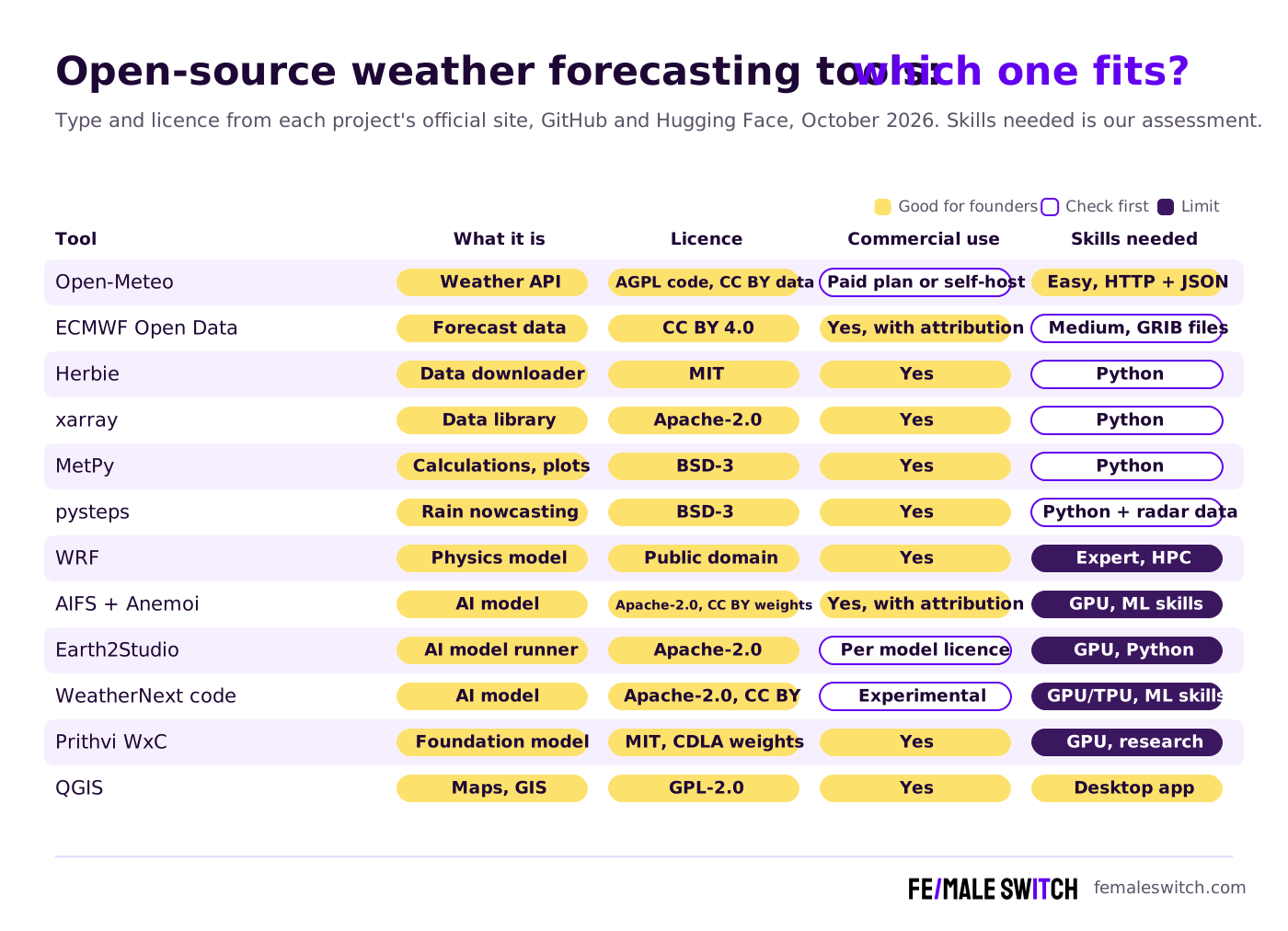
The Best Open-Source Weather Forecasting Tools in 2027
1. Open-Meteo: the easiest open-source weather API
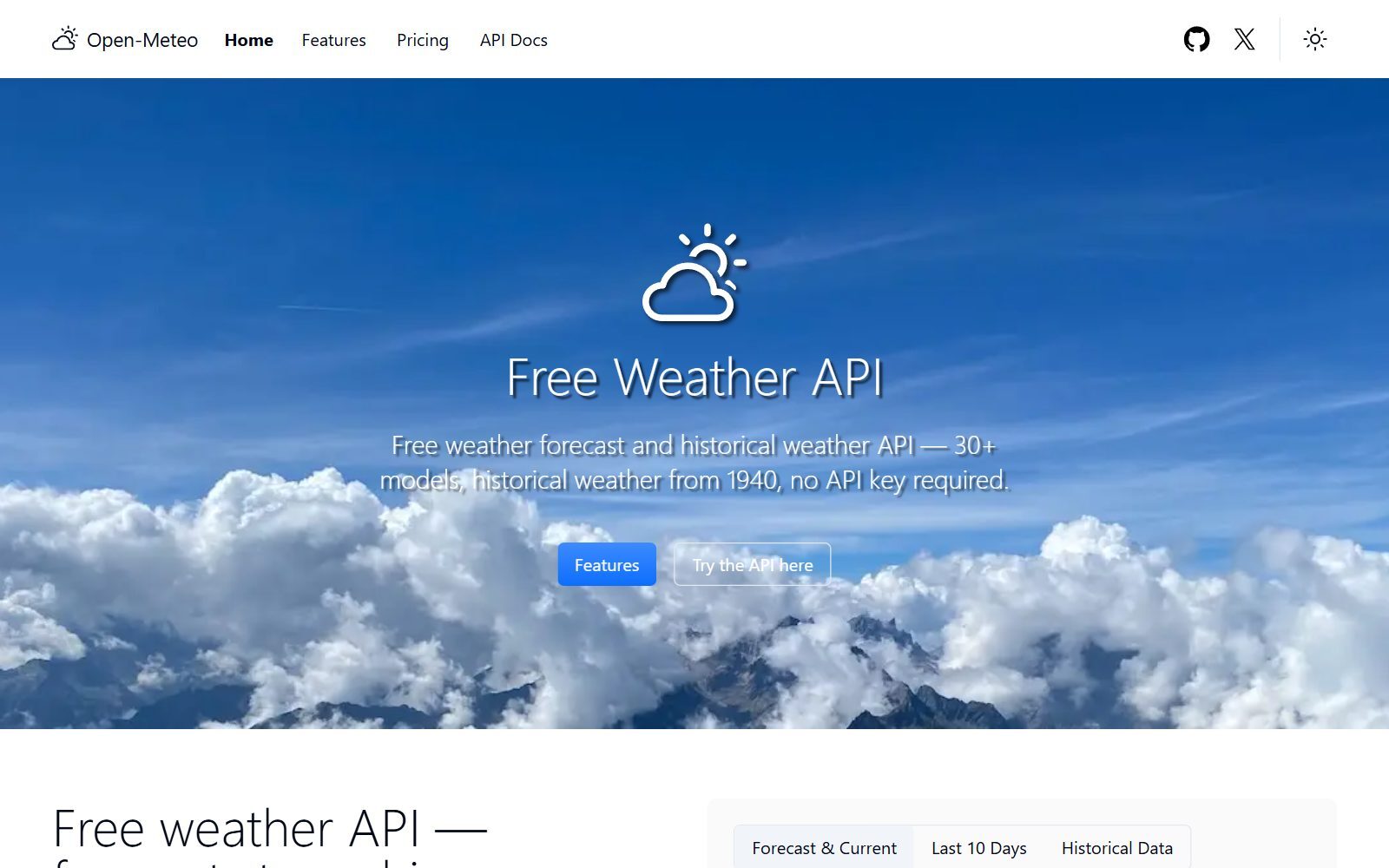
Open-Meteo is the closest thing to a ready-made weather insights service you can also run yourself. Its homepage lists more than 30 weather models from ECMWF, NOAA, DWD, Météo-France, JMA, the UK Met Office and other national services, at up to 1 km resolution, plus ERA5 historical weather back to 1940 and an archive of past forecasts from 2021. You call it with a simple HTTP request, get JSON back and need no API key. The data is licensed under CC BY 4.0, so you must credit it. The catch for startups: according to its pricing page, the free API is for non-commercial use, evaluation and prototyping only, with limits of 10,000 calls a day and 300,000 a month. Commercial products need a paid plan (Standard with 1 million calls a month, Professional with 5 million, or Enterprise), or you can self-host the server code, which is AGPL-3.0. Version 1.7.0 came out in October 2026.
2. ECMWF Open Data: global forecasts you may use commercially
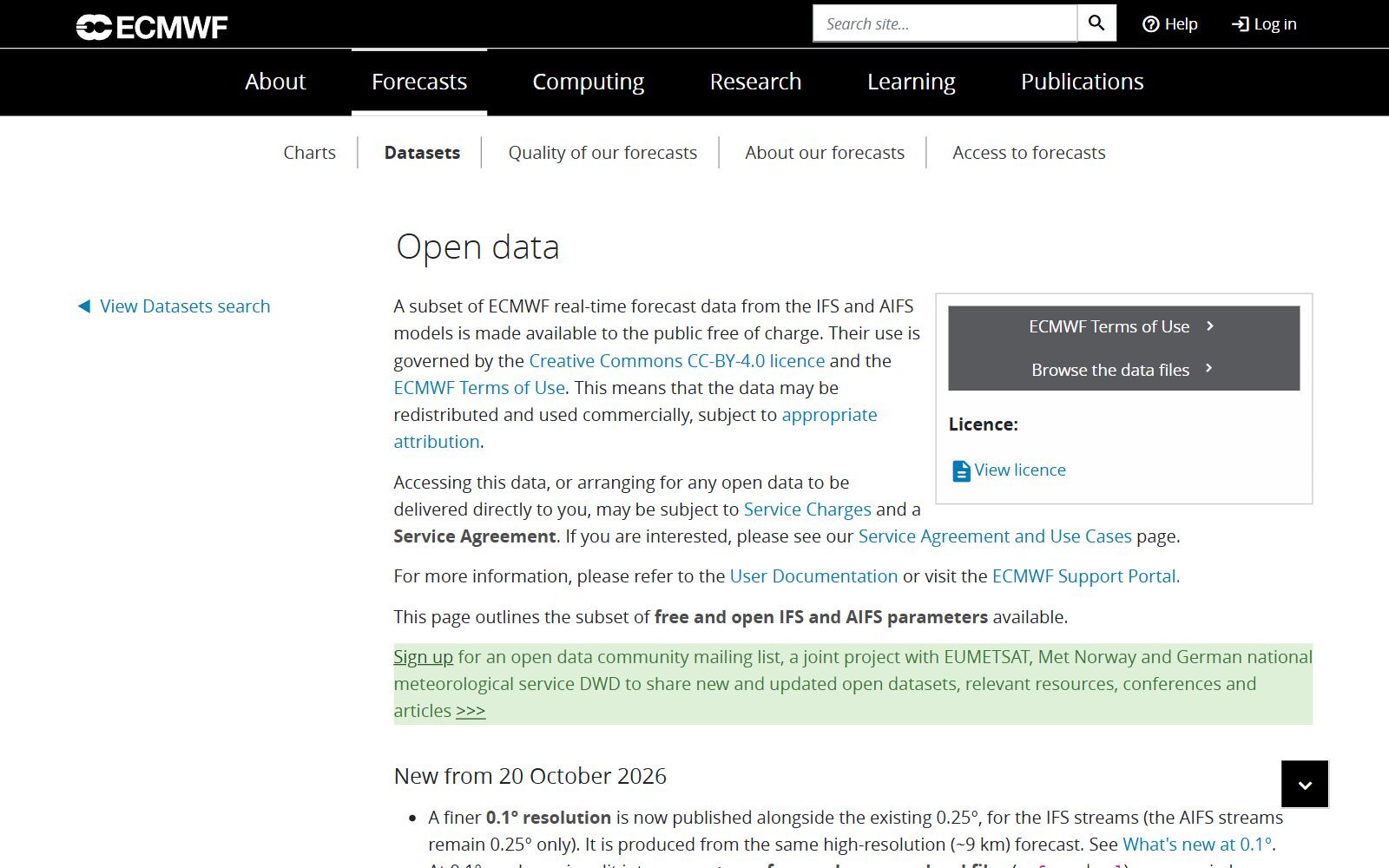
The European Centre for Medium-Range Weather Forecasts publishes a free subset of its real-time forecasts as ECMWF Open Data. It includes the physics-based IFS model (high-resolution and ensemble) and the AI model AIFS, with wave and tropical cyclone products. The data is under CC BY 4.0 and ECMWF's terms of use, which allow redistribution and commercial use with attribution. From 20 October 2026, IFS data is also published at 0.1° resolution next to 0.25°; AIFS runs four times a day and forecasts up to 360 hours ahead. Only the last 12 runs (about two to three days) stay online, so store what you need. Files are also mirrored on AWS, Microsoft Azure and Google Cloud. To fetch them, use the ecmwf-opendata Python client (Apache-2.0); to read the GRIB files, use ECMWF's ecCodes library (Apache-2.0, version 2.50.0 in October 2026).
3. Herbie: download forecast model data in a few lines of Python
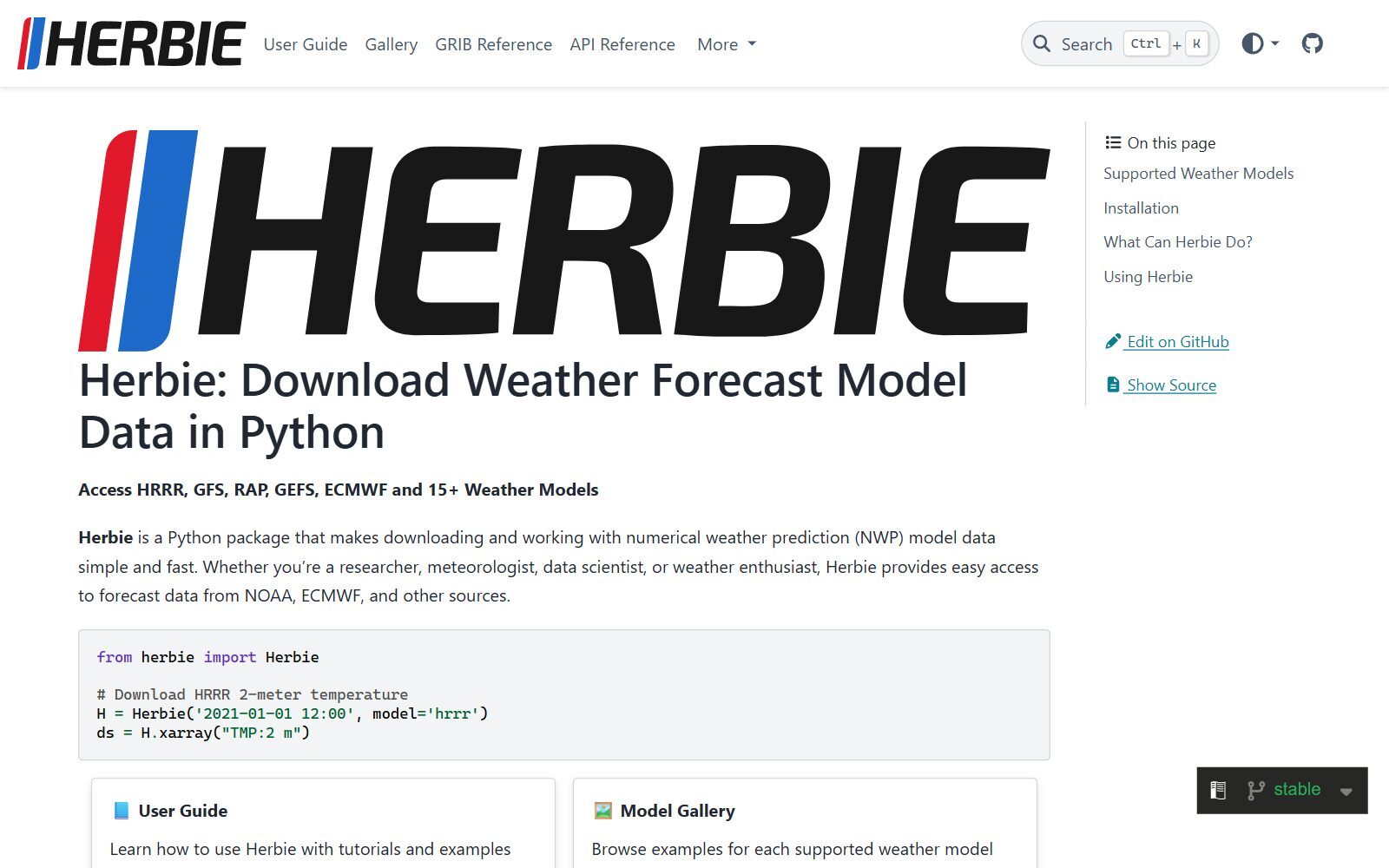
Herbie is an MIT-licensed Python package that finds and downloads numerical weather prediction data for more than 15 models, including NOAA's HRRR, GFS, RAP and GEFS and ECMWF's IFS. It searches several archives (AWS, Google Cloud, NOMADS and Azure), can download only the variables you need instead of whole GRIB2 files, and loads the result straight into xarray. It is a fast way to get the raw forecasts behind any weather feature. Version 2026.10.0 came out on 27 October 2026.
4. xarray: the standard way to work with gridded weather data
xarray is an Apache-2.0 Python library for labelled multi-dimensional arrays: exactly the shape of weather data (time, latitude, longitude, height). Almost every tool in this list either outputs or reads xarray datasets, so it is the glue of an open weather stack, together with NetCDF, GRIB and Zarr files. It is very actively developed; version 2026.09.0 was released in September 2026.
5. MetPy: weather calculations and charts in Python
MetPy, from NSF Unidata, is a BSD-3 collection of Python tools for reading, visualising and calculating with weather data: for example derived values such as dew point, wind chill or stability indices, and classic weather maps and soundings. It works with xarray and units. Its last tagged release is 1.7.1 from August 2025, but the code repository was still being updated in October 2026.
6. pysteps: short-term rain forecasts (nowcasting) from radar
pysteps is an open-source, community-driven Python framework for probabilistic precipitation nowcasting: forecasts of rain for the next minutes to hours, made by tracking radar images with optical flow and adding ensemble members. It also includes tools to visualise, post-process and verify the nowcasts. It is BSD-3 licensed, and version 1.21.5 came out in August 2026. Useful if your product reacts to rain soon, such as delivery, outdoor events or sports.
Validate your startup idea with the unique borrowed authority approach: we publish articles about your product in our blog and you get traffic and testers for your MVP
- Prove Market Demand: See real organic traffic and waitlist conversions
- Unlock High-Potential Keywords: Receive a curated list of top-performing keywords directly from Google Search Console data.
- Estimate Customer Acquisition Cost (CAC): Gain financial foresight with an estimated CAC based on real keyword performance data.
🔗 Start validating your startup now
7. WRF: run your own regional weather model
The Weather Research and Forecasting model (WRF) is a physics-based mesoscale weather prediction system for research and operational forecasting, developed at NCAR. Its licence file says NCAR and UCAR make no proprietary claims and consider WRF to be in the public domain. You can run it at high resolution over your own region, for example a wind farm or a city. It needs serious computing power and meteorology skills. Version 4.8.0 was published on GitHub in June 2026, although the NCAR page still showed 4.5 as the current version when we checked.
8. ECMWF AIFS and Anemoi: an open AI weather model and its framework
AIFS is ECMWF's data-driven (AI) forecasting system. Its model weights are on Hugging Face under CC BY 4.0: AIFS Single 1.1 (updated March 2026) and AIFS ENS 1.0 for ensemble forecasts. It is built with Anemoi, an Apache-licensed framework whose main developers work at operational weather centres, where it is used to create operational data-driven models. With Anemoi you can run AIFS yourself or train your own model on your own data. You will need GPUs and machine learning skills. anemoi-training v0.17.1 came out in October 2026.
9. NVIDIA Earth2Studio: run many AI weather models with one toolkit
Earth2Studio is an Apache-2.0 Python package from NVIDIA for running AI weather and climate models with a few lines of code. It supports models such as NVIDIA FourCastNet3, ECMWF AIFS, Google GraphCast and WeatherNext 2 Cyclones, and data sources such as GFS and ERA5. Its README notes that it is an interface to third-party models, checkpoints and datasets, so check the licence of each model you use. Version 0.19.0 came out in September 2026.
10. Google DeepMind WeatherNext (GraphCast and GenCast)
Google DeepMind's WeatherNext repository (formerly GraphCast) contains code for WeatherNext 2 and the earlier GraphCast and GenCast models. Its README says the code is licensed under Apache 2.0 and all other materials under CC BY 4.0, but also that the models are an experimental research project and not an officially supported Google product. The newest model, WeatherNext 3, is offered through Google Cloud, BigQuery and Earth Engine; its page does not say its code or weights are open. Good for research and testing AI forecasts, less so as the only base of a commercial product.
11. Prithvi WxC: the IBM and NASA weather foundation model
The 2025 list mentioned an open IBM and NASA AI model. It is Prithvi WxC, a 2.3-billion-parameter foundation model trained on 160 variables from NASA's MERRA-2 data. The weights are under the CDLA-Permissive-2.0 licence and the code is MIT. It is a research base to fine-tune for tasks like downscaling, not a ready forecast service. Activity is low: its only release, v1.0.0, is from November 2024, and the last code change was in February 2026.
12. QGIS: maps for your weather data
QGIS is a free GPL-2.0 desktop GIS. It does not forecast, but it opens NetCDF and GRIB layers, so you can map forecasts and combine them with your own locations, such as stores, fields or delivery zones. Version 4.2.3 was released in September 2026.
Weather APIs From the 2025 List That Are Not Open Source
The old version of this article mixed open-source tools with commercial weather APIs. All of the services below were still online in October 2026, but none of them is open source; they are paid services, some with free tiers, so read each provider's terms before you build on them:
- OpenWeatherMap (OpenWeather): despite the name, a commercial weather API, not open-source software.
- Weatherbit, Tomorrow.io, Visual Crossing and Meteomatics: commercial weather data and forecast APIs.
- Ambee: a commercial environmental data API (weather, air quality, pollen).
- Meteum: a consumer weather forecast website; the old article linked to google.com instead of its site.
If you need a hosted API with a contract and support, these can still make sense. If you want to own your stack, combine ECMWF Open Data with Herbie, xarray and MetPy, or self-host Open-Meteo.
Which Open-Source Weather Tool Should You Choose?
- You need forecasts in your app this week: Open-Meteo. Prototype on the free API, then take a paid plan or self-host when you go commercial.
- You want commercial rights to the raw data: ECMWF Open Data (CC BY 4.0), fetched with ecmwf-opendata or Herbie.
- You are a data scientist building weather features: Herbie to download, xarray to process, MetPy to calculate and plot.
- Your product depends on rain in the next hours: pysteps with radar data from your national weather service.
- You need very local forecasts for one area: WRF, if you have computing power and a meteorologist.
- You want to build or tune AI forecasts: AIFS with Anemoi, or Earth2Studio to compare several AI models.
- You want to show weather on maps: QGIS.
How Founders Use Open Weather Data
Weather becomes a business insight when you connect it to your own numbers. A café or shop can compare past sales with ERA5 historical weather to see how rain or heat changes demand; a delivery startup can plan riders with rain nowcasts; an agritech or energy startup can turn forecasts into planting or production schedules. Start small: one weather variable, one business metric, one dashboard. Our list of tools for data scientists and our guide to building APIs with vibe coding help you build the first prototype quickly. For demand forecasting in online shops, see also our open-source product recommendation engines.
If you are building in climate, food or farming, see the top climate tech startup events, these cleaner climate tech startups in Europe, the best deep tech cities in Europe and our story on women farm managers in the EU. More open-source picks for your stack: open-source GitHub Copilot alternatives for coding, open-source Inkscape alternatives for vector graphics and open-source StockAI alternatives for images. When your weather product is live, the F/MS AI SEO Tool helps you write the articles that bring users from Google and AI assistants.
Join ElonaHunt (like ProductHunt but for women) and explore the coolest women-focused startups out there!
Discover your next big inspiration and connect with like-minded female entrepreneurs!
👉 Join the Hunt Here
FAQ About Open-Source Weather Forecasting Tools
Is Forecastly Weather Insights a real product?
We could not verify it. In October 2026 we found no official website or product page for a product with that name. The company Forecastly sells AI revenue forecasts for cafés and restaurant chains that use weather as an input, but it is not a weather forecasting service.
What is the best open-source weather API?
Open-Meteo. It combines more than 30 weather models, historical weather from 1940 and a simple JSON API without an API key, and its server code is open source under AGPL-3.0, so you can self-host it.
Is Open-Meteo free for commercial use?
Not on the free API. Its pricing page says the free tier is for non-commercial use, evaluation and prototyping, up to 10,000 calls a day. Commercial use needs a paid plan, or you self-host the AGPL-3.0 code and credit the CC BY 4.0 data.
Is OpenWeatherMap open source?
No. Despite its name, OpenWeatherMap (OpenWeather) is a commercial weather API. For open-source software, look at Open-Meteo, and for open data, at ECMWF Open Data.
Can I use ECMWF forecast data in a commercial product?
Yes. ECMWF Open Data is licensed under CC BY 4.0 and ECMWF's terms of use, which allow redistribution and commercial use with attribution. Only the most recent runs stay online, so store what you need.
Which Python libraries do I need for weather data?
A common open stack is Herbie or ecmwf-opendata to download forecasts, ecCodes to read GRIB files, xarray to process the data and MetPy for weather calculations and plots.
Are there open-source AI weather models?
Yes. ECMWF publishes AIFS weights under CC BY 4.0 and the Anemoi framework under Apache 2.0, Google DeepMind's WeatherNext repository has Apache 2.0 code for GraphCast, GenCast and WeatherNext 2, and IBM and NASA released Prithvi WxC. NVIDIA's Earth2Studio runs many of them.
What open-source tool forecasts rain in the next hour?
pysteps, a BSD-3 Python framework for probabilistic precipitation nowcasting from radar images.
Can a small startup run its own weather model?
Yes, but it takes work. WRF is public domain and can run local high-resolution forecasts, and AI models like AIFS run on GPUs. Most startups start with Open-Meteo or ECMWF Open Data and only run models later.
Where can I get a backlink by writing about my startup?
You can publish a guest post in one of the Fe/male Switch startup blogs, which rank in Google and in AI tools. Get a quality backlink.
About the Author
Violetta Bonenkamp, also known as MeanCEO, is an experienced startup founder with an impressive educational background including an MBA and four other higher education degrees. She has over 20 years of work experience across multiple countries, including 5 years as a solopreneur and serial entrepreneur. Throughout her startup experience she has applied for multiple startup grants at the EU level, in the Netherlands and Malta, and her startups received quite a few of those. She’s been living, studying and working in many countries around the globe and her extensive multicultural experience has influenced her immensely.

