

TL;DR: EIT Urban Mobility funds mobility startups in three main ways: up to €2.5 million per company through its Financial Support to Startups call (only while you are raising a pre-seed, seed or Series A round, with EIT Urban Mobility investing alongside private investors), €60,000 lump sums for SMEs that test a proven solution with a city or another end client (RAPTOR and SME Market Expansion), and up to €2 million for consortium projects at 65% funding. The next startup cut-off is 16 November 2026, then 11 January 2027. Below: a deadline calendar, a route-fit table, an eligibility checklist, a scored fit check, a letter template and a worked example.
EIT Urban Mobility is the part of the European Institute of Innovation and Technology (EIT) that backs companies making cities easier, cleaner and safer to move around. Most pages that rank for it list a single call; this guide puts all its startup routes on one page.
All facts come from EIT Urban Mobility's own call pages and call manuals and from the EIT's opportunities pages, checked on 12 November 2026.
What EIT Urban Mobility is and what it funds

EIT Urban Mobility was founded in 2019 as an initiative of the EIT, an EU body. It is based in Barcelona, with hubs in Amsterdam, Munich, Copenhagen and Prague, and reports more than 250 partner organisations.
Its grants follow Horizon Europe rules, but the EIT also asks it to become financially sustainable. So many of its calls come with a "financial sustainability" contribution: a service fee or an equity stake. Read that part of each call manual first.
It reports more than 140 startups in its investment portfolio.
Its focus sectors: urban logistics, public and shared transport, mobility data, electrification and alternative fuels, and health and mobility.
The startup routes at a glance
Sources: EIT Urban Mobility call pages and call manuals; EIT opportunities pages; Catalyse NEB 2027 call page.
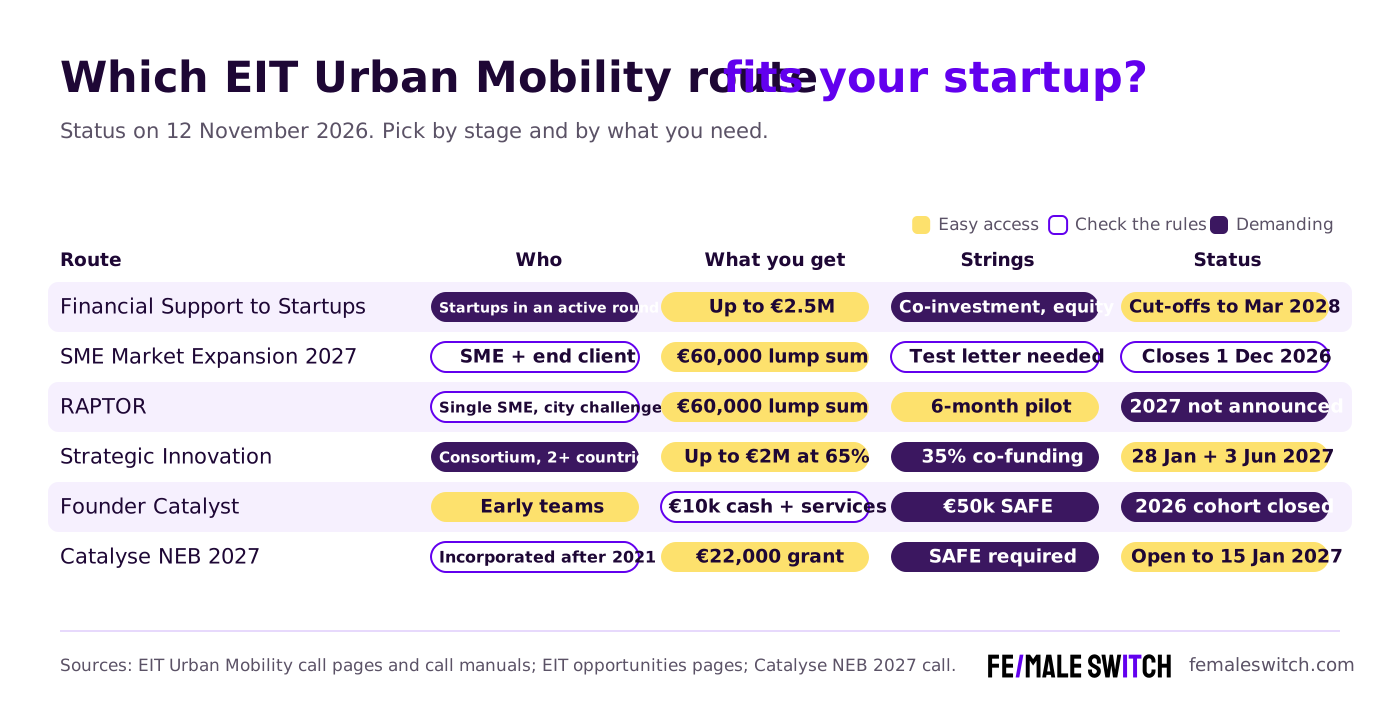
Financial Support to Startups: up to €2.5 million
The call manual (version 1, 23 December 2025) describes "financial support of up to €2.5 million per company" for startups with "breakthrough mobility solutions".
The catch: you must already be raising. The call is open only to startups "currently engaged in an active fundraising round". EIT Urban Mobility participates alongside venture capital or other private investors and "will not lead a funding round" except in exceptional circumstances. A round made only of grants or secondary share sales does not count.
Eligibility checklist
- Legal entity in an EU Member State or a country associated with Horizon Europe
- Active pre-seed, seed or Series A round (a signed term sheet helps but is optional)
- Your innovation targets the urban mobility market
- A prototype, pilot or minimum viable product
- Pre-money valuation of €50 million or less
- Founders or executives jointly hold more than 40% of the equity before this round
- Not already in EIT Urban Mobility's equity portfolio
- Not applying for a third cut-off in a row (after two, skip one)
- A PIC (Participant Identification Code) and an account on EIT Urban Mobility's programmes portal
Money and terms. The call's indicative budget for 2026–2028 is €14 million, of which about €4.5 million is earmarked for startups in countries covered by the EIT Regional Innovation Scheme (RIS); Spain and Israel are treated as non-RIS. The money is a sub-grant under Horizon Europe cost rules, for projects of 2 to 36 months ending by 31 December 2028. The manual adds a voluntary arrangement in which EIT Urban Mobility may become a shareholder; its investment page gives a 5% to 10% target stake, with shares subscribed at nominal value, and warns of possible tax effects.
Selection, in three stages:
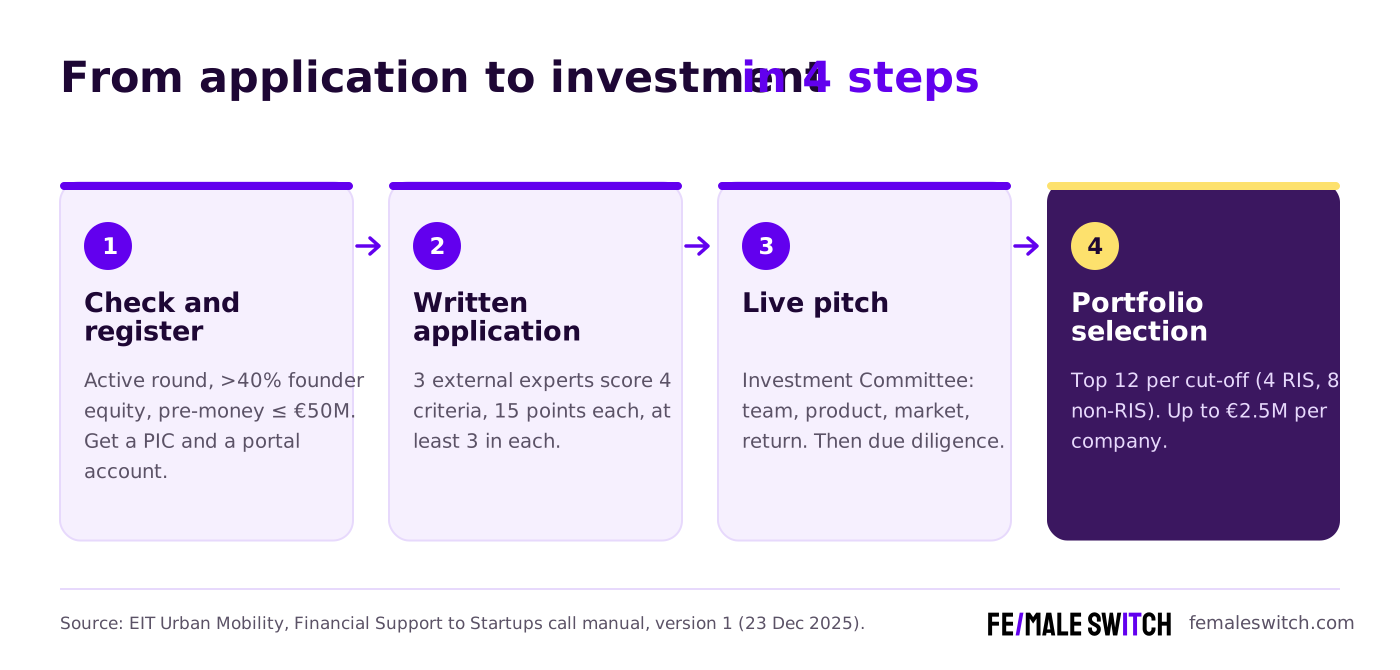
- Written application, scored by three external experts on strategic fit, excellence, impact and implementation (15 points each, at least 3 in each).
- Live online pitch to the Investment Committee: team, product, market and return potential, followed by due diligence and a data room.
- Portfolio selection by three members of the executive team for the top 12 per cut-off (4 from RIS countries, 8 from the rest), with up to 5 extra points for portfolio fit.
Results come about 3 to 4 weeks after the pitch. You submit an application form in English, the deed of incorporation and an investor pitch deck.
Pilots with cities: RAPTOR and SME Market Expansion
If you sell a working product and need a reference customer, these two calls fit better. Both pay a fixed €60,000 lump sum to one SME.
SME Market Expansion Open Call 2027 helps an SME test a proven urban mobility solution with an end client in a new customer segment, sector or country. The budget is €600,000 for around 10 projects. Every application needs a commitment letter from a public or private end client, plus a pitch deck. SMEs selected in the 2026 edition cannot apply. The deadline is 1 December 2026 at 17:00 CET; results are planned for March 2027 and projects run from about April to October 2027.
RAPTOR (Rapid Applications for Transport) matches SMEs with real challenges published by cities. In 2026 it offered up to 15 projects of €60,000 (€900,000 in total), for six-month pilots from July to December 2026. Only single SMEs could apply; consortia were not allowed. The 2026 call closed on 12 March 2026. A 2027 edition had not been announced on 12 November 2026.
Strategic Innovation Open Call: for consortia
This route funds larger projects that go beyond a pilot to certification and market entry. It offers up to €2 million of EIT funding per project, reimbursing up to 65% of eligible costs, so the consortium must co-fund at least 35%. A consortium needs at least two independent legal entities from two different EU Member States or associated countries. The total budget is €60 million for 2026–2028.
The fourth cut-off is 28 January 2027 and the fifth 3 June 2027, both at 17:00 CET. Under the 2025 call manual, the partner that commercialises the result must contribute to EIT Urban Mobility's financial sustainability through a sales-support fee, an equity commitment or an equity share in a new spin-off.
EIT Urban Mobility deadline calendar 2026–2027
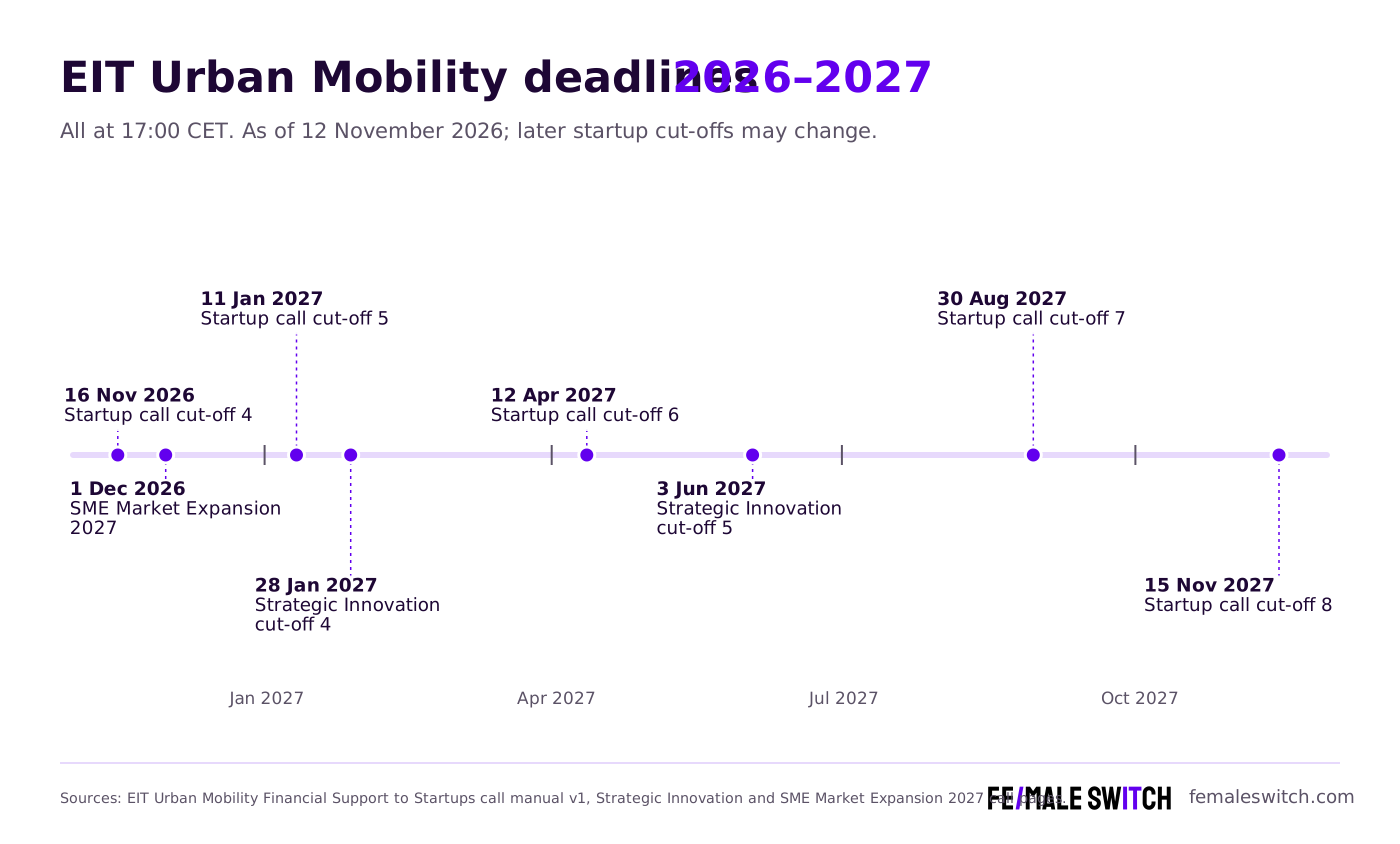
Later startup cut-offs follow on 10 January and 13 March 2028. For every other programme, see our EU grant calendar 2027.
Scored fit check: which route is yours?
A required line missing: look at general programmes on the hub instead. 5–8 points: SME Market Expansion or RAPTOR, or Catalyse NEB if you were incorporated after 2021. 9–12 points: add a Strategic Innovation consortium. 13+ points with an active round: apply to Financial Support to Startups at the next cut-off.
Copyable template: an end-client commitment letter outline
The pilot calls need a letter from your test client. Use the official template when you apply; this outline helps you agree the content early:
For the written parts of a larger EU application, read our guide to writing an EU funding application.
Worked example: a cargo-bike logistics startup
A three-founder startup in Portugal runs software that plans last-mile deliveries by cargo bike. It has €240,000 in annual revenue and is raising a €1.5 million seed round led by a local fund. Founders own 78%, and the pre-money valuation is €6 million.
- Financial Support to Startups? Yes. It has an active round with a private lead, meets every threshold and competes for the 4 RIS places (Portugal is a RIS country). It scores 15 on the check and applies for 11 January 2027 with its term sheet.
- SME Market Expansion? Also yes: a logistics operator agrees to test the planner in Madrid, a new market. It applies by 1 December 2026.
- Strategic Innovation? Later: it plans a consortium with a city and a bike maker for June 2027.
- After that: if the seed round closes, the EIC Accelerator 2027 becomes the next step for a bigger grant, and a bank loan or fund backed by InvestEU can add debt or equity.
Who should apply and who can skip it
Apply if you build a product for urban transport, logistics, mobility data or active travel, you can name a city or operator that wants it, and you are open to EIT Urban Mobility as a co-investor.
Skip it if your product is not about urban mobility, or you want a grant with no strings. Climate startups outside mobility should read our EIT Climate-KIC guide, and energy startups our InnoEnergy guide. EU projects also pay startups through cascade funding open calls, and some regions offer small innovation vouchers for a first test.
Related EU funding guides
- EU grants for startups: programme map, deadlines and decision tree
- Startup funding in Europe: where EU money fits next to angels and VCs
- How to find open EU funding calls for startups
- EU funding readiness checklist for startups (2027)
- The EU funding labyrinth: a critical analysis for startups
- InvestEU for startups: how EU guarantees reach you through banks and funds
For new EU calls every month, read Mean CEO's EU Funding News on blog.mean.ceo. And to practise pitching your mobility startup before the live pitch, play the Fe/male Switch startup game.
FAQ
How much funding does EIT Urban Mobility give startups?
Up to €2.5 million per company through the startup call, €60,000 per SME in the pilot calls, and up to €2 million for consortium projects at 65% funding.
Does EIT Urban Mobility take equity?
In some calls, yes. In the startup call it joins your round and may become a shareholder (5% to 10% target stake); its pre-accelerator uses a SAFE.
When is the next EIT Urban Mobility startup cut-off?
16 November 2026 at 17:00 CET, then 11 January, 12 April, 30 August and 15 November 2027. Later dates can change.
Can a pre-revenue startup apply?
Yes, with a prototype or minimum viable product and an active round with private investors. Without a round, try the pilot calls or Catalyse NEB.
What is EIT Urban Mobility RAPTOR?
A call that pays single SMEs €60,000 to solve a city's challenge in a six-month pilot. The 2026 edition closed on 12 March 2026.
About the Author
Violetta Bonenkamp, also known as MeanCEO, is an experienced startup founder with an impressive educational background including an MBA and four other higher education degrees. She has over 20 years of work experience across multiple countries, including 5 years as a solopreneur and serial entrepreneur. Throughout her startup experience she has applied for multiple startup grants at the EU level, in the Netherlands and Malta, and her startups received quite a few of those. She’s been living, studying and working in many countries around the globe and her extensive multicultural experience has influenced her immensely.

