

TL;DR: EIC Accelerator 2027 is the last round of the European Innovation Council's flagship startup fund under Horizon Europe, and its rules were adopted by the European Commission on 5 November 2026. It has €578 million: €428 million for the Open call (any technology) and €150 million for four Challenges. A single startup or SME can win a grant below €2.5 million (70% of costs), an equity investment from €1 million to €10 million, or both. Short proposals can go in at any time; full proposals have four 2027 batch dates: 20 January, 17 March, 1 September and 4 November. Below: the calendar, a fit table, a budget example, a scored readiness check and a copyable short-proposal outline.
Most pages ranking for this search were written before adoption and still guess at the dates. This guide uses only the adopted EIC Work Programme 2027 (Commission decision C(2026)7629) and the EIC's own 2027 pages, and flags what is still indicative.
What the EIC Accelerator 2027 offers

The EIC Accelerator funds single companies with a deep-tech innovation that is already validated in a relevant environment (all of TRL 5 completed) and needs money to reach the market and scale. You apply alone, as one company, without a consortium or a research partner.
There are three forms of support:
- Blended finance: a grant plus an equity investment, decided together in one award decision. This is the default option.
- Grant only: a lump-sum grant below €2.5 million. You can get it only once during Horizon Europe (2021–2027), and you must show you have the resources and the will to scale.
- Investment only: equity or quasi-equity (such as a convertible loan) from €1 million to €10 million, managed by the EIC Fund.
The grant covers up to 70% of eligible costs of TRL 6–8 work (demonstration, prototyping, testing, certification, IP), typically over 24 months; the other 30% is yours to fund. The investment covers market deployment and scale-up up to TRL 9. Winners also get the EIC's Business Acceleration Services: coaches, investor and corporate introductions and, new in 2027, support for pilot testing with buyers.
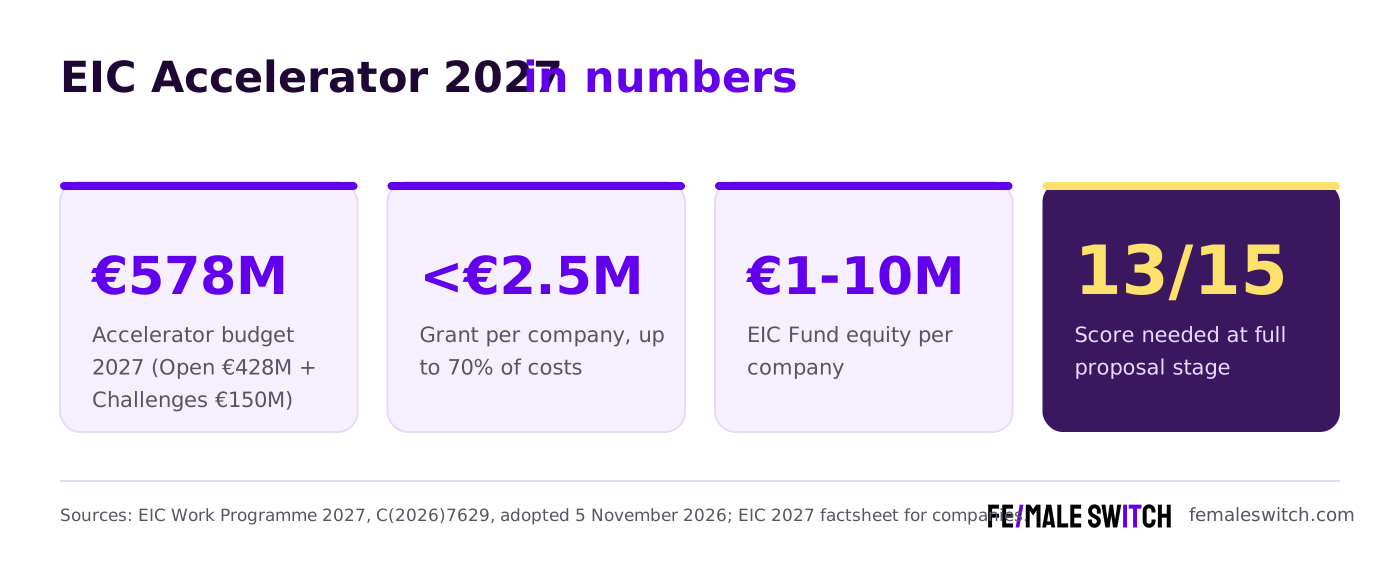
The 2027 budget
Sources: EIC Work Programme 2027; EIC, Funding opportunities in 2027 (5 November 2026).
The four 2027 Challenges and their indicative budgets are: advanced in-situ ocean observation technologies (€30 million), climate-neutral and smart cities (€50 million), alternative concepts and key enabling technologies for fusion power plants (€20 million), and carbon removal and circularity for climate change mitigation and EU industrial resilience (€50 million). If your innovation fits none of them, the Open call is your door. For the full map of other EU programmes, see our EU grants for startups hub.
EIC Accelerator 2027 cut-off dates
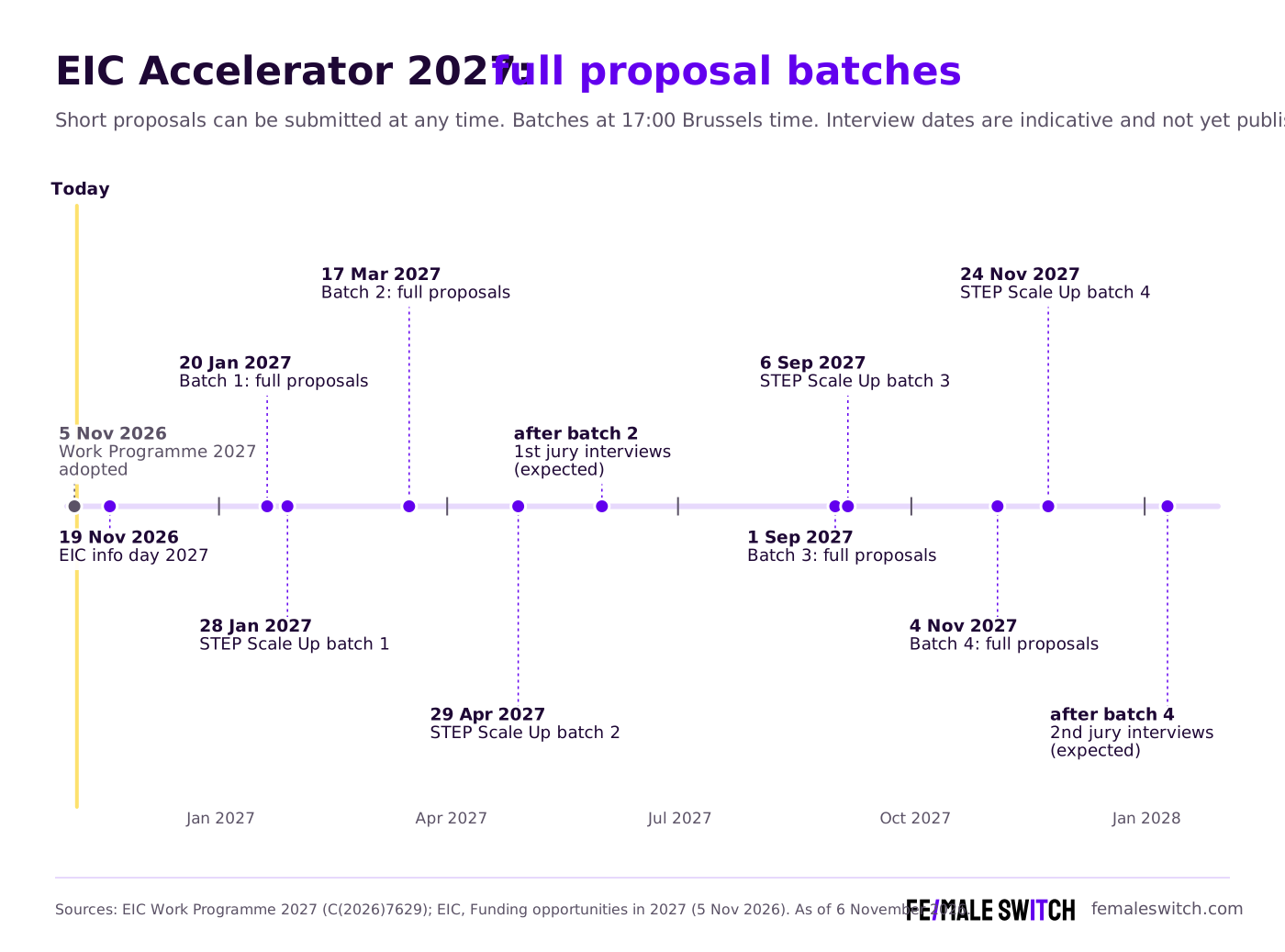
Three rules hide behind this table:
- Interviews come after every second batch. A January proposal waits for the session after the March batch. Indicative interview dates were not yet published on 6 November 2026.
- Panel results take about 8–9 weeks after the batch; the jury decision comes two to three weeks after the interview session.
- Dates can move. The Commission may delay a cut-off by up to two months.
If your short proposal received a GO under the 2026 work programme, you can send your full proposal to any 2027 batch. To plan your other EU deadlines around these, use our EU grant calendar 2027.
How to apply: the three steps
Step 1: short proposal. A 12-page form on your company, team, innovation and market, a pitch deck of up to ten slides, and a video pitch of up to three minutes with up to three main team members. Four evaluators each give a GO or NO GO; three GOs invite you to the full proposal, two NO GOs reject it with feedback. A GO also unlocks three days of optional remote coaching.
Step 2: full proposal. A form of up to 20 pages, a pitch deck and a video, plus annexes: financial data and cap table, IP strategy (with a freedom-to-operate analysis if you have one), and, if you ask for a grant, an implementation plan with milestones and a lump-sum budget table. A technology expert checks your claims and meets you online; a panel of at least three experts then scores the batch.
The full proposal is scored on three criteria, each with a threshold of 4 out of 5 and an overall threshold of 13 out of 15:
- Excellence: deep-tech nature, TRL 5 completed, IP protection.
- Impact: market size and share, business model, European technological leadership.
- Risk, implementation and need for EU support: team, risks, milestones, reasonable costs, and whether private investors would fund this alone.
Step 3: interview with the EIC jury. Proposals worth about 2.5 times the grant budget are invited. You pitch for up to ten minutes, then take questions. The jury gives a GO (funded), a GO Reserve (second session only, funded if budget frees up) or a NO-GO. Strong proposals that are not funded get a Seal of Excellence, which several countries fund nationally; see our Seal of Excellence guide. When proposals tie, women-led companies get priority.
After a GO, you prepare the grant agreement and the EIC Fund runs due diligence on the investment part.
Who can apply and the limits that catch founders out
You can apply if you are a single startup or SME (spin-offs included) established in an EU Member State or a Horizon Europe Associated Country. Individuals who intend to launch a company can apply too, and so can founders from outside Europe who will establish or relocate the company here: you must prove the company is established by the time you submit the full proposal. Small mid-caps with up to 499 employees can apply for investment only, or for blended finance in exceptional cases.
Three limits matter more than most founders expect:
- Three strikes. Since 1 January 2024, three unsuccessful submissions by the same legal entity, at any stage, end your EIC Accelerator chances under Horizon Europe. Don't "test" an idea with a short proposal.
- One call at a time. You can't have proposals in the Accelerator, STEP Scale Up and STEP Defence at the same time. Only the most recent one is evaluated.
- Grant only, once. A grant-only award is a one-time chance during Horizon Europe.
Coming from an EU or national project? The Fast Track and Plug-in schemes let eligible projects apply through their existing programme.
Which EU funding option fits your startup?
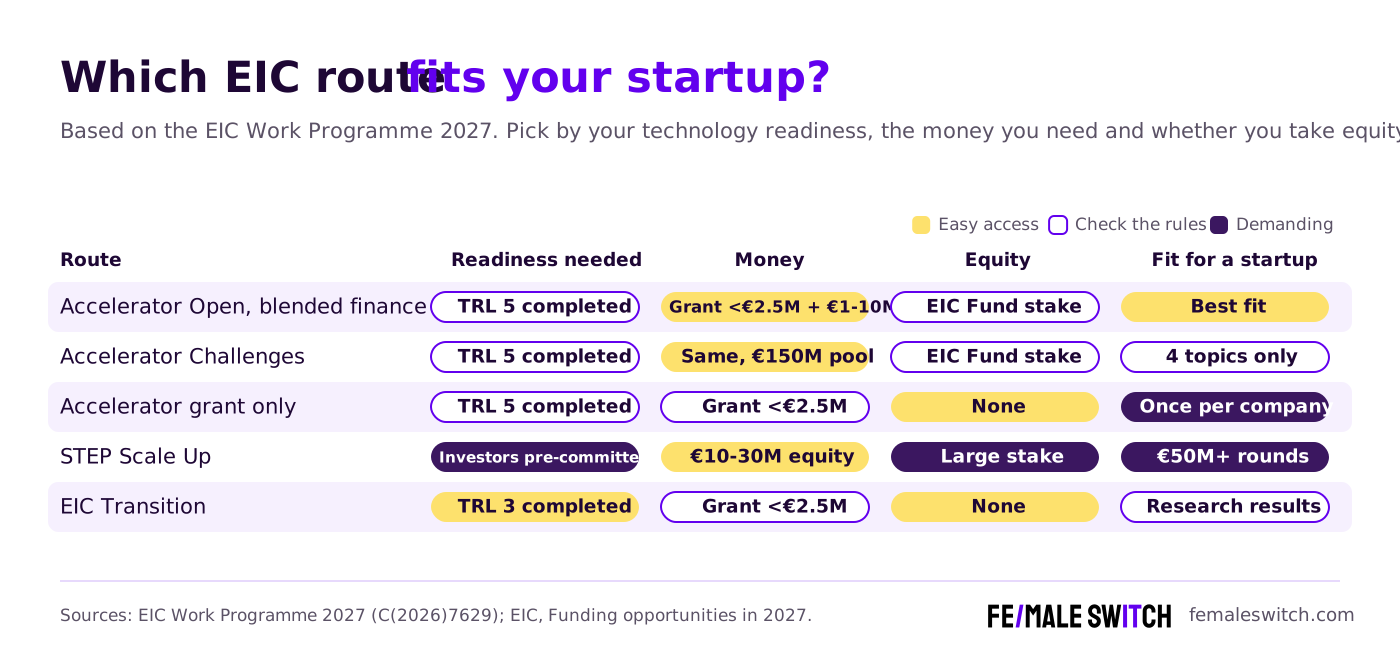
What the money looks like: a worked example
A generic medtech startup has a sensor validated in a hospital (TRL 5 done) and plans 24 months of clinical validation, certification and tooling.
The 30% co-funding is the line founders forget; the work programme lets the investment component help co-finance it. Equity terms are negotiated case by case, so model dilution as for any venture round. Our guide to startup funding in Europe shows how EIC money sits next to angels and VCs.
Before you apply: a scored readiness check
Give yourself one point for each line you can prove with a document, not a promise:
- All of TRL 5 is completed and you can show the validation report.
- Your innovation is deep tech: a clear scientific or technical advance, not only a business model.
- You have filed IP or have a written IP strategy and know your freedom to operate.
- You can size your market with sources and name your first paying customers or pilots.
- Your team covers tech, business and finance, and you know your skill gaps.
- You have talked to investors and can show early interest.
- You can fund 30% of the grant budget or explain how it is covered.
- You have up-to-date financials and a clean cap table.
- You have not already used two of your three Accelerator submissions.
- You can spend about two months on the full proposal.
8–10: submit a short proposal now and aim for the March or September batch. 5–7: fix the gaps first; start with IP and investor traction. 0–4: look at earlier-stage options on the EU funding readiness checklist.
Copyable short-proposal outline
Reuse it: the short proposal is designed so its content carries into the full proposal. For writing tips, read our guide on writing an EU grant proposal.
Who should apply and who can skip it
Apply if you have a validated deep-tech innovation, a team that can scale it, curious investors, and patience for a process of six months or more.
Skip it for now if you are below TRL 5, your product is software without a technical breakthrough, you need money within three months, or you can't fund 30% of the grant budget. Start with cascade funding open calls or other European funds for startups instead.
Related EU funding guides
- EU grants for startups: programme map, deadlines and decision tree
- Seal of Excellence: what the EU quality label is worth
- Women TechEU: eligibility, timeline and how to apply
- EU grant calendar 2027 for startups
- The EU funding labyrinth: a critical analysis for startups
- EIC Pathfinder: can a startup join a deep tech research consortium?
- EIC Transition: turning a research result into a startup with EU money
- European Prize for Women Innovators: who wins, what it pays and how to apply
For new EU calls every month, read Mean CEO's EU Funding News on blog.mean.ceo. To test your business model before you pitch to a jury, play the Fe/male Switch startup game.
FAQ
What are the EIC Accelerator 2027 cut-off dates?
Full proposals are batched on 20 January, 17 March, 1 September and 4 November 2027 at 17:00 Brussels time. Short proposals can go in at any time. Jury interviews follow the March and November batches.
How much funding can a startup get from the EIC Accelerator?
A grant below €2.5 million covering up to 70% of eligible costs, and an equity investment from €1 million to €10 million from the EIC Fund. You can ask for both (blended finance), grant only or investment only.
What is the EIC Accelerator budget for 2027?
€578 million: €428 million for the Open call and €150 million for four Challenges. About €347 million of it is for investment components. EIC STEP Scale Up has a separate €290 million.
Can I apply to the EIC Accelerator without a consortium?
Yes. Startups and SMEs apply alone. Individuals can apply before founding, as long as the company exists by the full proposal.
How many times can I apply to the EIC Accelerator?
Three unsuccessful submissions since 1 January 2024, at any stage, end your chances under Horizon Europe. Reapply only after real improvements.
Is the EIC Accelerator 2027 work programme adopted?
Yes. The European Commission adopted the EIC Work Programme 2027 on 5 November 2026. Interview dates are still indicative and will be published on the EIC website.
About the Author
Violetta Bonenkamp, also known as MeanCEO, is an experienced startup founder with an impressive educational background including an MBA and four other higher education degrees. She has over 20 years of work experience across multiple countries, including 5 years as a solopreneur and serial entrepreneur. Throughout her startup experience she has applied for multiple startup grants at the EU level, in the Netherlands and Malta, and her startups received quite a few of those. She’s been living, studying and working in many countries around the globe and her extensive multicultural experience has influenced her immensely.

