

TL;DR: Startup funding Europe-wide comes from three layers that work best together: private money (customers, business angels, venture capital), EU money you apply for (EIC Accelerator, Women TechEU, cascade funding open calls) and EU money hidden inside private products (bank loans guaranteed under InvestEU, VC funds backed by the European Investment Fund). The order matters. Some EU grants shut the door once you raise too much equity, and others expect investors next to them. Below: a side-by-side comparison, a stage-by-stage sequence, the rules where EU and private money collide, a worked 18-month example, a copyable funding plan and the 2026–2027 deadlines.
Most founders treat EU grants and investors as two separate worlds. The startups that get the most out of Europe stack them: a grant pays for the risky technical step, an angel round pays for the team, and an EU-guaranteed loan pays for equipment.
This guide shows where each piece fits. For the full programme map, see our EU grants for startups page.
The three layers of startup funding in Europe

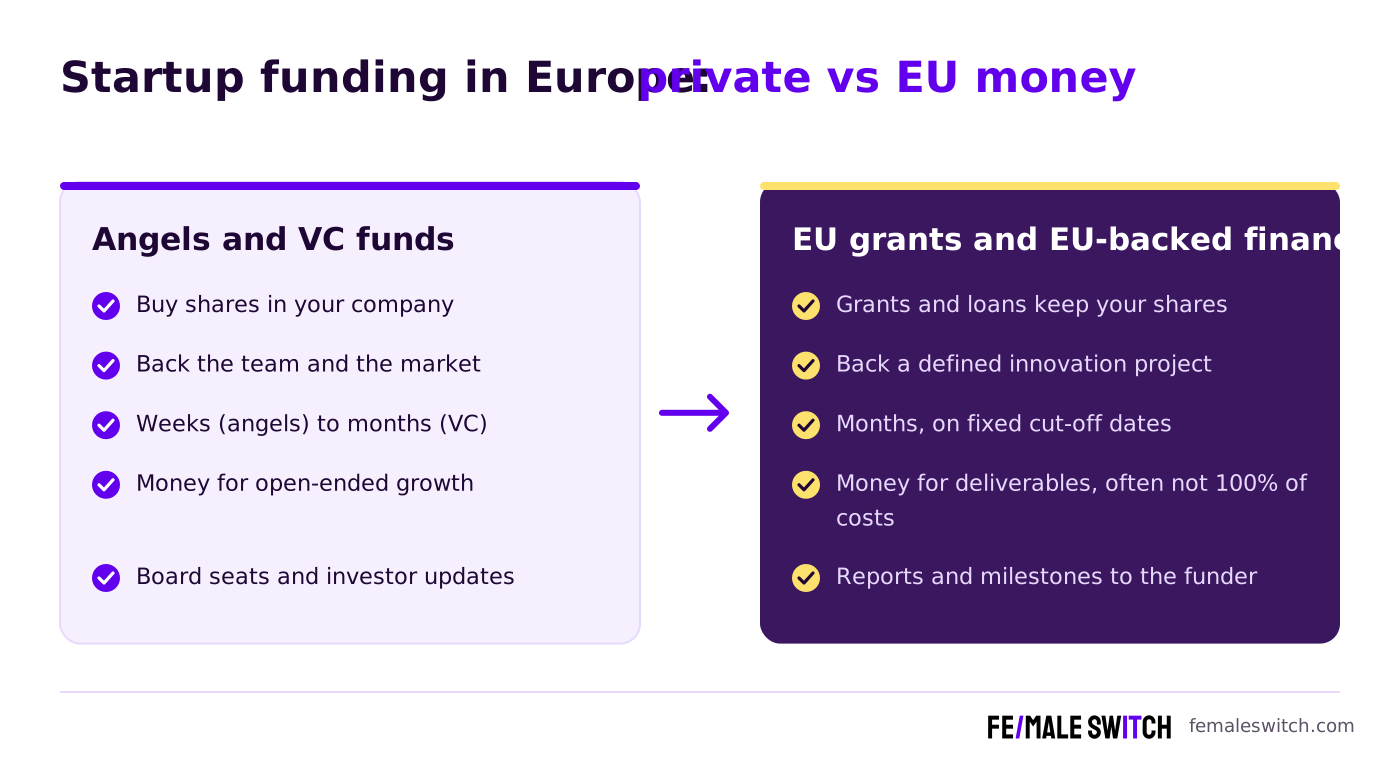
Layer 1: private money. Customers and your own savings come first, then business angels, then venture capital funds. Angels decide fast and invest their own money. VC funds invest other people's money, so they need a large market and a path to a big exit. Both buy shares.
Layer 2: EU money you apply for. This is equity-free money in exchange for a project, plus EU equity in some cases. According to the European Innovation Council, the EIC Accelerator pays a lump-sum grant below €2.5 million for innovation work at technology readiness levels 6 to 8, and can add an equity investment of €1 million to €10 million from the EIC Fund. Women TechEU gives €75,000 to women-led deep tech startups. Cascade funding open calls, run by EU-funded projects, usually pay up to €60,000 per company for a pilot.
Layer 3: EU money inside private products. You never fill in an EU form for this layer. The European Investment Fund guarantees bank loans and invests in venture capital funds, backed by the InvestEU programme. A loan with lower collateral thanks to an "EU guarantee" is EU money.
Where EU money fits at each stage
The question is not "grants or investors?" but "which one pays for the next proof point?". Each stage below has one private source and one EU source that complement each other.
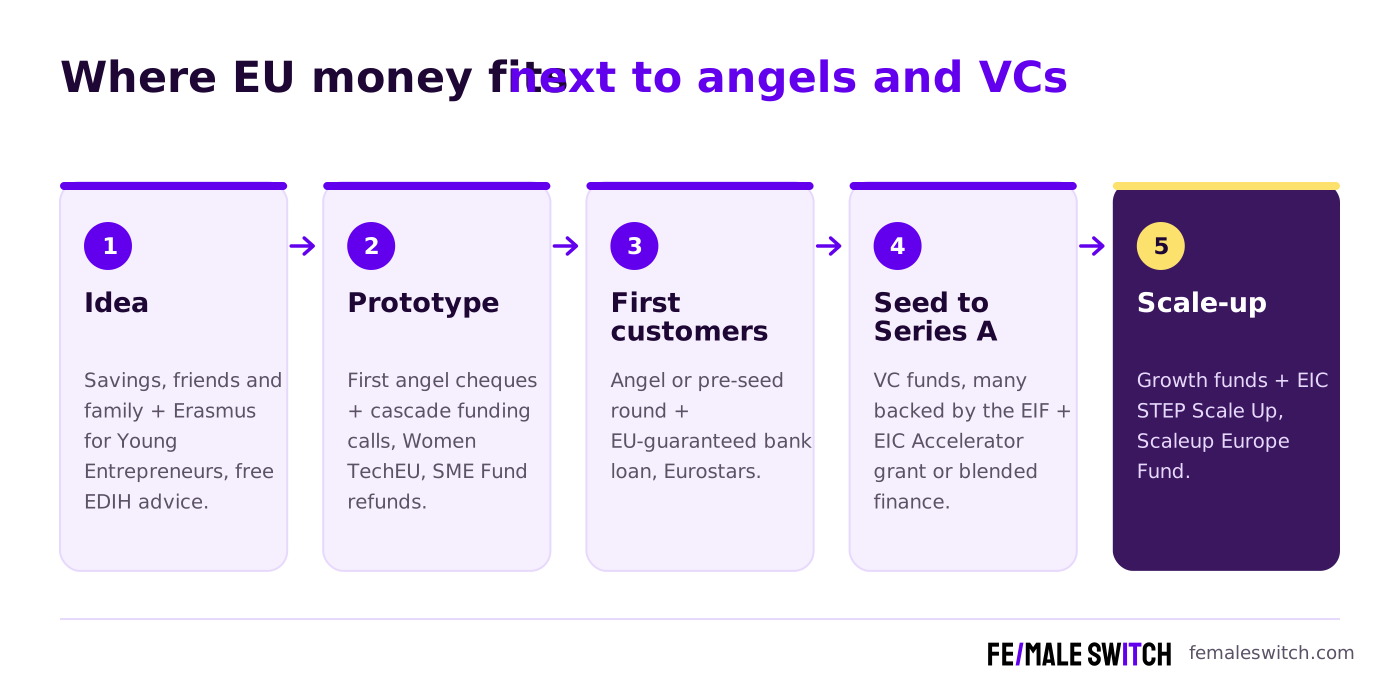
At the top end, the EIC says the Scaleup Europe Fund targets about €5 billion, with EQT as fund manager and tickets of €100 million and above. For most founders, the decisions that matter now sit in the first three rows.
Where EU money and private investors collide
This is the part generic funding guides skip. EU programmes have rules that react to your cap table, and investors react to your grants.
1. Raising too much equity can close a grant. Women TechEU only accepts companies that have raised less than €1 million in equity, and business angel money, VC money and convertible loans or SAFEs (once the cash is in) all count. If you are a woman-led deep tech startup close to that line, apply before your round closes, not after.
2. The EIC can become your shareholder. With EIC Accelerator blended finance, the EIC Fund invests next to the grant, so a public investor joins your cap table. You can also ask for the grant only or the investment only. UK applicants are limited to the grant only, according to the EIC.
3. Grants rarely pay 100%. Horizon Europe innovation actions pay up to 70% of costs for for-profit companies, and most calls expect you to cover the rest. That gap is where angel money, revenue or a bank loan comes in. Plan the co-funding before you write the proposal, not after you win.
4. Grant timelines don't match runway. The EIC batches full EIC Accelerator proposals on fixed cut-off dates and only invites proposals scoring at least 13 out of 15 to an interview. A startup with four months of cash can't wait for that.
5. Grants are a signal, not a substitute. Independent evaluators scored your project, which investors notice. But a grant pays for fixed deliverables, not open-ended growth.
6. Women founders face a bigger private gap. According to the European Commission, only 2–4% of venture capital raised in Europe went to female-only founder teams, and men account for more than 85% of decision-makers in venture capital. Under InvestEU, the Commission sets gender criteria for the funds it backs, and the EIC says it particularly welcomes EIC Accelerator applications from companies with female CEOs. For women-led teams, the EU layer is often the faster first cheque.
Want a structured way to judge your readiness before you choose? Our EU funding readiness checklist scores you out of 50.
Worked founder example: an 18-month funding mix
A three-person, woman-led agritech startup in Spain is building a soil sensor. It has a lab prototype, one farming cooperative ready to test it and €40,000 of the founders' own money. The amounts below are an illustration of how a team like this could combine the layers, not a promise of what any funder will give.
Three choices make this plan work:
- Women TechEU before the angel round, so the €1 million equity limit is never at risk.
- The angel round pays for co-funding: the people and costs the grants don't cover.
- The EIC Accelerator comes last, when the team has pilot data, a paying customer and private investors.
Copyable funding plan template
Fill this in before you talk to any funder. It forces you to match each source to one proof point.
The EU grants writing guide helps when you reach the proposal stage.
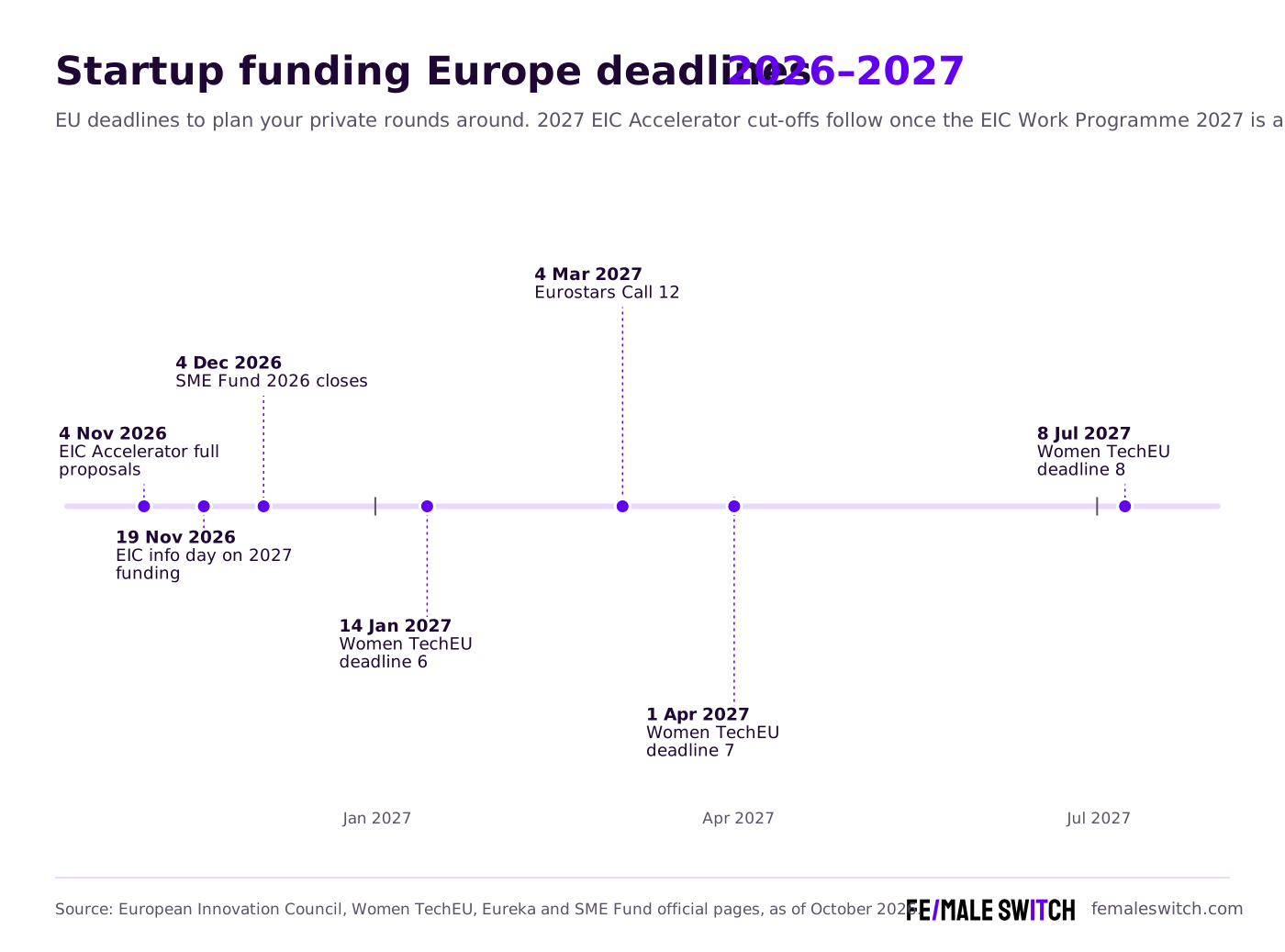
Key deadlines for 2026–2027
Dates confirmed on official pages as of October 2026. The EIC Work Programme 2027 is still a draft, so 2027 EIC Accelerator cut-offs are not final yet.
EIC Accelerator short proposals can be sent at any time; the EIC batches them on the first Tuesday of each month. Cascade funding calls open all year: our guide on how to find open EU funding calls shows where to look, and Mean CEO's EU Funding News lists new calls every month.
Who should apply and who can skip it
Mix EU money with private money if you are building something new enough to win a grant, you are in the EU or a Horizon Europe associated country, and you can plan 12 to 18 months ahead.
Skip EU grants for now if you need cash within weeks, your innovation is a business model rather than technology, or nobody on the team can spend two to three months on proposals. Start with customers and angels, and consider an EU-guaranteed loan through your bank.
Related EU funding guides
- EU grants for startups: programme map, deadlines and decision tree
- European funds for startups: the 2027 map of EU grants, equity and loans
- Cascade funding explained: how startups win EU open calls
- Women TechEU: eligibility, timeline and how to apply
- EU funding readiness checklist for startups
- How to find open EU funding calls for startups
- NGI open calls: funding for open-source and internet startups
- The EU funding labyrinth: a critical analysis for startups
- Call for evaluators 2027: how to become a paid EU expert evaluator
- Erasmus for Young Entrepreneurs: a funded stay with a host abroad
Want to test your startup before you pitch it to angels or to Brussels? The Fe/male Switch startup game lets you build a startup step by step with an AI co-founder.
FAQ
How do startups get funding in Europe?
From three layers: private money (customers, angels, VCs), EU money you apply for (EIC Accelerator, Women TechEU, cascade funding calls) and EU money inside private products (InvestEU-guaranteed loans, EIF-backed VC funds). Most funded startups combine at least two.
Should I raise from angels or apply for an EU grant first?
It depends on the next proof point. If you need fast cash for the team, angels come first. If you need to fund a risky technical step and can wait a few months, a grant comes first. Check equity limits: Women TechEU only accepts companies with less than €1 million in equity.
Can I get an EU grant if I already have investors?
Yes, for most programmes. The EIC Accelerator even pairs its grant with equity from the EIC Fund. Some early-stage programmes cap the equity you have raised, such as Women TechEU at €1 million, so read the eligibility rules of each call.
Does the EU invest in startups directly?
Yes. The EIC Fund invests €1 million to €10 million alongside EIC Accelerator grants, EIC STEP Scale Up up to €30 million, and the Scaleup Europe Fund €100 million and above in growth-stage companies.
How do I find EU-backed loans and VC funds in my country?
Use the European Commission's Access to Finance portal on Your Europe. It lists more than 1,000 financial institutions working with EU-backed financing, by country and type of finance. The bank or fund, not the EU, decides on your file.
Is startup funding in Europe harder for women founders?
The private side is. According to the European Commission, only 2–4% of venture capital raised in Europe went to female-only founder teams. EU programmes try to close that gap: Women TechEU funds women-led deep tech startups, and the EIC welcomes applications from companies with female CEOs.
About the Author
Violetta Bonenkamp, also known as MeanCEO, is an experienced startup founder with an impressive educational background including an MBA and four other higher education degrees. She has over 20 years of work experience across multiple countries, including 5 years as a solopreneur and serial entrepreneur. Throughout her startup experience she has applied for multiple startup grants at the EU level, in the Netherlands and Malta, and her startups received quite a few of those. She’s been living, studying and working in many countries around the globe and her extensive multicultural experience has influenced her immensely.

