

TL;DR: Interreg is the EU's programme for cooperation across borders, with almost €10 billion for 2021–2027 spread over almost 100 programmes. Companies rarely get Interreg money alone: they join a project as a partner, apply to a cross-border SME call, or receive a small grant from a small project fund. By late 2026 most programmes have committed their money, so the smart move now is to catch the last SME calls and get into position for 2028–2034. Below: a route decision tree, a partner-readiness score, a pitch template for lead partners, a worked example and a 2025–2029 calendar.
Interreg is not one fund with one deadline, and that is why most founders give up on it. Each programme covers its own border area or group of countries, writes its own rules and opens its own calls. The pages that rank for "interreg" are the programmes' own sites and the European Commission's overview, written for regional authorities, not for a ten-person company. This guide translates them.
All facts come from the European Commission's Interreg pages, Interact (the Interreg programme that runs interreg.eu and keep.eu), and the official sites of Interreg Europe, Interreg Central Europe, Interreg North-West Europe, Interreg Greece–Bulgaria and the Interreg IPA Bulgaria–Serbia programme (via the Serbian Ministry of European Integration), checked on 15 November 2026.
What Interreg is, in founder terms
Interreg, officially European Territorial Cooperation, is part of EU cohesion policy and is paid for by the European Regional Development Fund. Its job is to solve problems that stop at a border: a shared river, a tourist region split in two, a labour market cut by a frontier. The European Commission splits it into four strands:
Source: European Commission, "Interreg: European Territorial Co-operation".
The money is a grant that refunds part of your costs. Interact says Interreg pays up to 80% EU co-financing at programme level, and 85% for outermost regions and cross-border cooperation on external borders. Each programme then sets its own rate, often lower, and you usually pay first and claim later.
The three ways a company gets Interreg money
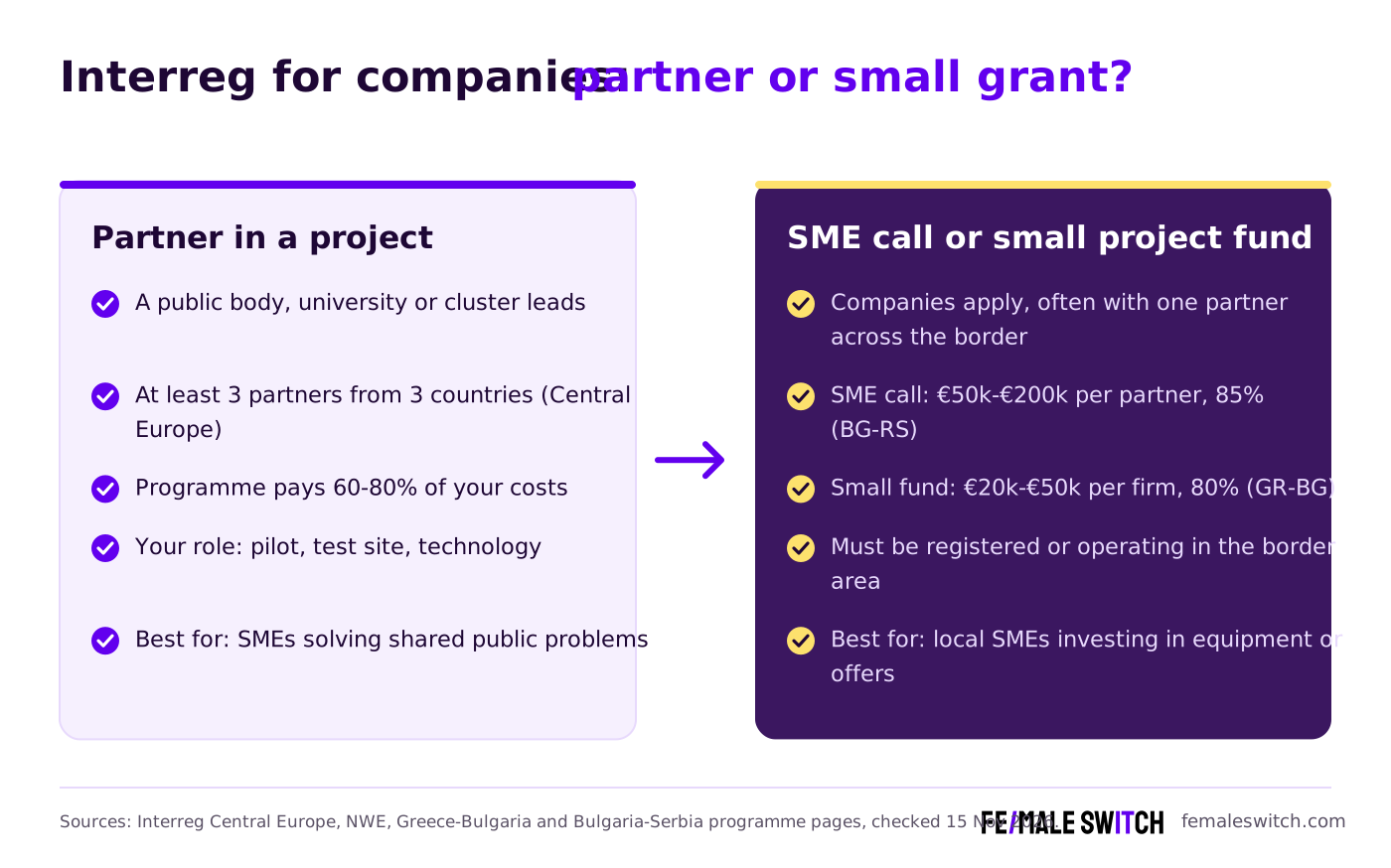
1. As a partner in a cooperation project. A public body, university or cluster leads, and your company joins as one of several partners from different countries. Interreg Central Europe lists "private institutions, including private companies, having legal personality" as eligible partners and asks for at least three partners from three countries. Interreg North-West Europe says SMEs and business support organisations are "encouraged to join partnerships" and pays 60% of costs, so you fund the other 40%.
2. Through a cross-border SME call. Some cross-border programmes run calls for companies only. The Interreg IPA Bulgaria–Serbia second SME call (closed 31 March 2026) funded projects of €100,000 to €400,000 with at least one SME from each country, €50,000 to €200,000 per partner, 85% EU grant, and at least 60% of the budget spent on investments such as equipment, digitalisation and new technologies.
3. As a final recipient of a small project fund. A regional authority holds the grant and passes small amounts to local businesses, much like the cascade funding used in other EU programmes. The Interreg Greece–Bulgaria fifth small project fund call (15 May to 22 June 2026) offered €20,000 to €50,000 per enterprise, from a €2.8 million call at an 80% EU rate, for companies registered and operating in the border area for at least two years, in the culture and tourism value chain.
Where things stand in late 2026
Interreg 2021–2027 is near the end of its money. What the programmes say themselves:
- Interreg Europe (€394 million, 262 projects, 36 countries): "All our funds have been committed. We are not planning any more open calls." Its partners are policy organisations, not companies.
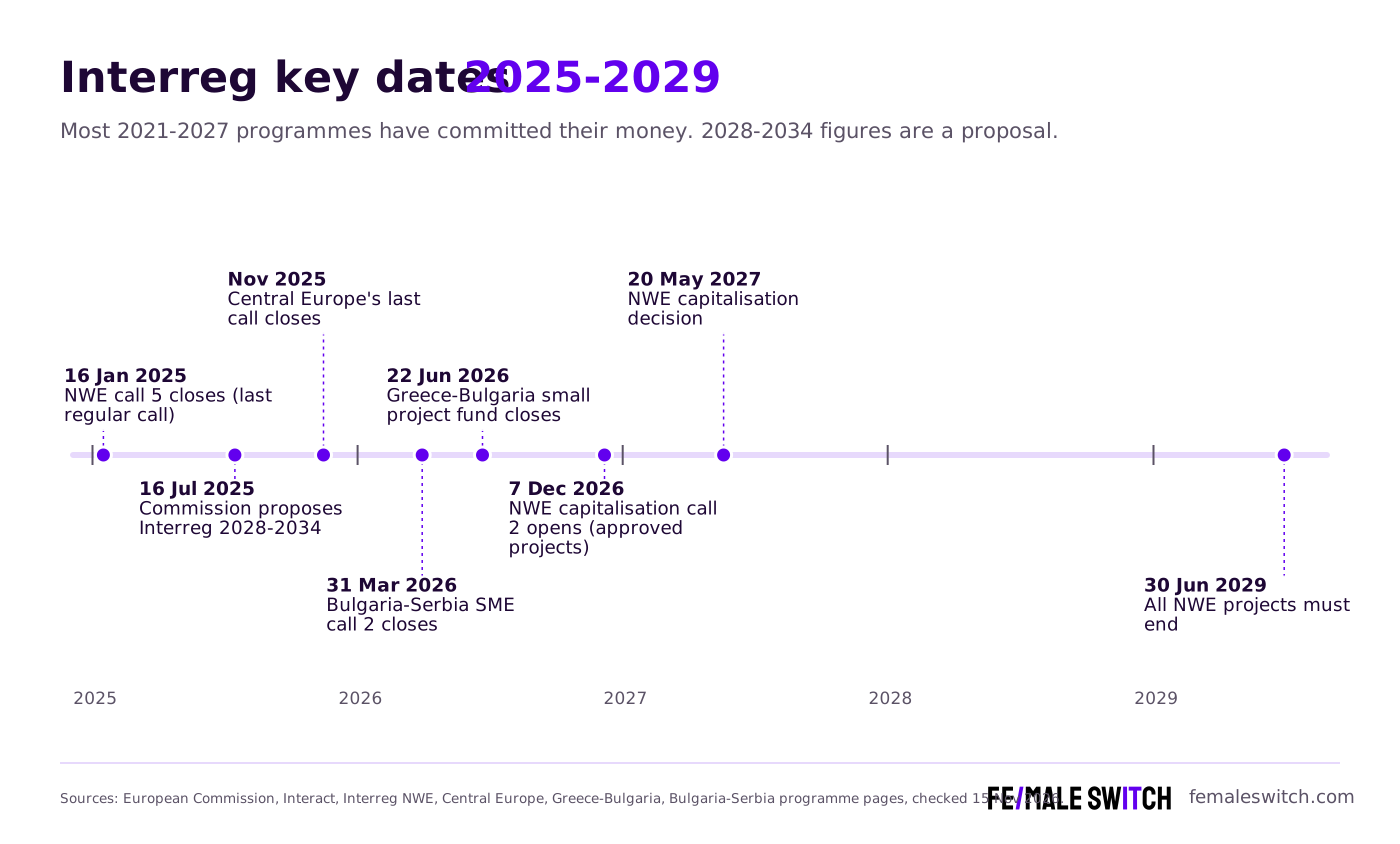
- Interreg Central Europe (€207 million ERDF): 100% allocated. Its strategic call closed in November 2025 and was "the last call of this funding period"; 25 projects with €23.2 million were approved on 21 May 2026.
- Interreg North-West Europe (€310 million, 91 projects, 969 partners): call 5, closed 16 January 2025, was the last regular call. A second capitalisation call is listed for 7 December 2026, but it is open only to projects already approved in 2021–2027. All projects must end by 30 June 2029.
So for most founders, the 2026–2027 work comes down to three things: joining an approved project that needs a company for its pilots or capitalisation phase, watching cross-border programmes that still run SME calls or small project funds in your region, and building the relationships that will matter when the 2028–2034 programmes open.
The 2028–2034 proposal
The European Commission published its proposal for the next long-term budget on 16 July 2025. According to Interact, it keeps the four strands "with the same definitions", proposes €10.2 billion in current prices (the Commission rounds it to "an increased budget of EUR 10 billion"), keeps the 80% and 85% co-financing rates and replaces separate strategies with one "Interreg Plan" for all of Interreg. It is still a proposal: the Council and the European Parliament negotiate it, and the long-term budget needs unanimity in the Council. Treat every 2028–2034 figure as draft until adopted.
Decision tree: which Interreg route fits your company?
Partner-readiness worksheet: score yourself
Give each line 0, 1 or 2 points.
11–14 points: contact lead partners and programme secretariats now. 6–10: start with a small project fund or a pilot role in someone else's project. Under 6: build a public-sector track record first, for example through innovation vouchers.
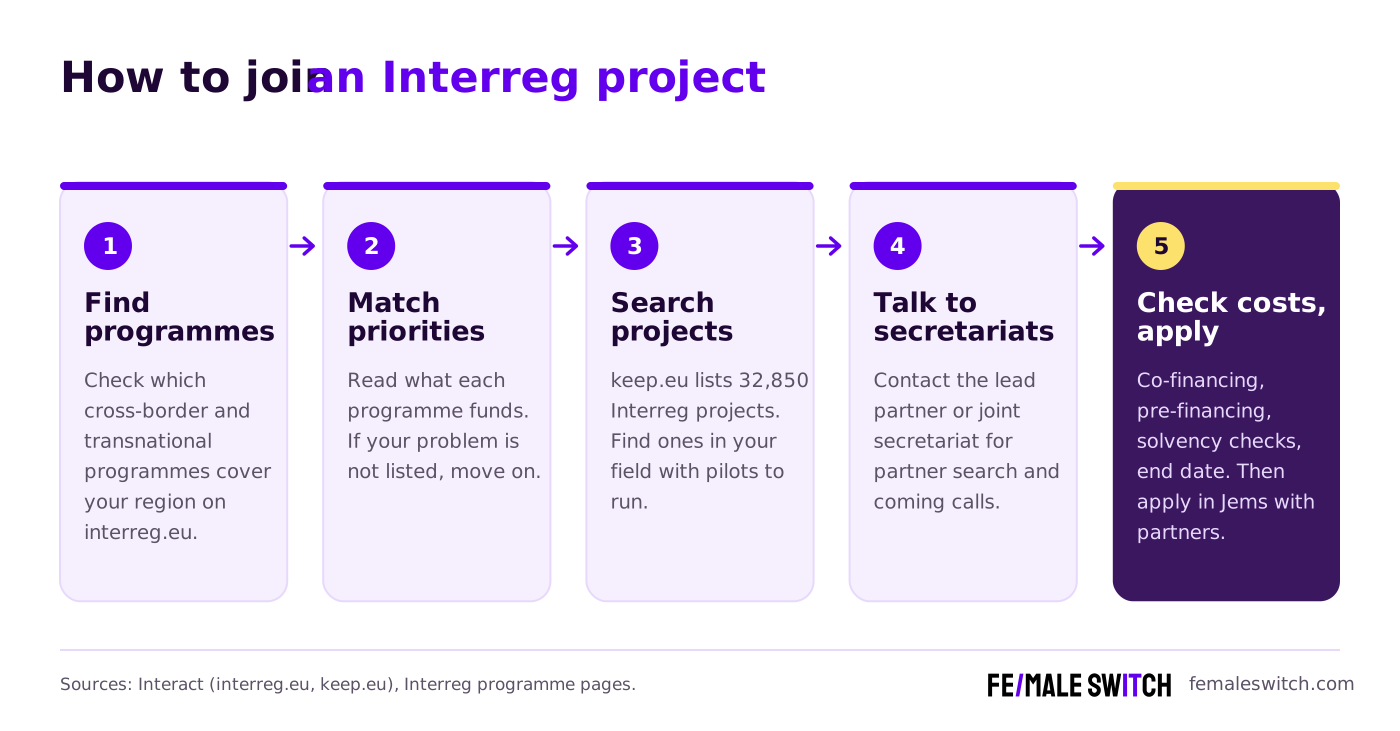
How to join an Interreg project, step by step
- Find your programmes. Check which cross-border and transnational programmes cover your region on interreg.eu.
- Read the priorities. Each programme lists the problems it funds. If yours is not there, move on.
- Search approved projects. keep.eu, run by Interact, lists 32,850 Interreg projects and 157,401 partnerships since 2000. Look for projects in your field with pilots still to run.
- Contact the lead partner or the joint secretariat. Secretariats help with partner search and tell you about calls before they open.
- Check the costs and rules. Co-financing share, pre-financing, solvency checks for private partners, and the end date.
- Apply through the programme's system, usually Jems, with your partners.
Copyable template: pitch to a lead partner
Worked example: a small tourism tech company on a border
A generic example. A six-person company in a Greek border region builds a booking and audio-guide app for small museums and wineries. It has traded for three years.
- Route chosen: the small project fund, because it is under €50,000, local, and in the culture and tourism value chain the fund targets.
- Budget: €45,000 for app features in Bulgarian, two new routes and marketing. At an 80% rate the grant is €36,000; the company funds €9,000 and pre-finances costs until claims are paid.
- The catch: the fund's window was five weeks long (15 May to 22 June 2026). The company that had quotes, accounts and a route plan ready applied; the one that heard about it in June did not.
- Next step: the company asks the joint secretariat about the next fund round, and offers its app as a pilot to an approved cooperation project on cultural tourism, to build the track record that will count in 2028–2034.
Interreg key dates 2025–2029
Some dates are listed as indicative by the programmes. For monthly news on new EU calls, follow Mean CEO's EU Funding News on blog.mean.ceo, and use our guide on how to find open EU funding calls.
Who should apply and who can skip it
Apply if you are an established SME in a border region, your product solves a problem public bodies share across the border, you can pay 15–40% of costs yourself and wait for refunds, and you are happy to work in a partnership.
Skip it if you are a pre-revenue startup that needs fast, flexible money, your market is global rather than regional, or you cannot handle timesheets and cost claims. Look at EU grants for small businesses, Eurostars or the EU funding readiness checklist first. When you do write a proposal, use our guide to writing an EU funding application.
Related EU funding guides
Want to practise building partnerships and pitching before you need them? Play the Fe/male Switch startup game.
FAQ
What is Interreg?
Interreg, or European Territorial Cooperation, is the EU programme that funds cooperation between regions and countries. It has almost €10 billion for 2021–2027 across almost 100 programmes in four strands: cross-border, transnational, interregional and outermost regions.
Can a private company get Interreg funding?
Yes, but usually as a partner in a project, not alone. Programmes such as Interreg Central Europe accept private companies with legal personality as partners, and some cross-border programmes run SME calls or small project funds for local businesses.
How much does Interreg pay?
Up to 80% of eligible costs at programme level, and 85% for outermost regions and external borders. Programmes set their own rates: Interreg North-West Europe pays 60%, the Bulgaria–Serbia SME call paid 85%, and the Greece–Bulgaria small project fund 80%.
Are there open Interreg calls for SMEs in 2027?
Few. Interreg Europe and Interreg Central Europe have committed all their 2021–2027 money, and North-West Europe's remaining calls are only for approved projects. Check your cross-border programme for small project funds and SME calls, and watch for the 2028–2034 programmes.
What is the difference between Interreg A, B, C and D?
A is cross-border cooperation between neighbouring regions, B is transnational cooperation over large areas, C is interregional cooperation and knowledge sharing across the EU, and D covers the outermost regions and their neighbours.
What happens to Interreg after 2027?
The Commission proposed about €10 billion for 2028–2034, with the same four strands, the same co-financing rates and one Interreg Plan. The Council and the European Parliament are still negotiating it.
About the Author
Violetta Bonenkamp, also known as MeanCEO, is an experienced startup founder with an impressive educational background including an MBA and four other higher education degrees. She has over 20 years of work experience across multiple countries, including 5 years as a solopreneur and serial entrepreneur. Throughout her startup experience she has applied for multiple startup grants at the EU level, in the Netherlands and Malta, and her startups received quite a few of those. She’s been living, studying and working in many countries around the globe and her extensive multicultural experience has influenced her immensely.

