

TL;DR: Eurostars is the Eureka programme that funds R&D projects run by innovative SMEs together with at least one partner in another country, co-funded by the EU through Horizon Europe. The next deadline is Call 12 on 4 March 2027 (opens 17 December 2026). There is no single Eurostars grant: each partner is paid by its own national agency, typically 50–60% of R&D costs for an SME, with caps such as €500,000 for the Dutch share or €360,000 per project in the UK. It is worth it if you already have a real partner abroad and can co-fund the rest; it is a poor fit if you are looking for a partner just to qualify. Below: a timeline, a fit worksheet, a budget table, a worked example and a copyable partner email.
Eurostars is often sold to founders as "the easy EU grant for SMEs", yet it is a demanding joint call run by the Eureka network, and strictly speaking a set of national grants: you apply once as an international consortium, independent experts score the project, and then every partner signs a separate funding agreement with its own national agency, under that country's rules.
That design makes Eurostars a good deal for some startups and a waste of three months for others. This guide helps you tell which one you are, using rules from Eureka, the Netherlands Enterprise Agency (RVO), Austria's FFG, Innovate UK and the Research Council of Norway, checked on 27 October 2026.
What Eurostars is, in plain words

Eurostars is part of the European Partnership on Innovative SMEs, co-funded by the European Union through Horizon Europe and run within Eureka, an intergovernmental network of national innovation agencies. The current edition, Eurostars-3, runs under the EU's 2021–2027 budget, with two cut-offs a year.
The programme funds market-oriented R&D in any civil field: software, medtech, cleantech, materials, food, anything. There are no topics to match. What matters is that the project leads to a new product, process or service that the partners will sell soon after the project ends.
Eureka's figures show the scale. Its March 2026 call (Call 10) received 687 applications, most from Germany, Switzerland, the Netherlands and the United Kingdom. In the latest call with published results, Eurostars supported 110 projects with 328 organisations from 28 countries. The two figures come from different calls, so they don't give an exact success rate, but the message is clear: most consortia that apply are not funded.
The seven eligibility rules
Every Eurostars project must meet all seven international criteria, according to Eureka and the national agencies:
- The consortium is led by an innovative SME from a Eurostars country.
- It has at least two independent organisations.
- They come from at least two Eurostars countries, at least one of them an EU member state or Horizon Europe associated country.
- SMEs from Eurostars countries carry at least 50% of the total project cost, not counting subcontracting.
- No single partner or country carries more than 70% of the budget.
- The project lasts 36 months or less.
- It focuses exclusively on civil applications.
Then come national rules, and these decide whether you actually get money. Some examples:
- Netherlands (RVO): universities and research institutes are funded only if a Dutch company is in the consortium; only R&D costs count, not marketing or management.
- Norway (Research Council of Norway): a Norwegian SME needs at least NOK 500,000 in equity at the deadline, may submit only one application per call and may take part in at most two running Eurostars projects.
- United Kingdom (Innovate UK, Call 10 terms): only SMEs are funded; the company must have been registered for at least 12 months before the deadline, and can have only one live Eurostars project at a time.
- Cyprus, Italy and Israel set no budget for Call 12, so partners from those countries can join only with their own money, according to RVO.
Eurostars Call 12 timeline: 4 March 2027
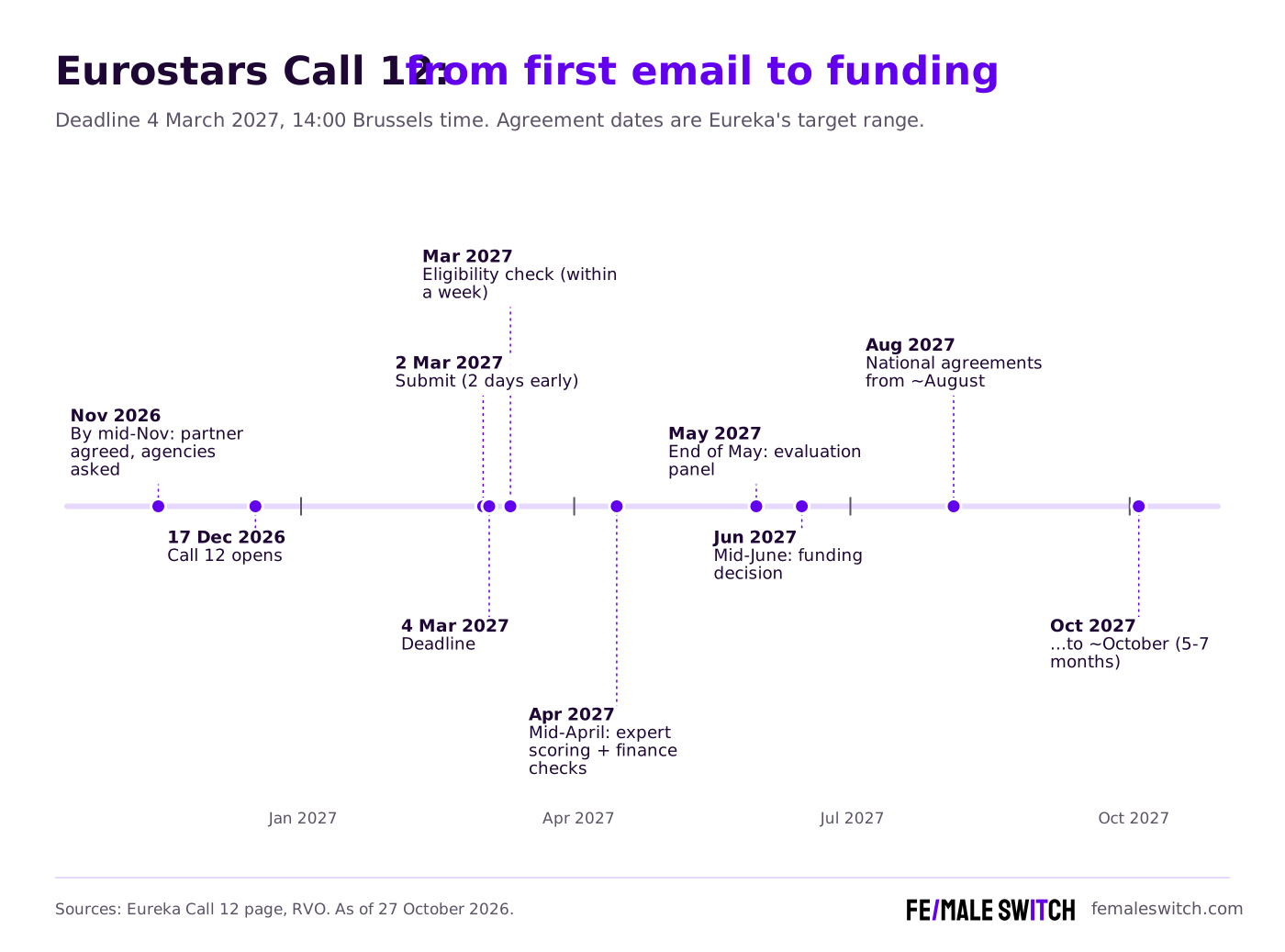
Sources: Eureka Call 12 page and call document, RVO, 27 October 2026.
Only projects among the best 200 after the remote expert evaluation go to the panel, and every partner must pass its national financial check. You cannot start the project before the approval notice, so count on money arriving nine months or more after you begin writing.
The previous round, Call 11, closed on 10 September 2026; its applicants expect results by mid-December 2026. Eurostars has run two cut-offs a year, but no date after 4 March 2027 had been announced on 27 October 2026, and the next EU research programme starts in 2028 under new rules. Treat Call 12 as the date to plan for, not a backup.
How much money does Eurostars pay?
There is no Eurostars amount. Each partner gets what its own country pays, up to its own cap, and only if its national budget stretches that far after the ranking. Rates are maximums, not promises.
Sources: RVO, FFG, Innovate UK, Research Council of Norway, 27 October 2026. Check your own country's agency before you build the budget.
Two things follow. First, you co-fund 40–50% of your own costs, in cash or staff time. Second, a partner whose country runs out of budget can hold up the whole consortium, so ask every partner to talk to its agency before you write.
Is the consortium route worth it? A scored worksheet
Score each line 0 (no), 1 (partly) or 2 (yes). Be honest; the experts will be.
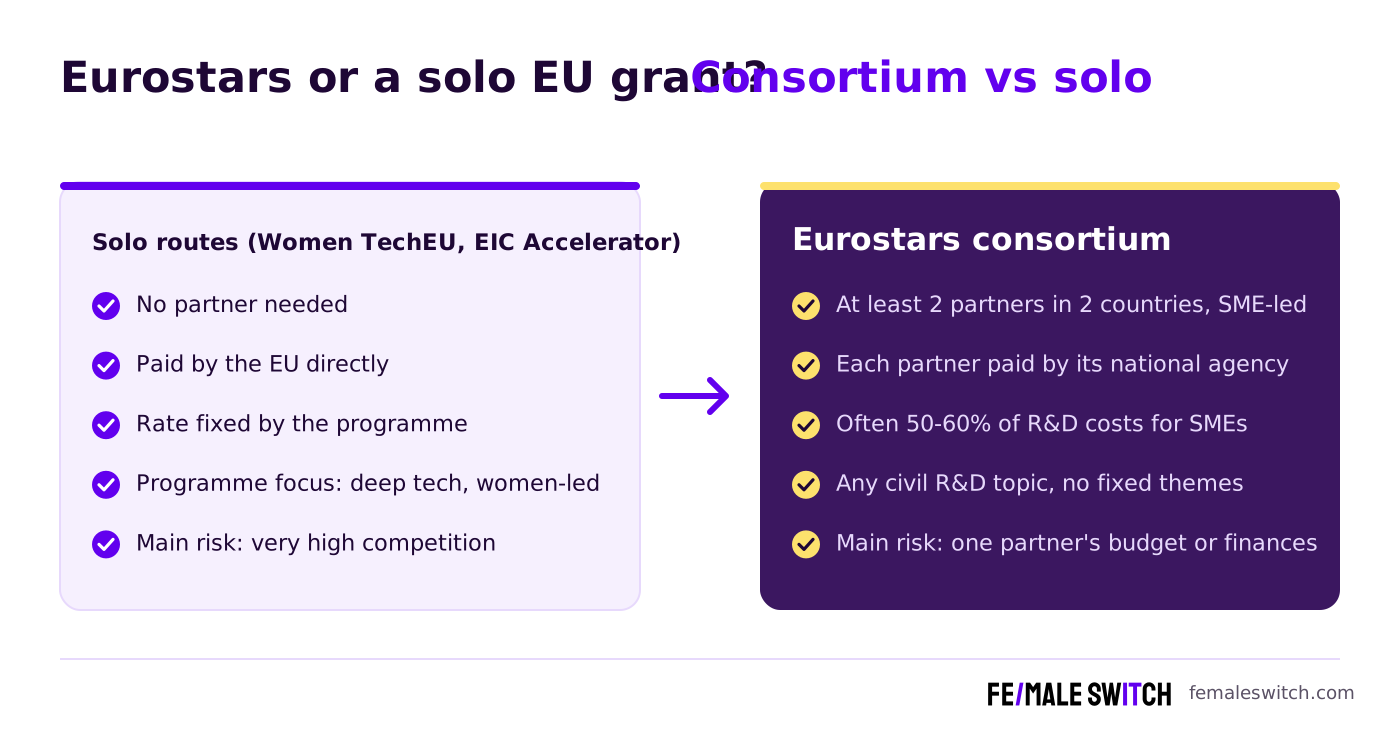
9–12: go. Eurostars fits, and the consortium is an asset, not a cost. 5–8: maybe. Fix the weakest line first, often the partner or the co-funding. 0–4: skip. A forced partnership shows in the proposal. Look at solo routes instead: the Women TechEU programme for early women-led deep tech, the EIC Accelerator for a scaling single company, or the cascade funding open calls for smaller, faster grants.
Worked example: a two-country medtech consortium
A generic case, not a real company: a 12-person Dutch software SME builds an AI tool that reads ultrasound images. A small Austrian company makes the probe hardware. Together they want a tested product in 30 months.
The checks: an SME leads; two countries; SMEs carry 100% of the budget; the Dutch share is 60%, under the 70% limit; 30 months is under 36. The Dutch grant stays under RVO's €500,000 cap.
Now swap the Austrian partner for a UK SME with €700,000 of costs. At 60%, it would earn €420,000, but Innovate UK caps UK funding at €360,000 per project, so the UK partner covers €340,000 itself. This is why you check caps before you split the work.
Plan backwards from 4 March 2027
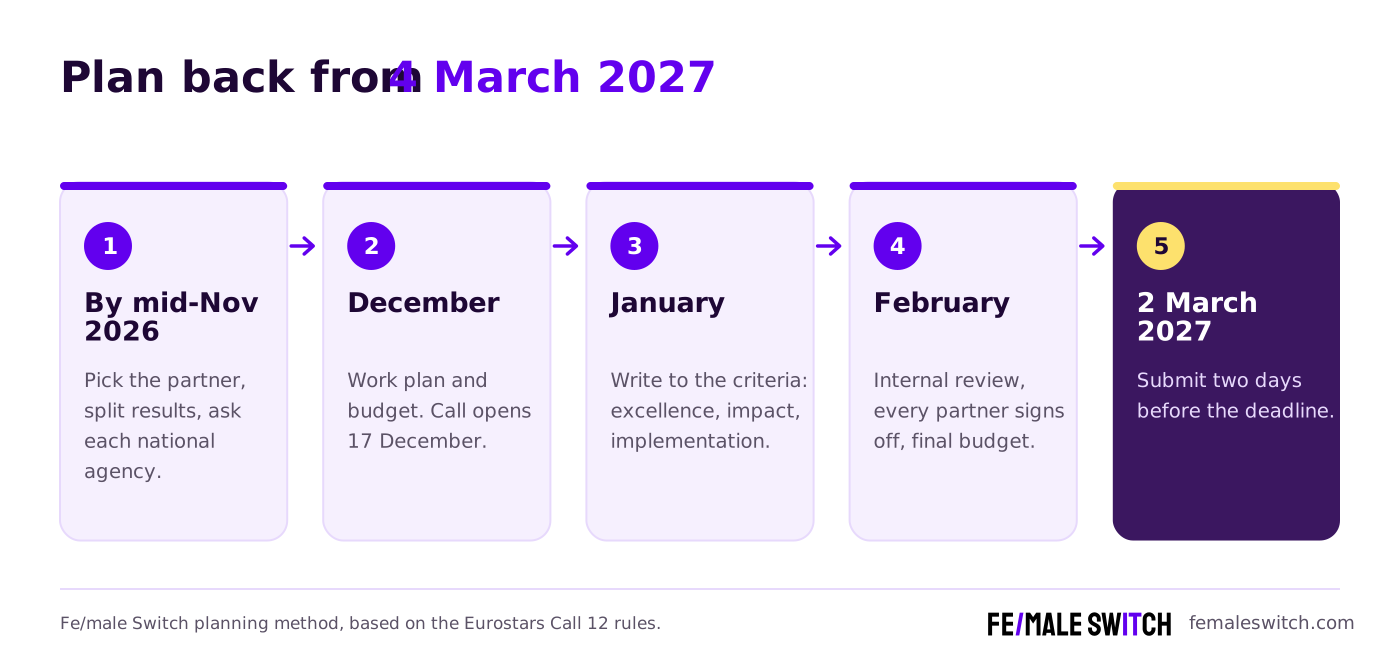
- Now to mid-November 2026: pick the partner, agree who owns which results, and ask each national agency whether it funds your partner type.
- December 2026: write the work plan and budget; Call 12 opens on 17 December. Norwegian coordinators who submit four weeks early can claim the NOK 100,000 project-establishment support if they reach a minimum average score of 3.6.
- January 2027: draft the proposal around the three criteria (excellence, impact, quality and efficiency of implementation). Get the market numbers right; the impact section asks for market size, access, competitive advantage and commercialisation plans.
- February 2027: internal review, sign-off from every partner, final budget.
- 2 March 2027: submit, two days before the deadline.
Our guide to writing an EU grant application covers the writing itself.
Copyable partner email
Send it to companies you already know first. If you need a new partner, the Enterprise Europe Network runs a partnering database where SMEs post Eurostars partner requests.
Who should apply and who can skip it
Apply if you are an R&D-driven SME with a product in development, a partner abroad who brings something you lack, and cash or staff time to co-fund half your costs. Eurostars is also a solid first step before the EIC Accelerator: a funded international project is proof that experts and agencies backed you.
Skip it for now if you are pre-product, need money within six months, have no R&D, or would invent a partner to qualify. Start with our EU funding readiness checklist, then compare the other doors in European funds for startups.
Related EU funding guides
- EU grants for startups: programme map, deadlines and decision tree
- EU grant calendar 2027 for startups
- EU grants for small businesses: what SMEs can actually get
- How to find open EU funding calls
- Startup funding in Europe: where EU money fits next to angels and VCs
- The EU funding labyrinth: a critical analysis for startups
For monthly updates on new calls, read Mean CEO's EU Funding News on blog.mean.ceo. And if you want to test the business behind your project first, the Fe/male Switch startup game walks you through it step by step.
FAQ
What is the Eurostars deadline in 2027?
Eurostars Call 12 closes on 4 March 2027 at 14:00 Brussels time. It opens on 17 December 2026. Results are due by mid-June 2027, and national funding agreements follow five to seven months after the deadline.
How much funding can an SME get from Eurostars?
It depends on the country. RVO pays Dutch SMEs 50% of eligible costs up to €500,000 for the Dutch share; Innovate UK paid UK SMEs up to 60%, capped at €360,000 per project, in Call 10; Norway pays SMEs up to 50%, up to NOK 6 million.
Can a startup apply to Eurostars alone?
No. You need at least two independent organisations from two Eurostars countries, led by an innovative SME. A company from a non-Eurostars country can join, but only with its own money.
Can universities take part in Eurostars?
Yes, as partners, as long as SMEs carry at least 50% of the project cost. Whether a university is funded depends on its country: the Netherlands funds them only with a Dutch company in the consortium, and the UK did not fund them in Call 10.
Is Eurostars better than the EIC Accelerator?
They do different jobs. Eurostars funds a joint R&D project through national agencies; the EIC Accelerator funds one company's scale-up directly, with a grant and possible equity. Many founders use a Eurostars project as proof before an EIC Accelerator bid.
What is the Eurostars success rate?
Eureka does not publish one rate per call in a single place. Call 10 received 687 applications, and the latest call with published results funded 110 projects, so most applications are not funded. Your odds also depend on your partners' national budgets.
About the Author
Violetta Bonenkamp, also known as MeanCEO, is an experienced startup founder with an impressive educational background including an MBA and four other higher education degrees. She has over 20 years of work experience across multiple countries, including 5 years as a solopreneur and serial entrepreneur. Throughout her startup experience she has applied for multiple startup grants at the EU level, in the Netherlands and Malta, and her startups received quite a few of those. She’s been living, studying and working in many countries around the globe and her extensive multicultural experience has influenced her immensely.

