

TL;DR: EU grants for small businesses exist, but almost none pay for day-to-day running costs. What a small company can realistically get falls into five groups: refunds of IP fees through the SME Fund, regional grants co-financed by the European Regional Development Fund, free expert services (Enterprise Europe Network, European Digital Innovation Hubs), bank loans guaranteed under InvestEU, and project grants for innovation (cascade funding calls, Eurostars, the EIC Accelerator). Below: a fit table, the de minimis rule, a scored worksheet, a worked example, a copyable email and the 2026–2027 deadlines.
Most "EU grants for SMEs" lists mix programmes that a café, a machine shop and a deep tech spin-out could never all apply to. This guide sorts them by the kind of business you run.
For the full programme map, see our EU grants for startups page.
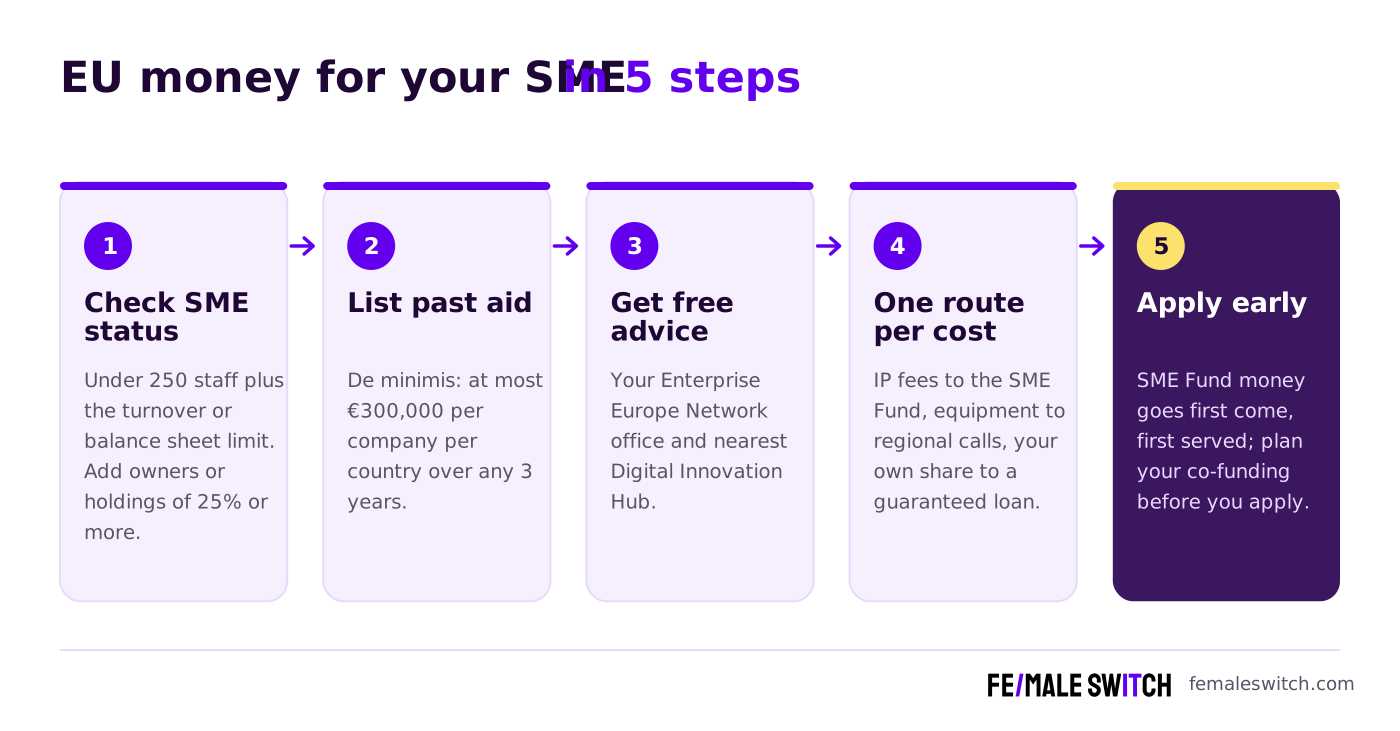
First check: are you an SME in EU terms?

Every programme below uses Commission Recommendation 2003/361: stay under the staff limit plus one of the two financial limits.
The trap is ownership. If another company owns 25% or more of yours, or you own 25% or more of another, you add part or all of its staff and figures to yours, according to the Commission's SME user guide. A 12-person company owned by a large group is not an SME.
What small businesses can actually get from the EU
Sorted from easiest to hardest, with amounts from the official programme pages.
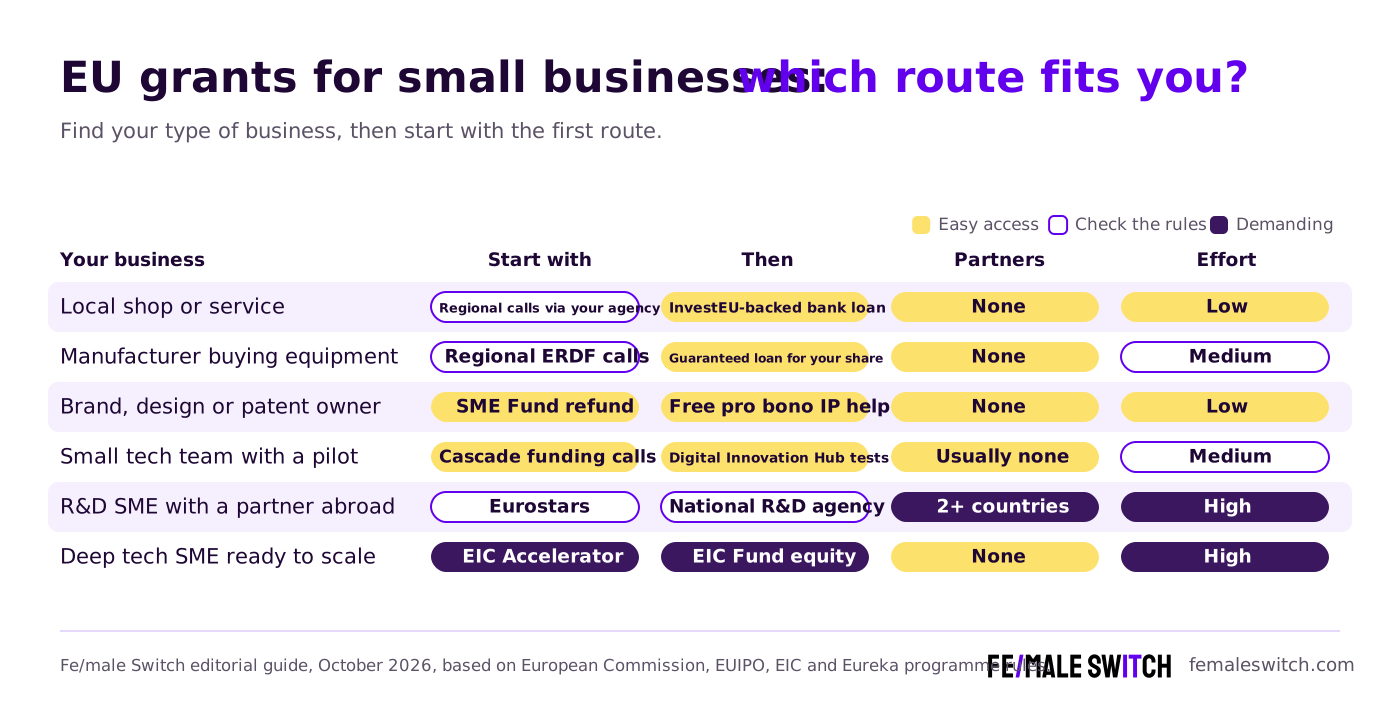
Missing on purpose: EU grants that pay rent, salaries or stock for a normal trading business. They don't exist at EU level. A shop or a local service business gets support through regional programmes and guaranteed loans.
The SME Fund in October 2026: what is still open
The SME Fund is the easiest EU money a small business can get: a European Commission initiative run by the EU Intellectual Property Office (EUIPO). The 2026 round runs from 2 February to 4 December 2026 for SMEs in the EU and Ukraine, first come, first served.
According to the EUIPO's SME Fund page, Voucher 1 (IP Scans) and Voucher 2 (trade marks and designs) are no longer available for new applications because the funds ran out. Voucher 3 (patents) and Voucher 4 (Community plant varieties) were still open at the time of writing. A separate voucher covers up to 50% of the costs of a craft and industrial geographical indication, up to €2,000.
How it works, according to the EUIPO:
- Apply with your VAT or registration certificate and a bank statement; a decision takes up to 15 working days.
- Activate a patent or plant variety voucher within one month (extendable by one) by paying for the service and requesting reimbursement.
- The EUIPO pays within one month. Each voucher type can be used once a year.
If you missed the trade mark voucher this year, plan for the next round early: the EUIPO has run the SME Fund every year since 2021, and money is handed out in order of application.
The rule nobody mentions: de minimis
Most regional and national grants for small businesses are State aid. The most common legal basis is the de minimis regulation (EU) 2023/2831: a single company can receive at most €300,000 of de minimis aid per Member State over any rolling three-year period. Since 1 January 2026, this aid is recorded in public registers, according to the EU's official summary of the regulation.
What this means in practice:
- Keep a list of every public grant, subsidised loan or voucher from the last three years, with amounts. Agencies will ask.
- Linked companies count as one. Two companies controlled by the same owner share one ceiling.
- Money the Commission awards directly, such as Horizon Europe or EIC grants, is not State aid and does not use up your de minimis ceiling. ERDF-funded regional grants paid by national authorities often do.
Decision tree: which route fits your small business?
Answer the questions in order and stop at the first "yes".
- Do you need to protect a brand, design or invention? Start with the SME Fund, the fastest money here.
- Is your project local: equipment, a new production line, energy savings, digital tools? Contact your regional managing authority and your Enterprise Europe Network office about ERDF-funded calls.
- Do you need cash you will repay from revenue? Ask your bank about InvestEU-guaranteed loans. The Commission's Access to Finance portal lists more than 1,000 institutions offering EU-backed finance.
- Do you have a tech pilot for a specific industry challenge? Search cascade funding calls. Our guide to cascade funding shows how they work.
- Do you do R&D with a partner in another country? Look at Eurostars.
- Are you a deep tech company ready to scale across Europe? Prepare for the EIC Accelerator.
If none fits, you are probably not ready for EU money yet; customers and private investors come first. Our guide to startup funding in Europe shows how the two worlds fit together.
Scored worksheet: is an EU grant worth your time?
Score each line from 0 to 2, then add up.
0–5: start with free help (EEN, EDIH) and the SME Fund. 6–9: regional grants, guaranteed loans and cascade calls. 10–12: you can also aim for Eurostars or the EIC Accelerator. For a longer self-test, use our EU funding readiness checklist.
Worked example: a 14-person manufacturer
A family-owned company in Portugal makes compostable food packaging: 14 staff, €1.8 million turnover, no outside shareholders, so a small enterprise. It wants a new moulding machine, a patent for a new tray and a pilot with a supermarket chain. This is an illustration, not a promise of what any funder will give.
The lesson: confirm SME status first, use free advice before writing anything, and match each cost to one route.
Copyable email to your regional agency or EEN office
Key deadlines for 2026–2027
Dates confirmed on official pages as of October 2026. The EIC Work Programme 2027 is still a draft, so 2027 EIC Accelerator cut-offs are not final.
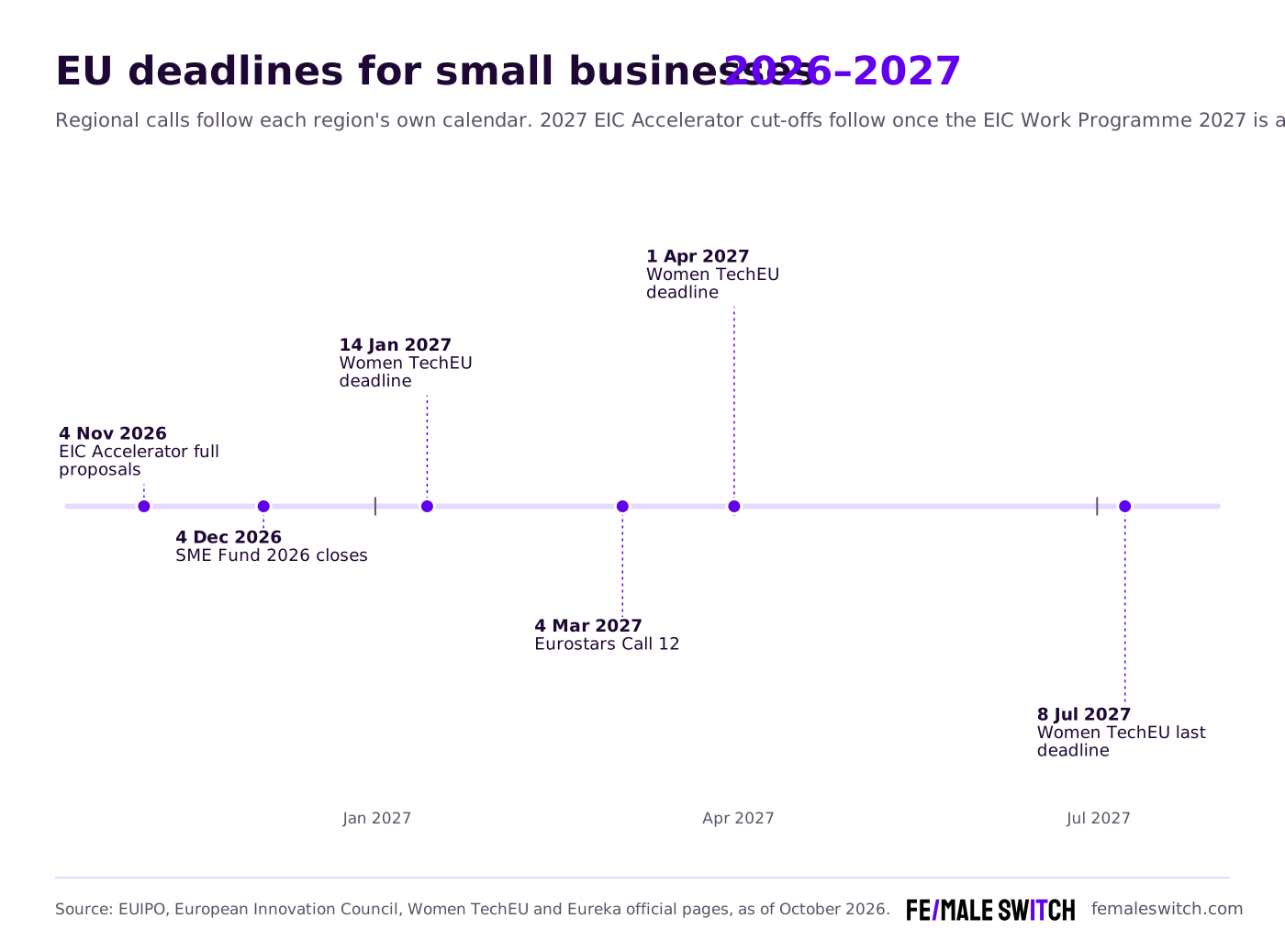
Regional calls open on each region's own schedule, so ask your managing authority directly. Our guide on how to find open EU funding calls shows where to search, and Mean CEO's EU Funding News lists new calls every month.
Who should apply and who can skip it
Apply if you are an SME under the EU definition, you have a defined project (protecting IP, new equipment, a pilot, R&D), you can pre-finance part of it, and someone on the team can handle the paperwork.
Skip EU grants for now if you need money for rent, wages or stock, you can't pre-finance anything, or you are part of a large group. Talk to your bank about guaranteed loans and keep building revenue. For writing help when you are ready, read our EU grants writing guide.
Related EU funding guides
- EU grants for startups: programme map, deadlines and decision tree
- European funds for startups: the 2027 map of EU grants, equity and loans
- Startup funding in Europe: where EU money fits next to angels and VCs
- Cascade funding explained: how startups win EU open calls
- How to find open EU funding calls for startups
- EU funding readiness checklist for startups
- Women TechEU: eligibility, timeline and how to apply
- NGI open calls: funding for open-source and internet startups
- The EU funding labyrinth: a critical analysis for startups
- Call for evaluators 2027: how to become a paid EU expert evaluator
- Erasmus for Young Entrepreneurs: a funded stay with a host abroad
Still at the idea stage? The Fe/male Switch startup game lets you build a business step by step with an AI co-founder before you spend money.
FAQ
Are there EU grants for small businesses to start a company?
Not at EU level: EU programmes fund projects, not start-up costs. Erasmus for Young Entrepreneurs pays a stipend for 1 to 6 months with a host entrepreneur abroad, and regional schemes co-financed by EU funds support new businesses locally.
How do I know if my business counts as an SME?
Under Commission Recommendation 2003/361, an SME has fewer than 250 staff and either turnover up to €50 million or a balance sheet up to €43 million. Add your partner and linked companies' figures if ownership links reach 25% or more.
Is the SME Fund still open in 2026?
The SME Fund 2026 runs until 4 December 2026 or until money runs out. According to the EUIPO, the IP Scan and trade mark and design vouchers have run out, while the patent and plant variety vouchers were still open in October 2026.
Where can small businesses find EU grants in their own country?
Regional grants co-financed by the European Regional Development Fund are run by national and regional managing authorities, not on the EU Funding & Tenders Portal. Ask them or your local Enterprise Europe Network office.
Do EU grants pay 100% of the costs?
Rarely. Horizon Europe innovation actions and the EIC Accelerator pay 70% of eligible costs for companies, and the SME Fund refunds up to 75% of IP fees. Plan your own share first.
What is the de minimis limit for small businesses?
Under Regulation (EU) 2023/2831, one company can receive up to €300,000 of de minimis aid per Member State over any rolling three years. Grants the Commission awards directly, such as Horizon Europe or EIC grants, don't count towards it.
About the Author
Violetta Bonenkamp, also known as MeanCEO, is an experienced startup founder with an impressive educational background including an MBA and four other higher education degrees. She has over 20 years of work experience across multiple countries, including 5 years as a solopreneur and serial entrepreneur. Throughout her startup experience she has applied for multiple startup grants at the EU level, in the Netherlands and Malta, and her startups received quite a few of those. She’s been living, studying and working in many countries around the globe and her extensive multicultural experience has influenced her immensely.

