
TL;DR: Jobs to be Done summary in one paragraph: in Jobs to be Done: Theory to Practice (2016), Tony Ulwick argues that customers don't buy products, they "hire" them to get a job done, and that every job can be broken into steps and measurable outcomes. Ask customers how important each outcome is and how well today's solutions deliver it, and the biggest gaps show you what to build. The method was designed for big companies with research budgets. Below you'll find a 2016-vs-2026 table, a copyable outcome worksheet with the opportunity score, a worked founder example and a 30-day plan you can run with 15 interviews and a small survey.
Jobs to be Done summary searches mix up three books, so let's be precise. Jobs to be Done: Theory to Practice is by Anthony (Tony) Ulwick, founder of the consultancy Strategyn, and was published by Idea Bite Press in 2016. It's not the Clayton Christensen book Competing Against Luck from the same year, and not Jobs to Be Done: A Roadmap for Customer-Centered Innovation by Stephen Wunker, Jessica Wattman and David Farber.
Ulwick calls his version Outcome-Driven Innovation (ODI). It grew out of his 2002 Harvard Business Review article and his earlier book What Customers Want (2005). This review covers what the method gets right, what's too heavy for a small startup and how to run a lean version this month.
Jobs to be Done summary in seven ideas

- People hire products to get a job done. The job, not the product and not the customer profile, is what you study. Jobs are stable: people have wanted to listen to music for centuries, while the solutions moved from records to streaming.
- A job has layers. Ulwick's needs framework separates the core functional job, related jobs people do around it, emotional and social jobs (how people want to feel and be seen), consumption jobs such as setting up, learning and maintaining the product, and the financial outcomes the buyer cares about.
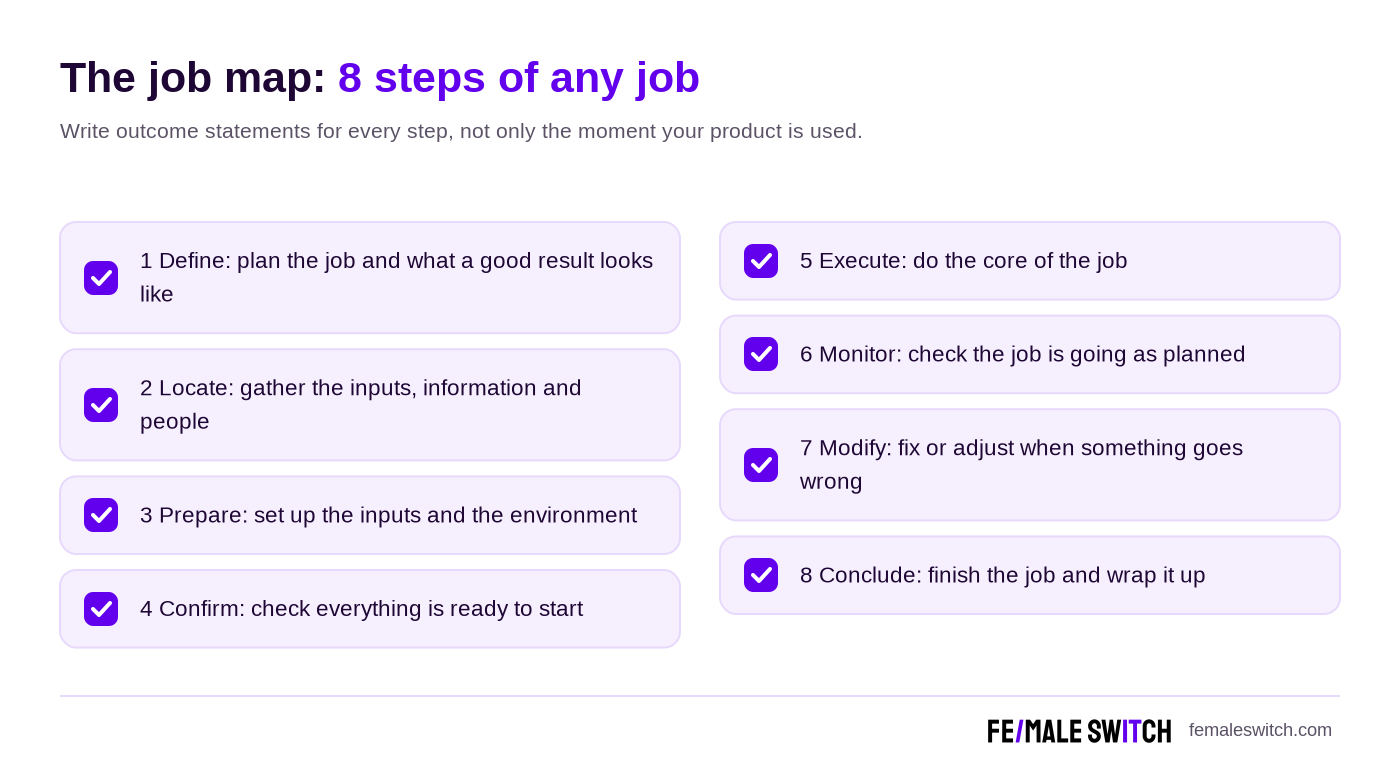
- Every job follows a map. Ulwick and Lance Bettencourt describe eight universal steps: define, locate, prepare, confirm, execute, monitor, modify and conclude. Not every job uses all of them, but the map makes you look at the whole job, not only the moment your product is used.
- Outcomes are the customer's own metrics. At each step, people judge success by speed, predictability and errors. Ulwick writes these as strict statements, such as "minimize the time it takes to…" or "minimize the likelihood of…", with no solution words in them. A single job can have dozens of outcomes, and more than a hundred is common.
- Score the gaps. Customers rate each outcome for importance and satisfaction on a 1–10 scale. The opportunity score is importance plus the gap between importance and satisfaction, never counting a negative gap. High scores are underserved needs; low ones are overserved.
- Segment by unmet needs, not demographics. Two customers with the same age and job title can struggle with very different outcomes. Ulwick groups customers by the outcomes they find underserved.
- Pick a growth strategy on purpose. His growth strategy matrix names five options: differentiated (better and pricier), dominant (better and cheaper), disruptive (worse but much cheaper, for overserved customers and non-consumers), discrete (worse and pricier, for customers with no other choice) and sustaining (slightly better or cheaper).
📘 Free e-book: Startup Idea Validation the Right Way. Before you market or build anything, make sure people want it. Violetta Bonenkamp's free e-book shows first-time founders how to test demand with minimal resources, track the metrics that matter and reach their first customers without giving away equity, with downloadable templates and checklists. Read about the book and get your free copy →
Why founders find this book hard to use
Readers' reviews tend to agree on two complaints. The first chapters read like a pitch for Strategyn, and the full process assumes a research team: many interviews, a quantitative survey of hundreds of customers and statistical segmentation. A two-person startup can't afford that, so many founders close the book with good ideas and no next step.
The other school, popularised by Christensen and Bob Moesta, studies the moment someone switches solutions, mostly through interviews. Ulwick's is more measurable, and for a founder that's the useful part: it turns vague feedback into a ranked list of problems. You just have to shrink it.
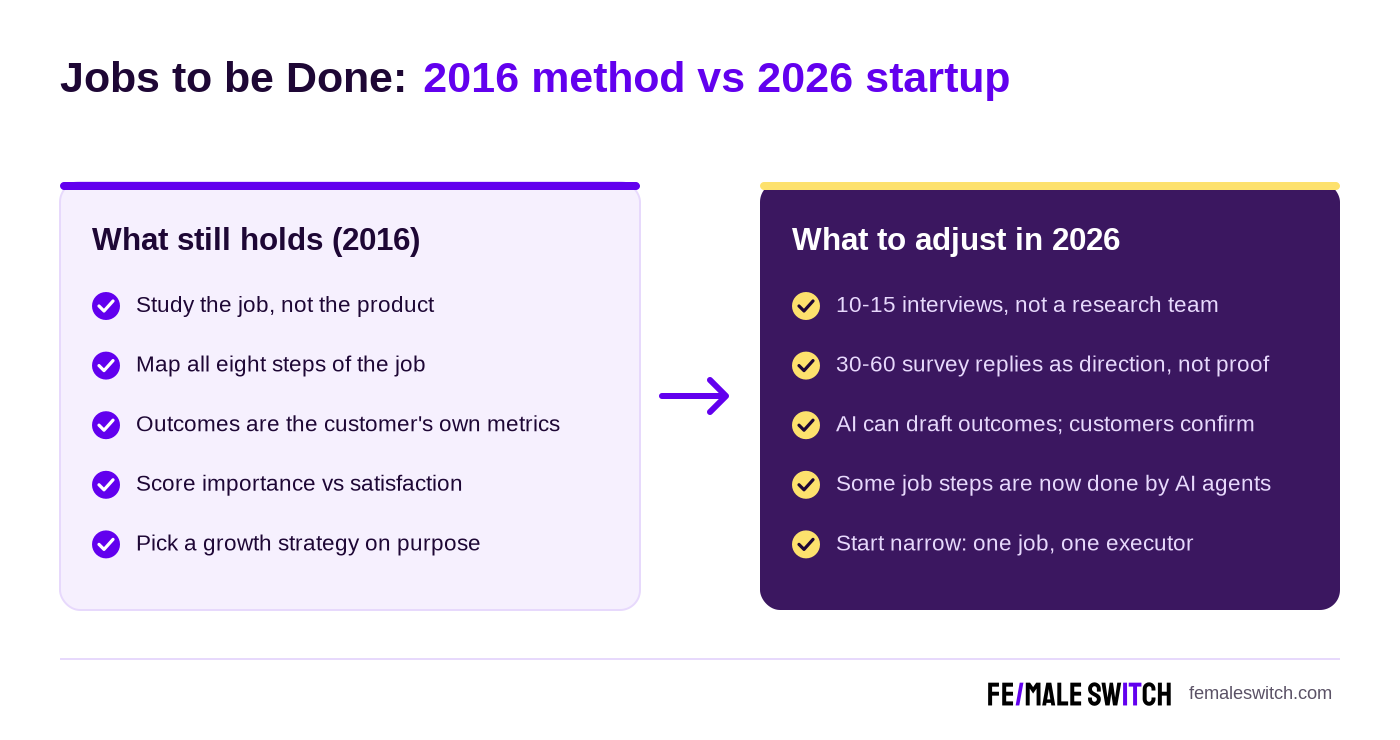
What still holds and what to adjust: 2016 vs 2026
Outcome worksheet: copy it and fill it in
Use this for one job only. Interview first, then turn what you heard into outcome statements, then score them.
A worked founder example
A founder wants to build software for freelance designers. Her first idea is a faster invoice maker. Instead of building it, she runs the worksheet on the job "get paid for finished client work". After 12 interviews she writes 18 outcome statements and sends a short survey to designers in two online communities. 41 reply. Five of the results, with averaged ratings:
Her original idea sits on an overserved outcome: designers already make invoices quickly with the tools they have. The real gaps are in the monitor and modify steps of the job map, after the invoice is sent. She drops the invoice maker and tests a payment-chasing assistant with a clear forecast of who pays when. In Ulwick's terms it's a differentiated play on a narrow job.
The numbers are an illustration, and 41 replies prove nothing on their own. They are enough to decide what to test next, which is all an early founder needs.
A 30-day Jobs to be Done plan for founders
If you want to practise this with feedback, our startup game with an AI co-founder takes first-time founders from idea to first customers, and the free bootstrapping with AI guide shows how to run research and build without funding.
Which growth strategy fits your startup? A decision checklist
- Are customers overserved and paying for more than they use? Go disruptive: do the job "good enough" for far less money, or reach people who can't afford today's options.
- Do several important outcomes score above 12? Go differentiated: do the job much better for those customers and charge for it.
- Can you do the job better and cheaper at the same time, say, because AI removes a costly manual step? That's dominant, the rarest and strongest position. Check that your cost advantage can't be copied in a month.
- Are your customers stuck with few choices, by rules, location or contracts? A discrete strategy can work, but it's fragile once alternatives appear.
- Is your idea only slightly better or cheaper? That's sustaining, and it's the incumbents' game. As a startup, avoid it unless you have distribution they don't.
Who should read Jobs to be Done (and who can skip it)
Read it if you keep collecting feedback you can't act on, you're choosing between several product ideas, or you build B2B products where buyers judge you on time, errors and cost. The needs framework, the job map and the outcome format are worth the price alone.
Skim or skip it if you want stories rather than method, or haven't spoken to a customer yet. Talk to customers first, then come back to Ulwick when you need to rank what you heard.
Related startup books for founders
- The Mom Test: how to run the interviews that feed your job map without collecting polite lies.
- The Lean Startup: turn your top outcome into an experiment and learn from it fast.
- Everybody Lies: why behaviour beats what customers say, and how to read it with little data.
- Hooked: once you solve the job, keep users coming back.
FAQ
What is the main idea of Jobs to be Done: Theory to Practice?
Customers hire products to get a job done. If you break that job into steps and measurable outcomes, then ask customers which outcomes matter most and are worst served today, you can predict which products will succeed instead of relying on luck.
What is the difference between Ulwick's and Christensen's Jobs to be Done?
Both start from the idea that people hire products for a job. Christensen and Bob Moesta focus on the circumstances and forces that make someone switch, studied mainly through interviews. Ulwick's Outcome-Driven Innovation is more structured: job maps, outcome statements and survey scores.
What is an outcome statement in Jobs to be Done?
It's a metric customers use to judge how well a job gets done, written without product words. A typical format is a direction, a metric and an object, such as "minimize the time it takes to chase a late payment".
How do you calculate the opportunity score?
Add importance to the gap between importance and satisfaction, both rated 1–10 and averaged across respondents. If satisfaction is higher than importance, the score is simply the importance rating. Higher scores mean bigger unmet needs.
What are the eight steps of the job map?
Define, locate, prepare, confirm, execute, monitor, modify and conclude. They describe what anyone does to get a job done, from planning it to finishing it, and help you find needs outside the moment your product is used.
Is Jobs to be Done: Theory to Practice worth reading for startup founders?
Yes, for the method, if you read it with a pencil and skip the sales parts. Scale the research down to 10–15 interviews and a small survey, and use the scores to decide what to test, not as final proof.
About the Author
Violetta Bonenkamp, also known as MeanCEO, is an experienced startup founder with an impressive educational background including an MBA and four other higher education degrees. She has over 20 years of work experience across multiple countries, including 5 years as a solopreneur and serial entrepreneur. Throughout her startup experience she has applied for multiple startup grants at the EU level, in the Netherlands and Malta, and her startups received quite a few of those. She’s been living, studying and working in many countries around the globe and her extensive multicultural experience has influenced her immensely.

