

TL;DR: Hooked summary in one paragraph: Nir Eyal's book explains how products become habits through a four-step loop he calls the Hook Model: a trigger, a simple action, a variable reward and an investment that makes the next visit more likely. For founders in 2026, the model is still the clearest way to think about retention, but most early startups don't have a "too addictive" problem; they have a "nobody comes back" problem. Below you'll find a one-page Hook canvas to copy, an ethics check, a worked founder example and a then-vs-now table.
Hooked summary first, founder's verdict second. Nir Eyal, a tech entrepreneur who has taught at Stanford's business school, wrote the book with Ryan Hoover, who later founded Product Hunt. Portfolio, a Penguin imprint, published it in 2014 (an earlier self-published version circulated in late 2013, which is why some listings show that year). Five years later, Eyal published Indistractable (2019), a book about the other side of the screen: how individuals can control their attention.
Most summaries explain the four steps and stop. This review asks the questions a small startup needs answered in 2026: does your product even belong in the "habit zone", how do you design a hook you could defend in public, and what has changed since app-era growth hacking?
Hooked summary in six ideas

- Habits beat advertising. A product people use without thinking doesn't need to buy their attention again and again. Habits raise customer lifetime value, give you pricing power and make it harder for rivals to steal users.
- The trigger starts the loop. External triggers are things like an email, a notification or a button. Over time the goal is an internal trigger: a feeling (boredom, loneliness, uncertainty, fear of missing something) that the user learns to answer with your product.
- The action must be easy. Eyal builds on BJ Fogg's behaviour model: a behaviour happens when motivation, ability and a trigger meet at the same moment. If an action is hard, motivation has to be huge; make it simpler instead.
- Rewards work best when they vary. Predictable rewards get boring. Eyal describes three kinds: rewards of the tribe (social approval), of the hunt (information, deals, content) and of the self (mastery, completion).
- Users invest, then return. The last step asks users to put something in: data, content, followers, settings, reputation. That stored value improves the product for them and loads the next trigger.
- Ethics are your job. Eyal adds a Manipulation Matrix with two questions: would you use the product yourself, and does it really improve users' lives? The answers sort makers into facilitators, peddlers, entertainers and dealers.
📘 Free e-book: Startup Idea Validation the Right Way. Before you market or build anything, make sure people want it. Violetta Bonenkamp's free e-book shows first-time founders how to test demand with minimal resources, track the metrics that matter and reach their first customers without giving away equity, with downloadable templates and checklists. Read about the book and get your free copy →
The book also introduces the "habit zone": behaviours that happen often and feel useful enough become habits. A tool you need twice a year won't form one, however clever its loop.
Does your startup need a hook at all?
Before you design anything, check whether habit is the right goal. Many good businesses are not habits: a tax filing service, a wedding planner, a B2B tool used once a quarter. They win on trust, referrals and doing the job well.
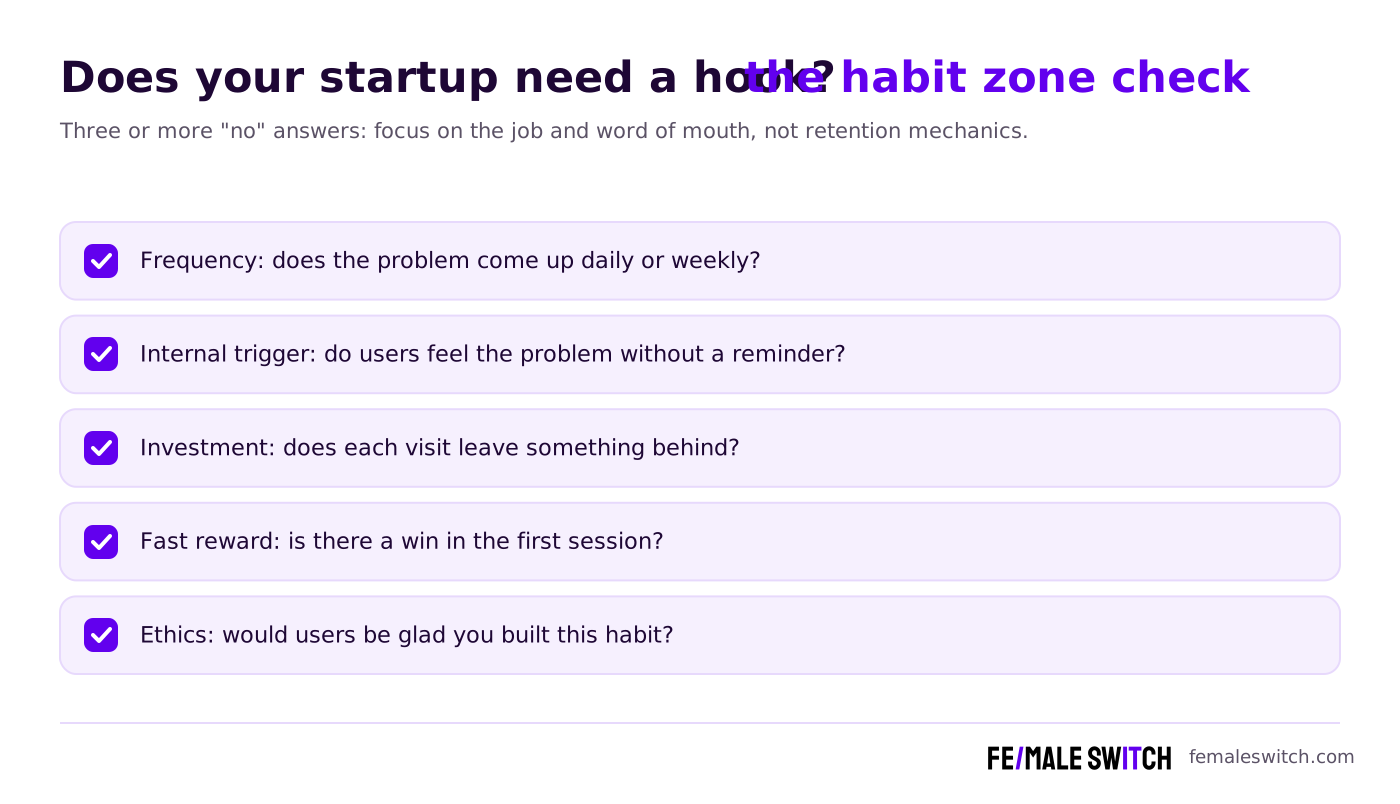
Use this quick diagnosis:
- How often does the problem occur? Daily or weekly means a hook can work. Monthly or less means you need reminders and referrals instead.
- Does the user feel the problem without being told? If yes, an internal trigger is possible. If you always have to remind them, you're relying on external triggers forever.
- Does each visit leave something behind? Notes, history, contacts or progress make the product better over time. If every visit starts from zero, there's no investment step.
- Can a new user get a reward in the first session? If the first win takes a week, most people never reach the loop.
- Would users be glad you built this habit? If you hesitate, stop and read the ethics section below.
Three or more "no" answers? Focus on solving the job well and earning word of mouth, not on retention mechanics.
Copy-paste Hook canvas for a small startup
Fill this in for one user and one core behaviour. Not for the whole product.
Line 6 is the one founders skip. Eyal recommends "habit testing": find your habitual users in the data, learn what they did differently and steer new users down the same path.
A worked founder example
Imagine a solo founder building a meal-planning app for parents who work full time. Weekly retention is poor: people plan one week, then vanish.
Her canvas:
- Habit: the parent plans next week's dinners every Sunday.
- Trigger: internal feeling is the Sunday evening worry about "what are we eating this week?" The external trigger for now is one Sunday 17:00 reminder, nothing more.
- Action: she cuts planning from 12 taps to one: "repeat last week, swap three meals".
- Variable reward: each week the swap suggestions change, based on what's in season and cheaper (hunt), and the app shows how much money the family saved against takeaway (self).
- Investment: the parent rates each meal. Ratings improve next week's suggestions and the shopping list.
- Ethics check: she'd use it herself, it saves time and money, and she could put the loop on her homepage. Facilitator.
Results after six weeks, with the same number of new sign-ups: the share of users who planned in week two moved from roughly one in five to about one in three. She didn't add streaks, badges or more notifications. She made the action easier and the reward more personal.
The ethics question in 2026
The book's biggest criticism has always been that its loop powers endless feeds and slot-machine design. Eyal's own answer is the Manipulation Matrix, and in 2026 it matters more, not less:
- Regulators are paying attention. In the EU, the Digital Services Act bans some deceptive "dark pattern" designs on online platforms, and consumer authorities are looking hard at addictive design, especially for young users.
- Trust is a growth channel. For a small startup, one viral complaint about a sneaky subscription or guilt-trip notification costs more than a week of extra engagement earns.
A simple rule: design hooks that you'd be happy to describe to your users in plain words. If the loop only works because they don't understand it, it's a dealer's loop.
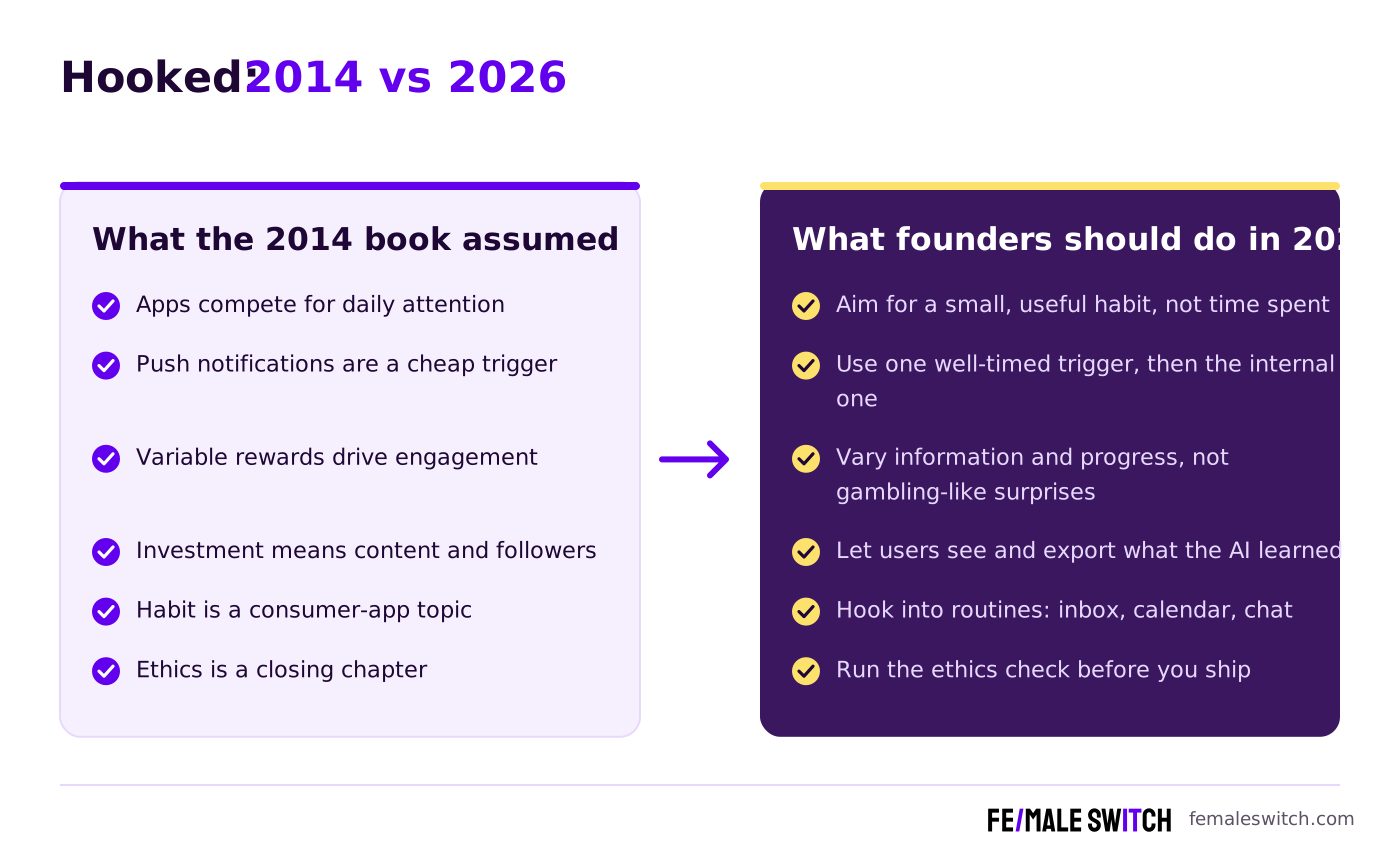
Then vs now: Hooked in 2026
Who should read Hooked (and who can skip it)
Read it if you're building a consumer app, a community, a marketplace or a SaaS tool people should open weekly, and your retention curve keeps sliding to zero. It's short and practical.
Skim or skip it if you haven't confirmed that anyone wants your product yet. Hooks can't save a product nobody needs; they only multiply value that already exists. Start with Startup Idea Validation the Right Way, and if you're building with a small budget, the Bootstrap AI Revolution shows how to get to a working product fast. If you'd like to practise these decisions on a real business with an AI co-founder before risking your savings, try our startup game.
Related startup books for founders
- The Lean Startup: Eric Ries on build-measure-learn, the testing habit you need before you design a hook.
- The Mom Test: Rob Fitzpatrick on customer interviews, the best way to find your users' real internal triggers.
- The Gamer's Brain: Celia Hodent on how game designers use cognitive science to make products engaging and easy to use.
- Jobs to be Done: Tony Ulwick on the job customers hire your product to do, which tells you which habit is worth building.
FAQ
What is the Hook Model in Hooked?
The Hook Model is Nir Eyal's four-step loop for building habits into products: a trigger prompts the user, they take a simple action, they get a variable reward, and they invest something (data, content, effort) that makes the next loop more likely.
Who wrote Hooked and when was it published?
Nir Eyal wrote it with Ryan Hoover, the founder of Product Hunt. Portfolio (Penguin) published it in 2014; an earlier self-published edition appeared in late 2013.
Is Hooked still relevant in 2026?
Yes. The loop still explains why people return to products, and it applies to AI tools and B2B software as well as consumer apps. What has changed is the context: more scrutiny of addictive design and more user fatigue, so the ethics part matters more.
What are the three types of variable rewards?
Eyal describes rewards of the tribe (social approval and connection), rewards of the hunt (information, resources, deals) and rewards of the self (mastery, competence and completion).
What is the Manipulation Matrix?
It's Eyal's ethics tool. It asks two questions: would you use the product yourself, and does it materially improve users' lives? Yes to both makes you a facilitator; the other combinations are peddler, entertainer and dealer.
About the Author
Violetta Bonenkamp, also known as MeanCEO, is an experienced startup founder with an impressive educational background including an MBA and four other higher education degrees. She has over 20 years of work experience across multiple countries, including 5 years as a solopreneur and serial entrepreneur. Throughout her startup experience she has applied for multiple startup grants at the EU level, in the Netherlands and Malta, and her startups received quite a few of those. She’s been living, studying and working in many countries around the globe and her extensive multicultural experience has influenced her immensely.

