

TL;DR: Slicing Pie Handbook summary in one paragraph: Mike Moyer's 2016 handbook (foreword by Noam Wasserman, author of The Founder's Dilemmas) replaces the fixed 50/50 handshake with a dynamic split. Every unpaid contribution (time, cash, equipment, rent, credit) is valued at its fair market price and turned into "slices", with cash weighted 4x and everything else 2x. Your share is your slices divided by all slices, and it updates as people contribute. When someone leaves, pre-agreed rules decide what they keep. The pie freezes once the company can pay its way or raises a priced round. Below you'll find a slice calculator template, a departure checklist, a worked three-founder example, a then-vs-now table and a 30-day plan.
The Slicing Pie Handbook summary you need starts with one uncomfortable fact: most co-founder fights are about equity that was split on day one, before anyone knew who would do the work. Mike Moyer, who teaches entrepreneurship at Northwestern University, first described his dynamic equity model in the book Slicing Pie and then published this shorter, practical handbook in 2016 through his own imprint, Lake Shark Ventures.
Most summaries explain the formula and stop. This review is for a 2026 founder bootstrapping with a friend, a freelancer or a part-time co-founder: how to run the model in a spreadsheet, where it breaks and what has changed since 2016.
Slicing Pie Handbook summary in seven ideas

- Fixed splits are a guess about the future. A 50/50 split on day one assumes both people will contribute equally for years. They almost never do, and the split can't adjust.
- Equity should follow risk. People who contribute without being paid are betting on the company. Their share should match the size of their bet.
- Value everything at fair market price. An hour of work is worth what the market would pay for it. A laptop, an office or a loan has a market price too.
- Cash counts double compared with time. Moyer's recommended multipliers are 2x for non-cash contributions and 4x for cash, because cash is scarcer and harder to get back.
- Your share is a live number. Your slices divided by the total slices gives your percentage today. It changes every month until the pie freezes.
- Departures follow rules agreed in advance. Whether someone leaves for a good reason or no reason, or is fired with or without cause, decides how many slices they keep.
- The pie freezes. When the company reaches breakeven (it can pay people) or takes a priced investment round, the slices are converted into fixed ownership.
📘 Free e-book: Startup Idea Validation the Right Way. Before you market or build anything, make sure people want it. Violetta Bonenkamp's free e-book shows first-time founders how to test demand with minimal resources, track the metrics that matter and reach their first customers without giving away equity, with downloadable templates and checklists. Read about the book and get your free copy →
The handbook also includes a "retrofit" guide for teams who already have a fixed split and want to switch, plus notes on legal and tax issues.
How the slice formula works
The whole model fits on a napkin:
- Time: the gap between your fair market salary and what the company actually pays you, multiplied by 2.
- Cash: every euro you put in, multiplied by 4.
- Non-cash items: equipment, supplies, office space, a personal loan guarantee or an introduction that leads to revenue, valued at market price and multiplied by 2.
- Your share: your slices ÷ all slices.
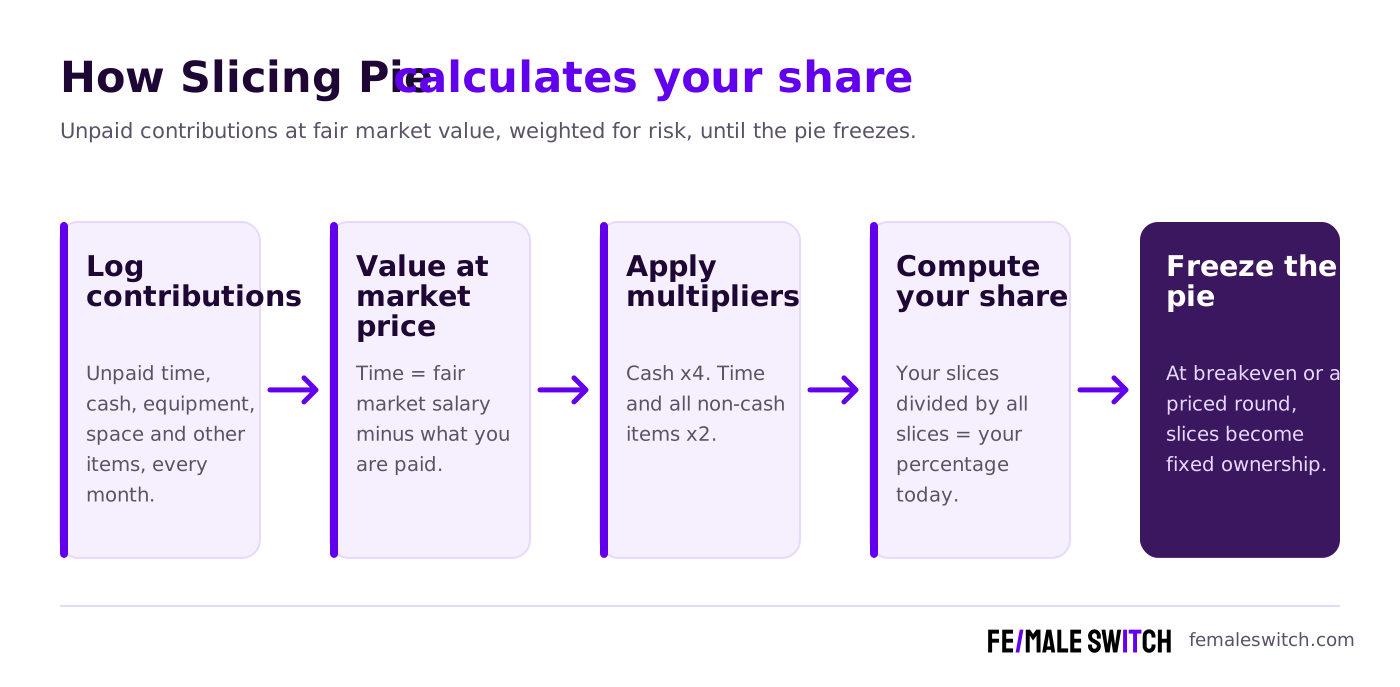
The beauty is that nobody negotiates percentages. You negotiate inputs, such as "what is a fair hourly rate for a senior developer here?", which is a much easier conversation than "do I deserve 35% or 40%?".
Copy-paste slice calculator template
Paste this into a shared doc or spreadsheet and update it monthly. One row per contribution keeps disputes small.
Two habits make it work: log contributions within a week, and agree the hourly rates before anyone starts, not after a big month.
A worked founder example
Imagine three people building a booking tool for small physiotherapy clinics, with no salaries for the first six months.
- Ana works full time, unpaid. Her fair market salary is €60,000 a year, so €5,000 a month. Over six months: €30,000 × 2 = 60,000 slices.
- Ben is a developer working about 40% of a full-time week. His market salary is €72,000 a year, so 40% of €6,000 = €2,400 a month. Over six months: €14,400 × 2 = 28,800 slices.
- Chloé keeps her day job, puts in €10,000 cash and lends a €1,500 laptop. Cash: €10,000 × 4 = 40,000. Laptop: €1,500 × 2 = 3,000. Total 43,000 slices.
All slices: 131,800. Ana owns about 45.5%, Chloé about 32.6% and Ben about 21.9%.
Now Ben quits in month six to take a job, with no good reason under their agreement. Under the handbook's recovery rules, someone who leaves without good reason loses the slices from their time. Ben only contributed time, so the pie becomes Ana 60,000 and Chloé 43,000: about 58.3% and 41.7%. That outcome feels harsh, which is exactly why the departure rules must be written down and signed before the first hour is logged.
Departure checklist: what happens when someone leaves
Moyer's recovery framework turns on two questions: who left, and whose fault was it? Use this checklist when a co-founder exits.
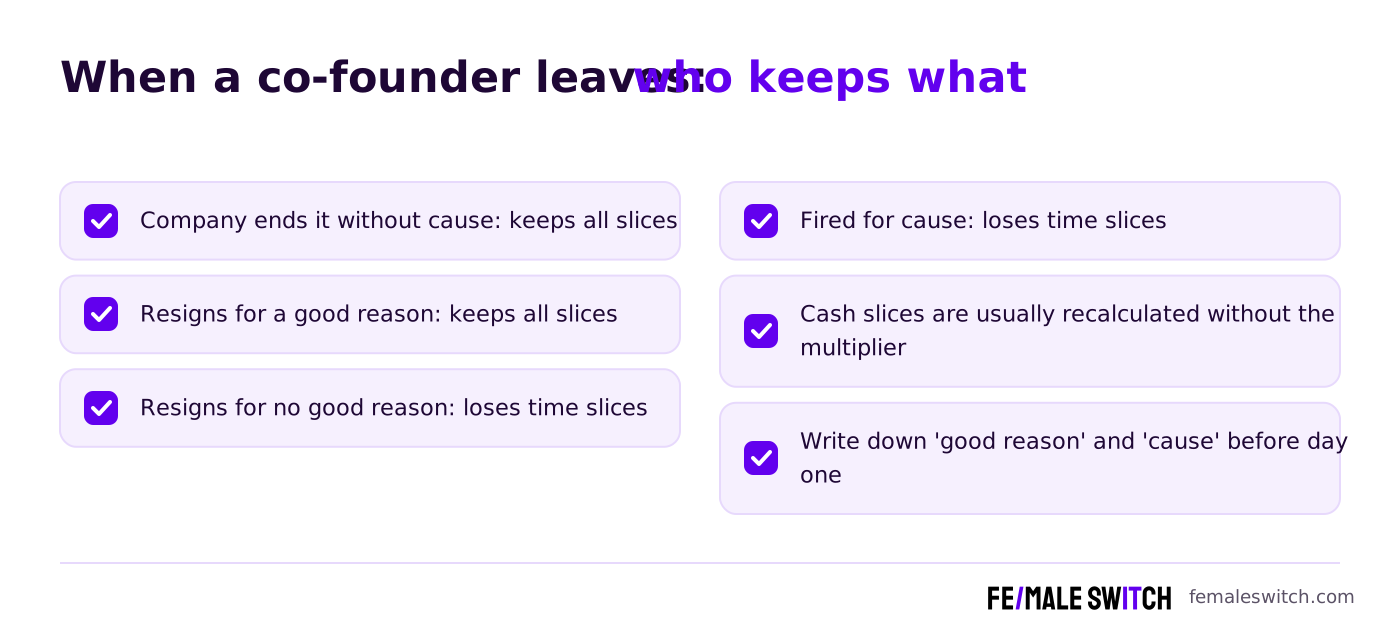
- Did the company end it without cause (for example, a pivot that no longer needs them)? They keep all their slices.
- Did they resign for a good reason (unpaid promises, a breach of the agreement, a big change in their role)? They keep all their slices.
- Did they resign for no good reason? They lose the slices from non-cash contributions. Their cash slices are usually recalculated without the multiplier, and the company can buy them back.
- Were they fired for cause (fraud, theft, serious neglect)? Same as resigning for no reason.
- Is the definition of "good reason" and "cause" written in your agreement? If not, stop and write it now, while everyone still gets along.
- Has a lawyer in your country checked how slices become shares? In many European countries, issuing shares needs a formal filing or a notary, so teams usually track slices first and convert them at the freeze.
Then vs now: Slicing Pie in 2026
The handbook was written in 2016. The logic has aged well, but the startup environment around it has changed.
A 30-day plan to switch to a dynamic split
- Week 1: agree the rules. Read the departure checklist together. Write down your definitions of "good reason" and "cause", and your freeze trigger.
- Week 2: agree the rates. Look up fair market salaries for each role in your city and convert them to hourly rates. Agree on them before you log anything.
- Week 3: log the past. Add every unpaid contribution since the start, using the tracker template. If you already have a fixed split, this is the retrofit.
- Week 4: make it official. Ask a startup lawyer to turn the rules into a signed agreement. Schedule a monthly 15-minute review of the tracker.
Want to rehearse these conversations before real money is at stake? Our startup game with an AI co-founder puts you through the first ninety days of a real business, including team decisions.
Who should read the Slicing Pie Handbook (and who can skip it)
Read it if you are starting a company with others and nobody is being paid yet, if you already regret a 50/50 split, or if a freelancer offered to work "for equity".
Skim or skip it if you are a solo founder, if you have raised a priced round already, or if every team member is on a full market salary. You might get more from a guide on running lean, such as the Bootstrap AI Revolution, which shows how one founder can cover many roles with AI tools.
Related startup books for founders
- Getting Acquired: a bootstrapped SaaS story that shows why a clean cap table matters on the day a buyer calls.
- Super Founders: Ali Tamaseb's data on 200+ unicorns, including what it says about solo founders and co-founding teams.
- The Lean Startup: the experiment-first method that keeps your team from spending slices on features nobody wants.
- Lost and Founder: Rand Fishkin's honest field guide, with hard lessons on founder relationships and investor expectations.
- Startup Idea Validation the Right Way: Violetta Bonenkamp's free e-book on testing demand before anyone invests time for equity.
FAQ
What is the Slicing Pie model in simple terms?
It's a dynamic equity split. Each person's unpaid contributions are valued at market price and turned into slices (cash at 4x, everything else at 2x). Your ownership is your share of all slices, and it changes as people contribute until the pie freezes.
How do you calculate slices in Slicing Pie?
For time, take the difference between your fair market salary and what you're paid, then multiply by 2. For cash, multiply the amount by 4. For equipment, space or other items, use the market value times 2. Divide your slices by the total to get your percentage.
When does the pie freeze?
According to the handbook, the pie freezes when the company can pay for what it needs (breakeven) or raises a priced investment round. After that, ownership is fixed and normal salaries and investment terms take over.
What happens to a co-founder's equity if they leave under Slicing Pie?
It depends on why they leave. If the company ends it without cause or they resign for a good reason, they keep their slices. If they quit without good reason or are fired for cause, they lose the slices from their time, and their cash slices are typically valued without the multiplier.
Is the Slicing Pie Handbook different from the book Slicing Pie?
Yes. Slicing Pie is Mike Moyer's earlier, longer book that introduced the model. The Slicing Pie Handbook (2016) is the shorter, practical version, with a retrofit guide for teams that already have a fixed split and notes on legal and tax issues.
Is Slicing Pie legally binding?
Only if you put it into a signed agreement. The model is a method, not a legal structure. Ask a startup lawyer in your country to draft the agreement and explain how slices become real shares when the pie freezes.
About the Author
Violetta Bonenkamp, also known as MeanCEO, is an experienced startup founder with an impressive educational background including an MBA and four other higher education degrees. She has over 20 years of work experience across multiple countries, including 5 years as a solopreneur and serial entrepreneur. Throughout her startup experience she has applied for multiple startup grants at the EU level, in the Netherlands and Malta, and her startups received quite a few of those. She’s been living, studying and working in many countries around the globe and her extensive multicultural experience has influenced her immensely.

