

TL;DR: Getting Acquired summary in one paragraph: Andrew Gazdecki's 2022 book tells how he started Bizness Apps at 21 with no work experience, grew it on a small budget, nearly lost it when Apple banned template-built apps in 2017, and sold it to the private equity firm Think3 in 2018, at 29. Most of the book is memoir; the last part covers the sale itself. The lessons that last: build a business a buyer can run without you, cut your dependence on any one platform and keep clean numbers from the start. Below you'll find a 2018-vs-2026 exit table, a copyable exit-readiness worksheet, a platform-risk checklist and a worked founder example.
Getting Acquired is one of the few books written by a founder who sold a small software company and then built a business around helping others do the same. Andrew Gazdecki published it in January 2022 through MicroAcquire, the startup marketplace he founded in 2020 and later renamed Acquire.com.
Search for this book and you mostly find the publisher's blurb repeated on store and library pages. This review is for founders in 2026 who want to know what the story teaches about building a company someone will pay for, even if selling is years away.
Getting Acquired summary in six ideas

- You can start with almost nothing. Gazdecki founded Bizness Apps in 2010 while still a college student, with money from selling an earlier side project. The product let small businesses build their own mobile apps from templates for a monthly fee.
- Your story sells the company. Customers, staff and later buyers bought into a clear story about who the product was for and why it mattered, more than a list of features. Several readers name this as the book's strongest idea.
- A platform can end your business overnight. In 2017 Apple's App Store guideline 4.2.6 started rejecting apps built from commercial templates, which hit Bizness Apps' core product. The crisis lasted months. Gazdecki emailed Apple's CEO directly, and Apple revised the rule in December 2017.
- Learn management on the job, fast. He went from no work experience to leading a team of over 100 people, and he's open about the hiring and leadership mistakes along the way.
- The exit is a process, not an event. The final part of the book covers the acquisition process and what can go wrong along the way. The work starts long before a buyer calls.
- There is a life after the sale. Gazdecki also writes about the personal side of an exit: what to do with the money, the time and your identity once the company is no longer yours.
📘 Free e-book: Startup Idea Validation the Right Way. Before you market or build anything, make sure people want it. Violetta Bonenkamp's free e-book shows first-time founders how to test demand with minimal resources, track the metrics that matter and reach their first customers without giving away equity, with downloadable templates and checklists. Read about the book and get your free copy →
The facts behind the story
What public sources confirm:
- Founded: 2010, when Gazdecki was a junior at California State University.
- Growth: the product served local small businesses. In a 2021 interview on the Built to Sell Radio podcast he said it passed 7 million dollars in yearly revenue within about four years, and that he turned down an offer of 15 million dollars for 70% of the company.
- The Apple crisis: guideline 4.2.6 came in 2017. Apple narrowed it in December 2017 after pressure from small businesses and a US congressman.
- The sale: Think3, an Austin-based private equity firm focused on software, bought Bizness Apps in May 2018. The press release didn't disclose the price. Gazdecki later described it on the same podcast as an all-cash deal for the whole company.
- After the sale: he launched MicroAcquire in 2020 and rebranded it Acquire.com in early 2023.
One honest caveat: some readers note that the book also works as marketing for the author's acquisition marketplace. That doesn't make the lessons wrong, but read the "selling is easy" parts with that in mind.
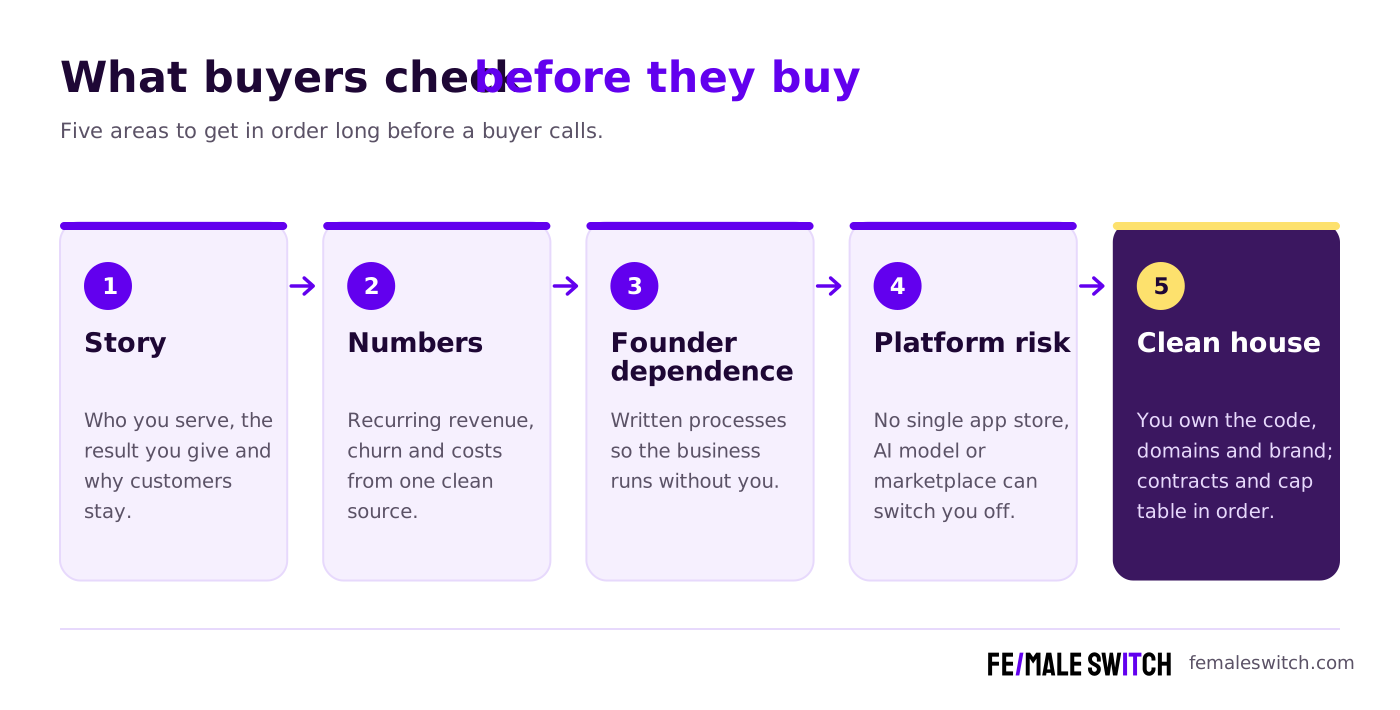
What changed: a 2018 exit vs a 2026 exit
Gazdecki sold in 2018, before startup acquisition marketplaces went mainstream and before AI changed how software is built.
The biggest change for 2026 is platform risk. Many new products are thin layers on top of someone else's AI model, app store or marketplace. Gazdecki's Apple story is the clearest warning in the book: if one company's policy change can switch off your product, a buyer will price that risk in, or walk away.
Copyable worksheet: is your startup ready to be acquired?
A business that's ready to sell is also easier to run and fund. Copy this into a doc and fill it in once a quarter.
Platform-risk checklist: learn from the Apple episode
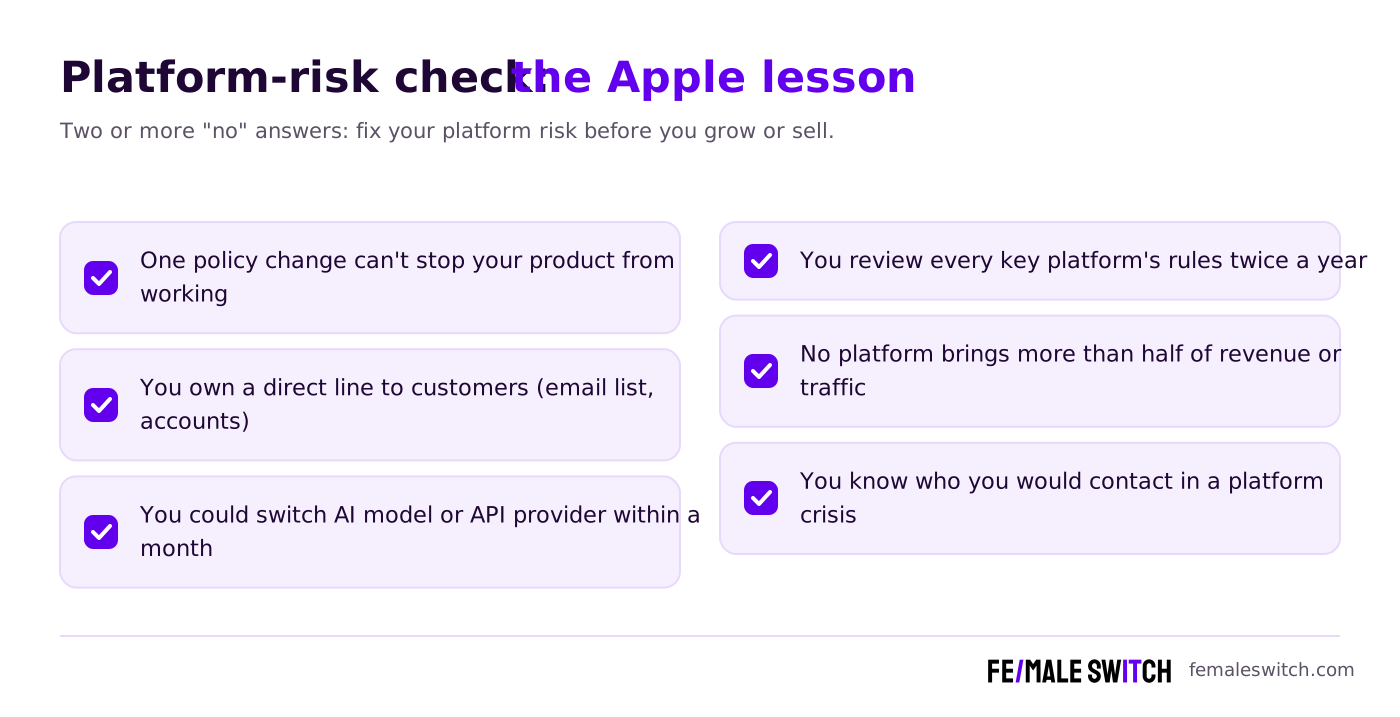
The Bizness Apps crisis is a story about dependence. Ask these five questions about your own startup:
- Can one company's policy change stop your product from working? Think app stores, AI model providers, payment processors and marketplaces.
- Do you have a direct line to your customers? An email list or account you own survives an algorithm change; followers on a platform may not.
- Could you switch providers in a month? If your product only works with one AI model or one API, test an alternative now, while it's calm.
- Do you read the rules? Check the policies of every platform you rely on at least twice a year, and before every big launch.
- Who would you call? Gazdecki's cold email worked because he went straight to the top and told a clear story. Know which people, groups or peers you would contact in a crisis.
A worked founder example
Picture a two-person startup that sells an AI writing assistant to independent real estate agents. It has a few hundred paying customers and steady monthly revenue. A buyer contacts the founder through a marketplace.
The founder runs the worksheet first and finds three problems. The product runs on a single AI model provider. All customer support goes through her personal inbox. And the revenue numbers in her pitch deck don't match the billing tool.
She asks the buyer for six weeks. In that time she tests a second AI model and adds it as a fallback, moves support to a shared inbox with written answers to the 20 most common questions, and rebuilds her numbers from the billing data only.
Whether or not the deal closes, her startup is now worth more and easier to run. That is the practical lesson of Getting Acquired: you prepare for a sale long before anyone makes an offer. To practise building a startup step by step without real money at stake, try our startup game with an AI co-founder.
Who should read Getting Acquired (and who can skip it)
Read it if you're building a small software or online business, you've wondered whether it could ever be sold, or you're a young founder who needs proof that you can learn to lead on the job. It's short and personal.
Skim or skip it if you want a detailed manual on valuation, tax or deal terms. Most of the book is one founder's story, and the practical part is brief. Pair it with a lean playbook such as The Bootstrap AI Revolution, which covers building a business with AI tools on a small budget.
Related startup books for founders
- Rework: build a calm, profitable company that doesn't need to sell, or can sell on your terms.
- The Slicing Pie Handbook: split equity fairly early, so a sale doesn't turn into a fight between co-founders.
- Super Founders: what data says about the founders behind the biggest outcomes.
- The Mom Test: talk to customers so you build something people, and later buyers, actually want.
- Free Bootstrapping with AI Guide: build a startup without funding, step by step.
FAQ
What is Getting Acquired by Andrew Gazdecki about?
It's Gazdecki's account of founding Bizness Apps at 21, growing it into a mobile app builder used by many small businesses, surviving Apple's 2017 ban on template-built apps and selling the company to private equity firm Think3 in 2018. The last part gives advice on the acquisition process.
Who bought Bizness Apps?
Think3, an Austin-based private equity firm that buys software companies, acquired Bizness Apps in May 2018. The price wasn't disclosed in the announcement. Gazdecki stayed on for a while to support the transition.
Is Getting Acquired worth reading?
Yes, if you want a quick, honest founder story with practical exit lessons. It's less useful if you want a technical guide to valuation, taxes or legal terms, since most of the book is memoir.
What is the main lesson of Getting Acquired?
Build a business that someone else can run and trust: a clear story, clean numbers, low dependence on the founder and on any single platform. Those same qualities make the company stronger even if you never sell.
How do you prepare a SaaS startup to be acquired?
Track revenue, churn and costs from one source, document every task only you can do, own all your code and accounts, keep contracts and the cap table in order, and reduce reliance on any one platform. The worksheet above turns this into a quarterly routine.
What is Acquire.com?
It's the startup acquisition marketplace Gazdecki founded in 2020 as MicroAcquire and renamed Acquire.com in early 2023. Founders list their startups there and buyers contact them directly.
About the Author
Violetta Bonenkamp, also known as MeanCEO, is an experienced startup founder with an impressive educational background including an MBA and four other higher education degrees. She has over 20 years of work experience across multiple countries, including 5 years as a solopreneur and serial entrepreneur. Throughout her startup experience she has applied for multiple startup grants at the EU level, in the Netherlands and Malta, and her startups received quite a few of those. She’s been living, studying and working in many countries around the globe and her extensive multicultural experience has influenced her immensely.

