

TL;DR: Startup Mixology summary in one paragraph: Frank Gruber's 2014 book treats a startup like a cocktail. You need the right ingredients in the right order: a founder mindset, an idea you act on quickly, product-market fit, a team you trust, marketing, money and the habit of celebrating progress. The recipe still works for founders in 2026. What aged is the setting: in-person mixers, launch-day press and easy seed money. Below you'll find a 2014-vs-2026 table, a "missing ingredient" diagnosis, a copyable celebration ritual and a 30-day plan.
Startup Mixology is a practical guide to starting a company, written by someone who watched thousands of founders try. Wiley published it in 2014 under the full title Startup Mixology: Tech Cocktail's Guide to Building, Growing, and Celebrating Startup Success. Frank Gruber co-founded Tech Cocktail in 2006 with Jen Consalvo. It began as a series of local mixers for tech founders and grew into a startup news site and events company, later renamed Tech.Co. Tony Hsieh, the Zappos CEO, wrote the foreword.
The book mixes short how-to advice with stories from companies such as Zappos, Basecamp, WordPress, MakerBot and Uber. Most summaries online copy the publisher's blurb. This one asks a different question: if you're starting with a tiny team and little money in 2026, which ingredients still matter, and which ones are missing from your glass?
Startup Mixology summary in six ingredients

The book is split into six parts. Each one is an ingredient you need before the next one makes sense.
- Think like an entrepreneur, then act. Ideas are cheap. The book's first part is about moving from idea to action quickly, testing it and setting up the company properly.
- Find product-market fit before you push. Launch, measure and keep adjusting until people actually use and pay for what you built. Metrics matter more than buzz.
- Build a team, a culture and real relationships. The people you hire and the network you build carry the company through bad months. Trust comes before titles.
- Market and sell on purpose. Getting noticed is hard, and the book is honest about launches nobody sees. Marketing and sales are skills you practise, not a one-day event.
- Choose your money carefully. Bootstrapping and outside funding are both options, and each changes how you run the company.
- Expect failure, and celebrate along the way. Running out of money or upsetting customers is part of the story. Gruber's most unusual point is that celebrating progress keeps founders and teams going long enough to succeed.
📘 Free e-book: Startup Idea Validation the Right Way. Before you market or build anything, make sure people want it. Violetta Bonenkamp's free e-book shows first-time founders how to test demand with minimal resources, track the metrics that matter and reach their first customers without giving away equity, with downloadable templates and checklists. Read about the book and get your free copy →
Why the cocktail metaphor works
A cocktail fails when one ingredient is missing or out of balance. Too much sugar and it's undrinkable. No ice and it's warm. Startups fail the same way. A brilliant product with no marketing goes nowhere. Strong sales with no product-market fit burn cash. A funded company with a broken team falls apart.
That makes the book useful as a checklist rather than a story. Instead of asking "what does a successful founder do?", you ask "which ingredient is weak in my startup right now?" Most first-time founders overpour one ingredient, usually building, and leave out two others, usually selling and celebrating.
What held up and what aged: 2014 vs 2026
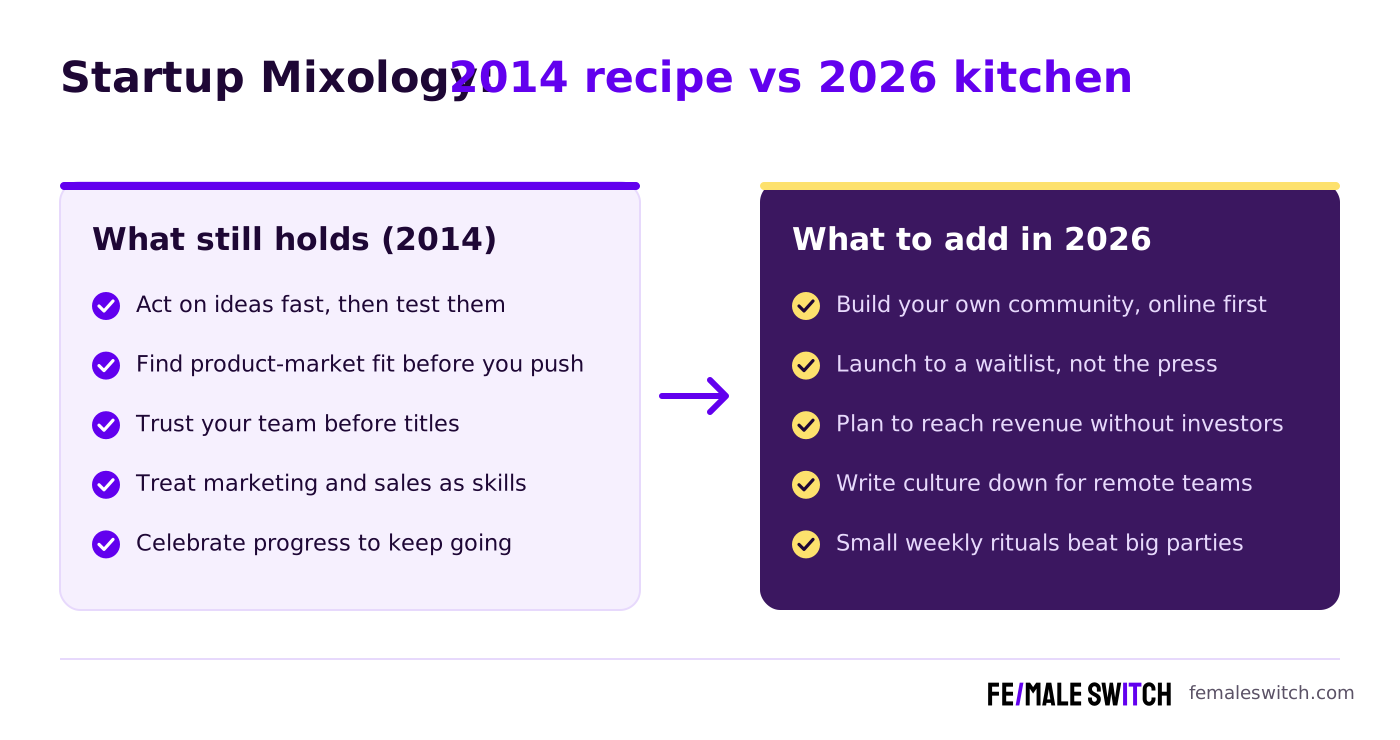
What aged best is the book's honesty about failure and its focus on people. What aged most is the assumption that you live in a startup city with weekly events, a tech press that cares about launches and investors ready to write seed cheques. In 2026 you build your own small version of that scene.
Which ingredient is missing? A diagnosis checklist
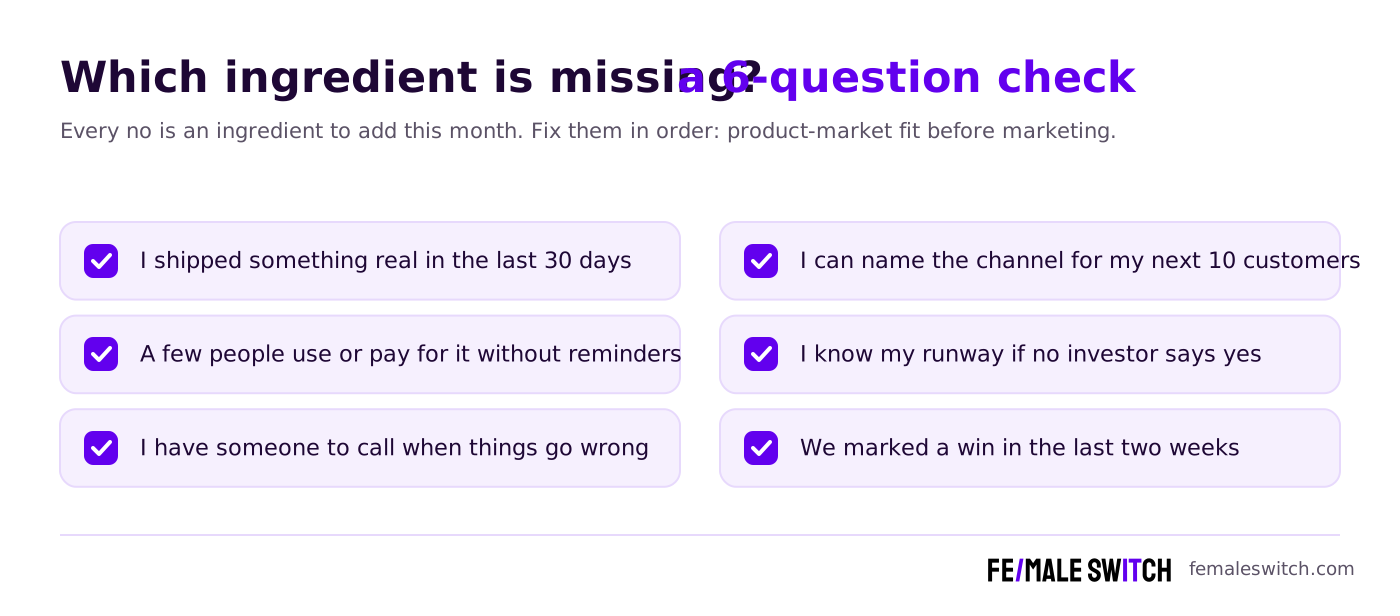
Before you change everything, find the weak ingredient. Answer each question honestly:
- Mindset and action: Have you shipped something real in the last 30 days, even a small test?
- Product-market fit: Do at least a few people use your product again without being reminded, or pay for it?
- Team and relationships: Is there at least one person, a co-founder, adviser or peer founder, you can call when things go wrong?
- Marketing and sales: Can you name the one channel where your next ten customers will come from?
- Money: Do you know your runway in months, and what happens if no investor says yes?
- Celebration: Did you and your team mark a win in the last two weeks?
Every "no" is an ingredient to add this month. Fix them in order. There's no point in polishing marketing if nobody comes back to the product.
Celebration ritual: a template you can copy
The celebration chapter is what makes Startup Mixology different from most startup books, and it's the easiest part to skip. Small teams need it most, because there's no HR team or office party to fall back on. Copy this into your team notes:
Agreeing on milestone rewards in advance stops you from moving the goalposts. Many founders hit a goal and immediately set a bigger one without stopping.
A worked founder example
A solo founder builds a booking tool for small yoga studios. After four months she has a polished product, a logo, a website and eleven sign-ups, but only one studio uses it every week. She's tired and thinking of quitting.
She runs the diagnosis checklist. Action: yes, she ships constantly. Product-market fit: no, only one regular user. Relationships: no, she works alone. Marketing: no, she can't name a channel. Money: savings for six more months. Celebration: she hasn't marked a single win.
Instead of adding features, she spends two weeks calling the ten studios that stopped using the tool. Four say the same thing: they need class packs, not single bookings. She builds that in a week. She also joins an online founder group and finds a peer founder for a weekly check-in.
Two months later, six studios pay. She celebrates the first one with her peer founder and sets the next milestone before she starts on it. The product didn't need to be better. The mix needed to be balanced.
A 30-day plan to apply the book in a small startup
If you don't have a startup yet, you can practise the whole recipe first. Our startup game with an AI co-founder walks you through each step, from idea to first customers, where mistakes cost nothing. And if the money ingredient is the hard one, The Bootstrap AI Revolution shows how to build without waiting for investors.
Who should read Startup Mixology (and who can skip it)
Read it if you're a first-time founder who wants a friendly, broad overview of the whole journey, from idea to funding, in one book. It's easy to read in chunks, it's honest about failure and the celebration chapter is something few other startup books cover.
Skim or skip it if you already know the basics and want depth on one topic. The book covers a lot of ground, so each subject gets a short treatment. For customer conversations, fundraising or company culture, a book focused on that one ingredient will teach you more. Some of the company stories also show their age.
Related startup books for founders
- Startup Communities: Brad Feld's guide to the local founder scenes that Tech Cocktail's mixers grew from.
- The Lean Startup: the deeper version of the "launch, measure, adjust" ingredient.
- The Mom Test: how to run the customer conversations that tell you whether you have product-market fit.
- Rework: Basecamp's founders on building a calm, small company, one of the stories Startup Mixology draws on.
FAQ
What is Startup Mixology about?
It's a practical guide to building a startup from idea to growth. Frank Gruber, co-founder of Tech Cocktail, presents the key ingredients of entrepreneurship, including mindset, product-market fit, team, marketing, funding and celebration, with stories from real companies.
Who wrote Startup Mixology?
Frank Gruber, who co-founded the startup media and events company Tech Cocktail, later Tech.Co, in 2006. Wiley published the book in 2014, with a foreword by Tony Hsieh of Zappos.
What are the main lessons of Startup Mixology?
Act on ideas quickly, find product-market fit before you scale, build a team and network you trust, treat marketing and sales as skills, choose your funding carefully, and celebrate progress so you and your team keep going.
Why does Startup Mixology focus on celebration?
Gruber argues that startups are hard enough that founders and teams burn out without regular moments to mark progress. Celebrating wins keeps morale and motivation up through the bad months.
Is Startup Mixology still relevant in 2026?
Mostly yes. The ingredients still apply. The setting has aged: it assumes in-person startup events, launch-day press and easier seed funding. Small teams today need to build their own network and plan for revenue before investment.
Is Startup Mixology good for beginners?
Yes. It's one of the friendlier overviews for first-time founders. Experienced founders may find it too broad and prefer books that go deep on one topic.
About the Author
Violetta Bonenkamp, also known as MeanCEO, is an experienced startup founder with an impressive educational background including an MBA and four other higher education degrees. She has over 20 years of work experience across multiple countries, including 5 years as a solopreneur and serial entrepreneur. Throughout her startup experience she has applied for multiple startup grants at the EU level, in the Netherlands and Malta, and her startups received quite a few of those. She’s been living, studying and working in many countries around the globe and her extensive multicultural experience has influenced her immensely.

