

TL;DR: Rework summary in one paragraph: Jason Fried and David Heinemeier Hansson's 2010 book says you don't need a business plan, investors, a big team, long hours or an office to build a business. Start small, ship a focused product, say no to most requests, charge from day one and teach your audience what you know. Most of it holds up even better in 2026, because AI tools let a team of two do what once took ten. Some parts aged: the book leans on the authors' own unusual position, and its "culture" chapters look different after 37signals' own 2021 staff crisis. Below you'll find a 2010-vs-2026 table, a copyable scope-cutting worksheet, a fit checklist and a worked founder example.
Rework summary first, opinion second: this is the short, blunt business book that told a generation of founders they could skip venture capital and still build something good. Fried and Hansson run 37signals, the Chicago software company behind Basecamp and HEY, and Hansson also created the Ruby on Rails web framework. Crown Business published Rework in March 2010, and it grew out of the essays the pair had been writing on their company blog for years.
The book is made of dozens of one- or two-page chapters, each built around one contrarian claim. That makes it easy to read in an evening and easy to summarise badly. This review skips the chapter-by-chapter retelling and asks what a first-time founder in 2026, often bootstrapped and often building with AI, should take from it, and what to leave on the shelf.
Rework summary in seven ideas

- Planning is guessing. Long-range plans pretend you can see the future. Decide what to do next week, do it, and adjust. Plans aren't banned; treating guesses as facts is.
- You need less than you think. Less money, fewer people, less time and no office. Constraints force better decisions, and outside money is the last option, not the first.
- Build half a product, not a half-baked one. Cut features until only the core is left, then make that core excellent. A small, great product beats a large, mediocre one.
- Launch now and charge from day one. Ship as soon as the essential part works. Paying customers are the only market research that doesn't lie.
- Say no by default. Every feature request, meeting and new project costs focus. Turn most of them down, even good ones, and let some customers outgrow you.
- Out-teach your competition. Instead of outspending rivals on ads, share what you know: tutorials, behind-the-scenes posts, lessons. Build an audience that comes back for the teaching.
- Protect calm, productive time. Meetings, interruptions and "ASAP" requests destroy deep work. Workaholism is a sign of bad priorities, not dedication. Send people home on time.
📘 Free e-book: Startup Idea Validation the Right Way. Before you market or build anything, make sure people want it. Violetta Bonenkamp's free e-book shows first-time founders how to test demand with minimal resources, track the metrics that matter and reach their first customers without giving away equity, with downloadable templates and checklists. Read about the book and get your free copy →
Rework vs startup culture: who the book is really arguing with
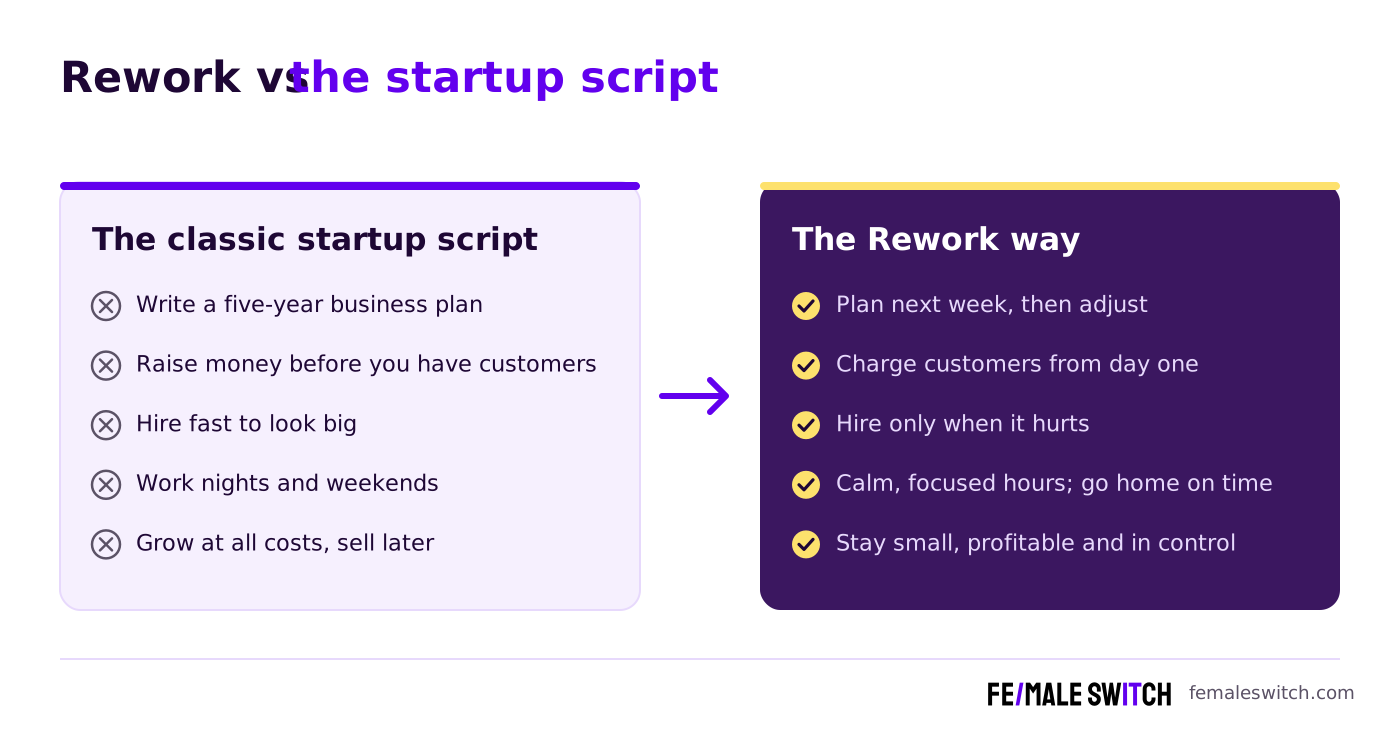
Rework reads best as a reply to the 2000s startup script: write a plan, raise money, hire fast, work 80-hour weeks, grow at all costs, sell the company. The authors reject almost every step. They even push back on the word "startup", arguing that a real business has to make more money than it spends from the start, instead of planning to figure that out later.
That makes it a useful counterweight to books like Zero to One, which argue for venture-scale, winner-takes-most companies. Neither book is "right". They describe two different kinds of business, and the first decision you have to make is which one you are building.
What aged and what held: Rework in 2010 vs 2026
The authors wrote from 37signals' own position: a profitable company with a famous blog, a well-known open-source project and years of consulting income behind its first product. Keep that in mind. Here is how the main advice looks today.
That last row matters. In 2021, after the founders banned societal and political discussions on internal company channels, roughly a third of the staff accepted buyouts and left, according to reporting by TechCrunch, NPR and other outlets. You don't have to take a side on the policy to learn from it: "culture just happens" is risky advice once a team grows beyond a handful of people.
Copyable worksheet: cut your product in half
The most practical chapter for 2026 is the idea of building half a product. With AI, it's tempting to build everything because building feels cheap. Your users' attention isn't cheap. Copy this worksheet before your next build sprint.
Is Rework advice right for your startup? A fit checklist
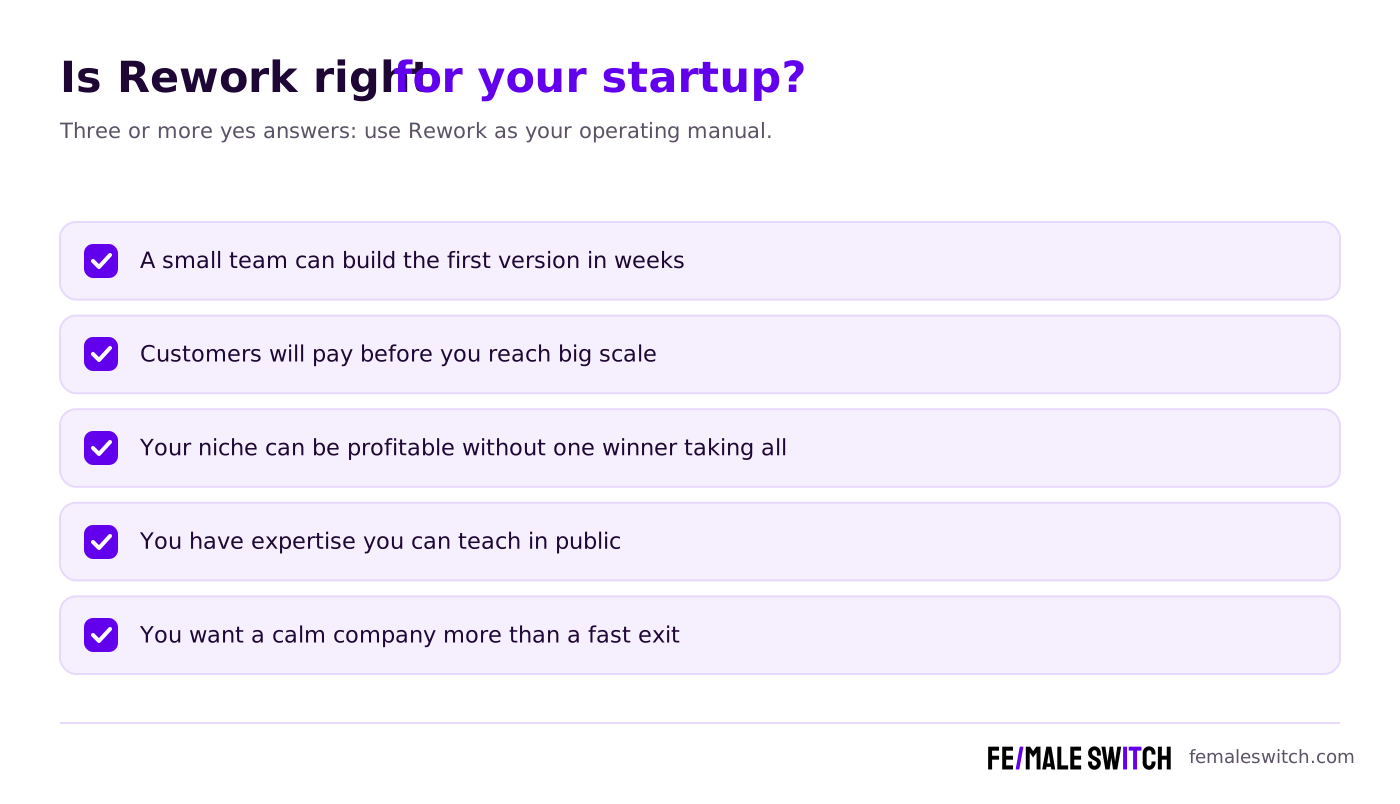
Answer yes or no. The more "yes" answers, the more of Rework applies to you as written.
- Can a small team build the first version in weeks, not years? Software, services, content and digital products usually can. Hardware and regulated products usually can't.
- Will customers pay before you reach a big scale? If your model only works with millions of free users, you'll need outside money.
- Is your market big enough for a profitable niche, but not a race to one winner? Rework fits markets where the third-best tool still makes a good living.
- Do you have something to teach? Your expertise is your cheapest marketing channel.
- Do you want a calm company more than a fast exit? Be honest. Both are valid goals, but they lead to different decisions.
Three or more "yes" answers: treat Rework as your operating manual. Fewer: read it for the habits (focus, saying no, writing things down), not the funding philosophy.
A worked founder example
Picture a solo founder building a booking tool for independent yoga teachers. Her first feature list has 14 items: payments, class packs, a mobile app, waiting lists, marketing emails, reviews, analytics and more.
Using the scope cut, she keeps three CORE features: a booking page, online payment and automatic reminders. She parks the mobile app and the analytics for 90 days. She launches in three weeks at a small monthly fee, with ten teachers she met at a local studio.
Instead of ads, she writes one short guide a week on running a profitable small studio, the "out-teach" idea. Two months later, the most common request is waiting lists, so that's what she builds next. She hasn't raised money, hired anyone or held a single weekly meeting, and she knows exactly what her customers will pay for.
That is Rework applied in 2026: fewer features, earlier revenue, public teaching and decisions made from real customer behaviour. To practise this loop without risking real money, try our startup game with an AI co-founder.
Who should read Rework (and who can skip it)
Read it if you're a first-time founder, a freelancer turning a service into a product, or anyone who feels they must raise money and work nights before they're allowed to start. It's short, and it gives you permission to start small.
Skim or skip it if you need step-by-step methods. Rework is a manifesto, not a manual, and many claims rest on the authors' own experience rather than evidence. Pair it with practical guides: The Lean Startup for testing ideas and The Bootstrap AI Revolution for building a lean business with AI today.
Related startup books for founders
- The Lean Startup: the testing method behind "launch now".
- Zero to One: the opposite view, for founders aiming at venture scale.
- The Slicing Pie Handbook: split equity fairly when you bootstrap with co-founders.
- Getting Acquired: what happens when a small, bootstrapped SaaS does sell.
- Free Bootstrapping with AI Guide: build a startup without funding, step by step.
FAQ
What is the main idea of Rework?
You can build a successful business with less than conventional advice says: less planning, less money, fewer people and less work time. Focus on a small, excellent product, charge from the start, say no to most requests and protect your team's time.
Who wrote Rework and when was it published?
Jason Fried and David Heinemeier Hansson, the co-founders of 37signals (Basecamp, HEY), wrote it. Crown Business published it in March 2010. Hansson is also the creator of Ruby on Rails.
Is Rework still relevant in 2026?
Mostly, yes. Small teams, remote work and teaching your audience fit 2026 even better than 2010, because AI tools lower the cost of building. The parts to question are the dismissal of planning for capital-heavy businesses and the hands-off view of company culture.
What does "planning is guessing" mean in Rework?
Long-term business plans rely on predictions nobody can make. The authors suggest deciding what to do next, doing it and adjusting, instead of following a five-year plan written before you had any customers.
Is Rework good for bootstrapped founders?
Yes, it's one of the best mindset books for bootstrappers. It argues that outside money should be a last resort and that profit from early customers keeps you in control. Use it with a practical validation method.
What books are similar to Rework?
The same authors wrote Remote: Office Not Required (2013) and It Doesn't Have to Be Crazy at Work (2018). For a method rather than a manifesto, read The Lean Startup; for the opposite philosophy, read Zero to One.
About the Author
Violetta Bonenkamp, also known as MeanCEO, is an experienced startup founder with an impressive educational background including an MBA and four other higher education degrees. She has over 20 years of work experience across multiple countries, including 5 years as a solopreneur and serial entrepreneur. Throughout her startup experience she has applied for multiple startup grants at the EU level, in the Netherlands and Malta, and her startups received quite a few of those. She’s been living, studying and working in many countries around the globe and her extensive multicultural experience has influenced her immensely.

