

The Best Countries for AI Startups, Ranked by Data You Can Check
Where you build an AI startup decides how much investor money is nearby, whether you can get GPUs at public prices, which AI law you must follow and whether you can get a visa. This guide compares 20 countries using the latest figures from Stanford's AI Index Report 2026, which counts private AI investment and newly funded AI companies in 2025. For each country we add its national AI strategy or law and the public AI support a founder can actually use, checked on government pages in October 2026. We removed the market-size forecasts and unsourced counts older lists repeat. For general startup visas and grants, see our guide to the best countries for early-stage startups.
Quick answer: the United States is far ahead for AI money, with $285.9 billion of private AI investment in 2025 and 1,953 newly funded AI companies, more than ten times any other country. The United Kingdom (172 new AI companies) and China (161) follow. For public help a founder can use now, look at the UK's Sovereign AI compute offer, the free EuroHPC AI Factories in France, Germany, Sweden, Spain and their partners, India's subsidised IndiaAI Compute and Israel's national supercomputer. Israel and Singapore have the highest share of AI talent. Canada's AI Compute Access Fund and its Start-up Visa are both closed to new applicants.
Write FREE SEO-optimized Blog Articles! Our Article Writer ensures your blog is loved by both Google and your readers, turning those clicks into customers.
👉 Write your article here
AI Investment, New AI Companies and National AI Plans at a Glance
Sources: investment and company counts from the Stanford HAI AI Index Report 2026, figures 4.2.8 and 4.2.9 (Quid data for 2025; "Not in top 15" means the country is not shown in that chart); strategies and programmes from the official pages linked in each section, checked in October 2026.
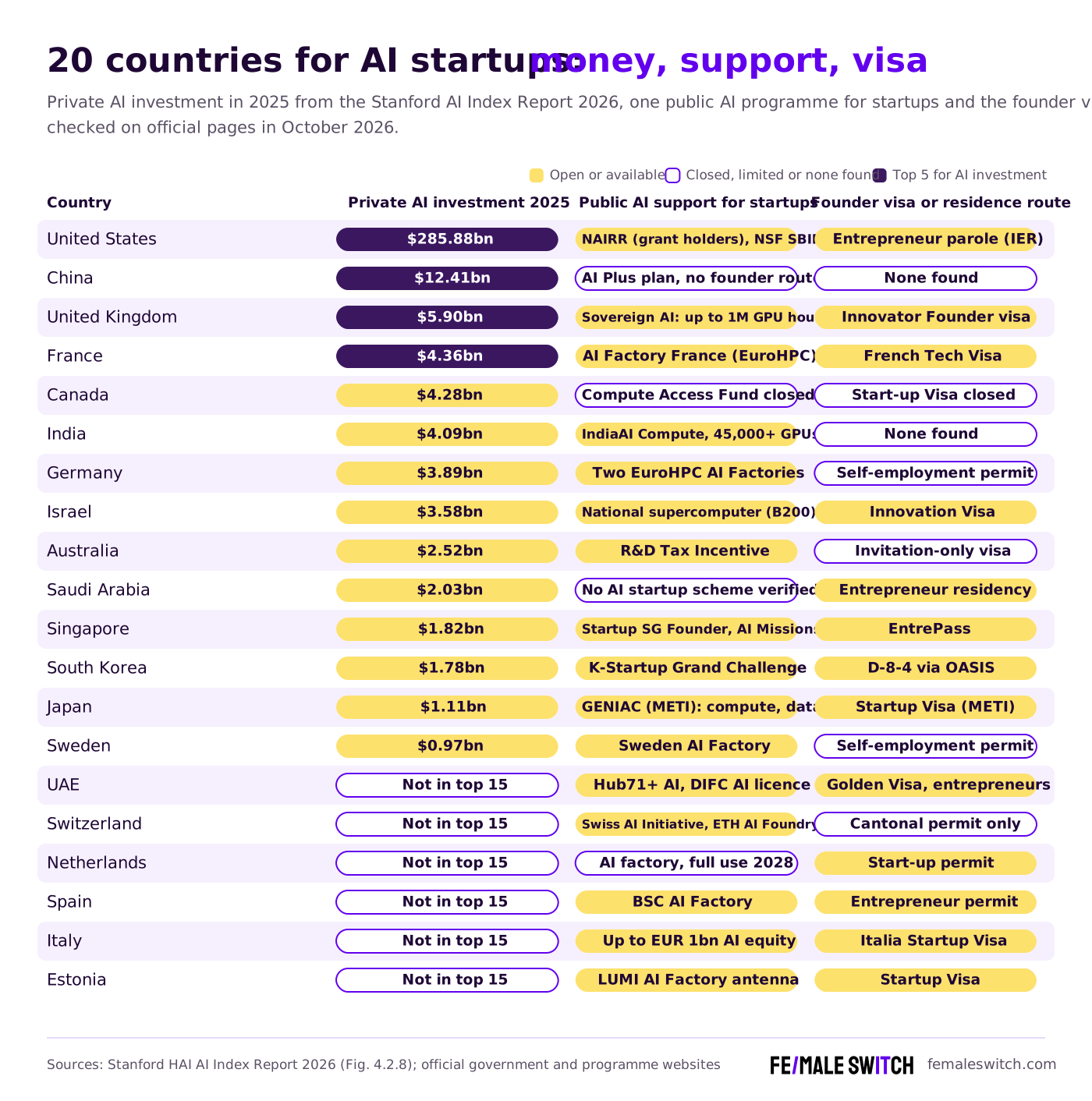
How We Chose and Ordered the Countries
We ordered the countries by private AI investment in 2025 as published in the AI Index Report 2026 (Stanford HAI, April 2026), then added six countries outside its top 15 that have strong AI talent or public AI infrastructure. The report also measures talent: in 2025 Israel had the highest share of AI talent among LinkedIn members (2.1%), followed by Singapore (1.8%) and Luxembourg (1.6%), and the UAE had the second-highest net inflow of AI talent (4.40 per 10,000 LinkedIn members) after Luxembourg. Generative AI use is highest in the UAE (64%) and Singapore (61%). The report warns that private investment figures likely understate China's total AI spending because of its government guidance funds. We did not use the Tortoise Global AI Index, because its website did not load when we checked.
The 20 Best Countries for AI Startups in 2027
1. United States
The White House published America's AI Action Plan on 23 July 2025: over 90 federal policy actions under three pillars, accelerating innovation, building AI infrastructure and leading in international diplomacy and security. Since Executive Order 14434 of 29 September 2026, federal agencies say "Super Intelligence" (SI) instead of AI, and ai.gov now redirects to si.gov, so expect US programme pages to use the new term. The NAIRR Pilot gives researchers free AI compute, but only startups and small businesses that hold federal grants can apply. Most founders start with NSF's SBIR/STTR: Phase I up to $305,000 and Phase II up to $1,250,000 for US small businesses, after an invited project pitch; the next deadline is 4 November 2026. Investors are listed in our guides to VCs for AI startups and deep tech VCs in North America.
2. China
China's State Council issued its AI Plus guideline in August 2025: by 2027 it wants new-generation intelligent terminals and AI agents to pass 70% penetration in six key sectors, and more than 90% by 2030. China ranks second for AI investment and third for newly funded AI companies. It suits founders who are already in China; we found no national founder visa or AI startup programme for foreigners.
3. United Kingdom
The AI Opportunities Action Plan of 13 January 2025 has 50 recommendations, including expanding the AI Research Resource at least 20 times by 2030 and creating AI Growth Zones. Its progress report of 29 January 2026 says 38 of the 50 actions are met. For founders the best part is Sovereign AI: up to 1 million GPU hours per startup on the AI Research Resource for UK companies doing substantial AI R&D. Smaller firms can use UKRI's AIRR rapid access, 20,000 GPU hours on Isambard-AI or Zenith with no closing date. Non-UK founders use the Innovator Founder visa, which needs an endorsing body and lasts 3 years.
4. France
France launched the third phase of its national AI strategy on 6 February 2025, funded through France 2030; at the Paris AI Action Summit the president announced €109 billion of private AI investment in France over the coming years. AI Factory France, led by GENCI, is the single entry point to the Jean Zay, Adastra and Joliot-Curie supercomputers; under the EuroHPC access modes, AI startups and SMEs use AI Factories free of charge, with Fast Lane requests of up to 50,000 GPU hours. Bpifrance's Pionniers de l'IA call closed on 9 June 2026. Non-EU founders use the French Tech Visa, a renewable 4-year talent passport.
5. Canada
Prime Minister Carney launched AI for All, Canada's new national AI strategy, on 4 June 2026, targeting $200 billion of additional economic growth. Its main founder tool so far, the AI Compute Access Fund (up to $300 million, part of the Canadian Sovereign AI Compute Strategy of December 2024), covered two-thirds of Canadian cloud compute costs for projects of $100,000 to $5 million, but its call closed on 31 July 2025 and it is not accepting applications. The Start-up Visa is closed to new applicants too, so founders already in Canada are best placed.
Boost Your SEO with 1,500+ Free Business Directories: increase your DA, get backlinks and traffic.
We've compiled an exclusive list of directories and websites where you can submit your business and start building high-quality backlinks to boost your website traffic and get your SEO snowball rolling.
👉 Submit your startup now!
6. India
India's cabinet approved the IndiaAI Mission on 7 March 2024 with a budget of ₹10,371.92 crore. Its IndiaAI Compute portal rents GPUs from partner cloud providers at subsidised rates; a government backgrounder of August 2026 puts the shared pool at 45,000+ GPUs as of June 2026. Startups need DPIIT recognition, AI/ML experience and revenue of ₹50 lakh or funding of ₹100 lakh, and requests under 5,000 GPU hours are approved automatically. IndiaAI Startups Global, launched in March 2025 with Station F and HEC Paris, takes Indian AI startups into Europe. India ranks fourth for newly funded AI companies (108). See our guide to early-stage VCs in Asia.
7. Germany
Germany's cabinet adopted the Hightech Agenda Deutschland on 30 July 2025, with AI as one of six key technologies and an AI offensive aiming for 10% of economic output to be AI-based by 2030. Startups get compute through Germany's two EuroHPC AI Factories, JUPITER in Jülich and HammerHAI in Stuttgart, on the free startup access terms above. Germany ranks fifth for newly funded AI companies (92). The EXIST Start-up Grant pays university founders a 12-month stipend.
8. Israel
Israel has the highest concentration of AI talent of all countries in the AI Index (2.1% of LinkedIn members). On 18 January 2026 the Israel Innovation Authority opened access to the national supercomputer, run by Nebius: 1,000 Nvidia B200 accelerators over the coming years at below-market prices, 70% of them for companies training AI models. Foreign founders can apply for the Innovation Visa, a stay permit of up to 2 years through a supporting accelerator.
9. Australia
Australia had $2.52 billion of private AI investment in 2025 and the third-highest net inflow of AI talent (1.79 per 10,000 LinkedIn members). According to the Department of Industry's website, the federal National AI Plan was published in December 2025; the page did not load in full when we checked, so we leave out its measures. Its AI Accelerator put up to $20 million for AI projects into round 19 of the CRC Projects grants ($100,000 to $3 million of matched funding, led by an SME); that round closed on 12 May 2026. The R&D Tax Incentive gives companies with turnover under A$20 million a refundable offset, and the National Innovation visa is by invitation only.
10. Saudi Arabia
Saudi Arabia's National Strategy for Data and AI, run by the data and AI authority SDAIA, was approved on 17 July 2020, and the government named 2026 the Year of Artificial Intelligence. AI talent concentration more than doubled between 2019 and 2025, one of the three fastest rises in the AI Index. Founders can use the Entrepreneur Residency and the Monsha'at startup hubs.
11. Singapore
Singapore launched its National AI Strategy 2.0 in December 2023 and updated it in 2026: a National AI Council chaired by the Prime Minister was set up in February 2026, and national AI Missions target advanced manufacturing, financial services, connectivity and healthcare. It has the second-highest AI talent share (1.8%). AI Singapore runs the national AI programmes, Startup SG Founder gives first-time founders S$20,000 to S$50,000, and the EntrePass is open to all nationalities. AI Singapore's 100 Experiments co-funds AI projects up to S$150,000, and from 28 January 2027 the Tech.Pass is replaced by a new ONE Pass track for AI and tech founders and leaders earning at least S$22,500 a month. See our guide to startup incubators in Asia.
12. South Korea
South Korea's AI Basic Act came into force on 22 January 2026, with a grace period of at least one year before fines and an AI Basic Act Support Desk that advises companies. Foreign founders can enter through the K-Startup Grand Challenge (its 2026 call closed in June) or the points-based D-8-4 startup visa via the OASIS programme.
13. Japan
Japan's AI Promotion Act has been fully in force since 1 September 2025, and the cabinet adopted AI Basic Plans under it on 23 December 2025 and 14 July 2026. METI's GENIAC programme pays for compute and data for generative AI developers, including startups. Japan ranks tenth for newly funded AI companies (56). Its Startup Visa runs through local governments certified by METI and gives up to 2 years to prepare, which matters because the regular Business Manager visa now needs ¥30 million of capital.
14. Sweden
Sweden published its first comprehensive AI strategy on 25 February 2026, aiming for a place among the top 10 AI countries. The Mimer AI Factory has been called the Sweden AI Factory since 24 August 2026; it is hosted by Linköping University with RISE and gives startups free compute and support. Vinnova's Innovative Startups gives young Swedish companies up to SEK 500,000; the current call closes on 12 January 2027.
15. United Arab Emirates
The UAE Council for AI works to make the UAE a world leader in AI by 2031, and the AI Index ranks it first for generative AI use (64%) and second for net AI talent inflow. The AI and coding licence from DIFC and the UAE AI Office lets licence holders get Golden Visas for their staff, and Hub71 in Abu Dhabi runs Hub71+ AI for AI startups with free housing, office space and health insurance. Founders themselves can apply for the Golden Visa for entrepreneurs.
Boost Your SEO by Getting Featured in Our Blogs and get a backlink.
We publish content about startups, education, tech, funding, etc. that ranks well not only in Google but also in Perplexity, ChatGPT, Grok and other AI tools.
👉 Get featured now!
16. Switzerland
The Federal Council decided on 12 February 2025 to ratify the Council of Europe AI Convention and regulate AI sector by sector instead of with one AI act. The Swiss AI Initiative of ETH Zurich and EPFL trains open models on the Alps supercomputer, and ETH's AI Foundry gives ETH spin-offs up to 10,000 GPU hours. There is no startup visa; non-EU founders apply to their canton.
17. Netherlands
We found no new national AI strategy, and the Dutch cabinet decided in March 2026 not to put public money into the EU's AI gigafactories. The Dutch AI factory in Groningen will be fully available to startups from early 2028, according to the government's progress letter of 1 July 2026. The start-up residence permit lasts 1 year and needs an approved facilitator.
18. Spain
Spain approved its AI Strategy 2024 with €1.5 billion for 2024 and 2025, and the AI bill that names the AESIA agency as supervisor went to parliament in May 2026 and is not yet law. The BSC AI Factory adds AI partitions to the MareNostrum 5 supercomputer and onboards startups and SMEs. Startups certified by ENISA get the startup-law benefits.
19. Italy
Italy was the first EU country to pass its own AI law: Law 132/2025 came into force on 10 October 2025, and article 23 authorises up to €1 billion of equity investment, through CDP Venture Capital, in Italian SMEs and tech champions in AI, cybersecurity, quantum and telecoms. Invitalia's Smart&Start Italia finances innovative startups up to 60 months old; Bologna hosts the IT4LIA AI Factory.
20. Estonia
Estonia's government launched the Eesti.ai initiative on 27 January 2026 with leading entrepreneurs, and its AI Leap programme puts AI tools in secondary schools. Its AI talent share in the AI Index (1.15%) is level with Germany's and is an antenna of the LUMI AI Factory in Finland. e-Residency lets founders register an EU company online, and non-EU founders who want to live there use the Startup Visa.
What Changed: Closed Programmes and New Rules
- Canada: the AI Compute Access Fund call closed on 31 July 2025, and the Start-up Visa no longer takes new applicants. Canada launched a new national AI strategy, AI for All, in June 2026.
- United States: America's AI Action Plan of July 2025 sets federal AI policy, and since September 2026 federal pages say "Super Intelligence"; ai.gov redirects to si.gov.
- EU AI Act: the AI Omnibus entered into force on 27 July 2026 and moved the high-risk rules for areas such as hiring and education to 2 December 2027. Most other rules apply from 2 August 2026.
- Renamed or closed: Sweden's Mimer AI Factory is now the Sweden AI Factory, France's Pionniers de l'IA call is closed, and the Netherlands moved full use of its AI factory to 2028.
- New laws: South Korea's AI Basic Act (January 2026), Italy's AI law (October 2025) and Japan's AI Promotion Act (2025).
- Removed from this list: Romania (no data in the sources we used) and every statistic in the 2025 version that had no source, including the China market forecast and the company counts.
Which Country Should You Choose?
- You need investors and customers first: the United States, then the UK.
- You need free or cheap GPUs: the UK's Sovereign AI offer, the EuroHPC AI Factories (France, Germany, Sweden, Spain, Italy and partners), IndiaAI Compute or Israel's national supercomputer.
- You need AI engineers: Israel, Singapore, Switzerland and Estonia have the highest AI talent shares.
- You want clear AI rules: the EU AI Act, South Korea's AI Basic Act and Italy's AI law all have published dates.
- You are building in the Gulf: the UAE (Hub71, DIFC AI licence, Golden Visa) or Saudi Arabia (Year of AI, Entrepreneur Residency).
- You were counting on Canada: its compute fund and founder visa are closed, so plan around a work permit or another country.
Join F/MS: Startup Facilitator & Incubator and unlock your startup dreams today! Get your first customers, register you company in the Netherlands and get startup visas for the team.
How Founders Use This List
Pick two or three countries that fit your passport, your data and your first customers, then compare the help on the ground. In Europe, our guides to the best cities for AI startups in Europe, incubators for AI startups in Europe and the best countries for startups in Europe go deeper. For money, see deep tech VCs in Europe and grants for female entrepreneurs. Before you move anywhere, validate your startup idea with real customers.
FAQ About the Best Countries for AI Startups
Which country is best for AI startups in 2027?
The United States, by a wide margin: $285.9 billion of private AI investment in 2025 and 1,953 newly funded AI companies, according to the Stanford AI Index Report 2026. The UK and China follow.
Which country has the most new AI startups after the US?
The United Kingdom, with 172 newly funded AI companies in 2025, ahead of China (161), India (108), Germany (92) and France (84).
Where can an AI startup get free GPU compute?
The EU's AI Factories are free for AI startups and SMEs, the UK's Sovereign AI offers up to 1 million GPU hours per startup, and UKRI gives smaller firms 20,000 GPU hours. India's IndiaAI Compute and Israel's national supercomputer are discounted.
Is Canada's AI Compute Access Fund still open?
No. Its call closed on 31 July 2025 and the fund is not accepting applications. Canada launched a new AI strategy, AI for All, in June 2026.
Which countries have the most AI talent?
In the AI Index Report 2026, Israel has the highest share of AI talent on LinkedIn (2.1%), followed by Singapore (1.8%), Luxembourg, Ireland, Switzerland and Finland.
When do the EU AI Act rules apply to startups?
Bans applied from February 2025 and rules for general-purpose AI from August 2025. Most other rules apply from 2 August 2026, and the high-risk rules for areas such as hiring and education from 2 December 2027.
Which countries have a national AI law?
The EU has the AI Act, Italy passed Law 132/2025, South Korea's AI Basic Act came into force in January 2026, and Japan's AI Promotion Act has been fully in force since September 2025.
Is the Middle East good for AI startups?
The UAE leads the world for generative AI use (64%) and has the second-highest net inflow of AI talent; Saudi Arabia named 2026 its Year of AI. Both offer founder residency routes.
Why did you remove the old statistics?
The 2025 version cited sources as numbers in brackets without linking them, and its FAQ linked to fake websites. We replaced them with dated figures from the Stanford AI Index and government pages.
Can you feature my AI startup?
Yes. We publish articles about startups, funding and tech; see how to get featured and get a backlink in the callout above, or read our guide to startup incubators in Europe.
About the Author
Violetta Bonenkamp, also known as MeanCEO, is an experienced startup founder with an impressive educational background including an MBA and four other higher education degrees. She has over 20 years of work experience across multiple countries, including 5 years as a solopreneur and serial entrepreneur. Throughout her startup experience she has applied for multiple startup grants at the EU level, in the Netherlands and Malta, and her startups received quite a few of those. She’s been living, studying and working in many countries around the globe and her extensive multicultural experience has influenced her immensely.
