

Deep Tech VCs in North America: 20 Venture Capital Firms Backing Fusion, Chips, Robotics, Space, Bio and Defence Tech
Most lists of "top deep tech VCs" in the US are really lists of famous generalist firms with a few space or AI deals. A deep tech founder needs something narrower: investors who say they back hard science, can wait for a first-of-a-kind plant or chip, and know which government customers matter. We checked 20 North American firms on their own websites in October 2026: where they are based, what they say they invest in, the earliest stage they invest at, the ticket size if they publish one, their latest fund, and portfolio examples taken only from their own portfolio pages. Canada gets its own part, because two well-known Canadian deep tech sources have changed.
Quick answer: for the very first cheque, look at SOSV (pre-seed, up to $550,000), Fifty Years, Playground Global and Khosla Ventures. For a seed lead, Root Ventures ($3 million to $5 million initial investments), Material Impact (materials science) and DCVC are the clearest deep tech specialists. For capital-heavy industrial and climate hardware, Eclipse (new $720 million early fund and $591 million growth fund), Lux Capital, Engine Ventures and Lowercarbon. Defence and dual-use founders should add IQT and Shield Capital; Canadian founders Two Small Fish, Radical Ventures and BDC Capital.
Write FREE SEO-optimized Blog Articles! Our Article Writer ensures your blog is loved by both Google and your readers, turning those clicks into customers.
👉 Write your article here
Deep Tech VC Firms in North America Compared
Sources: each firm's own website and announcements, checked 28 October 2026. "Not published" means the firm's site does not state it; press-only figures are marked "according to".
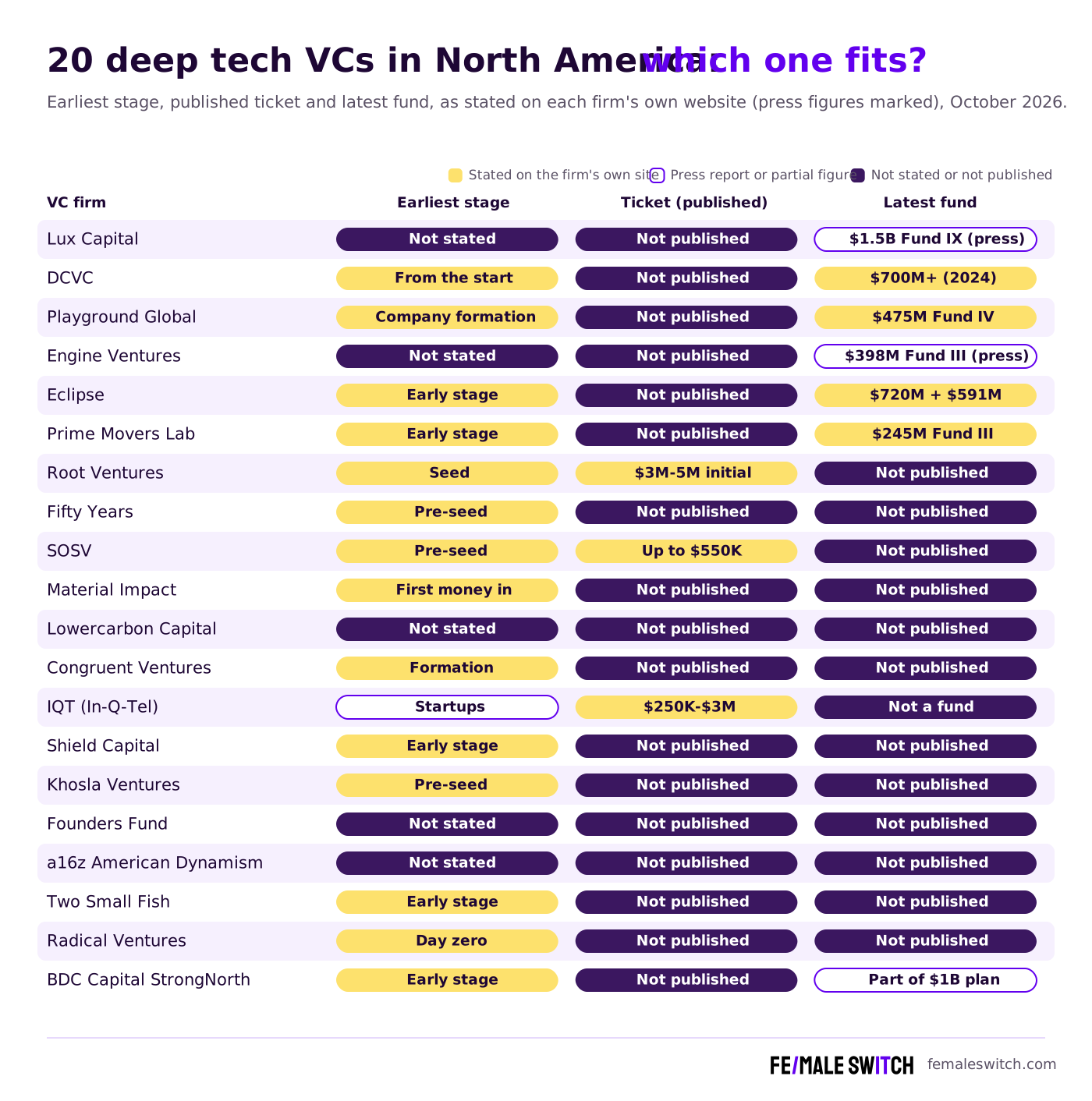
The 20 Deep Tech VC Firms in North America for 2027
First the dedicated deep tech specialists, then the climate funds, then the national security investors, then three generalists that back a lot of hard tech, and finally Canada.
1. Lux Capital
Lux Capital is based in New York City and Silicon Valley and describes itself as a venture firm with $7 billion under management, investing in emerging science and technology companies; its tagline is "We turn sci-fi into sci-fact". Its portfolio page sorts companies by science (biology, chemistry and materials, engineering and electronics, physics and aerospace) and lists Anduril and Applied Intuition (both since 2017), Physical Intelligence, A-Alpha Bio and Databricks. Its site states no fund size; according to TechCrunch, it closed Lux Ventures IX at $1.5 billion in January 2026, its largest fund.
2. DCVC
DCVC (founded as Data Collective in 2010, offices in Palo Alto and San Francisco) says it plainly: "We are deep tech venture capital." It reports over $4 billion under management and says its team has more published scientists than MBAs. Its topics run from AI, compute and quantum to computational bio, defence, energy, space and agriculture; homepage examples include Fervo Energy (geothermal, now listed on Nasdaq), Pivot Bio (first investment 2014) and Radiant (nuclear microreactors). On September 30, 2024 it announced over $700 million across its first dedicated climate fund and a new DCVC Bio fund.
3. Playground Global
Playground Global (Palo Alto) says it invests "at the earliest stages of company formation", backing technical founders in next-gen compute (quantum, AI acceleration, interconnects), automation, the energy transition and engineered biology: "If it's too early for everyone else, it's probably right for us." It reports $1.7 billion under management. Its portfolio includes Agility Robotics, Ayar Labs (silicon photonics), Amber Bio (RNA editing) and Alva (nuclear uprates). Its news page lists a $475 million Fund IV, announced May 18, 2026.
4. Engine Ventures (formerly The Engine)
Engine Ventures invests in "Tough Tech" founders and says it is rooted in the Boston research community around MIT and Harvard. It used to be the investing side of The Engine, which was built by MIT; the two are now separate, and The Engine is a 501(c)(3) nonprofit incubator with labs and programmes that does not invest. Portfolio companies on its homepage include Commonwealth Fusion Systems, Form Energy (multi-day batteries), Lilac Solutions (lithium extraction) and Celestial AI (optical interconnect, exited). Its site gives no fund size; according to Gunderson Dettmer, the law firm that advised it, Fund III closed at $398 million in June 2024.
5. Eclipse
Eclipse (Palo Alto, renamed from Eclipse Ventures and now at eclipse.capital) backs entrepreneurs "transforming the physical economy", the industries behind resilience, competitiveness and security, such as manufacturing, compute, mobility and construction. Its team has built factories and shipped hardware, and its companies page tags deals as early stage or early growth. Examples on its companies page: Cerebras Systems, Wayve, VulcanForms, Oxide, Bedrock Robotics and True Anomaly. On April 7, 2026 it announced $1.3 billion across Eclipse Fund VI ($720 million) and Early Growth Fund III ($591 million), with about $10 billion under management.
6. Prime Movers Lab
Prime Movers Lab funds "breakthrough scientific startups" in energy, transportation, infrastructure, manufacturing, human augmentation and agriculture, and says it makes only a small number of investments. Its announcements are datelined Jackson, Wyoming. Its Fund III press release (July 26, 2023) gives $245 million for early-stage startups and over $1.2 billion under management, and names Quantum Space, Paradromics, Boom Supersonic and Axiom Space; its site also names Commonwealth Fusion Systems, Figure and Hark.
7. Root Ventures
Root Ventures calls itself "a San Francisco-based deep tech seed fund" run by engineers. It specialises in leading the first round, with initial investments of typically $3 million to $5 million, a few new deals a year and two thirds of each fund held in reserve for follow-ons. Portfolio examples on its site: nTopology (engineering design software), Tortuga AgTech (harvesting robots), Particle (IoT) and Nautilus Labs (shipping optimisation).

8. Fifty Years
Fifty Years is a pre-seed and seed VC that loves "scientists, engineers, hackers" and also helps start companies. Its homepage promotes a programme it calls "a cheat code for starting a deep tech startup", with the next cohort starting in April 2027. It says it is backed by 46 founders of $1 billion-plus tech companies. Its companies page lists Aalo (nuclear power), Astranis (satellites for high orbits), Atom Computing (quantum computing) and 64x Bio.
Boost Your SEO by listing your startup and get a FREE backlink.
Create a profile in the F/MS Startup Game, add the link to your website and submit.
👉 List your startup now!
9. SOSV
SOSV invests in "Deep Tech for Human and Planetary Health" from programmes in San Francisco, New York and Newark (home of its HAX hardware programme). It makes about 60 pre-seed investments a year of up to $550,000 each and follows on at least through Series B. It counts more than 800 portfolio companies; examples on its site are NotCo, Opentrons, Upside Foods and Smartex.
10. Material Impact
Material Impact (Boston) builds "deep tech companies powered by material science" and wants to be the "first money in" for first-of-their-kind innovations. Its companies page tags each company with one of three funds (MIF-I to MIF-III) and lists 6K (microwave plasma materials, listed on the ASX), Amperesand (solid-state transformers), CorePower Magnetics and AgZen. It publishes no fund sizes.
11. Lowercarbon Capital
Lowercarbon Capital backs companies that "make real money" slashing CO2 emissions, removing carbon from the sky and buying time against warming. Its team includes a dedicated fusion partner. Companies on its homepage: Antora (thermal batteries), Crusoe (compute clusters), Commonwealth Fusion Systems, Panthalassa (ocean power), Solugen (chemicals made with enzymes) and Heart (electric planes). Its site publishes no fund size, stage or office address.
12. Congruent Ventures
Congruent Ventures (San Francisco) is a climate investor backing early-stage teams based in North America that innovate "across atoms, bits, or business models". Initial investments range from formation capital to Series A. Its portfolio includes Parallel Systems (autonomous electric rail freight), Lydian (sustainable fuels and chemicals) and Coastal Assembly (nature-based coastal infrastructure).
Boost Your SEO with 1,500+ Free Business Directories: increase your DA, get backlinks and traffic.
We've compiled an exclusive list of directories and websites where you can submit your business and start building high-quality backlinks to boost your website traffic and get your SEO snowball rolling.
👉 Submit your startup now!
13. IQT (In-Q-Tel)
IQT was set up in 1999 by the CIA as an independent, not-for-profit strategic investor; it says it is neither a government entity nor part of the CIA. It has offices in Tysons (Virginia), Menlo Park and Cambridge (Massachusetts), plus London, Munich, Sydney and Singapore, and covers frontier tech from biotech to microchips, AI and space. Its deal sizes are published: technology development agreements typically involve $500,000 to $3 million, equity-only investments $250,000 to $500,000. Recent names on its portfolio page include Proteus Space, Mueon (microelectronics and quantum) and Locus Lock.
14. Shield Capital
Shield Capital invests in early-stage companies building technologies that matter for national security in artificial intelligence, autonomy, cybersecurity and space; its team combines founders, investors and national security leaders. Its news page shows it leading Watchtower's $35 million seed round (October 21, 2026) and SiFly's $20 million Series A (August 26, 2026). It publishes no fund size or ticket.
15. Khosla Ventures
Khosla Ventures (2128 Sand Hill Road, Menlo Park) says it invests "earliest", from pre-seed and seed to Series A, across eight areas, two of which are Frontier and Sustainability. It is a mixed fund (Ramp, DoorDash and OpenAI are also in its portfolio), but its homepage features hard tech bets: Rocket Lab (a seed investment), Commonwealth Fusion Systems and eGenesis. Its site names a Seed Fund, Main Fund and Opportunity Fund without sizes.
16. Founders Fund
Founders Fund describes itself as a San Francisco firm investing in companies building revolutionary technologies. It is a generalist, but its portfolio page is heavy on hard tech: SpaceX, Anduril, Varda (manufacturing in space), PsiQuantum, Hadrian (automated factories), General Matter (nuclear fuel) and Neuralink. Its site gives no stage, ticket or fund size.
17. Andreessen Horowitz American Dynamism
Andreessen Horowitz (a16z) was on the 2025 list as a generalist. Its deep tech money now has a clear home: the American Dynamism practice, which invests in aerospace, defence, public safety, supply chain, industrials and manufacturing. Companies featured on that page include Anduril, Hadrian, Saronic, Castelion and Mariana Minerals. The page states no stage or fund size.
Canada: Deep Tech VCs and What Changed
Canada has world-class quantum and AI research, but two of the most-cited Canadian sources of deep tech money have changed, so check before you pitch.
18. Two Small Fish Ventures
Two Small Fish Ventures is an "early-stage deep tech venture firm" with offices in Toronto, Montreal and New York. Its partners were engineers, entrepreneurs and operators, with experience in semiconductors and AI products. Portfolio companies named on its site: Ideogram, Blumind, BenchSci and Ada. It publishes no fund size or ticket.
19. Radical Ventures
Radical Ventures (Toronto, San Francisco and London) is an AI-focused investor that backs companies "from day-zero incubations to growth and pre-IPO scaling". Much of its portfolio is deep tech: Xanadu (photonic quantum computing, marked IPO), Aspect Biosystems (bioprinted tissue), Muon Space (satellites) and Orbital Materials, next to Cohere and Waabi. For pure AI startups, see our list of VCs for AI startups.
20. BDC Capital (StrongNorth Fund)
BDC Capital, the investment arm of Canada's Business Development Bank, now points deep tech founders with defence or dual-use technology to its StrongNorth Fund, which invests in early-stage companies, as part of a commitment to invest $1 billion in Canadian defence innovation. Its older Deep Tech Venture Fund ($200 million, launched in May 2021, seed and Series A in quantum, photonics, electronics and AI) is closed to new investments and only supports its portfolio, which includes Xanadu, Nord Quantique and Haply Robotics.
Firms That Left This List and Why
The 2025 version of this article listed 25 names. Six stay (Lux, DCVC, SOSV, Founders Fund, Khosla and a16z, now through American Dynamism). The rest changed:
- Generalists without a stated deep tech focus: Sequoia, Kleiner Perkins, Union Square Ventures, Accel, Bessemer, Lightspeed, General Catalyst, SV Angel, Benchmark, GV, Pear VC, Index Ventures, First Round and Trinity Ventures. They invest across consumer, SaaS and fintech; compare them in our early-stage VC firms list instead.
- GGV Capital no longer exists under that name: on March 29, 2024 it separated into two firms, Notable Capital in the US and Granite Asia in Singapore.
- 83North is based in London and Herzliya, not North America. European deep tech firms are in our deep tech VCs in Europe guide.
- OpenAI Startup Fund is AI-only, and "DeepTech Ventures" could not be found: its domain does not resolve. Alumni Ventures sells venture funds to individual investors, and the deep tech fund page we checked returns an error.
- Changed since 2025: The Engine split into Engine Ventures (the VC) and a nonprofit incubator; Eclipse Ventures is now Eclipse; Real Ventures in Montreal says it is not making new investments and only follows on in its portfolio; BDC's Deep Tech Venture Fund is closed to new deals.
- Breakthrough Energy Ventures was left out: Breakthrough Energy's site no longer shows a separate page for the venture fund that we could check, and according to Bloomberg Law the group's Catalyst programme stopped making new investments in February 2026.
- Removed claims: every old "notable investments" line (none came from the firms' own portfolio pages) and the old FAQ answers that named firms from third-party list sites.
Funding a Deep Tech Startup in North America in 5 Steps
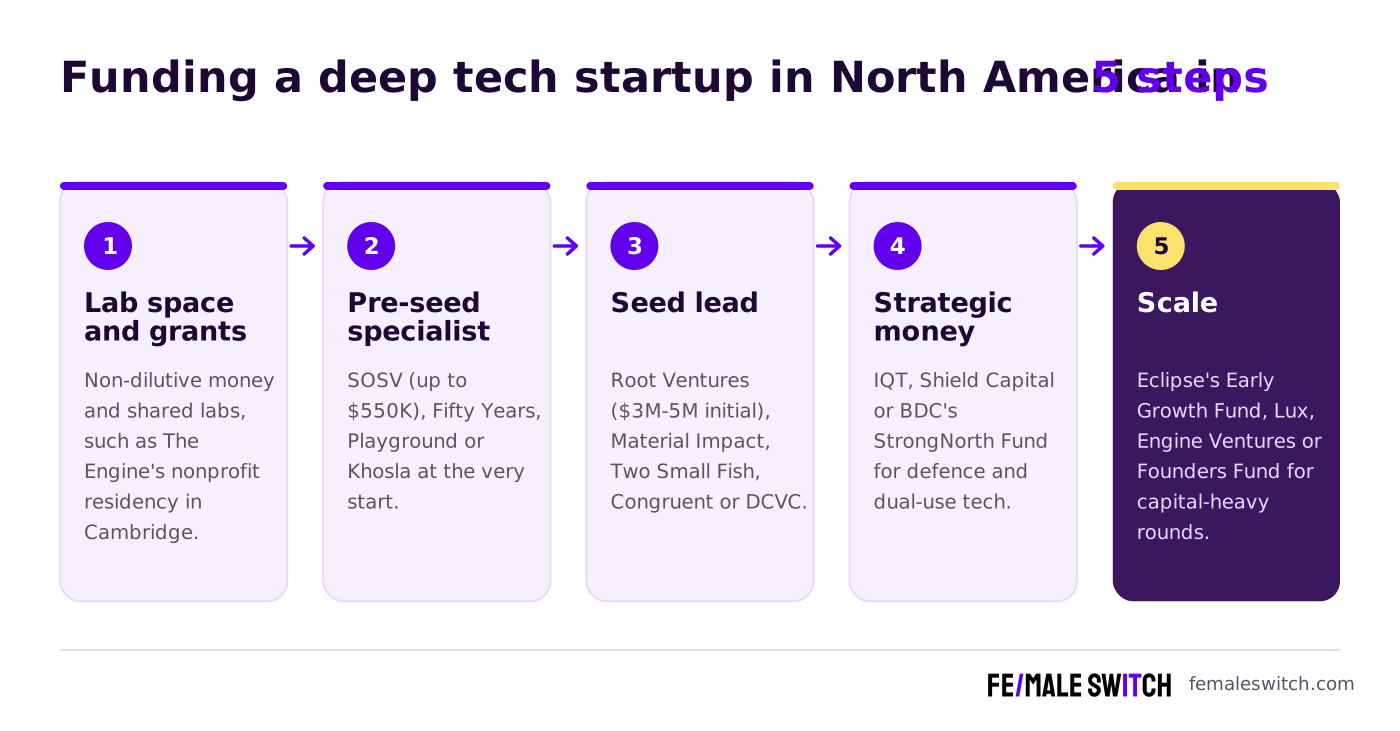
- Start with lab space and grants. The Engine's nonprofit residency rents labs to teams that have no VC yet. Our sister site covers research grants for deep tech and deep tech, AI and quantum grants.
- Find a pre-seed specialist. SOSV (up to $550,000), Fifty Years, Playground and Khosla say they invest at the very start.
- Pick a seed lead by sector. Engineering and robotics: Root Ventures; materials: Material Impact; climate: Congruent or Lowercarbon; compute and bio: DCVC or Playground; Canada: Two Small Fish.
- Add strategic money if the government is a customer. IQT publishes its deal sizes; Shield Capital and BDC's StrongNorth Fund focus on national security and dual-use technology.
- Plan the scale-up round early. Eclipse's $591 million Early Growth Fund III, Lux, Engine Ventures and Founders Fund write the bigger cheques that first factories and plants need. Read how blended grant and equity finance works.
Which Deep Tech VC Should You Choose?
- Pre-revenue science team: SOSV, Fifty Years (and its founder programme), Playground Global or Khosla Ventures.
- Hardware, robotics and industrial software at seed: Root Ventures or Eclipse.
- Materials and chemistry: Material Impact, Lowercarbon (Solugen) or DCVC.
- Fusion, nuclear and energy storage: Engine Ventures, Lowercarbon, Khosla and Prime Movers Lab all hold Commonwealth Fusion Systems; DCVC backs Radiant, Fifty Years backs Aalo.
- Space and defence: Founders Fund, a16z American Dynamism, Lux (Anduril), IQT and Shield Capital.
- Quantum: Founders Fund (PsiQuantum), Fifty Years (Atom Computing), Radical Ventures and BDC's portfolio (Xanadu, Nord Quantique).
- Canadian startup: Two Small Fish, Radical Ventures and BDC Capital; see the best countries for early-stage startups if you are deciding where to incorporate.
Boost Your SEO by Getting Featured in Our Blogs and get a backlink.
We publish content about startups, education, tech, funding, etc. that ranks well not only in Google but also in Perplexity, ChatGPT, Grok and other AI tools.
👉 Get featured now!
How Deep Tech Founders Prepare to Raise in North America
Deep tech partners read the science first, but they still want a path to paying customers. Before the VC round, many founders raise from angel investors in North America and win prize money at startup competitions in North America. Location matters for labs and hiring: compare the best startup cities in North America and our city guides to San Diego (biotech), Baltimore and Chicago startups to watch. Then build a fundraising pitch deck that tells a story, read up on term sheet negotiation and avoid the classic pre-seed fundraising mistakes. Women founders can add our female founder grants and grants for female entrepreneurs guides. Not sure VC is right? Read venture capital vs grants. Many partners meet founders at events: see our list of fundraising and investor events.
Building in AI or looking beyond North America? See the best countries for AI startups, the incubators for AI startups in Europe, the best cities for deep tech startups in Europe and our mobile startups to watch.
Join F/MS: Startup Facilitator & Incubator and unlock your startup dreams today! Get your first customers, register you company in the Netherlands and get startup visas for the team.
FAQ About Deep Tech VCs in North America
What is a deep tech VC?
A venture capital firm that invests in startups built on scientific or engineering breakthroughs, such as fusion and nuclear power, chips and photonics, quantum computing, robotics, space, new materials or engineered biology. DCVC ("We are deep tech venture capital"), Root Ventures ("deep tech seed fund") and Two Small Fish ("early-stage deep tech venture firm") describe themselves that way.
Which deep tech VCs in North America invest at pre-seed?
SOSV makes about 60 pre-seed investments a year of up to $550,000; Fifty Years invests at pre-seed and seed; Playground Global at company formation; Khosla Ventures from pre-seed; Congruent Ventures from formation capital; Material Impact wants to be the first money in.
How much do North American deep tech VCs invest?
Few publish it. Root Ventures typically invests $3 million to $5 million initially, SOSV up to $550,000 at pre-seed, and IQT $250,000 to $500,000 in equity-only deals or $500,000 to $3 million in technology development agreements.
Which is the largest deep tech fund on this list?
Lux Ventures IX at $1.5 billion (January 2026, according to TechCrunch). Among funds the firms announced themselves, Eclipse's Fund VI ($720 million) and Early Growth Fund III ($591 million), announced together in April 2026, and Playground's $475 million Fund IV (May 2026) are the newest.
Which VCs invest in fusion and nuclear startups?
Commonwealth Fusion Systems appears on the portfolio pages of Engine Ventures, Khosla Ventures, Lowercarbon and Prime Movers Lab. DCVC backs Radiant (microreactors), Fifty Years backs Aalo, Playground backs Alva, and Founders Fund backs General Matter (nuclear fuel).
Which VCs invest in defence and national security tech?
IQT (set up by the CIA as an independent not-for-profit), Shield Capital, a16z American Dynamism, Founders Fund and Lux (Anduril). In Canada, BDC Capital's StrongNorth Fund invests in early-stage deep tech with defence or dual-use uses.
What happened to The Engine?
The Engine, built by MIT, split in two: Engine Ventures is the venture firm (Fund III of $398 million in June 2024, according to Gunderson Dettmer), and The Engine is a nonprofit incubator with labs and programmes that does not invest.
Is the BDC Deep Tech Venture Fund still investing?
No. BDC says its $200 million Deep Tech Venture Fund is closed to new investments and supports its existing companies. For defence and dual-use deep tech, BDC points founders to its StrongNorth Fund.
Why are Sequoia and other big names no longer on the list?
They are generalists that do not describe a deep tech focus on their own sites, and the old "notable investments" were not taken from their portfolio pages. We kept the generalists whose own pages are heavy on hard tech (Founders Fund, Khosla and a16z's American Dynamism) and replaced the rest with deep tech specialists.
How can I get my deep tech startup in front of more investors?
Get covered where investors and AI assistants look: you can publish a guest post in the Fe/male Switch startup blogs. Get featured and earn a backlink.
About the Author
Violetta Bonenkamp, also known as MeanCEO, is an experienced startup founder with an impressive educational background including an MBA and four other higher education degrees. She has over 20 years of work experience across multiple countries, including 5 years as a solopreneur and serial entrepreneur. Throughout her startup experience she has applied for multiple startup grants at the EU level, in the Netherlands and Malta, and her startups received quite a few of those. She’s been living, studying and working in many countries around the globe and her extensive multicultural experience has influenced her immensely.
