

AI Startup Grants in Europe: EU Programmes, Free AI Compute and National Grants for 2027
AI startups in Europe can fund a large part of their first years without giving away equity, but the money is spread over very different tools: EU grants for deep tech, free supercomputer time at the EU's AI Factories, prize challenges for generative AI, open calls for open-source work, and national grants and tax credits that depend on where your company is registered. We checked every programme below on its official page in late October and early November 2026: who can apply, what you get and the next deadline or call status. Where a call has closed and the next one is not announced, we say so instead of guessing a date. The 2025 version of this article listed 25 items, including ten venture capital firms and several funds for non-profits; those are explained at the end.
Quick answer: if your AI product is close to market, send a short proposal to the EIC Accelerator (grant below €2.5 million, accepted at any time). If you train or fine-tune models, apply for free GPU hours at an EU AI Factory through the Playground or Fast Lane access calls. For your first prototype, use a national grant: exist in Germany, Bourse French Tech in France, Business Finland Sprint, the Irish Priming Grant or Vinnova Innovative Startups (open until 12 January 2027). Dutch AI startups should claim the WBSO R&D tax credit for software development. Startups in EU widening countries can prepare for the EIC Pre-Accelerator, which opens on 5 May 2027.
Write FREE SEO-optimized Blog Articles! Our Article Writer ensures your blog is loved by both Google and your readers, turning those clicks into customers.
👉 Write your article here
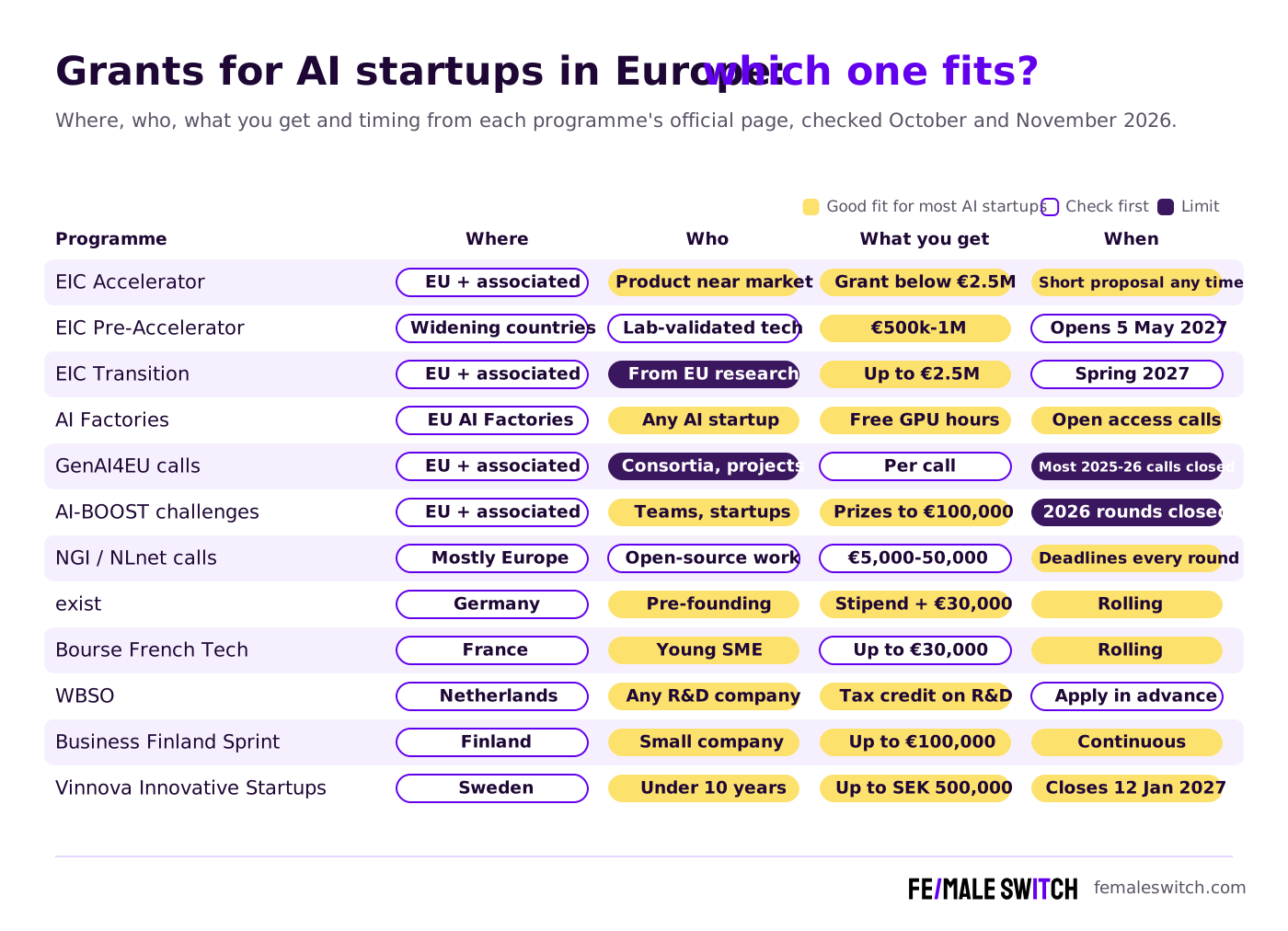
AI Startup Grants in Europe Compared
Sources: each programme's official website or call page, checked between 29 October and 1 November 2026. Rules change between rounds, so check the official page again before you apply.
EU Grants for AI Startups
1. EIC Accelerator: a grant below €2.5 million for AI products close to market
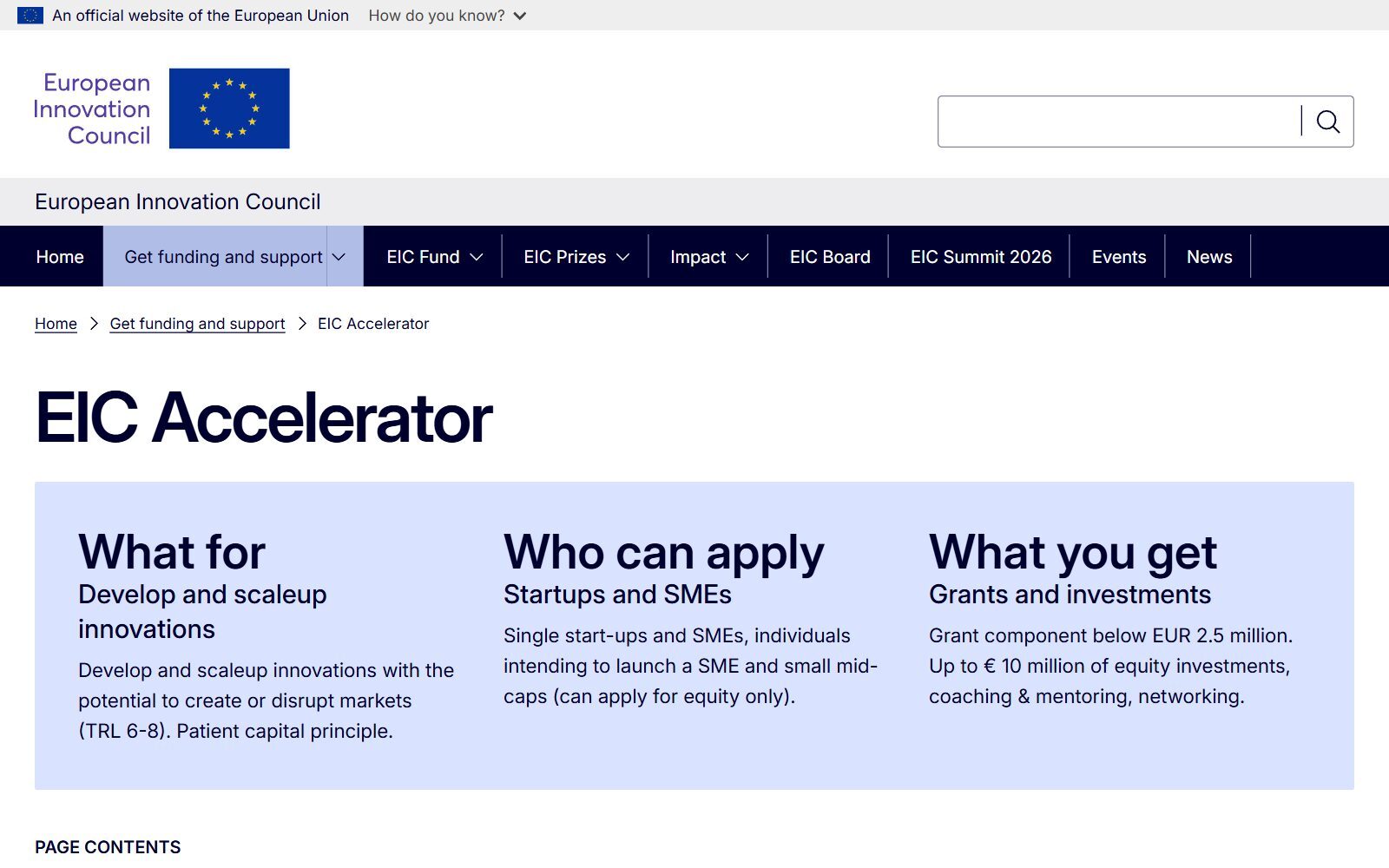
The EIC Accelerator is the European Innovation Council's main programme for single startups and SMEs, including people who intend to set one up. It is open to any technology, so AI startups apply through the Open call: the innovation must be at technology readiness levels 6 to 8 and able to create or disrupt a market. You get a lump-sum grant below €2.5 million for work done within 24 months and, optionally, an equity investment of €1 million to €10 million. UK applicants can only apply for the grant. Short proposals are accepted at any time, batched on the first Tuesday of each month at 17:00 Brussels time, with feedback in about four to six weeks. The last full-proposal cut-off of 2026 is 4 November 2026; the 2027 cut-offs had not been published when we checked. None of the five 2026 Accelerator Challenges is about AI (they cover energy storage, fusion, soil biotech, raw materials and climate adaptation); the EIC holds an info day on the 2027 Accelerator Challenges on 20 November 2026. Our sister site's EIC Accelerator programme guide walks through the application.
2. EIC Pre-Accelerator: €500,000 to €1 million in widening countries (opens 5 May 2027)
The EIC Pre-Accelerator is for early-stage deep tech startups in Horizon Europe widening countries, among them Bulgaria, Croatia, Cyprus, Czechia, Estonia, Greece, Hungary, Latvia, Lithuania, Malta, Poland, Portugal, Romania and Slovakia. Your technology must be at least validated in the lab (TRL 4), and only single companies apply. The 2027 call raises the grant to a lump sum of €500,000 to €1 million (it was €300,000 to €500,000 in the 2025 call), covering 70% of eligible costs for up to two years, with coaching and a fast track to the EIC Accelerator. The call opens on 5 May 2027 and the deadline is 18 November 2027.
3. EIC Transition and EIC Pathfinder: for AI research spin-offs
EIC Transition gives up to €2.5 million to turn a research result into a product, but only if it builds on an eligible EU-funded project (such as EIC Pathfinder or ERC Proof of Concept) at TRL 3 completed or TRL 4. The 2026 deadline was 16 September 2026; the EIC says the next call opens in spring 2027. EIC Pathfinder funds earlier, riskier research (TRL 1 to 4) with up to €4 million, mostly for consortia of at least three partners from different countries, so it suits university AI labs more than young companies. Both 2026 Pathfinder deadlines have passed (12 May and 28 October 2026), and the EIC runs an online information day on its 2027 opportunities on 19 November 2026.
Boost Your SEO by listing your startup and get a FREE backlink.
Create a profile in the F/MS Startup Game, add the link to your website and submit.
👉 List your startup now!
4. AI Factories: free supercomputer time for AI startups
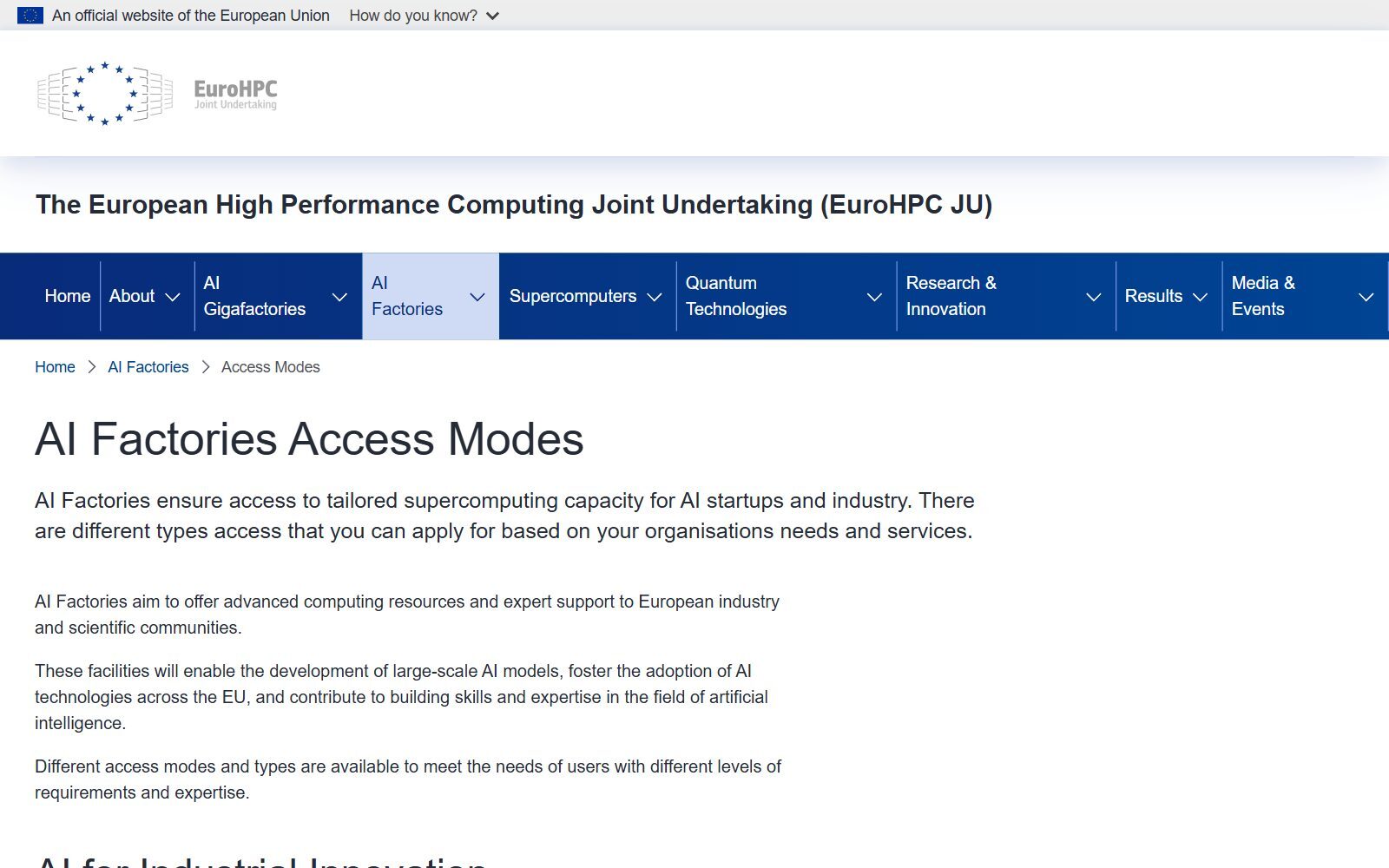
For many AI startups, compute costs more than salaries. The EuroHPC Joint Undertaking's AI Factories are ecosystems built around AI-optimised European supercomputers: the EU lists 19 AI Factories, including Finland, Luxembourg, Italy, Sweden, Germany, Spain, Greece, France, Austria, Poland, Czechia, Lithuania, the Netherlands and Romania, plus 13 AI Factory Antennas that extend access to other countries. In the AI for Industrial Innovation track, three access modes are open and free of charge to AI SMEs, including startups, for innovation purposes: Playground (limited resources for entry-level users), Fast Lane (up to 50,000 GPU hours for teams familiar with HPC) and Large Scale (more than 50,000 GPU hours for up to a year). It is not cash, but it replaces a cloud GPU bill, and the factories also offer free customised support to startups and SMEs.
5. GenAI4EU: Horizon Europe and Digital Europe calls for generative AI
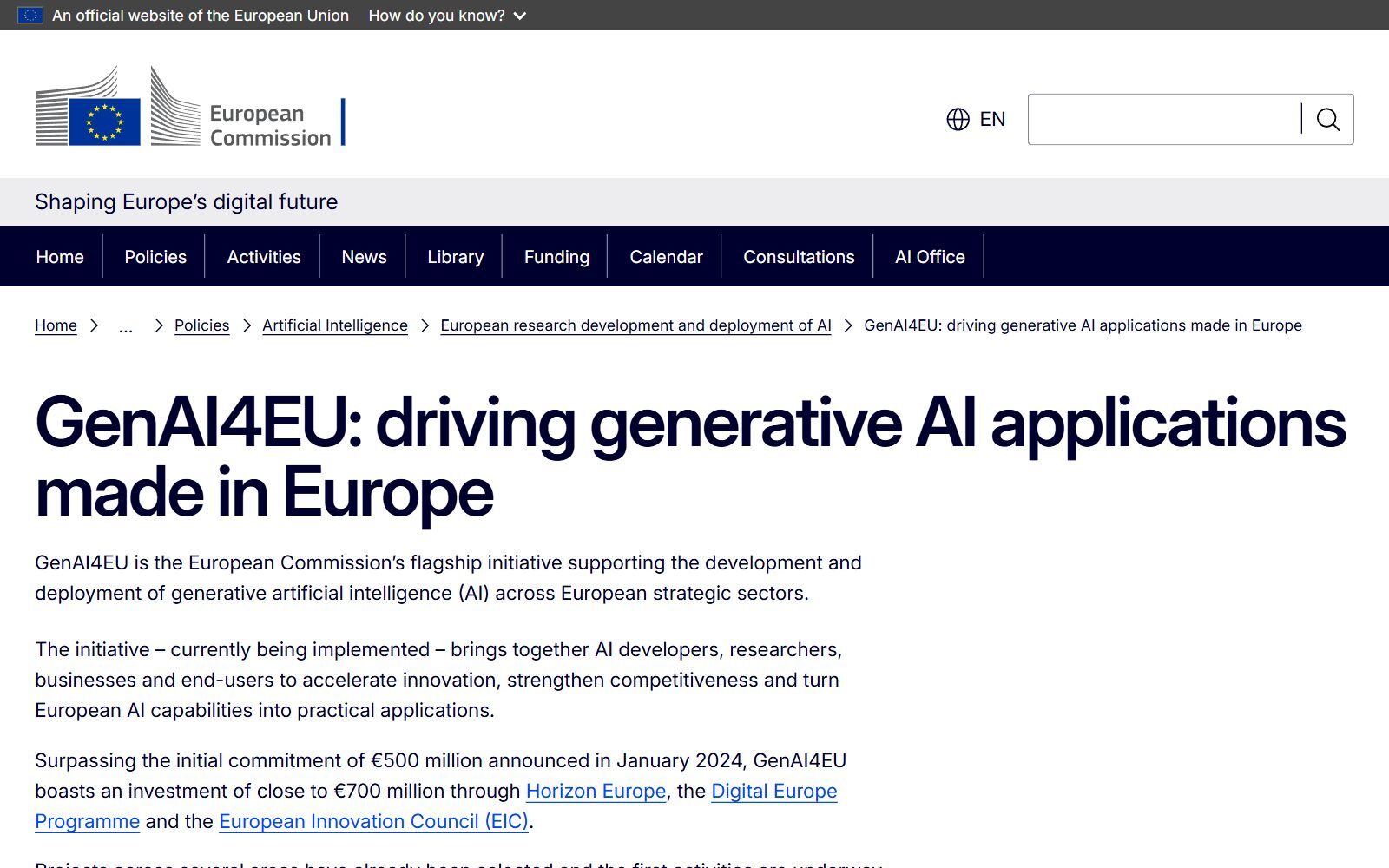
GenAI4EU is the European Commission's flagship initiative for generative AI in strategic sectors such as healthcare, robotics, mobility, agrifood and public administration. It has grown to close to €700 million, above the €500 million first announced in January 2024, and is paid through Horizon Europe, the Digital Europe Programme and the EIC. The money goes out through individual calls: in 2025 these included an EIC Accelerator Challenge for European champions in generative AI and Horizon Europe calls on generative AI in robotics and healthcare. The Commission says the first calls opened in 2025 and most are now closed, so this is a programme to watch in the 2027 work programmes rather than one to apply to today. Most GenAI4EU calls fund consortia, so a startup usually joins as a partner next to research organisations and end users.
6. Digital Europe Programme and European Digital Innovation Hubs
The Digital Europe Programme has a budget of over €8.1 billion for 2021 to 2027 and funds AI, data, cybersecurity and digital skills. Its calls are mostly for large projects and consortia and are published on the EU Funding & Tenders Portal. For a small AI startup the more practical door is the network of European Digital Innovation Hubs: regional one-stop shops offering "test before invest", training and financing advice, and acting as experience centres for AI. In October 2025 the Commission selected 83 hubs for renewed funding with a stronger AI focus. Whether a service is free depends on the hub, so ask the one nearest to you.
7. AI-BOOST: EU-funded AI prize challenges
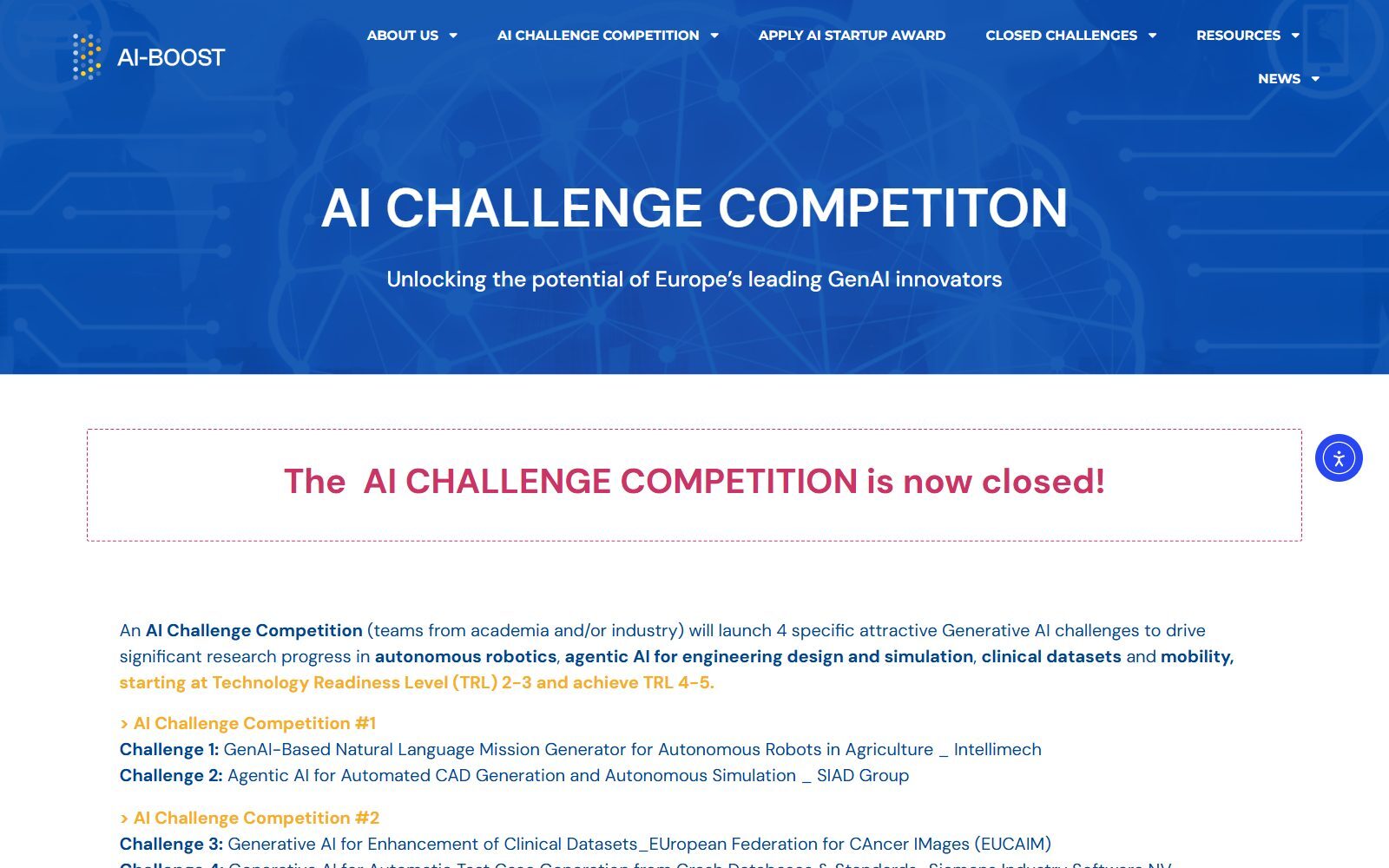
AI-BOOST is an EU-funded project that runs open challenges for European AI teams. Its 2026 AI Challenge Competition had four generative AI challenges set by companies and research bodies, from agricultural robots to automated CAD generation and crash-test cases. Startups, SMEs, researchers and individuals from the EU and associated countries could apply; five teams per challenge each won €28,500 in the Spark phase, and one winner per challenge gets €100,000 at a final event in Brussels in February 2027, with optional access to the LEONARDO supercomputer. Applications closed on 25 August and 8 September 2026. AI-BOOST also ran the Apply AI Startup Award for the EU AI Office, a non-cash award for nominated startups presented at the Apply AI Summit on 17 November 2026. Watch the site for the next rounds.
8. NGI open calls: €5,000 to €50,000 for open-source AI and internet tools
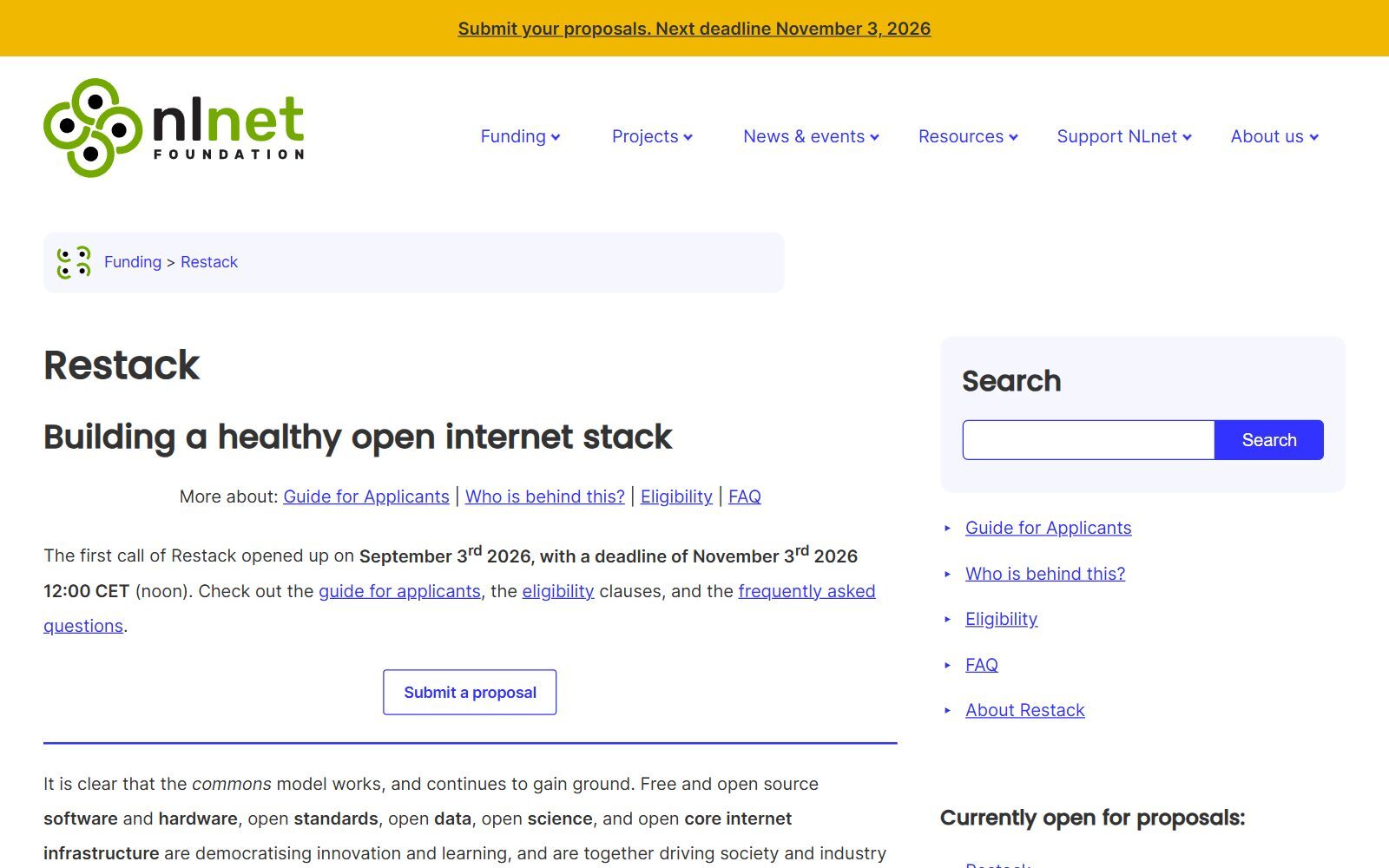
The EU's Next Generation Internet initiative funds small open-source projects through cascade calls run by foundations such as NLnet. The current first calls of Restack (a healthy open internet stack, €7 million in total) and CodeSupply (software supply chain security) give €5,000 to €50,000 per project, and SMEs can apply alongside individuals and non-profits. Both close on 3 November 2026 at 12:00 CET. The condition is that the results are open: software under a recognised open-source licence and scientific results in open access. That suits AI startups building open models, datasets or developer tools. See our list of NGI open calls and cascade funding explained.
9. Eurostars: cross-border R&D grants for AI SMEs
Eurostars funds joint R&D projects led by an innovative SME with at least one partner from another Eurostars country. The money comes from each partner's national agency: in Austria, FFG pays small companies up to 60% of eligible R&D costs. There are two cut-offs a year; the latest was 10 September 2026, and the next had not been published when we checked. Read our guide to Eurostars for SMEs.
Boost Your SEO with 1,500+ Free Business Directories: increase your DA, get backlinks and traffic.
We've compiled an exclusive list of directories and websites where you can submit your business and start building high-quality backlinks to boost your website traffic and get your SEO snowball rolling.
👉 Submit your startup now!
National Grants and Tax Credits for AI Startups
Most national programmes are open to any innovative startup, AI included, and follow the country where your company is registered. The ones below are the most useful for AI founders; our guide to grants for early-stage startups in Europe covers more countries in detail.
10. Germany: exist Gründungsstipendium
The exist Gründungsstipendium pays founders from universities and research institutes a stipend for 12 months before they start a company: €3,000 a month with a doctorate and €2,500 for graduates, plus up to €30,000 for material costs for teams. Your university applies for you at any time, which makes it a good fit for AI teams coming out of a lab.
11. France: Bourse French Tech
Bpifrance's Bourse French Tech is a subsidy of up to €30,000 for innovative SMEs in their feasibility phase, covering up to 50% of eligible costs (up to 70% depending on the company category) for a programme of up to 24 months. There are no application or processing fees, and you apply to Bpifrance at any time.
12. Netherlands: WBSO R&D tax credit
The Netherlands has no general cash grant for startups, but WBSO from RVO lowers the wage tax on R&D work, and developing technically new software counts. In 2026 the credit is 36% of the R&D base up to €391,020, 50% for starting entrepreneurs, and 16% above that amount. You must apply before the work starts; applications for 2027 open in mid-November 2026.
13. Ireland: LEO Priming Grant and New Frontiers
Irish micro-enterprises in their first 18 months can apply to their Local Enterprise Office for a Priming Grant of 50% of the investment, normally up to €80,000 and up to €150,000 for projects that could become Enterprise Ireland clients. Pre-founding teams can join Enterprise Ireland's New Frontiers, a support package valued at over €40,000 without giving away equity.
14. Finland: Business Finland Sprint grant
Business Finland's Sprint grant gives small Finnish companies up to €100,000, covering 75% of approved project costs, without repayment. You need at least €50,000 of cash equity on the balance sheet. After a pilot call from 2 March to 31 August 2026, Sprint has been continuously open since 1 September 2026.
15. Sweden: Vinnova Innovative Startups (closes 12 January 2027)
Vinnova's Innovative Startups call gives Swedish limited companies with up to 10 employees and no more than 10 years old a maximum of SEK 500,000 for a short project. The current call closes on 12 January 2027 at 14:00.
16. Spain and Switzerland: NEOTEC and Innosuisse
Spain's NEOTEC from CDTI funds technology-based companies under three years old; according to the Spanish government announcement, the 2026 call paid up to €250,000, or €325,000 for companies that hire a PhD, and ran from 14 April to 14 May 2026; the 2027 call has not been announced. In Switzerland, Innosuisse start-up innovation projects pay up to 70% of direct project costs for Swiss startups under five years old, with applications accepted at any time.
Boost Your SEO by Getting Featured in Our Blogs and get a backlink.
We publish content about startups, education, tech, funding, etc. that ranks well not only in Google but also in Perplexity, ChatGPT, Grok and other AI tools.
👉 Get featured now!
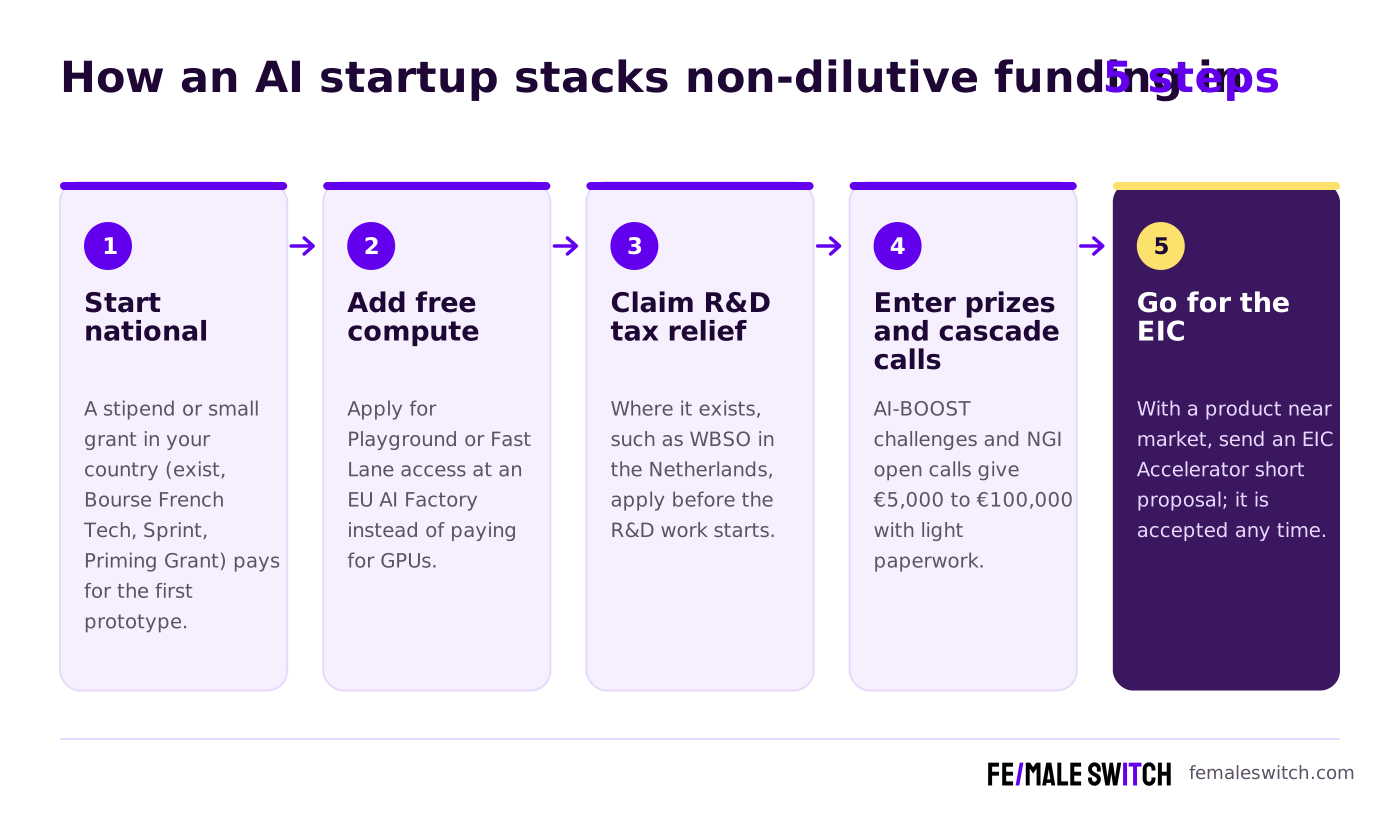
How AI Founders Stack Non-Dilutive Funding
Grants are slow and rarely cover everything, so AI startups combine them. A typical order looks like this; track the dates in our EU grant calendar for 2027.
Programmes Closed, Changed or Removed
These items were in the 2025 versions of this article (25, 20, 15 and 10 grants) or are often still listed elsewhere. Here is what changed:
- Innovate UK Smart grants and the UKRI Technology Missions Fund (UK): Smart grants are closed to new applications while Innovate UK aligns its funding to a new strategy; the old Technology Missions Fund article no longer exists. UK startups can still apply for the EIC Accelerator grant.
- EIT Digital: it became 28DIGITAL in October 2025 and now runs incubation and access-to-finance programmes as an independent foundation; we found no cash grant for startups.
- Large AI Grand Challenge: a 2024 AI-BOOST edition, closed; the current AI-BOOST challenges are above.
- EIC STEP Scale-Up: equity for scale-ups, not a grant (the old link returns an error).
- European AI & Society Fund, AI Accountability Grants and the Build Initiative: funders for civil-society organisations, not startups. The Pulitzer Center's AI Accountability Fellowships are for journalists.
- EIT Urban Mobility and the Innovation Fund: mobility and climate programmes with no current AI startup grant confirmed.
- "AI and EDGE Solutions", the Female Entrepreneur Deep-Tech Accelerator, "Various calls", TALOS, AI-IGNITE, AI for Climate and Nature, AI4Good, AI for Earth and AI Research Networks: single past calls, or only found on unofficial listing sites (the eufundingportal.eu page now returns an error); we found no current official call.
- ERC, Marie Skłodowska-Curie Actions, Digital Innovation Hubs and Smart Cities programmes: research fellowships and regional programmes, not startup grants; the AI-related services of the hubs are now under the EDIHs above.
- Ten venture capital firms (Balderton, Northzone, Index, Speedinvest, Earlybird, Seedcamp, Octopus, Accel, Atomico, LocalGlobe): investors, not grants. They are covered in our list of VCs for AI startups.
Which AI Startup Grant Should You Apply For?
- Your AI product is close to market: EIC Accelerator, starting with a short proposal.
- You need GPUs to train or fine-tune models: AI Factories Playground or Fast Lane access.
- You are still at a university: exist in Germany, EIC Transition if your research came from an EU project, or a national grant before you incorporate.
- You need a first €30,000 to €150,000: Bourse French Tech, the Irish Priming Grant, Business Finland Sprint or Vinnova before 12 January 2027.
- You build in the Netherlands: WBSO for your developers' R&D hours.
- You build open-source AI tools: NGI open calls through NLnet.
- You are in a widening country: EIC Pre-Accelerator from 5 May 2027, and your national grant before that.
How Founders Combine Grants With Other AI Funding
Learn how to find open EU funding calls and read our overview of European funds for startups. Grant money moves slowly, so most AI founders also join an accelerator and raise private money: compare accelerators for AI startups and angel investors for AI startups. If you are still choosing where to build, see the best countries for AI startups and AI startup cities in Europe. Outside Europe, our guide to grants for early-stage startups covers other regions, and women founders should add the grants for female entrepreneurs in Europe.
Join F/MS: Startup Facilitator & Incubator and unlock your startup dreams today! Get your first customers, register you company in the Netherlands and get startup visas for the team.
FAQ About Grants for AI Startups in Europe
Which grants for AI startups in Europe are open now?
In early November 2026: EIC Accelerator short proposals (any time), AI Factories access calls for free compute, Vinnova Innovative Startups in Sweden (until 12 January 2027), Business Finland Sprint, Bourse French Tech, the Irish Priming Grant, exist, Innosuisse and the Dutch WBSO for 2027.
Is there an EU grant only for AI startups?
Not as a standing programme. AI startups apply to the EIC Accelerator like any deep tech company, while AI-specific money comes through GenAI4EU calls, AI-BOOST challenges and free AI Factories compute.
What is the largest EU grant an AI startup can get?
The EIC Accelerator, with a grant below €2.5 million plus optional equity of €1 to €10 million. EIC Transition also gives up to €2.5 million, but only for projects built on earlier EU-funded research.
How do I get free GPU hours in Europe?
Apply to an EU AI Factory. The Playground, Fast Lane (up to 50,000 GPU hours) and Large Scale access modes are free of charge to AI SMEs and startups for innovation purposes.
Can a startup apply for GenAI4EU funding?
Yes, but most GenAI4EU money goes to consortia through Horizon Europe and Digital Europe calls, and most calls launched since 2025 have closed. Watch the 2027 work programmes and the EIC Accelerator Challenges.
Can UK AI startups get EU grants?
UK applicants can apply for the EIC Accelerator grant, but not its equity part. Innovate UK Smart grants are closed to new applications.
Are AI prize competitions worth it?
For small teams, yes: the 2026 AI-BOOST round gave €28,500 to each Spark winner and promises €100,000 to each final winner, with far less paperwork than a grant.
Do open-source AI projects get EU money?
Yes. NGI open calls run by NLnet give €5,000 to €50,000 per project, as long as the results are released under an open-source licence.
Do I have to pay to apply for these grants?
No. All programmes on this list are free to apply. Bpifrance states there are no application or processing fees for the Bourse French Tech.
Where can I get a backlink by writing about my AI startup?
You can publish a guest post in one of the Fe/male Switch startup blogs, which rank in Google and in AI tools. Get a quality backlink.
About the Author
Violetta Bonenkamp, also known as MeanCEO, is an experienced startup founder with an impressive educational background including an MBA and four other higher education degrees. She has over 20 years of work experience across multiple countries, including 5 years as a solopreneur and serial entrepreneur. Throughout her startup experience she has applied for multiple startup grants at the EU level, in the Netherlands and Malta, and her startups received quite a few of those. She’s been living, studying and working in many countries around the globe and her extensive multicultural experience has influenced her immensely.
